How Much Do AI Voice Agents Cost per Resolved Call? 2026
How much do AI voice agents cost per resolved call? In 2026, use actual charges and fully resolved calls, not answered calls, to calculate your store’s rate.
September 28, 2026
AI voice agents have no universal cost per resolved call in 2026. Calculate your store’s rate by dividing applicable voice-agent charges by calls fully resolved without human follow-up. A 7-day free trial gives Shopify owners a way to measure that rate, but the result depends on what counts as resolved and which charges you include.
TL;DR
- AI voice agents cost per resolved call is total applicable charges divided by fully resolved calls, not answered calls.
- Avasales is best for Shopify owners who need phone support alongside abandoned-cart recovery calls.
- Keep inbound support resolutions separate from outbound cart recoveries; they have different outcomes.
- Use the 7-day free trial to record resolutions and verify current plan and usage charges before calculating a rate.
Why this matters
A phone agent can answer every incoming call and still leave customers waiting for a human to finish their requests. If you divide charges by answered calls, you reward the system for picking up the phone, whether or not it solves anything. A resolved-call rate tells you what you paid for a completed support outcome.
For Shopify stores, that distinction affects order-status questions, refund requests and other calls that depend on store information. A customer who gets an answer and has no further work to do belongs in the resolution count. A customer who must call back or wait for a team member does not. For a broader look at the charges you need to check, see AI phone answering service cost.
How much do AI voice agents cost per resolved call?
The 2026 calculation is applicable voice-agent charges ÷ fully resolved calls. Neither a subscription amount nor a per-minute charge answers the question alone. You need the charges for the same measurement period as the calls, plus a consistent definition of resolution.
Answered calls
- What it counts: Calls the agent picks up
- Use in the calculation: Shows coverage, not resolution
Fully resolved calls
- What it counts: Calls completed without further support work
- Use in the calculation: The denominator for cost per resolved call
Escalated calls
- What it counts: Calls that require a person to complete the request
- Use in the calculation: Track separately; do not count as agent-resolved
Applicable charges
- What it counts: Plan and usage charges attributable to the measured calls
- Use in the calculation: The numerator, after checking current billing terms
The table separates activity from outcome. An agent that answers an order question but cannot provide the information the customer needs has answered a call, not resolved it. An escalation can still be a useful customer experience; it simply belongs in a different reporting category.
Do not put abandoned-cart calls in the support-call denominator. An outbound call intended to recover a checkout is measured against cart outcomes, not whether an inbound support question was resolved. Mixing the two makes both figures harder to interpret.
Calculate your store’s rate
- Define resolution. Specify what the customer must accomplish on the call and how you will identify a later follow-up on the same issue.
- Separate call types. Keep inbound support calls, escalations and outbound cart calls in distinct groups.
- Capture charges. Check the current plan and usage terms, then record the charges that apply to the same period and call group.
- Divide totals. Divide applicable charges by fully resolved calls. If no calls qualify as resolved, do not report a per-resolved-call rate.
- Review exceptions. Inspect calls that were answered but not resolved so the denominator reflects the definition you set.
The sequence matters because changing the definition halfway through the period changes the result. Use the same rule when reviewing another period or another provider. In 2026, a rate calculated from completed outcomes is more useful than a headline per-call figure that does not say what happened after the greeting.
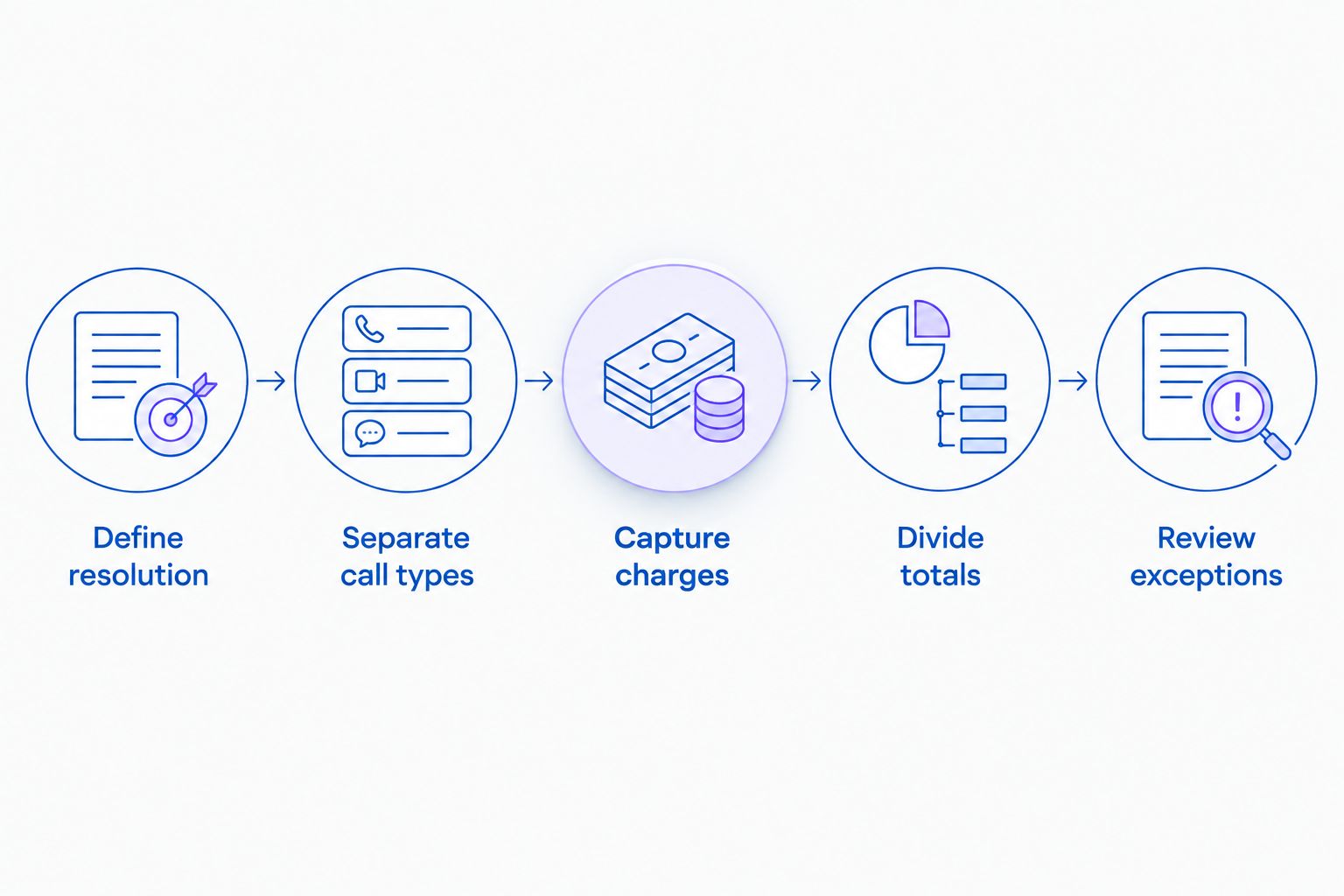
Set the resolution rule before dividing charges by completed calls.
Inbound support and outbound recovery need separate calculations
These uses of a voice agent do different jobs. For inbound support, the question is whether the caller’s request was completed. For outbound abandoned-cart calls, the question is whether a contacted checkout led to the outcome you chose to measure. A recovered checkout is not a resolved support call, and an answered outbound call is not automatically a recovered checkout.
Inbound order support
- Best for: Answering customer questions about existing orders
- Outcome to track: Request completed without human follow-up
- Limitation: A correct greeting does not establish resolution
Inbound refund support
- Best for: Handling refund requests
- Outcome to track: Request completed under the store’s rules
- Limitation: A request passed to a person remains an escalation
Outbound abandoned-cart calls
- Best for: Following up on unfinished checkouts
- Outcome to track: Cart outcome attributed under a stated rule
- Limitation: A connected call is not proof of recovery
This comparison also prevents an attractive outbound result from masking unresolved inbound calls. Keep the charges and outcomes for each group together. If a plan bundles usage across both, identify the allocation rule before presenting either rate; otherwise, the figure is not a reliable comparison.
Why cost per resolved call varies
- Your resolution rule changes the denominator. Counting a completed answer is stricter than counting every call the agent picks up.
- The call mix changes what completion means. An order-status answer and a refund request do not have the same completion test.
- Escalations reduce the agent-resolved count. A human handoff can help the customer, but it is not a resolution by the agent alone.
- Plan and usage terms change the numerator. Verify current charges rather than copying a figure from an older comparison.
- Follow-up changes the result. A caller who must return about the same unresolved issue should not be treated as a completed outcome under a no-follow-up definition.
- Outbound activity serves a different goal. Cart recovery calls need their own charges, outcomes and attribution rule.
These factors explain why two stores using a voice agent can report different rates without either calculation being wrong. The figures become comparable only when the stores use the same billing scope, call types and resolution definition. If you cannot explain those choices beside the rate, the rate cannot support a buying decision.
What should a Shopify owner check before comparing agents?
Start with the customer requests you want the phone agent to complete. Write down the outcome for each request, then check whether the agent can access the information or perform the action needed to reach it. For order questions, an answer that depends on current Shopify order information must be checked against the actual order, not against a generic response.
Next, decide when a person takes over. An agent should not receive credit for resolving a refund request if your team still has to assess or complete it. Record the handoff as an escalation, and assess the customer experience separately. This keeps a useful transfer from being mistaken for completed automation.
Finally, check the billing terms that apply to your intended call mix. Confirm current plan pricing and usage charges in the Shopify App Store before publishing a cost comparison or committing to a rate. Keep setup effort separate from recurring call charges so the per-resolved-call figure has a clear scope.
Avasales is best for Shopify owners who need an AI voice phone agent for customer support calls and outbound abandoned-cart recovery. It answers support calls 24/7 and handles order and refund requests, while its outbound calls serve a separate checkout-recovery goal. Its fit is narrower if you need a provider comparison based on verified per-resolved-call charges: calculate that figure from your own outcomes and current billing terms, not from the product description. You can start with the Avasales site.
Can a free trial tell you the cost per resolved call?
A 7-day free trial can show which calls your agent answers, which requests it completes and which calls require a person. It cannot establish a lasting per-resolved-call rate unless you pair those outcomes with the charges that would apply to the same usage. Treat the trial as a way to test the resolution definition and inspect individual exceptions, not as a substitute for current billing terms.
Avasales offers setup in minutes and zero commission on recovered revenue. Zero commission on recovered revenue addresses one outbound-recovery charge; it does not establish the total cost of inbound support calls or prove a per-resolved-call rate. Check plan pricing and usage charges in the Shopify App Store before using a trial result in a cost forecast.
Measure your resolved calls
Start with the 7-day free trial, then check current plan and usage terms.
Is an answered call the same as a resolved call?
No. An answered call shows that the agent picked up; a resolved call shows that the customer’s request was completed under your stated rule. If an order question still needs a team member’s answer, count the call as answered and escalated, not agent-resolved.
That distinction protects the metric from a common reporting error. Answer rates describe access to support. Resolution rates describe completed work. Report both when assessing an agent, but use only completed calls as the denominator for cost per resolved call.
Should refund calls count as resolved?
Count a refund call as resolved only when the request reaches the completion point in your definition without further human work. If the agent collects details and passes the decision to a person, record the call as an escalation. This rule makes refund reporting comparable with order-support reporting without claiming that every request has the same workflow.
For a Shopify store, the completion point must reflect what actually happened to the customer’s request. A polite explanation is not the same outcome as a completed action. Check the call record and any resulting order or refund activity before marking the request resolved.
FAQ
How much do AI voice agents cost per resolved call in 2026?
There is no universal per-resolved-call rate. Divide applicable agent charges by calls fully resolved in the same period, using current billing terms and a stated resolution rule.
Does an answered call count as resolved?
No. An answered call counts as resolved only when the customer’s request meets your completion rule without further human follow-up.
Should escalated calls be included in the resolved-call count?
No. Track escalated calls separately when a person must finish the request, even if the handoff helps the customer.
Can I include abandoned-cart calls in my support cost per resolved call?
No. Outbound abandoned-cart calls serve a checkout-recovery goal and need a separate outcome measure and charge allocation.
Does zero commission on recovered revenue mean support calls have no cost?
No. Avasales states zero commission on recovered revenue, which does not establish its total plan or usage charges for support calls. Check current terms in the Shopify App Store.
What should I measure during the 7-day free trial?
Record answered calls, fully resolved requests and escalations separately. Match any later cost calculation to current charges for the same call type and period.
Can I compare two agents by their advertised per-call charge?
Not as a cost-per-resolution comparison. Apply the same resolution rule and charge scope to both agents before comparing the resulting rates.
One last thing
The denominator is the decision. In 2026, a lower cost per answered call can coexist with more unresolved requests; neither figure alone tells you what support work the agent completed. Set the completion rule first, keep outbound recovery separate, and let actual resolved calls determine the rate.