AI phone support vs live chat for ecommerce: Both, 2026
Is AI phone support better than live chat for ecommerce? Phone wins for callers; chat suits written requests. Compare Shopify order, refund and handoff workflows.
September 27, 2026

AI phone support is better than live chat for ecommerce when a customer wants to call about an order or refund. Live chat is better when the customer wants a written exchange while browsing. For a Shopify store in 2026, the stronger choice is the channel that resolves the request, not simply the one that answers first.
TL;DR
- Is AI phone support better than live chat for ecommerce? Yes for customers who want to call; chat suits written exchanges.
- Ava AI is best for Shopify stores that need 24/7 phone support for orders and refunds.
- Keep both channels when customers use both, and compare completed resolutions rather than replies alone.
- Check what happens when either channel cannot finish a request before replacing an existing support option.
Why this matters
A customer asking where an order is can type the question or call. The underlying task is the same, but the path to an answer differs. If you're choosing between channels, start with the requests your store receives and the information needed to resolve them. For a closer look at the text side of that decision, see this guide to AI chatbots for ecommerce.
Avasales offers Ava AI, a voice phone agent app for Shopify store owners. It answers support calls 24/7 and handles order and refund requests. The stated offer includes a 7-day free trial, setup in minutes and zero commission on recovered revenue. Those details make it possible to assess the phone workflow without treating phone support as a substitute for every written conversation.
Is AI phone support better than live chat for ecommerce?
AI phone support wins for callers; live chat wins for customers who want to type. Neither channel is better for every ecommerce request in 2026. Choose based on how the customer wants to communicate, what the request requires and whether the channel can complete it.
Avasales with Ava AI
- Best for: Shopify stores that need an AI voice agent for support calls
- Strength: Answers calls 24/7 and handles order and refund requests
- Limitation to check: It is a phone agent; keep a written path for customers who prefer one
Live chat
- Best for: Customers who want to type while on the site
- Strength: Keeps the exchange in writing
- Limitation to check: It does not answer a customer's phone call
Both channels
- Best for: Stores whose customers call and type
- Strength: Lets customers choose how to start
- Limitation to check: You need a clear route when either channel cannot finish a request
The table compares the channels by their use, not by an unverified response-time or satisfaction claim. Avasales is best for Shopify stores that need to answer support calls; it is not a replacement for customers who want written support. That distinction matters more than a blanket claim that voice or chat performs better.
A phone answer also needs to be useful. If a caller asks about an order, the answer depends on the available order information. If a refund request needs a decision the agent cannot complete, the customer needs a clear next step. Apply the same standard to chat: a quick written reply is not a resolution if the customer must start again elsewhere.
The comparison is easiest to picture as a choice of entry point with a shared goal: resolve the request. A caller and a visitor typing into chat need the same underlying facts, even though they use different channels.
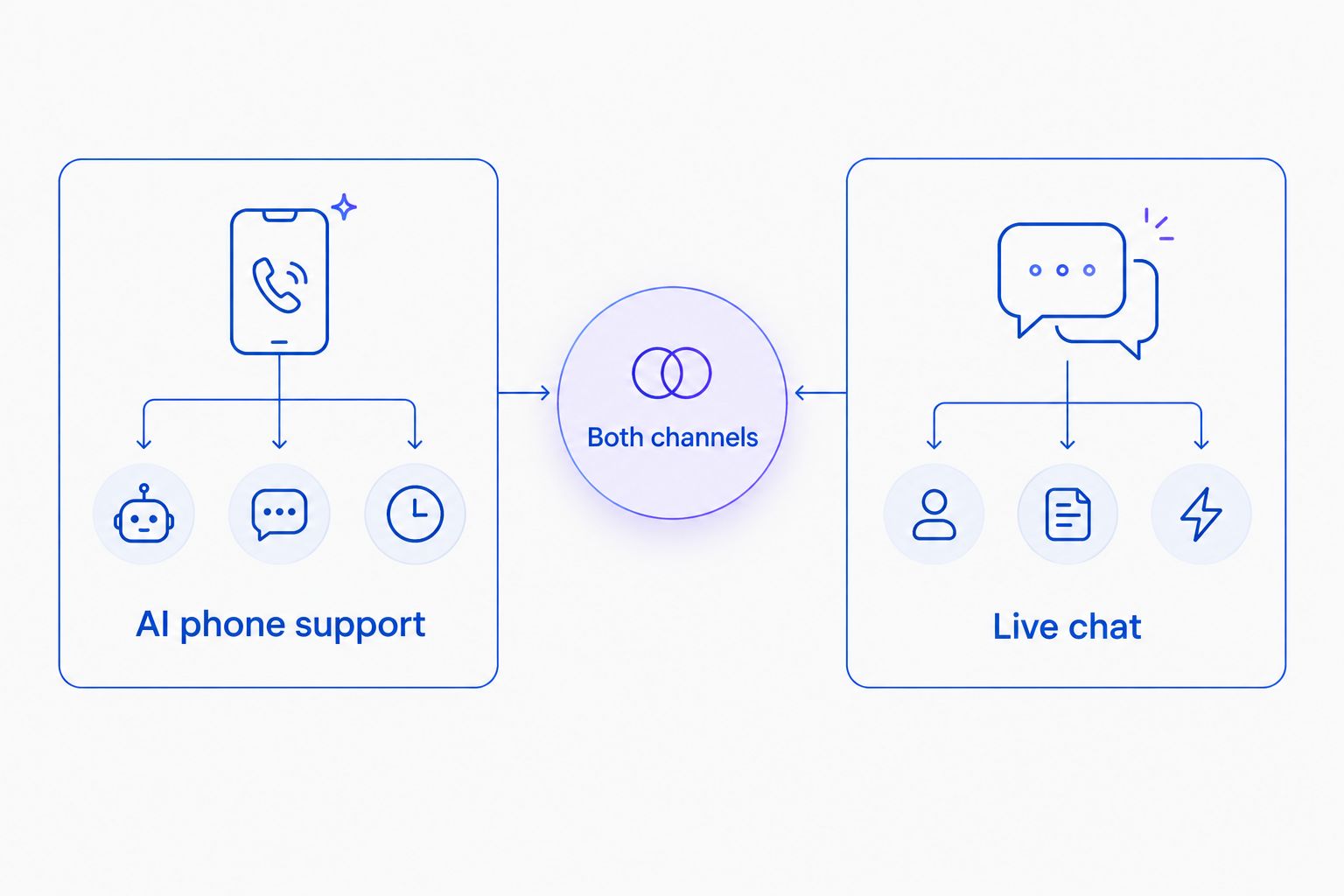
The right entry point depends on whether the customer calls or types.
When AI phone support is the better choice
Phone support is the better fit when the customer is already calling. Sending that person to a chat box changes the task: instead of getting help, they must switch channels and restate the problem. In 2026, evaluate phone support against the calls you actually need to answer, not against every possible support interaction.
Order questions that begin with a call
Order questions are a direct fit for a phone workflow when the caller expects an answer in the conversation. Ava AI handles customer support calls and order requests for Shopify stores. Check that the information available to the agent matches the answers customers need, and define what should happen when it does not.
A useful review follows the entire request. Can the customer explain the issue? Can the agent identify the relevant order information? Does the interaction end with an answer or a clear next step? Those questions expose gaps that a simple count of answered calls would miss.
Refund requests that need a clear outcome
A refund request can be more involved than an order-status question. Ava AI handles refund requests, but the merchant still needs to decide what information and decisions the phone workflow should cover. Assess the request from the customer's perspective: did the call settle the issue, or does the customer need another contact?
Don't assume that answering a call and approving every refund are the same capability. Review the actual workflow before assigning refund requests to any automated channel. The same test applies to live chat, where a written acknowledgement can still leave the underlying issue open.
Calls outside staffed hours
Ava AI answers support calls 24/7. That makes it relevant when you want a phone answer outside the hours your team is available. The useful question is what happens after the answer: which requests can be completed, and which need to reach a person later?
For a Shopify merchant in 2026, coverage and resolution are separate measures. Count a request as resolved only when the customer's issue is settled. A call that produces an answer but leaves the customer waiting for an unstated next step should be treated differently.
When live chat is the better choice
Live chat fits a customer who wants to type while shopping. The exchange is written, so the customer can read the answer and refer back to it without relying on what they heard during a call. If that is how customers prefer to contact your store, removing chat to make phone the only path creates unnecessary work for them.
Chat is also a sensible entry point when the customer has a short question while already on the site. Whether chat resolves it depends on the information behind the answer and the way unresolved requests are handled. The presence of a chat box alone does not establish that those requests are being completed.
Keep live chat for written conversations rather than asking AI phone support to win every interaction. Avasales addresses phone calls through Ava AI; the decision to retain chat should follow the way your customers contact you. A customer who does not want to call still needs a workable support path.
In 2026, the practical comparison is between completed customer journeys. Review examples of calls and chats involving the same type of request. If both channels can answer an order question, preference decides the entry point. If only one can reach the information needed to finish it, that capability decides where the request belongs.
Why the answer varies by store
Use these factors to decide how much work each channel should take. Each one concerns a real difference between a call and a written conversation, not an assumed industry benchmark.
- Customer entry point: A customer who dials a number has chosen a call. A customer who opens chat has chosen to type. Make the chosen path useful before trying to redirect them.
- Request type: Order questions and refund requests require different information and decisions. Assess both separately rather than labelling all support contacts as equivalent.
- Available order information: An agent needs the relevant facts to answer an order question. Check the information available in each channel before comparing its results.
- Unfinished requests: Decide where a request goes if phone or chat cannot complete it. The customer should not have to reconstruct the conversation without a clear next step.
- Hours of coverage: Ava AI answers calls 24/7. Compare that coverage with your need for phone answers, while judging completed outcomes separately.
- Customer preference: A written exchange and a spoken conversation serve different preferences. Retain both when the customers you support use both.
Turn those factors into a decision rule. If unanswered calls are the problem, assess phone coverage and the types of calls the agent can resolve. If customers mainly want written answers during a site visit, assess chat first. If you have both kinds of contact, assign each channel a clear job and inspect the requests that move between them.
How to compare phone and chat without confusing activity with results
A channel report should separate contact from resolution. An answered call, a chat reply and a completed refund request describe different events. Put them in separate columns when reviewing support performance in 2026; otherwise, a rise in replies can conceal requests that remain unfinished.
Use this sequence for each recurring request type:
- Name the request. Separate order questions, refund requests and other issues rather than grouping every contact together.
- Record the entry channel. Note whether the customer called or opened chat. This shows which path the customer chose.
- Identify the needed information. List what an answer requires, such as the relevant order details or a refund decision.
- Check the outcome. Distinguish a completed answer from a handoff, follow-up or unresolved contact.
- Review the next step. When the channel cannot finish the task, make sure the customer knows what happens next.
This process makes a phone-versus-chat decision actionable. It also prevents a channel from appearing effective simply because it responds. A Shopify store choosing support tools in 2026 needs to know which requests finish in the first interaction and which create more work.
Avasales is relevant when that review identifies support calls that need coverage. Ava AI also makes outbound calls to recover abandoned carts, which is a separate use from answering inbound support calls. Keep those activities separate when judging whether the phone support channel works for your customers.
Assess your Shopify calls
Review Ava AI's phone support workflow and the stated 7-day free trial.
Can phone support and live chat work together?
Yes. Use phone support for customers who call and live chat for customers who type, then define how unresolved requests reach the right next step. The channels do not need identical roles to give customers consistent answers.
Start with the requests that can arrive through either path. An order question should draw on accurate order information whether it begins in a call or a chat. If a request cannot be completed in its starting channel, the customer needs a clear explanation of what will happen next.
Should a small Shopify store replace live chat with an AI phone agent?
Not solely because an AI phone agent can answer calls. Replace chat only if your customers no longer need a written support path and the phone workflow handles the requests you intend to move. Otherwise, keep chat and use the phone agent for calls.
For a small store, the useful first question is narrower: are calls going unanswered, or are written requests the larger issue? Answer that from your own support contacts. Avasales supplies a phone option through Ava AI; the fit depends on the calls your store needs handled.
Is answering a call the same as resolving it?
No. Answering starts the interaction; resolution means the customer's request has reached an outcome. Apply that distinction to both AI phone support and live chat before comparing their value in 2026.
For an order question, check whether the customer received the needed answer. For a refund request, check whether the decision or next step was clear. A fast opening response in either channel does not settle those questions.
FAQ
Is AI phone support better than live chat for ecommerce?
AI phone support is better for customers who want to call, while live chat is better for those who want a written exchange. Compare each channel by whether it resolves the customer's request.
Can AI phone support handle Shopify order questions?
Ava AI handles order requests for Shopify stores. Check that the phone workflow has the information needed for the order questions your customers ask.
Can an AI phone agent handle refund requests?
Ava AI handles refund requests for Shopify stores. Review which decisions the workflow can complete and what happens when a request needs a further step.
Should my store offer both phone support and live chat?
Offer both when customers use both calls and written chat. Give each channel a clear role and a route for requests it cannot finish.
Does 24/7 phone coverage mean every issue is resolved?
No. Ava AI answers support calls 24/7, but answering a call and completing the customer's request are different outcomes.
Is live chat better for a customer browsing my store?
Live chat is the better choice when that customer wants to type while browsing. A customer who wants to call needs a phone path instead.
How should I compare AI phone support with live chat?
Compare completed requests of the same type across both channels. Track the entry channel, the information needed and whether the customer received an answer or a clear next step.
One last thing
The choice is not really between a voice and a chat box. It is between making a customer use your preferred channel and helping them through the one they chose. In 2026, keep the channel that finishes the request, and fix the handoff when it cannot.