Can AI Voice Agents Transfer Calls to a Human? Yes (2026)
Can AI voice agents transfer calls to a human? Yes, when live handoff is supported. Learn what Shopify stores must test before promising callers a person.
September 28, 2026

Yes, AI voice agents can transfer calls to a human when the phone system and agent are configured for handoff. That does not mean every agent or plan supports live transfer. For a Shopify store, confirm where the call goes, what information reaches the person who answers, and what happens when no one is available.
TL;DR
- Yes: AI voice agents can transfer calls to a human when live handoff is supported and configured.
- For Shopify support, define which order and refund requests need a person before routing calls.
- Ava AI is best for Shopify merchants seeking phone support and abandoned-cart calls; verify its live-transfer capability before choosing it.
Can AI voice agents transfer calls to a human when needed?
Yes, but live transfer is a feature to verify, not an assumption to make from the phrase AI voice agent. A working handoff needs a trigger, a reachable destination and a clear outcome if the person cannot answer. Ask for a demonstration of each part using a call that resembles one your store actually receives.
Agent resolves the request
- What the customer experiences: The caller gets an answer or completes a supported task without speaking to staff.
- Best for: Routine questions the agent is authorized to handle.
- Limitation to check: An answer is not enough when the caller needs a decision outside the agent's authority.
Live human transfer
- What the customer experiences: The call moves to a person while the customer is still on the line.
- Best for: Sensitive, disputed or unresolved requests.
- Limitation to check: The destination must be staffed, and you must confirm what context follows the call.
Follow-up request
- What the customer experiences: The call ends with a request for a person to respond later.
- Best for: Requests that can wait when live staff are unavailable.
- Limitation to check: A promised follow-up is not a live transfer; someone must own the request.
These are different outcomes. A vendor's statement that an agent escalates calls does not establish which outcome the caller receives. Ask to see a live transfer, a missed transfer and the resulting record before treating handoff as covered.
Why this matters
A customer calling about a delayed order, an unfamiliar charge or a refund wants the next action, not an account of how the phone system works. A transfer that drops the call makes the customer repeat the request. An agent that keeps talking after it reaches the edge of its authority creates a different problem: the caller cannot reach someone who can make a decision.
Ava AI provides an AI-powered voice phone agent app for Shopify store owners. It answers customer support calls 24/7, handles order and refund requests, and makes outbound calls about abandoned carts. The Ava AI website lists a 7-day free trial, setup in minutes and zero commission on recovered revenue. Those stated terms do not establish whether live human transfer is available. Make transfer behavior a separate question during evaluation.
The distinction matters in 2026 because phone coverage and human availability are separate decisions. An agent can answer around the clock while a merchant's staff cannot. If you plan to advertise an easy route to a person, test that route outside staffed hours as well as during them.
How should a human handoff work?
A handoff should preserve the customer's progress. The agent identifies that it cannot or should not finish the request, tells the caller what will happen, and routes the call according to the store's rules. The person receiving it needs enough context to avoid starting the conversation over.
- Identify the reason for the call. Establish whether the customer needs order information, a refund action, help with checkout or another request. Do not collect more information than the next step requires.
- Check the agent's authority. A request within the approved workflow can continue with the agent. A dispute, exception or explicit request for staff should follow the store's escalation rule.
- Tell the caller what is happening. Say whether the next step is a live transfer or a later follow-up. Do not describe a follow-up request as a transfer.
- Route to the intended person or team. Confirm the destination for each escalation reason. A general number is not useful if it sends the caller back to the same automated greeting.
- Handle an unanswered call. Decide whether the caller stays on the line, reaches another staffed destination or leaves a request for follow-up. Test the path rather than assuming it works.
- Preserve the context. Check whether the receiving person sees the call reason and any relevant details. If context does not travel with the call, tell the caller what they will need to repeat.
Use this sequence as a test script in 2026, not as a claim that every voice agent performs every step. Ask the provider to show the actual calling path. Then place the test call yourself, including one in which the transfer destination does not answer.
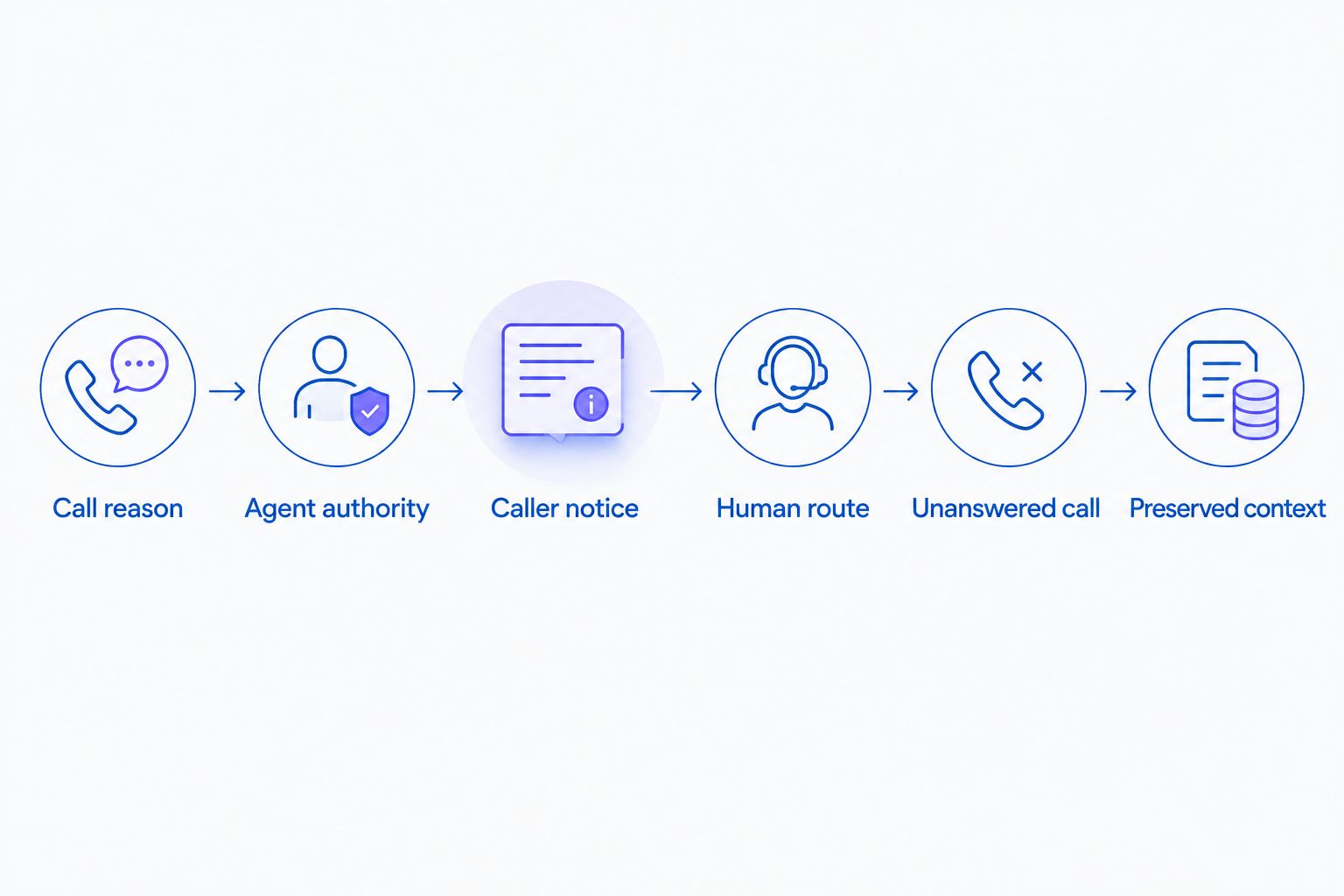
A handoff is complete only when the caller has a workable next step.
A diagram cannot tell you what a specific app supports. Ask for the product's current handoff settings and a call demonstration. The gap to look for is the step between recognizing that a person is needed and actually connecting the caller to one.
What should a Shopify store route to a person?
Set escalation rules around decisions your team must own. The relevant question is not whether the agent sounds capable. It is whether the request fits the authority and information you have given it.
- Order questions: Let the agent use available order information for requests it can answer. Route cases where the customer disputes the status or the information does not resolve the issue.
- Refund requests: Define which requests the agent can process and which need review. Test an exception rather than only a straightforward request.
- Abandoned-cart calls: Decide what the agent should do when an outbound conversation changes into a support complaint. A recovery call needs a route out of the sales workflow.
- Requests for a person: Make the policy explicit. If the caller asks for staff, the agent should not present an automated answer as a human handoff.
- Unavailable staff: Decide what happens when a call needs a person outside staffed hours. A follow-up request is a valid distinct outcome if the caller is told what it is.
These are routing decisions, not evidence that Ava AI provides a particular transfer setting. Ava AI handles the stated Shopify call types; its live-transfer options need separate confirmation. For a closer look at the information a phone agent needs to answer order questions, read the Shopify order data to real-time phone answers workflow.
Ava AI is best for Shopify merchants who want phone support and abandoned-cart calls; confirm live human transfer before making it part of your customer promise. Its fit for those stated tasks does not remove the need to test escalation. If a person must take over a refund dispute, the handoff is part of the service you are evaluating, not an optional detail.
Why does transfer behavior vary?
In 2026, compare products against your own call rules rather than assuming the word escalation means the same thing everywhere. These factors determine whether a proposed handoff solves the customer's problem:
- The request type. An order-status question and a disputed refund call require different decisions. Write a test case for each request you expect to route.
- The agent's approved actions. If an action needs merchant review, set a clear boundary. The agent should not continue as though it has approval.
- The destination. A handoff needs a number or team that can receive the call. Verify what happens when that destination is busy or unavailable.
- The hours of human coverage. Ava AI answers support calls 24/7, but that fact alone says nothing about when your staff can take a transferred call.
- The information passed along. The receiving person needs the call reason and relevant context. Test whether those details arrive or must be gathered again.
- The result of a failed transfer. Decide whether to retry, direct the caller elsewhere or request follow-up. The caller should know which result occurred.
Do not treat a transcript, ticket or notification as proof of live transfer. Each can be useful for follow-up, but none by itself shows that a person joined the call. Ask the provider to identify the exact event that marks a successful transfer and show it in a test call.
Can the customer ask to speak to a person?
Yes, a caller can ask. Whether the agent connects them depends on the product's live-transfer capability and the rules configured for that store. In 2026, test the direct request in plain language and check that the agent gives an accurate response when staff are unavailable.
Make the test specific: ask for a person during an ordinary order question, then during a disputed refund request. A policy that routes only one of those calls should be visible to the caller. If the product offers a follow-up request instead, call it that.
What happens when nobody answers the transfer?
The outcome depends on the phone setup, so require a demonstrated fallback. The caller should not be left believing a person has the issue when the transfer failed. Test the unanswered destination and inspect what, if anything, reaches your team for follow-up.
This is a separate 2026 test from a successful handoff. Ask who owns the request after the call ends, how they find its context and what the caller was told. Without those answers, the transfer rule covers only the easiest case.
Can an agent pass the order details to the human?
An agent can pass context only if the chosen setup supports it and has access to the relevant information. Confirm what the receiving person actually gets: the reason for the call, any order details the customer provided and the action the agent already took. A call that connects but makes the customer start again is a weaker handoff.
Keep the test focused on a real Shopify request. For example, have a caller ask about an order, then introduce a question the agent should route to staff. Observe the information the staff member receives rather than relying on a feature description.
FAQ
Can AI voice agents transfer calls to a human when needed?
Yes, AI voice agents can transfer calls to a human when live transfer is supported and configured. Confirm the transfer destination and test what happens if nobody answers.
Does escalation always mean a live transfer?
No. Escalation can mean a live transfer or a request for later follow-up. Ask the provider to demonstrate which outcome the caller receives.
Can a Shopify customer ask an AI phone agent for a person?
Yes, the customer can ask for a person. Whether the call connects depends on the agent's capabilities, the store's rules and staff availability.
What should happen if a transferred call is not answered?
The caller should get a clear alternative rather than an implied successful handoff. Test the unanswered-call path and confirm who receives the request for follow-up.
Should refund disputes go to a human?
Route refund disputes to a person when they need a decision outside the agent's approved actions. Define that boundary before enabling the call workflow.
Does 24/7 AI phone support mean 24/7 human transfers?
No. An agent answering 24/7 does not establish that staff can receive transfers at every hour. Check the store's human coverage and the agent's after-hours behavior separately.
Does Ava AI support live transfer to staff?
The provided Ava AI information does not confirm live-transfer capability. Ask for a current demonstration of a successful transfer and its unanswered-call fallback before depending on either.
One last thing
Test the moment after the agent decides a person is needed. In 2026, that is the distinction that keeps a useful automated answer, a live handoff and a follow-up request from being described as the same thing. Make one call when staff can answer and another when they cannot; record exactly what the customer is told in each case.
If Ava AI's Shopify call workflows match your support needs, use the trial to check the calls you actually receive. Setup in minutes is useful, but a working transfer policy requires its own demonstration. Do not promise callers a human handoff until both the answered and unanswered paths pass your test.