AI Customer Service Software: Worth It Solo? 2026
Is AI customer service software worth it for a one person store? Yes, if it resolves real requests and saves owner time. See what to test before paying in 2026.
September 28, 2026

Yes, AI customer service software is worth it for a one-person store in 2026 when it handles calls you cannot answer without leaving customers with unresolved problems. It is not worth it when your customers rarely call, the software cannot use the order information they need, or reviewing its work takes more time than it saves. Judge the decision by resolved requests and owner time returned, not by call volume alone.
TL;DR
- AI customer service software is worth it for a one-person store when it resolves missed calls without creating more work.
- Avasales' Ava AI is best for solo Shopify merchants who need phone support and abandoned-cart calls, not just chat.
- Test order and refund calls during the 7-day free trial; track what actually gets resolved.
- A text chatbot is a better first step when customers mainly contact you through chat.
Why this matters
A missed call has two possible costs for a solo merchant: the customer waits, and you must stop other work to return it. But answering quickly is not the same as answering correctly. If a caller asks about an order, a useful phone agent needs to give an answer tied to that order or move the issue to you clearly.
The decision is narrower than whether automation sounds useful. It is whether your store has repeatable requests, a channel customers use, and enough owner time spent on those requests to justify a tool. If phone support is the immediate problem, this guide to whether a voice agent is worth it for a small Shopify store examines that choice specifically.
Is AI customer service software worth it for a one-person store?
Yes, if it reliably takes a meaningful task off your plate; no, if it only receives the message and sends the customer back to you. Start with the requests you handled recently. Which ones had a clear answer, which required a decision, and which required access to an order? That split tells you more than a list of advertised features.
Customers seldom contact you
- Best starting point: Keep handling requests yourself
- Benefit: No new workflow to monitor
- Limitation: You remain responsible for every response
Customers mostly write through chat
- Best starting point: Consider a text support tool
- Benefit: Matches the channel customers use
- Limitation: Does not answer a phone call
Customers call about orders, tracking, or refunds
- Best starting point: Evaluate a phone agent connected to store workflows
- Benefit: Can handle calls while you do other work
- Limitation: Needs testing for accuracy and exceptions
Customers call with disputes or unusual requests
- Best starting point: Keep a clear route to the owner
- Benefit: You retain control of sensitive decisions
- Limitation: Takes your time when the case cannot be resolved automatically
The table is a channel decision, not a ranking of vendors. A phone agent does not solve a chat backlog, and a chatbot does not answer a ringing phone. For a one-person store, the best tool matches the contact method customers already choose.
Do not count every answered call as a resolved request. A call that ends with the customer waiting for your reply still belongs in your workload. Likewise, an order question answered incorrectly can create another contact. Your test must distinguish a completed answer from a handoff.
What should count as a successful resolution?
Count a request as resolved only when the customer receives the needed answer or the agreed action is completed without you reopening the case. For an order-status call, that means the answer reflects the relevant order information. For a refund request, it means the outcome matches the store's rules and the customer understands what happened.
Mark anything that requires your judgment as a handoff, not a failure to be hidden. The useful distinction is whether the handoff gives you enough context to finish the job without asking the customer to start again. During a trial, review both resolved calls and handoffs rather than accepting an answered-call total as the result.
When does phone support make sense for a solo Shopify store?
Phone support makes sense when calls interrupt work you alone must do, such as managing orders or answering customers on another channel. It matters even more when callers ask repeatable questions about tracking, orders, and refunds. Those are specific tasks to test; a general promise to handle customer service is not enough.
Avasales' Ava AI is an AI-powered voice phone agent app for Shopify store owners. It answers customer support calls 24 hours a day, 7 days a week, handles order and refund requests, and makes outbound abandoned-cart calls. Avasales is best for a solo Shopify merchant who needs both incoming phone support and a way to follow up on abandoned carts. Its downside is equally clear: a phone-focused app is a poor fit if your customers do not call or you need your first improvement to happen in text chat.
The app has a 7-day free trial, setup in minutes, and zero commission on recovered revenue. None of those terms proves that it will save time for your store. Use the trial to check the calls you actually receive, including cases that cannot be finished without you. Check current plan pricing and usage charges in the Shopify App Store before deciding whether the work saved justifies the ongoing charge.
What about abandoned-cart calls?
Outbound recovery is a separate use case from answering support calls. Measure it separately. An answered support call, a website click after a call, an app install, a trial start, and a paid customer are different events; none is a substitute for the outcome you need to evaluate.
For a solo store, the practical question is whether outbound calls produce recoveries without creating complaints or extra follow-up work. Check what a customer is told, when the call happens, and whether any approved text link takes them to the intended next step. Do not use a support-resolution tally to claim cart-recovery results.
How do you test whether it saves you time?
Use your normal customer questions, not a polished demonstration. A test should reveal what the software finishes, where it hands off, and how much review each outcome requires. Keep a simple record so that a busy day does not decide the verdict for you.
- Count missed calls. Note calls you could not answer and why the customer called. Separate sales questions from existing-order support so one busy category does not mask the other.
- Map call types. Group questions into tracking, order changes, refunds, and issues needing judgment. Write down which answers require store data and which actions need your approval.
- Test real calls. During the 7-day trial, check whether the response uses the right order context, explains the outcome, and gives the customer a clear next step. Include difficult cases, not just routine tracking questions.
- Review outcomes. Record resolved calls, handoffs, incorrect answers, and time you spend checking or fixing them. Compare that work with the time you spent on similar calls before the trial.
The sequence matters because a successful demonstration is not evidence that your own requests are resolved. If you do not first identify the calls you need handled, you can end a trial knowing the agent answered but not knowing whether it helped.
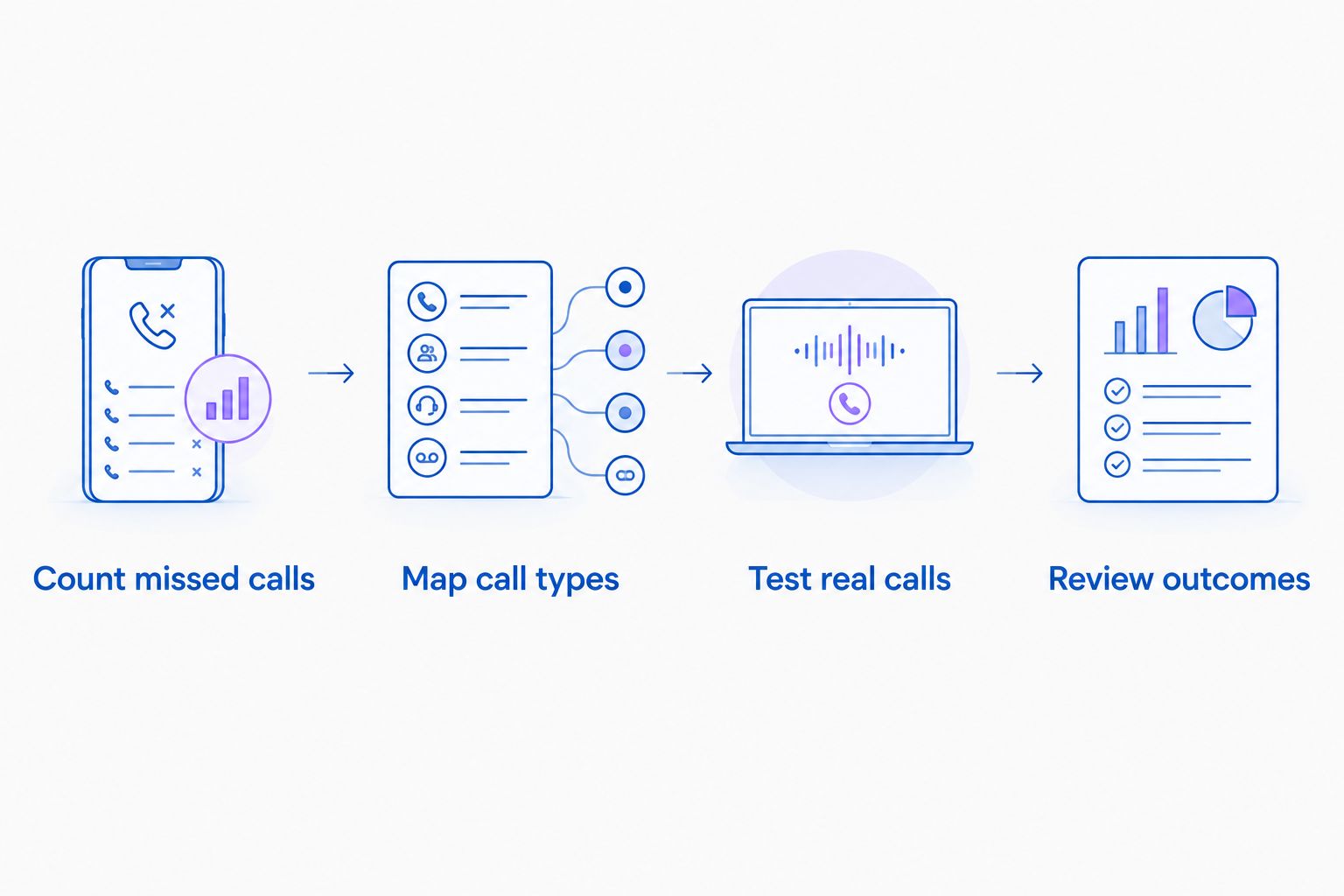
Judge the trial by completed work and handoffs, not by answered calls alone.
A small review log can stay simple: the customer's reason for calling, whether the answer was correct, whether an action was completed, and whether you intervened. Do not add a success label merely because the call ended. If you need to repair the result, record the repair work too.
Why the value varies between one-person stores
The same software can save one owner time and give another owner a new queue to monitor. These factors decide which outcome is more likely:
- Contact channel. If customers call, phone coverage addresses an existing interruption. If they mostly send messages, a phone agent leaves the main workload untouched.
- Call subject. Tracking and order questions have identifiable answers to check. Unusual disputes need more judgment and a reliable handoff.
- Access to order information. A caller asking about a specific purchase needs an answer about that purchase, not a generic policy explanation.
- Quality of handoffs. An unresolved request still takes owner time. A clear record of the issue reduces the need to repeat the conversation.
- Review effort. You need to catch incorrect answers and confirm consequential actions. That work belongs in the value calculation.
- Outbound relevance. Abandoned-cart calls matter only if you intend to use that channel and can evaluate recoveries separately from support.
In 2026, a store owner should buy the task, not the label attached to the software. Write down the task you expect to stop doing, then check whether it has actually stopped. If the tool answers quickly but every caller still needs you, it has changed the route to your inbox rather than reduced the workload.
Can a phone agent handle order and refund questions?
Yes, a phone agent designed for Shopify order support can address those requests, but you must test the specific actions and exceptions your store receives. For Ava AI, order and refund handling is part of the stated app offering; that does not remove the need to review accuracy, permissions, and handoffs before relying on it.
Start with a straightforward order-status question, then try a request that needs a decision. The first checks whether the caller gets the relevant information. The second checks whether the agent takes an appropriate action or passes the issue to you. Both matter to a one-person store because errors and repeat calls consume the time the software is supposed to return.
Is a chatbot enough for a one-person store?
A chatbot is enough when your main support workload arrives in text and its answers cover the questions customers ask. It is not a substitute for phone coverage when customers call and expect an answer. Choose the channel before comparing feature lists.
If you have both kinds of requests, do not assume one tool handles both. Check where each conversation starts and which tasks are completed there. A shorter text queue does not help a customer waiting on the phone, just as phone coverage does not clear a chat backlog.
How soon should a solo merchant decide?
Use the 7-day free trial to reach a decision based on your own calls, not on a promise about setup speed. Setup in minutes gets you to a test; it does not establish that order answers, refund requests, and handoffs work as you need them to.
At the end, ask one question: did the tool complete enough of the calls you would otherwise handle to justify its charge and your review time? If the trial did not include the requests that matter most, do not treat the missing evidence as a positive result. Verify current pricing and usage charges in the Shopify App Store when making that decision.
FAQ
Is AI customer service software worth it for a one-person store in 2026?
Yes, when it resolves requests you would otherwise handle and does not create more review work. If customers rarely contact you or mainly use a channel the tool does not cover, keep your current process or test a better-matched option.
What's the best type of customer service software for a solo Shopify merchant?
The best type matches the channel customers already use. Choose phone support for recurring calls about orders and tracking; consider text support when most requests arrive through chat.
Can an AI phone agent answer calls outside business hours?
Ava AI answers customer support calls 24 hours a day, 7 days a week. Check whether it can resolve the questions your callers ask, not just pick up the phone.
Can a phone agent resolve Shopify refund requests?
Avasales says Ava AI handles refund requests for Shopify stores. Test your store's rules and requests that need owner judgment before treating a completed call as a completed refund case.
Is phone support better than a chatbot for a one-person store?
Phone support is better when customers call; a chatbot is a better first choice when customers mainly write. Neither channel's coverage proves that individual requests are resolved correctly.
How do I measure whether customer service software saves time?
Track completed requests, handoffs, corrections, and the time you spend reviewing them. Compare that work with the calls you handled before the trial rather than counting answered calls alone.
Does a free trial prove the software is worth paying for?
No. A 7-day free trial gives you a chance to test real requests, but the decision depends on resolved work, review time, and current plan and usage charges.
One last thing
Your strongest test is the call you least want to interrupt your day to answer again. If the tool handles that request accurately and leaves a clear path for exceptions, you have evidence of value. If it only records the caller's problem, you still own the task. That distinction is the answer to whether customer service software is worth it for your one-person store in 2026.