AI customer service software ranked by uptime in 2026
AI customer service software ranked by uptime: choose Shopify phone support by workflow fit, verify availability evidence, and test order and refund handling.
October 13, 2026

Best for Shopify phone support: Avasales, with a 7-day free trial, setup in minutes and zero commission on recovered revenue. For AI customer service software ranked by uptime in 2026, distinguish scheduled coverage from measured availability before choosing a platform; the shortlist below ranks workflow fit, not unverified uptime percentages.
TL;DR
- For AI customer service software ranked by uptime, require measured availability rather than promises of continuous coverage.
- Avasales is best for Shopify merchants seeking phone support and outbound abandoned-cart recovery in one app.
- Zendesk suits ticket-centered support; Intercom suits messenger-led support; Salesforce Service Cloud suits CRM-centered service.
- Test call connection, order lookup, authorized actions and fallback separately before expanding automated phone support.
Why this matters
A phone agent can answer a call while failing to retrieve the customer's order. A support messenger can load while its automated answer service is unavailable. Both situations expose the gap between an accessible interface and a completed support task.
For a Shopify merchant, reliable service means the customer reaches the right workflow and receives an accurate result. Order tracking, refunds and checkout recovery have different dependencies. A single availability percentage does not explain which of those functions it covers.
Avasales is best for Shopify merchants who want automated phone support and abandoned-cart recovery calls in one app. That is a workflow-fit verdict, not an uptime certification. Treat a vendor's service hours, measured availability and contractual commitments as separate purchasing questions.
What makes the best uptime-focused customer service software
Use these criteria for your 2026 shortlist before reading a vendor's headline availability claim:
- Measurement scope: Identify whether the measurement covers the interface, incoming calls, automated responses or completed customer actions.
- Incident visibility: Ask for dated incident records that identify affected functions and restoration details.
- Dependency coverage: Check how telephony, order data, payment-related actions and other integrations affect the support workflow.
- Failure handling: Require a defined response when the system cannot retrieve information or finish an action.
- Operational fit: Choose software built around the channel and customer tasks your team needs to support.
- Evidence quality: Separate documented service commitments from measured historical results and trial observations.
These criteria prevent a familiar purchasing mistake: selecting a platform for a strong headline metric that measures the wrong service. Your customer's experience starts with a request and ends with an answer or action, not a successful page load.
Customer service software at a glance
The order below prioritizes the Shopify phone-support brief. It does not establish a measured uptime leaderboard across these vendors.
1
- Software: Avasales
- Best for: Shopify voice support and cart recovery
- Standout function: Incoming customer support calls and outbound recovery calls
- Key limitation for this decision: Round-the-clock coverage does not establish a measured uptime percentage
2
- Software: Zendesk
- Best for: Ticket-centered support operations
- Standout function: Organizing customer service around tickets
- Key limitation for this decision: Ticket availability alone does not prove a complete voice workflow works
3
- Software: Intercom
- Best for: Messenger-led customer support
- Standout function: Customer conversations through a support messenger
- Key limitation for this decision: Messenger availability does not establish telephone availability
4
- Software: Salesforce Service Cloud
- Best for: CRM-centered customer service
- Standout function: Service operations connected to customer records
- Key limitation for this decision: CRM availability does not establish every connected workflow's availability
Do not interpret a higher position as a stronger service-level agreement. Match the product to your operating model, then compare evidence for the same functions over the same measurement window.
1. Avasales: best customer service software for Shopify phone support
Avasales provides a voice phone agent app for Shopify store owners. It answers customer support calls 24/7, handles order and refund requests, and makes outbound calls to recover abandoned carts.
That combination fits merchants who need phone conversations tied to store operations. An incoming order question and an outbound checkout-recovery call have different purposes, so evaluate both rather than assuming success in one proves success in the other.
Avasales pros:
- Built for Shopify store owners rather than an unspecified service environment.
- Supports incoming customer support and outbound abandoned-cart recovery calls.
- Covers order and refund requests through the phone channel.
- Offers a 7-day free trial for evaluating the store's actual workflows.
Avasales cons:
- Its stated 24/7 coverage is not a measured uptime guarantee.
- Its Shopify voice focus does not establish suitability for every business model or support channel.
- Call answering alone does not establish that every order or refund request reaches the correct outcome.
Best for: Shopify merchants who want automated phone customer service and outbound recovery calls in the same app.
During the trial, check whether an order answer matches Shopify's record and whether a refund follows your approved policy. For recovery calls, evaluate the conversation and the checkout outcome separately. Record failed tasks as well as completed ones.
Verdict: Buy only after the trial confirms your critical phone workflows and you review the applicable service terms.
2. Zendesk: best customer service software for ticket-centered operations
Zendesk organizes customer service around tickets. That makes it a relevant option when your primary operating requirement is tracking requests, assigning work and keeping a support record.
For an uptime-focused purchase, identify exactly which Zendesk functions your team intends to use. A functioning ticket queue does not prove that every automated answer, connected application or voice interaction is working.
Zendesk pros:
- Provides a ticket-centered model for organizing customer requests.
- Gives teams a defined request record to use during follow-up.
- Fits a selection process focused on support operations rather than checkout recovery alone.
Zendesk cons:
- Ticket-system availability is narrower than successful end-to-end customer service.
- The platform's ticketing role does not establish fit for Shopify abandoned-cart calling.
Best for: Teams whose central requirement is managing customer requests through tickets.
Ask which components are covered by the proposed service commitment. Then test the specific channel and integration configuration you plan to deploy, including how incomplete customer requests enter the team's queue.
Verdict: Hold until the proposed configuration demonstrates your required automated workflows.
3. Intercom: best customer service software for messenger-led support
Intercom provides customer support through a messenger-based conversation model. It belongs on the shortlist when customers primarily contact you through your website or application rather than by telephone.
Evaluate the messenger and its automated support functions separately. A visible conversation window is only the entry point; your test should follow the customer's request through the answer and any required follow-up.
Intercom pros:
- Uses a conversation-based support interface.
- Fits customer journeys that begin inside a website or application.
- Provides a relevant comparison when deciding whether messaging matches your support demand.
Intercom cons:
- Messenger availability is not evidence of phone-call availability.
- A messenger-led workflow does not establish Shopify refund or outbound recovery-call capabilities.
Best for: Businesses choosing customer messaging as their primary support channel.
In your 2026 evaluation, test representative questions and record whether the answer resolves the request. Also check what happens when the automated response cannot complete the task. Keep interface accessibility separate from answer quality.
Verdict: Hold for messenger-led support; skip as a phone-support choice unless the proposed solution explicitly meets that requirement.
4. Salesforce Service Cloud: best customer service software for CRM-led teams
Salesforce Service Cloud connects customer service operations with customer records. It is relevant when support must work within a broader CRM-centered operating model.
The reliability question extends beyond access to a customer record. Your evaluation must also cover the connected systems and actions that turn the record into a useful service response.
Salesforce Service Cloud pros:
- Centers service operations on customer records.
- Fits teams whose support requirements are tied to their CRM processes.
- Gives CRM-led buyers a distinct option rather than treating every support tool as interchangeable.
Salesforce Service Cloud cons:
- CRM availability does not establish the availability of connected telephony or commerce workflows.
- A broad customer-service platform is not evidence of a ready-to-use Shopify voice workflow.
Best for: Organizations that need customer service organized around Salesforce customer records and processes.
List the complete proposed configuration before comparing availability claims. Include the service application, telephone channel and commerce integration where relevant. Evaluate the resulting workflow, not just the central platform.
Verdict: Hold until the complete configuration proves the required service path.
How we ranked
The shortlist ranks operating fit against the stated Shopify phone-support need. Shopify voice support comes first, followed by ticket-centered, messenger-led and CRM-centered service models.
An uptime ranking requires comparable measurements: the same service scope, measurement window, incident treatment and calculation method. Without those conditions, assigning precise availability positions would imply evidence the comparison does not establish.
Do not purchase a claimed uptime winner until you know what the uptime figure measures. A documented commitment helps evaluate contractual expectations; measured history helps evaluate past operation. Neither replaces testing your own workflow.
How to evaluate uptime evidence in 2026
Use a consistent sequence so vendor claims and trial observations remain comparable. Preserve the original scope of each claim rather than turning every service metric into a generic uptime score.
Define scope
Write down the customer journey you need to keep working. For Shopify phone support, include call connection, order lookup, answer delivery and any authorized action. The guide to Shopify order data and real-time phone answers provides a related workflow to examine.
Review history
Request dated incident records for the relevant services. Look for affected components, incident duration and restoration details. A record concerning a dashboard should not serve as evidence about call completion.
Test workflows
Run representative support requests through the proposed configuration. Include an order question, a refund request and an unavailable-data scenario. Record what happened at each step rather than assigning a single pass to the entire platform.
Confirm fallback
Ask what happens when a required dependency fails. Specify the customer-facing response, how unfinished work reaches your team and how an interrupted action is reconciled. Do not assume a particular transfer or retry feature exists.
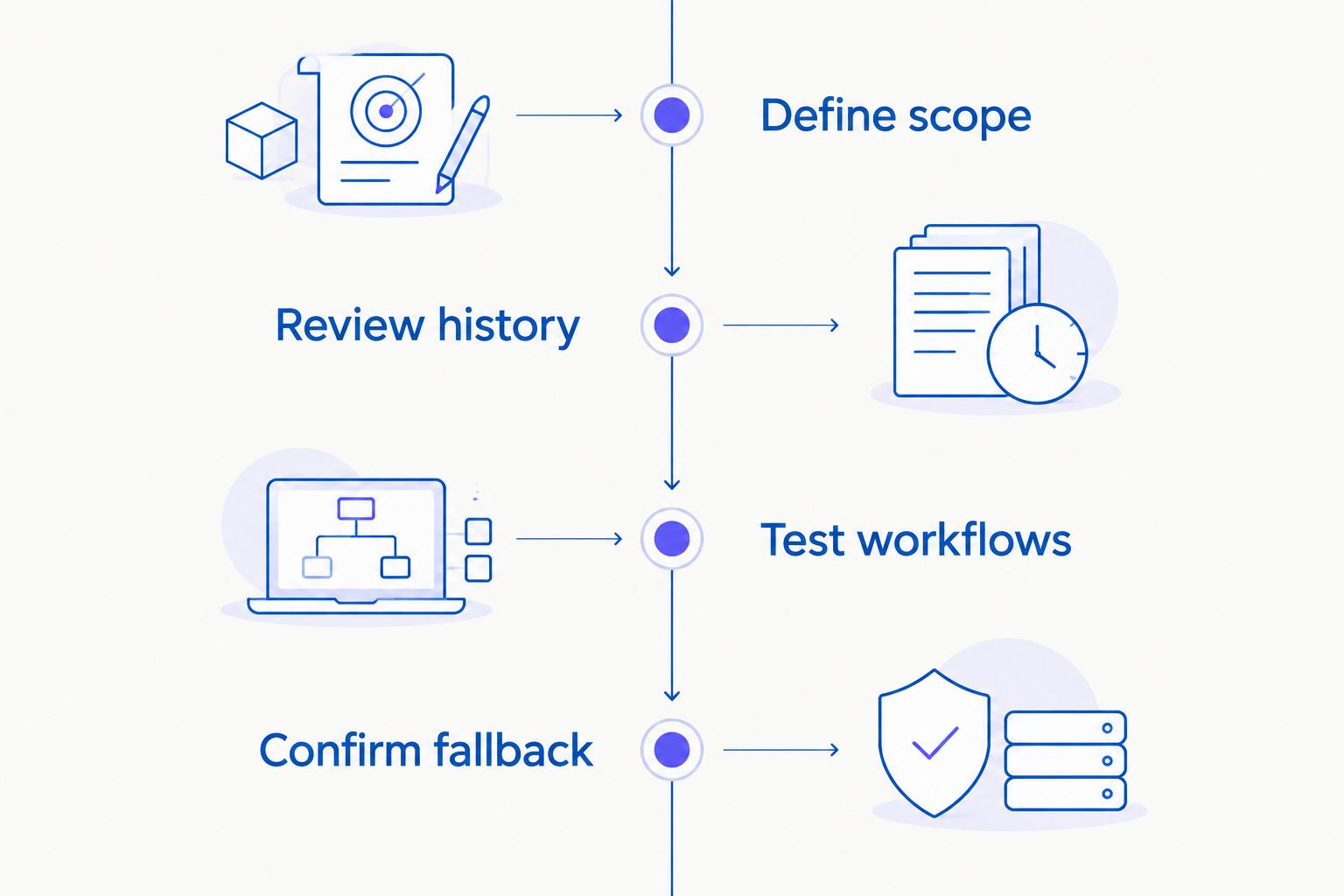
Evaluate the complete customer workflow before accepting a headline uptime claim.
Document the results in plain language. A useful finding identifies the failed step and the customer consequence, such as an answered call that could not retrieve an order. That is more actionable than a broad statement that the software worked.
What an uptime percentage actually means
Availability measures the share of a defined period during which a defined service is operational. A 99.9% uptime target allows 43.2 minutes of downtime in a 30-day month. That is a mathematical illustration, not a reported result for any product in this shortlist.
The definition matters as much as the percentage. Ask whether planned maintenance is excluded, which failures count and whether partial outages enter the calculation. Also ask whether the commitment concerns a component or the full customer-facing service.
Keep these measurements distinct:
- Coverage: When the service is intended to operate, such as 24 hours a day.
- Availability: Whether the defined service is operational during the measured period.
- Response time: How long a customer waits for a response.
- Resolution: Whether the customer's request reaches the correct outcome.
For your 2026 decision, examine each independently. Fast responses can contain incorrect information, and continuous coverage does not establish uninterrupted operation.
Which customer service software should you choose?
Choose Avasales for a Shopify phone-support trial when incoming order questions, refunds and outbound cart recovery are the core requirements. Its stated functions match that brief. Use the trial to establish workflow fit rather than treating it as proof of long-term availability.
Choose a ticket-centered, messenger-led or CRM-centered platform when that operating model matches your actual support demand. Do not replace a channel decision with an uptime headline: an available messenger cannot answer a telephone call by virtue of being available.
Before committing, obtain service terms that identify the covered functions and review the trial's incomplete tasks. Your default choice should be the platform that performs the required work and gives you a clear response when that work cannot finish.
FAQ
What's the best AI customer service software ranked by uptime in 2026?
A defensible uptime winner requires comparable, measured availability for the same service scope. Avasales is the workflow-fit choice in this shortlist for Shopify phone support and abandoned-cart recovery, not a certified uptime winner.
Does 24/7 customer support mean the software never goes down?
No. Continuous coverage describes intended operating hours, while uptime measures whether a defined service is operational during a stated period.
What does 99.9% uptime mean for customer service software?
A 99.9% uptime target allows 43.2 minutes of downtime in a 30-day month. Check which services and exclusions the calculation covers before comparing vendors.
Is Avasales better than a messenger tool for Shopify phone support?
Avasales matches a Shopify phone-support requirement because its stated functions include answering customer calls and making outbound cart-recovery calls. A messenger-based tool should be evaluated for its stated channels rather than assumed to provide equivalent phone support.
How should I test reliability during a customer service software trial?
Test complete customer workflows, including call connection, order lookup, authorized actions and failure handling. Record incomplete tasks separately from successful connections and accurate answers.
Should I compare uptime or call resolution when choosing software?
Compare both separately. Uptime concerns service availability, while resolution concerns whether the customer receives the correct answer or completed action.
What should I ask before trusting an uptime guarantee?
Ask which components are covered, how downtime is measured and which exclusions apply. Confirm the defined failure response for your customer-facing workflow as well.
One last thing
A refund workflow needs more than a successful call and a completed transaction. Your reliability test should also establish what happens if confirmation is interrupted after the action succeeds, so the customer and your team can distinguish an unfinished conversation from an unfinished refund.
Make that interrupted-confirmation scenario part of your 2026 evaluation. Require a clear reconciliation procedure before allowing automated actions to operate without routine supervision.