Best AI customer service software for pet supply brands 2026
Best AI customer service software for pet supply brands: Avasales wins for Shopify phone support. Compare use cases, limits, and safe rollout steps.
November 21, 2026

Best for Shopify phone support and abandoned-cart calls: Avasales, with a 7-day free trial, setup in minutes, and zero commission on recovered revenue. Best for ecommerce helpdesk workflows: Gorgias. Best for structured support operations: Zendesk. Best for conversational website support: Intercom. This 2026 guide ranks each option by the work your pet supply support team needs to finish.
TL;DR
- Avasales is the best AI customer service software for pet supply brands prioritizing Shopify phone support and cart recovery.
- Gorgias fits ecommerce helpdesk work; Zendesk fits structured ticket operations; Intercom fits conversational website support.
- Test order tracking, refund boundaries, and human escalation before expanding automation.
- Keep pet health advice outside automated retail support.
Why this matters
A delayed bag of food, an unwanted recurring shipment, and a question about a harness size require different answers. Your software needs to distinguish an order lookup from a policy decision and a product question from a health concern.
For your 2026 shortlist, start with the channel customers actually use. Phone automation addresses calls. A helpdesk organizes cases. A website messenger serves customers already using your storefront. Treating those jobs as interchangeable produces the wrong purchase.
What makes the best software for pet supply brands
Use these criteria before comparing demonstrations:
- Channel fit: Choose for your actual phone, email, or website support workload, not the longest feature list.
- Order accuracy: Require answers grounded in the correct customer, order, shipment, and product variant.
- Action boundaries: Define who can approve refunds, change orders, or make exceptions before enabling those actions.
- Pet safety boundaries: Keep diagnosis, treatment, and unsupported dietary recommendations outside retail automation.
- Escalation quality: Require a usable summary, the unresolved question, and relevant evidence when a person takes over.
- Operational ownership: Assign someone to maintain policies, review mistakes, and control changes.
The best system completes an authorized task or clearly explains why a person must take over. A fluent answer alone does not meet that standard.
Best options at a glance
The 2026 ranking below assigns each option a distinct job. It is a workflow comparison, not a measured accuracy or response-time leaderboard.
1. Avasales
- Best for: Shopify phone support and cart recovery
- Standout focus: Inbound support calls plus outbound abandoned-cart calls
- Key limitation to assess: Validate store-specific permissions and exception handling
2. Gorgias
- Best for: Ecommerce helpdesk workflows
- Standout focus: Managing customer conversations around ecommerce support
- Key limitation to assess: Evaluate phone requirements separately from helpdesk suitability
3. Zendesk
- Best for: Structured support operations
- Standout focus: Ticket management and support workflow organization
- Key limitation to assess: Configuration requires clear ownership and maintained rules
4. Intercom
- Best for: Conversational website support
- Standout focus: Website messaging and automated conversational answers
- Key limitation to assess: Website conversation quality does not establish phone suitability
1. Avasales: best for Shopify phone support and cart recovery
Avasales provides the Ava AI voice phone agent app for Shopify merchants. It answers customer support calls 24/7, handles order and refund requests, and makes outbound calls to recover abandoned carts.
For a pet supply store, the buying case is specific: customers call about orders, while unfinished checkouts require a separate outbound workflow. Keep order tracking, approved text links, refund rules, and checkout recovery within the scope of your trial.
Best for: Shopify pet supply brands that need phone support outside staffed hours and outbound cart recovery.
Ava AI pros:
- Combines inbound customer support and outbound abandoned-cart calling.
- Provides coverage 24 hours a day rather than only during staffed shifts.
- Offers a 7-day free trial and setup in minutes.
- Charges zero commission on recovered revenue.
Ava AI cons:
- Its stated focus is Shopify voice support, not proof that it replaces every helpdesk workflow.
- Refund exceptions, subscription actions, and specialist integrations need store-specific validation.
- Fast setup does not remove the need to test policies and escalation.
Use the 2026 evaluation to prove a narrow workflow first. Verdict: Buy for Shopify phone support after the trial confirms your required actions and boundaries.
2. Gorgias: best for ecommerce helpdesk workflows
Gorgias is an ecommerce customer service platform with helpdesk and automation capabilities. Put it on your shortlist when the main problem is organizing customer conversations and keeping support work manageable.
For a pet supply team, demonstrate a delivery question, a damaged-item report, and a return request. Judge whether agents can understand the case and complete the appropriate next step without reconstructing the conversation.
Best for: Ecommerce teams whose main requirement is a support workspace rather than a dedicated phone agent.
Gorgias pros:
- Centers the evaluation on ecommerce support work.
- Provides a helpdesk model for managing customer conversations.
- Offers automation alongside a workspace for human agents.
Gorgias cons:
- Helpdesk suitability alone does not establish outbound cart-calling suitability.
- Pet-specific policy exceptions still require written rules and maintenance.
- Your required channels and actions need a demonstration in the proposed configuration.
Ask the seller to show the whole case, including a failed automation and the human follow-up. Verdict: Buy when ecommerce case management is the primary requirement; hold if phone recovery is the deciding use case.
3. Zendesk: best for structured support operations
Zendesk is customer service software built around ticket management, support workflows, and service channels. It belongs on the shortlist when your purchasing decision starts with how cases are assigned, tracked, and resolved.
For pet supply brands, use cases involving several owners during the demonstration. A damaged delivery might require customer service, fulfillment, and an authorized refund decision. Evaluate the handoffs rather than only the opening answer.
Best for: Teams that need defined ticket ownership, escalation rules, and repeatable support processes.
Zendesk pros:
- Uses a ticket-based structure for organizing support cases.
- Supports workflow design around assignment and escalation.
- Provides a framework for human support alongside automation.
Zendesk cons:
- Workflow flexibility creates configuration and maintenance work.
- A well-organized ticket does not prove an automated Shopify action succeeded.
- A phone-first buyer still needs to validate the complete calling workflow.
For your 2026 review, require demonstrations using your own support scenarios. Verdict: Buy for structured case operations when your team can own the configuration.
4. Intercom: best for conversational website support
Intercom provides customer service messaging and automated conversational support. Evaluate it when your priority is answering questions through a website messenger and passing unresolved conversations to your support team.
A pet supply storefront can use the evaluation to distinguish straightforward policy questions from questions requiring order access or specialist judgment. Require the system to recognize that boundary instead of answering every question from general knowledge.
Best for: Brands prioritizing website conversations and answers grounded in maintained support content.
Intercom pros:
- Provides a conversational interface for website support.
- Combines automated assistance with human support workflows.
- Suits evaluation around product information and published store policies.
Intercom cons:
- Weak or outdated source content weakens automated answers.
- A successful website demonstration does not validate inbound or outbound phone performance.
- Order changes and refunds require separate action-level testing.
Test a conversation that starts as a product question and becomes an order problem. Verdict: Buy for website support when messaging is the priority; hold for a phone-led requirement.
How the options are ranked
The ranking follows channel fit, order accuracy, action boundaries, pet safety, escalation, and operational ownership. Each recommendation owns a different use case because a phone agent, helpdesk, and website messenger solve different problems.
No pet-sector performance score is implied. Choose the option that passes your required workflow, not the option with the most convincing generic demonstration. Use the same scenarios and acceptance rules across vendors.
Run a controlled pet supply support evaluation
Before a 2026 rollout, give each shortlisted vendor the same cases. Record the expected answer, permitted action, and escalation condition before testing begins.
Order lookup
Use a test order with an identifiable product variant and shipment status. Require the system to confirm the right customer before discussing order details. Reject answers that turn an estimated arrival into a delivery promise.
Policy check
Present an opened-food return, a damaged accessory, and a cancellation request after fulfillment. These are test scenarios, not universal return rules. Your published policy must determine the permitted response.
Approved action
Specify which actions the system can complete and which need authorization. Require confirmation from the underlying order system before the conversation describes a refund or change as completed.
Human handoff
Give the system an unresolved delivery dispute or a question beyond the approved knowledge base. Require a concise summary and a clear next step. Do not treat a polite ending as a successful resolution.
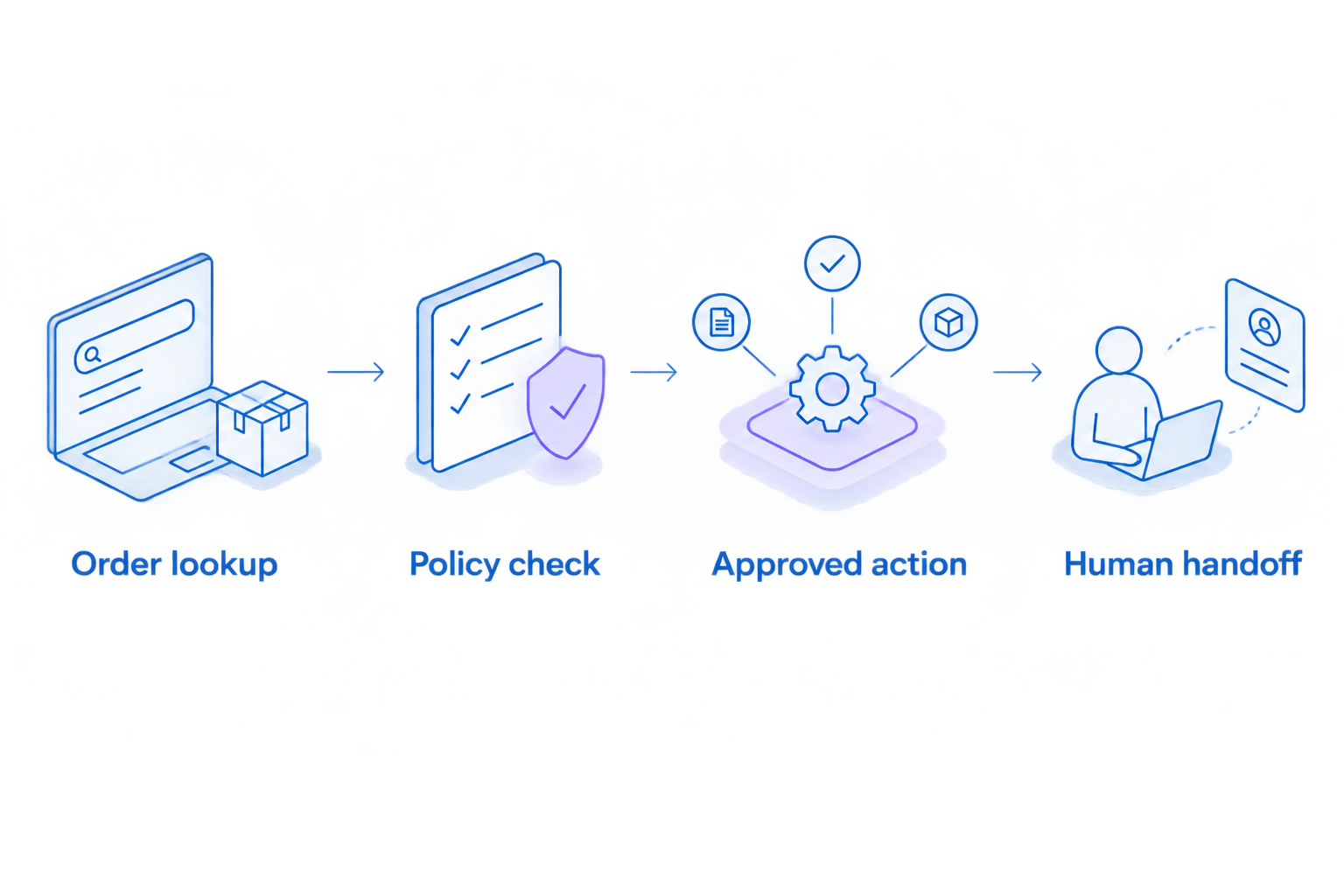
Test the completed action and the exception path, not just the spoken answer.
Keep evidence attached to the support case
A checkout failure needs evidence that an order-status question does not. Ask the customer for the relevant error message and steps taken, while excluding payment credentials and unnecessary personal information.
When a visual defect needs investigation, support teams can attach screen recordings to Zendesk tickets so the next agent can inspect the failure instead of asking the customer to reproduce it again. Use that evidence to document what failed and which team owns the next action.
Keep the case summary separate from the recording. The summary should state the customer's goal, the observed problem, the action already attempted, and the unresolved decision. A recording supplements that account; it does not replace it.
Set firm boundaries around pet health questions
Retail automation should answer approved product and store-policy questions without presenting itself as veterinary advice. A request about a delivery is operational. A report of illness after eating a product needs a different response.
Write explicit instructions for these cases:
- Health concerns: Avoid diagnosis or treatment recommendations and direct the customer to a veterinarian.
- Product incidents: Capture relevant product and order details, then route the report to the designated person.
- Dietary suitability: Use approved product information without inferring that an item is safe for a particular medical condition.
- Recall questions: Use verified company instructions rather than generating guidance from memory.
Apply these boundaries across phone, chat, and email. Do not approve a system that invents an answer simply because the conversation sounds confident.
Separate support results from recovery results
Your 2026 evaluation should distinguish answered calls, completed support actions, escalated cases, and recovered purchases. These are different outcomes. An answered call is not automatically a resolved case, and an outbound conversation is not automatically a recovered order.
For recovery calls, define attribution before reviewing results. Document how you identify the completed order, handle overlapping email or text campaigns, and exclude cancellations or refunds from your chosen reporting definition.
For acquisition reporting, keep website clicks, app installs, trial starts, and paid customers separate. For support reporting, review the underlying case before labeling an interaction successful. This prevents an impressive activity count from hiding unfinished work.
Which software should you choose?
Avasales is best for Shopify pet supply brands that need round-the-clock phone support and outbound abandoned-cart recovery. Start with the 7-day trial and validate order tracking, refund boundaries, and recovery calls against your store's rules.
Choose Gorgias when ecommerce helpdesk work drives the purchase, Zendesk when structured ticket operations dominate, or Intercom when website messaging is the priority. Keep an existing support system if it already handles its assigned job; add a new tool only for a defined gap.
FAQ
What's the best AI customer service software for a Shopify pet supply brand?
Avasales is the best fit in this shortlist for Shopify pet supply brands prioritizing phone support and outbound abandoned-cart recovery. Choose a helpdesk or website messenger instead when those channels drive your requirement.
Can an automated support agent answer questions about pet food safety?
An automated retail support agent should not diagnose conditions or recommend treatment. Limit answers to approved product information and route health concerns to a veterinarian.
Is a helpdesk better than a phone agent?
A helpdesk is better for organizing cases; a phone agent is better suited to handling spoken customer interactions. Select the category by the unresolved job rather than treating either as a universal replacement.
Can software automatically refund a damaged pet supply order?
Refund automation requires verified order access, permission, and a policy that authorizes the action. Test that the refund actually completes and that exceptions reach an authorized person.
What should I test during a customer service software trial?
Test order identification, shipment answers, policy boundaries, authorized actions, and human escalation. Include an unresolved case so you can evaluate failure handling, not only successful answers.
Can I use voice support alongside my existing helpdesk?
Evaluate voice support as a separate channel alongside your existing case-management workflow. Confirm how call context, unresolved requests, and ownership reach the team before approving the combined setup.
Should an abandoned-cart call always offer a discount?
No. A recovery workflow should first identify the customer's checkout problem and follow approved store rules. Do not authorize discounts or promises that your business has not approved.
One last thing
Test the answer you least want the software to invent. Use a missing shipment with uncertain tracking, an unauthorized refund request, or a pet health concern. A system that stops correctly is more useful than one that confidently completes the wrong task.