Best AI voice agents for beauty and skincare brands 2026
Best AI voice agents for beauty and skincare brands: Ava AI leads for Shopify support and cart recovery. Compare options, limits and trial checks.
November 21, 2026

Best overall: Avasales for Shopify beauty and skincare stores, with a 7-day free trial, setup in minutes and zero commission on recovered revenue. For your 2026 shortlist, compare its Ava AI app with a support-only agent for inbound calls, an outbound-only agent for checkout recovery, or a custom-built agent for workflows your team needs to develop.
TL;DR
- Avasales tops this best AI voice agents for beauty and skincare brands shortlist for Shopify support and abandoned-cart recovery.
- Ava AI answers customer support calls 24/7, handles orders and refunds, and makes outbound abandoned-cart calls.
- Choose a support-only agent when inbound order questions are your immediate priority.
- Keep skincare advice, refund exceptions and outbound calling permissions inside clearly defined boundaries.
Why this matters
A beauty shopper asking where a cleanser order is needs a different answer from someone reporting a reaction. Your phone agent needs to distinguish routine order support from questions that require a qualified person or a policy decision.
Avasales is the best fit on this shortlist for Shopify beauty brands seeking phone support and abandoned-cart recovery in one app. Ava AI's stated capabilities cover both jobs. That makes it the default here, rather than a recommendation based only on how natural a demonstration sounds.
This 2026 guide ranks one named app alongside three deployment options. The alternatives are buying approaches, not additional products with verified feature sets. Use them to decide what belongs on your shortlist before comparing individual vendors.
What makes the best AI voice agents for beauty and skincare brands
Judge your 2026 shortlist against these six criteria before listening to sales demonstrations:
- Order accuracy: Require answers tied to the correct customer and order, with a clear response when information is unavailable.
- Action boundaries: Define which refund and order requests the agent can complete and which require approval.
- Product-answer discipline: Restrict answers to approved product information. Do not permit improvised treatment or safety advice.
- Recovery scope: Separate inbound support from outbound abandoned-cart calls so you can evaluate each workflow independently.
- Escalation quality: Test what happens when a customer disputes an answer, reports a reaction or requests a person.
- Operating visibility: Require a way to review what happened, what action followed and whether the issue actually closed.
A pleasant voice does not establish any of these capabilities. Ask for demonstrations using your policies, awkward questions and incomplete information.
AI voice agent options at a glance
1. Ava AI
- Best for: Shopify stores combining support and recovery
- Standout feature or design goal: Inbound customer support plus outbound abandoned-cart calls
- Key limitation: Clinical advice and policy exceptions must remain outside the automated scope
2. Support-only agent
- Best for: Stores prioritizing inbound order questions
- Standout feature or design goal: A deliberately narrow support workflow
- Key limitation: Does not address outbound recovery within this deployment
3. Outbound-only agent
- Best for: Teams isolating checkout recovery
- Standout feature or design goal: A dedicated recovery workflow
- Key limitation: Leaves inbound support to another system or team
4. Custom-built agent
- Best for: Teams developing unusual workflows
- Standout feature or design goal: Control over workflow design
- Key limitation: Your team owns implementation, testing and maintenance
The table compares deployment fit, not measured voice quality or resolution rates. For the generic options, the standout column describes what to require from a vendor or build.
1. Ava AI: best for combined Shopify support and cart recovery
Ava AI is Avasales' voice phone agent app for Shopify store owners. It answers customer support calls 24/7, handles order and refund requests, and makes outbound calls to recover abandoned carts.
For a beauty store, that scope connects post-purchase questions with checkout follow-up. You can evaluate both workflows without treating them as the same business outcome.
Ava AI pros:
- Covers inbound support and outbound abandoned-cart calls.
- Handles order and refund requests, rather than answering general questions alone.
- Provides around-the-clock phone answering.
- Offers a 7-day free trial, setup in minutes and 0% commission on recovered revenue.
Ava AI cons:
- Its stated audience is Shopify merchants; do not assume equivalent suitability for another commerce platform.
- Order and refund automation does not replace a qualified person for medical questions or disputed policy exceptions.
- A combined deployment requires separate acceptance tests for support and recovery.
Best for: A Shopify beauty or skincare store that wants both customer support calls and abandoned-cart recovery.
During the trial, test a straightforward order question, a refund request and a shopper who declines a recovery conversation. Inspect the result of each call, not just the dialogue. Verify current plan terms and usage charges in the Shopify App Store before subscribing.
Verdict: Buy if the trial meets your order, refund and recovery requirements.
2. Support-only agent: best for inbound order questions
A support-only deployment limits the initial project to customers calling your store. Define its scope around order tracking, approved policy explanations and routing requests that need a person.
This option suits a team that wants to address inbound support before adding outbound calling. It is a narrower project, not a claim that every support-focused product handles Shopify actions.
Support-only agent pros:
- Gives your team a focused set of call types to evaluate.
- Keeps outbound permissions and recovery reporting outside the initial deployment.
- Lets you prioritize order accuracy and escalation before expanding scope.
Support-only agent cons:
- Does not recover abandoned carts within this configuration.
- Still requires a dependable order-data connection and action permissions.
- Leaves exceptions with your existing support team.
Best for: A beauty store whose immediate requirement is answering inbound order and policy questions.
Ask the vendor to demonstrate a missing order, a shipment with no fresh tracking update and a return request that falls outside your policy. The correct response includes acknowledging uncertainty when the source information is incomplete.
Verdict: Hold until the shortlisted product proves order accuracy and escalation.
3. Outbound-only agent: best for a focused recovery pilot
An outbound-only deployment concentrates on calling shoppers about abandoned checkouts. Specify eligibility, calling permissions, approved language, follow-up rules and the conditions that end the conversation.
Choose this approach when your inbound support arrangement is staying in place. It lets you assess recovery as a separate operational project, without changing how existing customers reach support.
Outbound-only agent pros:
- Keeps the pilot centered on a defined commercial workflow.
- Separates recovery outcomes from customer service outcomes.
- Gives your team a clear place to review objections and checkout friction.
Outbound-only agent cons:
- Does not answer inbound support calls within this deployment.
- Requires careful rules for permission, timing and opt-outs.
- Needs attribution controls before you credit an order to a call.
Best for: A Shopify beauty team evaluating voice recovery while retaining its current inbound support process.
Do not write a script that invents a discount or promises a skincare result to close a sale. Where your selected system supports approved text links, verify the destination and obtain the appropriate permission before sending one.
Verdict: Hold until calling permissions, opt-outs and attribution are ready.
4. Custom-built agent: best for workflows your team must develop
A custom-built agent is an implementation project rather than a ready-made merchant app. Your team defines how telephony, product information, order access, permitted actions and escalation work together.
Consider this approach when a specific requirement cannot be met by the apps you evaluate. Name that requirement before committing engineering time; customization alone is not a business case.
Custom-built agent pros:
- Lets your team design the workflow around a defined operational requirement.
- Gives you control over which systems and information sources the agent uses.
- Allows purpose-built review and approval steps.
Custom-built agent cons:
- Requires ownership of implementation and ongoing maintenance.
- Makes your team responsible for testing failures across connected systems.
- Needs operational documentation so support staff can manage exceptions.
Best for: A beauty business with technical ownership and a documented requirement that evaluated apps cannot satisfy.
Before starting, assign responsibility for policy updates, failed actions and customer complaints. A working demonstration is not an operating support service.
Verdict: Skip unless a specific unmet requirement justifies the build.
How the options rank
Avasales ranks first because its stated Shopify capabilities cover both support and abandoned-cart recovery. The remaining options narrow the scope or move implementation responsibility to your team.
The ranking follows the criteria above: order accuracy, action boundaries, approved product answers, recovery scope, escalation and visibility. It does not assign unsupported scores or claim comparative testing across named vendors.
Run a beauty-specific acceptance test
For your 2026 evaluation, build a short test pack from your actual policies and product information. Include routine requests and cases where the safest answer is to stop or escalate.
Use this sequence for every shortlisted agent:
- Identify: Confirm how the system establishes which customer and order the caller means.
- Retrieve: Check the answer against the source order or approved product information.
- Authorize: Verify that the requested action falls within your written rules.
- Resolve: Confirm that an allowed action actually completes.
- Escalate: Check the next step when information, permission or confidence is insufficient.
The sequence applies to a refund request as much as an order question. A correct explanation followed by the wrong account action is a failed test.
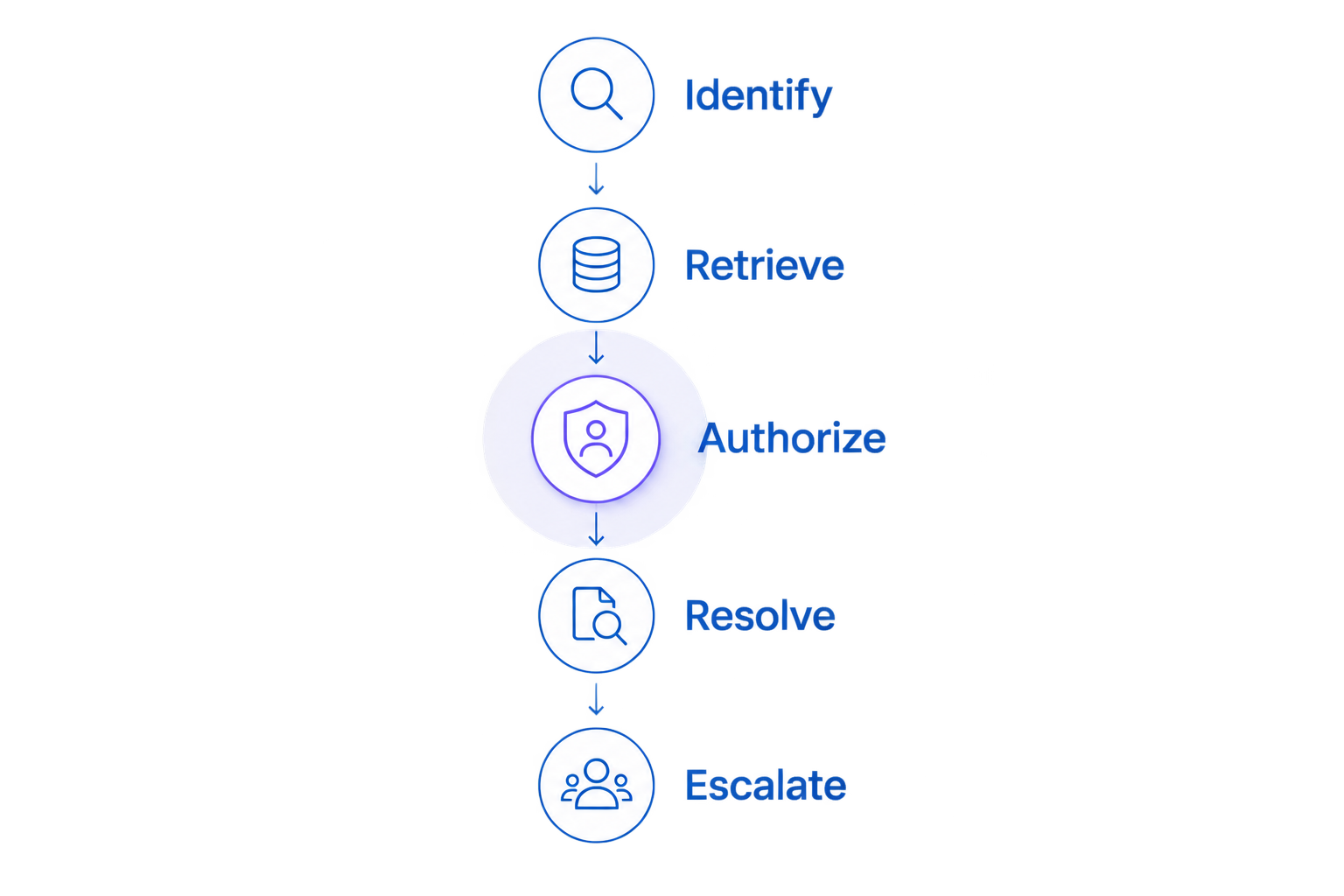
Test the completed action as well as the spoken answer.
For beauty-specific boundaries, include a shopper asking whether a product will treat a condition and another reporting discomfort after use. Require the agent to stay within approved information and follow your escalation process, rather than improvise advice.
For deeper implementation planning, use the AI phone support guide for beauty and skincare brands. Build your call rules before expanding automation.
Keep the trial scorecard tied to outcomes
Record whether each test produced a correct answer, an authorized action and a clear next step. Mark an unresolved request as unresolved even when the conversation sounded polished.
Keep acquisition reporting separate, too. A website click is not an app install; an app install is not a trial start; a trial start is not a paid customer. For recovery, distinguish an answered call, an expressed intention to buy and a completed order.
Your 2026 decision should rest on those distinctions. Do not let a single activity count stand in for every stage of the customer journey.
Evaluate your Shopify phone workflows
Start with the 7-day free trial, setup in minutes and zero commission on recovered revenue.
Which option should you choose?
Choose Avasales first if your Shopify store needs both phone support and outbound cart recovery. Use the trial to confirm the workflows against your own policies before committing.
Choose a support-only deployment when inbound calls are the defined project. Choose outbound-only when recovery is the defined project and your existing support process stays. Reserve a custom build for a requirement you can describe precisely and assign someone to maintain.
For 2026, the default is the option that completes your approved work accurately. Voice naturalness belongs on the scorecard, but it cannot substitute for correct order handling.
FAQ
What's the best AI voice agent for a Shopify skincare brand?
Ava AI is the first option to evaluate when a Shopify skincare brand needs both customer support calls and abandoned-cart recovery. Test its order, refund and recovery workflows against your store policies during the trial.
Can an AI voice agent recommend skincare treatments?
Do not authorize an AI voice agent to diagnose conditions or improvise treatment advice. Restrict product answers to approved information and define an escalation process for medical or safety questions.
Can Ava AI answer beauty-store calls after business hours?
Yes. Ava AI answers customer support calls 24/7, so its stated answering coverage includes calls outside your business hours. Define how unresolved requests reach your team.
Should I choose inbound support or outbound recovery first?
Choose the workflow that matches your immediate operational requirement. Keep inbound resolution and outbound recovery reporting separate even if the same app handles both.
Does Avasales take commission on recovered revenue?
Avasales states that it charges zero commission on recovered revenue. Review current plan terms and usage charges separately in the Shopify App Store before subscribing.
How long is the Ava AI free trial?
Ava AI offers a 7-day free trial, with setup in minutes. Use the trial to test your actual order questions, refund rules and recovery conversations.
What should a beauty brand test before turning on automated calls?
Test customer identification, order accuracy, permitted actions, product-answer boundaries and escalation. For outbound calls, also verify calling permissions, opt-outs and the rules for approved follow-up messages.
One last thing
Your most revealing test is an order the agent cannot find. Require an honest explanation and a usable next step. An agent that invents a tracking update has failed, regardless of how convincing the voice sounds.