Best AI phone agents for warranty and damage claims in 2026
Compare the best AI phone agents for warranty claims. Choose Avasales for Shopify support, and assess claim evidence, refund controls and human handoffs first.
October 7, 2026

Best for Shopify order and refund support: Avasales, with a 7-day free trial, setup in minutes and zero commission on recovered revenue. For warranty-specific workflows in 2026, shortlist Retell AI for configurable voice agents, Vapi for developer-controlled calling, Amazon Connect for contact-center operations and Dialogflow CX for structured conversations; choose by claim authority and evidence handling, not voice quality alone.
TL;DR
- For best AI phone agents for warranty claims, shortlist Avasales for Shopify order support and refund calls.
- Retell AI suits configurable voice workflows; Vapi suits teams building their own claim integrations.
- Amazon Connect suits contact-center operations; Dialogflow CX suits structured claim conversations.
- Keep damage evidence, warranty eligibility and refund authorization separate when evaluating phone automation.
Why this matters
A damaged delivery and a warranty failure require different decisions. A delivery claim concerns what arrived and its condition; a warranty claim concerns whether a defect qualifies under the applicable warranty terms. Your phone agent must preserve that distinction.
For a Shopify merchant, answering the call is only the first task. The useful outcome is an accurate order reference, a clear next step and no unauthorized promise. Automate routine support before handing software disputed warranty decisions.
This 2026 shortlist separates ready-made Shopify support from platforms you configure or build around. It is a buying guide to workflow fit, not a claim that every listed platform includes a finished warranty-management system.
What makes the best AI phone agents for warranty claims
Use these criteria before comparing demos. A fluent answer is not proof that the correct business action occurred.
- Order context: Can the workflow identify the correct order and affected item without exposing another customer's information?
- Policy boundaries: Can you distinguish published eligibility rules from decisions that require approval?
- Evidence handling: Can the wider workflow collect photos or documents and associate them with the claim?
- Action control: Can you restrict refunds, replacements and other consequential actions to approved conditions?
- Human escalation: Can an unresolved claim reach a person with enough context to avoid restarting the conversation?
- Claim records: Can your team find what the caller reported, what the agent said and what action followed?
Ask vendors to demonstrate these criteria against your policies. Do not accept a scripted greeting as evidence of claim handling.
AI phone agents at a glance
1. Avasales
- Best for: Shopify order and refund support
- Standout feature: Shopify-focused phone support available around the clock
- Key limitation to evaluate: Test warranty eligibility and damage-evidence handling separately from routine support
2. Retell AI
- Best for: Configurable voice claim workflows
- Standout feature: Voice agents that connect conversations to backend functions
- Key limitation to evaluate: Claim rules and business actions need deliberate configuration
3. Vapi
- Best for: Developer-owned claim integrations
- Standout feature: APIs for building voice assistants
- Key limitation to evaluate: Your team owns the surrounding claim application and integration work
4. Amazon Connect
- Best for: Contact-center claim operations
- Standout feature: Contact-center routing and workflow infrastructure
- Key limitation to evaluate: A usable warranty workflow requires more than enabling a phone channel
5. Dialogflow CX
- Best for: Structured claim conversations
- Standout feature: Flow-based conversational design
- Key limitation to evaluate: Telephony and claim actions need connected services
These options occupy different buying slots. The default for a Shopify support problem is not automatically the default for a manufacturer with repair authorization, serial-number validation and several service teams.
1. Avasales: best for Shopify order and refund support
Avasales is best for Shopify merchants who need around-the-clock order and refund phone support. The app answers customer support calls 24 hours a day, resolves orders and refunds, and makes outbound abandoned-cart recovery calls.
For warranty and damage inquiries, evaluate the app first as your Shopify support layer. Order tracking and routine refund conversations are relevant capabilities, but warranty eligibility, replacement approval and photo review are distinct workflow requirements. Include each in your acceptance tests.
Avasales pros
- Shopify store owners are the stated target users.
- Around-the-clock answering covers support calls outside your team's working hours.
- Order and refund resolution are stated capabilities, rather than phone answering alone.
- A 7-day free trial gives you a defined window for evaluating your own support scenarios.
Avasales cons
- A spoken description cannot establish the physical condition of a damaged item; your claim process still needs evidence review.
- Order and refund support does not, by itself, establish authority to approve every warranty claim.
Best for: Shopify merchants prioritizing order questions and refund support before broader claim automation.
Use the trial to check whether the actual call outcome matches your policy. A successful conversation ends with the correct action or a clearly assigned next step, not merely a polite response.
Verdict: Buy for the stated Shopify support use case after testing; hold disputed warranty decisions for authorized review.
2. Retell AI: best for configurable voice claim workflows
Retell AI is a voice-agent platform for building phone conversations and connecting them to backend functions. That makes it a shortlist option when you want a configured claim workflow rather than a Shopify-specific support app.
The relevant design question is what each function is allowed to do. An order lookup, claim creation and refund approval are separate actions; give each a separate permission boundary.
Retell AI pros
- A voice-focused platform fits teams whose primary customer channel is the phone.
- Backend functions can connect the conversation to your existing business systems.
- A configurable workflow lets you organize questions around your own claim categories.
Retell AI cons
- Your claim policy must be translated into workflow rules; the platform is not the policy owner.
- Backend functions need safeguards against incorrect inputs, repeated actions and failed requests.
Best for: Teams with an existing claim system and the resources to configure its voice interface.
In your 2026 evaluation, ask for a demonstration using a disputed claim, not just an eligible refund. Retell AI should be assessed on the surrounding configuration and integrations as well as the conversation.
Verdict: Buy when configurable calling is the requirement and you have a claim-workflow owner.
3. Vapi: best for developer-owned claim integrations
Vapi provides APIs for building voice assistants. It belongs on the shortlist when your engineering team wants control over how a call connects to order records, claim tools and business logic.
A developer-owned implementation can keep the phone conversation separate from the system that authorizes an action. That separation is useful when a claim requires several checks before a refund or replacement is permitted.
Vapi pros
- An API-centered approach suits custom applications and integration work.
- Developers can connect voice interactions to tools in the wider claim workflow.
- Your team can define the application logic around the conversation rather than treating the call as an isolated event.
Vapi cons
- Your team remains responsible for building and maintaining the claim application.
- A working voice assistant does not prove that authentication, evidence storage or refund controls are correct.
Best for: Engineering-led businesses building a phone interface for an existing or custom claim system.
Write acceptance tests before selecting individual components. The integration must handle a customer changing an order number, withdrawing a request or disconnecting before an action finishes.
Verdict: Buy for developer control; skip if you need a ready-made Shopify support app.
4. Amazon Connect: best for contact-center claim operations
Amazon Connect provides cloud contact-center infrastructure, including contact flows and routing. It fits organizations evaluating claim calls as part of a larger support operation with human agents and connected services.
Its buying slot is operational control. The warranty process still needs explicit rules for identifying customers, assigning cases and deciding which actions require a person.
Amazon Connect pros
- Contact flows support designed paths through the customer interaction.
- Routing supports a contact-center approach to assigning calls.
- Connected AWS services provide building blocks for conversational and backend workflows.
Amazon Connect cons
- Contact-center infrastructure is not a finished warranty-management application.
- Configuration, connected services and operating procedures add work beyond selecting a conversational voice.
Best for: Organizations managing claim calls across a staffed contact center.
During a 2026 review, require a complete demonstration from incoming call to assigned claim record. Include the handoff to a human, because the transfer is part of the customer experience rather than an administrative afterthought.
Verdict: Buy for contact-center operations; skip for a narrowly scoped Shopify app requirement.
5. Dialogflow CX: best for structured claim conversations
Dialogflow CX is Google's flow-based conversational platform. It suits teams that want to design explicit conversation states for identifying a claim, collecting information and selecting the next step.
For warranty calls, structured flows can distinguish delivery damage from product failure and route each through different questions. Telephony connections and backend services complete the workflow around the conversational layer.
Dialogflow CX pros
- Flow-based design supports explicit conversational paths.
- Fulfillment connections let the conversation interact with backend services.
- Separate flows can organize different claim categories and information requirements.
Dialogflow CX cons
- You must connect the conversational design to telephony and the systems that perform business actions.
- A completed conversation flow is not proof that the underlying claim decision was correct.
Best for: Teams prioritizing structured conversation design across defined claim paths.
Choose this route when the conversation model is a central implementation requirement. Do not choose it solely because a demonstration handles the easiest claim without interruption.
Verdict: Buy for structured conversational design; hold until the phone and claim integrations pass testing.
Build the claim workflow before expanding automation
Use the same workflow to evaluate every candidate. Your Shopify order-data workflow is a useful starting point for separating record retrieval from claim decisions.
- Identify caller: Apply your approved identity checks before sharing order information or performing an action.
- Find order: Locate the affected purchase and item, then confirm the caller's request.
- Classify claim: Separate delivery damage, missing items, product failure and ordinary returns.
- Collect evidence: Direct the customer to your approved evidence channel and associate submissions with the claim.
- Apply policy: Resolve only requests within the workflow's authority; assign exceptions to an authorized person.
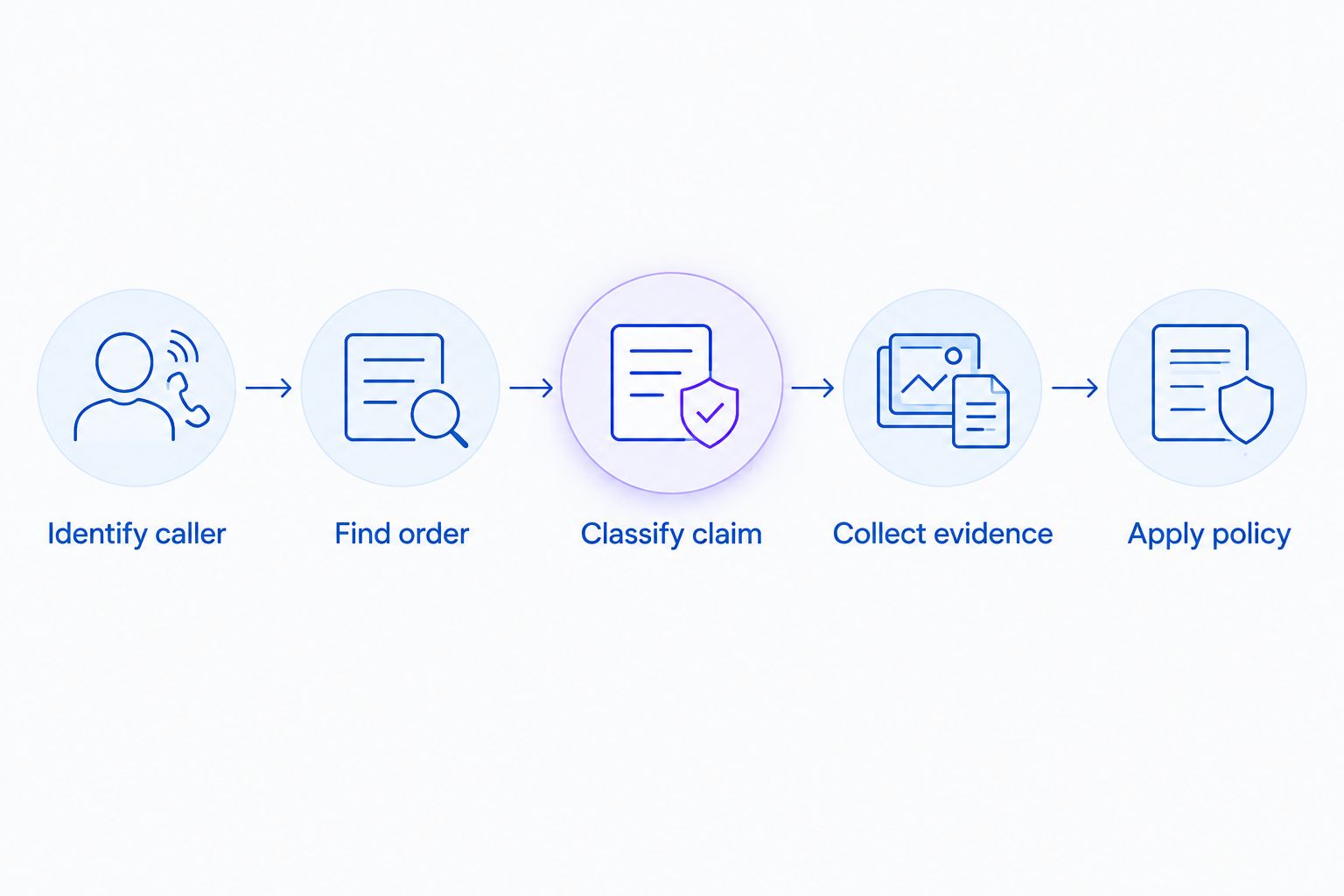
Identify the claim and collect evidence before authorizing an outcome.
For damage claims, do not treat the caller's description as an image inspection. For warranty claims, do not treat the purchase date alone as an eligibility decision. Your policy determines which facts matter and who can approve an exception.
A useful call summary distinguishes what the customer reported from what the system verified. Preserve that distinction when a claim moves between the phone agent and your support team.
Test these calls before launch
For a 2026 launch, schedule 5 test calls covering these scenarios. These are recommended acceptance tests, not performance benchmarks.
- Eligible request: The caller supplies matching order information and a request within the approved policy.
- Incomplete evidence: The caller reports damage but has not submitted the evidence your process requires.
- Identity mismatch: The caller cannot satisfy your approved verification requirements.
- Policy exception: The caller requests an outcome outside the agent's authority.
- Interrupted action: The caller disconnects or changes the request before the workflow finishes.
Classify each result into 3 outcomes: resolved, pending evidence or assigned for review. Check the business record as well as the recording. An agent must not report a refund as completed when the underlying action failed.
How this ranking works
The ranking prioritizes the merchant problem each option addresses: Shopify support, configurable voice workflows, developer-controlled integrations, contact-center operations or structured conversations. It does not rank unverified warranty accuracy, customer satisfaction or financial returns.
Use the criteria above to change the order for your business. If evidence review and human assignment dominate your workload, those requirements should outweigh a more natural-sounding voice.
Which AI phone agent should you choose?
Choose the Shopify-focused option for routine Shopify order and refund support. Choose Retell AI for a configured voice workflow, Vapi for a developer-owned application, Amazon Connect for contact-center operations or Dialogflow CX for explicit conversational paths.
For warranty and damage claims in 2026, keep the first deployment narrow. Expand authority only after identity checks, evidence handling and business actions produce the correct outcomes in your tests.
Start your Shopify support trial
Evaluate order and refund calls during a 7-day free trial, with zero commission on recovered revenue.
FAQ
What's the best AI phone agent for Shopify warranty calls?
Avasales is the Shopify-focused shortlist choice for order and refund phone support. Test warranty-specific policy decisions and evidence handling before giving any agent authority over disputed claims.
Can an AI phone agent decide whether an item is damaged?
A phone conversation alone cannot verify physical damage. Collect evidence through your approved channel and use an authorized review process before deciding the claim.
Is Retell AI or Vapi better for a custom warranty workflow?
Retell AI fits a configurable voice-agent workflow, while Vapi fits an API-centered implementation owned by developers. Choose according to who will build, maintain and control the claim integrations.
Can an AI phone agent issue warranty refunds automatically?
Automatic warranty refunds require an authorized workflow connected to the system that performs the refund. Keep identity checks, eligibility rules and action confirmation separate, and send exceptions for review.
What should happen when a caller asks for a warranty exception?
A warranty exception should go to a person authorized to decide it. The phone workflow should preserve the order reference, customer report, evidence status and requested outcome.
How should I compare AI phone-agent costs?
Compare the current plan terms, usage charges and integration work for your expected workflow. For Shopify apps, check the current Shopify App Store listing rather than treating a static article as a pricing source.
What should I test before launching an AI warranty phone agent?
Test an eligible request, incomplete evidence, an identity mismatch, a policy exception and an interrupted action. Confirm the resulting claim or order record, not just the spoken response.
One last thing
Make action confirmation a launch requirement. A reassuring sentence is not a completed refund, an assigned claim or a replacement authorization. Require the workflow to distinguish a request received from an action completed, and your team can audit the outcome without guessing what happened during the call.