AI Voice Agent Refund Verification: Check Access First | 2026
How do AI voice agents verify identity before issuing a refund? Confirm account access, enforce refund rules, and route failed checks for review, not approval.
October 2, 2026

AI voice agents should verify refund requests by locating the order, confirming access to a contact channel already attached to it, and checking the caller’s authority against the store’s refund rules. An order number or matching caller ID alone is not enough; identity verification and permission to issue a refund are separate checks.
TL;DR
- How do AI voice agents verify identity before issuing a refund? Confirm order access, then check refund authorization.
- Order numbers locate purchases; they do not prove that callers control the customer account.
- Send verification challenges only to contact details already recorded, not replacements supplied during the call.
- Avasales is best for Shopify merchants seeking voice customer support and abandoned-cart recovery calls.
Why this matters
A refund call involves access to customer information and permission to move money. Your phone workflow must control both. A caller who knows an order number should not automatically receive the customer’s address, purchase history, or a refund.
Avasales provides Shopify voice customer support, including order and refund resolution. For a 2026 deployment, evaluate identity checks separately from conversational ability: answering a refund question is different from executing a refund safely.
Require a verified customer session and an eligible refund before allowing a financial action. A helpful conversation does not replace either condition, and a successful identity check does not make every refund request valid.
How do AI voice agents verify identity before issuing a refund?
Use the following sequence as your implementation standard. These are controls to require from your phone-support system, not a claim that every voice agent includes them.
- Locate the order. Ask for an order reference or another approved lookup detail. Retrieve the matching record without reading private information aloud to an unverified caller.
- Select the recorded contact. Use the email address or phone number already associated with the customer or order. Do not substitute a new destination simply because the caller requests it.
- Confirm access. Require completion of a support-specific verification challenge through that recorded channel or an authenticated customer session. The backend, rather than the conversation alone, should validate completion.
- Check refund authority. Confirm that the verified customer is permitted to request the action and that the order meets your refund policy. Identity, eligibility, and permission remain separate decisions.
- Execute or escalate. Submit only an approved refund action. If verification fails, the policy is unclear, or the requested destination changes, stop the automated financial step and route the case for review.
The Shopify order-data-to-phone-answers workflow is relevant to the lookup stage. Keep order retrieval separate from authentication: finding a record proves that the record exists, not that the caller owns it.
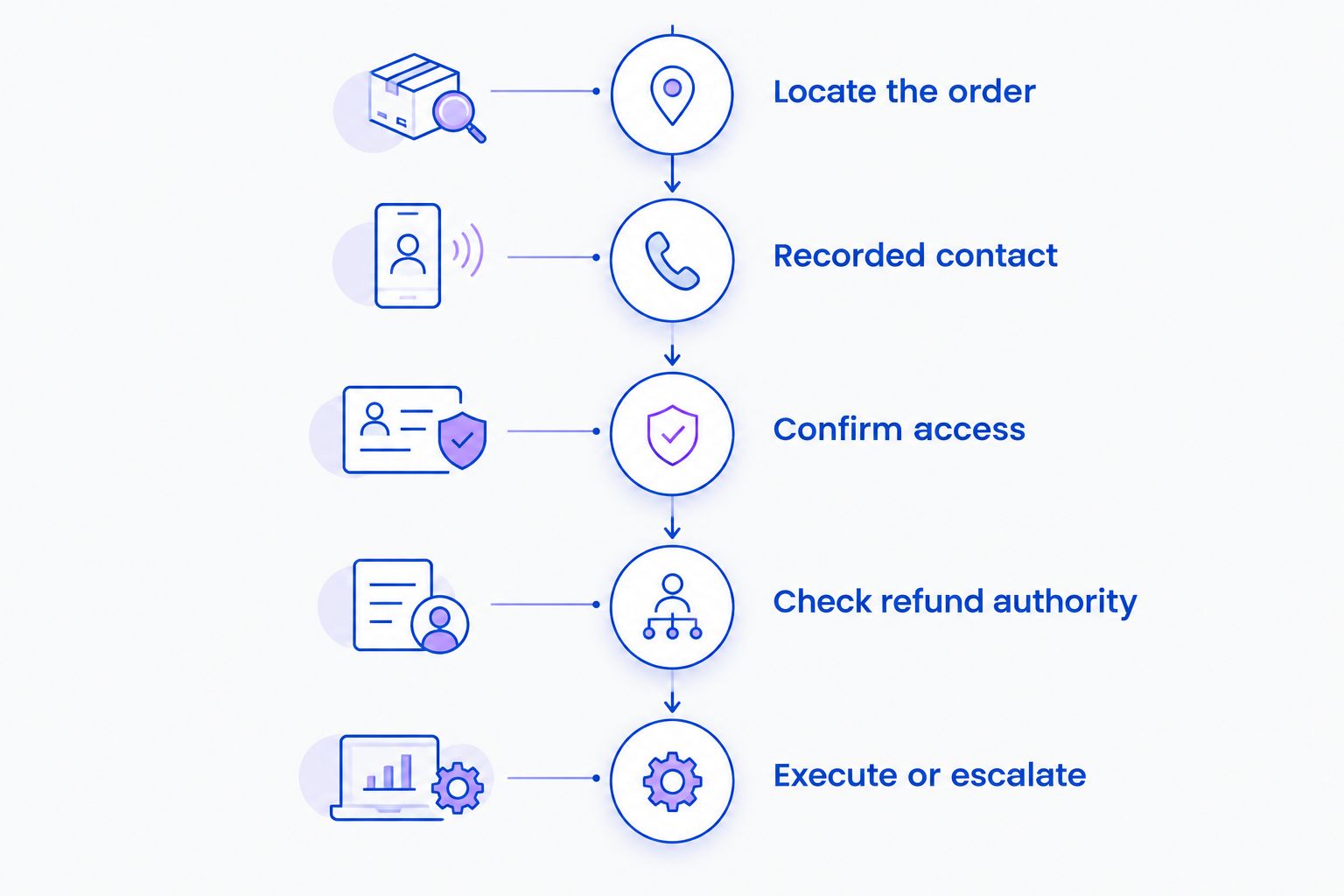
Order lookup starts the process; refund authority determines whether the financial action proceeds.
Which identity checks belong in a refund workflow?
Different checks answer different questions. Use the comparison below to distinguish a lookup aid from evidence of account access, then decide which combinations your refund policy accepts.
Order number
- Best for: Locating a purchase
- Advantage: Connects the request to a specific record
- Limitation: Does not establish control of the customer account
Caller ID
- Best for: Initial routing
- Advantage: Helps identify a possible matching customer
- Limitation: Can be spoofed and is not proof of identity
Order-detail questions
- Best for: Supporting a review
- Advantage: Checks whether the caller knows purchase information
- Limitation: Shared or exposed details can be known by someone else
Challenge to a recorded contact
- Best for: Confirming channel access
- Advantage: Tests access to an existing customer contact
- Limitation: Channel access does not settle refund eligibility
Authenticated customer session
- Best for: Account-linked requests
- Advantage: Connects the request to an authenticated account
- Limitation: Account authentication does not authorize every action
Human review
- Best for: Exceptions and disputed authority
- Advantage: Allows investigation beyond a fixed workflow
- Limitation: Still requires a defined verification process
Use caller ID and order details as supporting context, not standalone refund authorization. A recorded-contact challenge has a different role: confirming access to a channel your store already associates with the purchase.
For your 2026 evaluation, ask vendors to demonstrate the failed-verification path as clearly as the successful one. A system that handles the normal case but exposes customer details during failure has not met the requirement.
Why refund verification varies
Your verification workflow should reflect the request and the records available. Define the following factors in policy rather than letting a conversational agent improvise them:
- Account access: An authenticated account request and an unauthenticated phone call begin with different evidence. Specify which evidence each route must supply.
- Recorded contact availability: A customer who cannot access the existing email address or phone number needs an account-recovery path, not an automatic contact substitution.
- Requested action: Asking whether an order qualifies for a refund is different from authorizing a financial transaction. Separate informational answers from execution rights.
- Refund eligibility: Return status, previously refunded items, and the applicable store policy affect whether a verified request can proceed.
- Caller authority: Gift recipients, family members, and business buyers can have different relationships to an order. Define who is allowed to request each action.
- Exceptions: A disputed order, changed contact information, or a request to redirect funds should follow an explicit review path.
Document the evidence required for each route. Your agent should explain the next step without revealing the exact private information that would help an unauthorized caller pass it.
What should happen if the customer cannot access their email?
Do not send the verification challenge to a replacement email address supplied during the refund call. That would let the caller choose the channel used to prove their own authority.
Instead, separate account recovery from refund processing. Route the customer through your approved recovery procedure, then resume the refund request after the contact change has been authorized. The person handling recovery needs evidence independent of the newly supplied address.
The same rule applies when a caller reports a lost phone or asks to use a relative’s number. Offer a clear next step, but keep the refund pending until your required verification is complete.
Your 2026 support script should explain the restriction in ordinary language: the store must confirm access through an existing account record before changing details or processing the financial request. Do not promise a refund while recovery remains unresolved.
Is knowing the order number enough to get a refund?
Knowing the order number is not enough to establish authority to receive a refund. It identifies a purchase, and a purchase reference can appear in forwarded emails, shared messages, or paperwork.
Use the number to locate the order without disclosing the customer record. Avoid reading out a full address, email address, or purchase history and asking the caller to agree. Confirmation of information you have just supplied is not independent evidence.
Order-detail questions have a supporting role when your policy permits them. Ask the caller to provide the information rather than revealing it first, and do not treat several details from the same receipt as independent authentication factors.
A correct order number should open the verification workflow, not bypass it. The financial action stays blocked until the required customer-access and refund-policy checks have passed.
Can the agent issue a refund immediately after verification?
A verified caller still needs an eligible refund request. Check the specific order and items against your store policy before giving the agent permission to execute the action.
Your backend should confirm the refundable state, prevent an already completed refund from being submitted again, and enforce the permitted refund destination. Prefer the original payment route where the payment system and applicable process support it; a caller’s request for a different destination needs separate review.
Do not let a verbal instruction override these controls. A caller saying that a manager approved the refund is a claim to investigate, not authorization the system should accept automatically.
Keep the final response tied to the execution result. If the financial action is pending, the agent should say it is pending. It should announce completion only after the transaction system confirms success, and it should not invent a settlement date.
How to test the workflow before enabling live refunds
Test the full decision path in a controlled environment. Use synthetic customer records or approved test data rather than exposing real customer information in demonstrations.
Test the successful request
Confirm that an eligible customer can locate an order, complete the required verification, and request an authorized refund. Check that the system submits the intended action and reports the actual result.
Test the blocked request
Try an incorrect challenge response, a mismatched order reference, and a caller who knows purchase details but cannot access the recorded contact. The agent should withhold protected information and avoid submitting the refund.
Test the exception request
Ask to change the contact address, redirect the refund, repeat a completed refund, or bypass verification because the caller is upset. Each request should follow the written exception policy without granting extra privileges.
Test the interrupted request
End the call during verification or after the refund request has been submitted. Confirm that a resumed conversation does not assume authentication or repeat a financial action without checking its state.
Make these scenarios part of your 2026 release checklist. Review the recorded decisions as well as the spoken responses; a polite refusal is not enough if the backend still permits the action.
Keep the conversation separate from financial permissions
Your conversational layer should gather the request and explain the process. The transaction layer should enforce authentication state, permitted actions, and refund eligibility. Keep that boundary explicit.
When comparing AI agents for customer support, distinguish the ability to discuss a refund from the authority to execute one. An agent can understand the customer correctly while still needing to stop because the required authorization is absent.
Give the system only the permissions it needs. An agent handling order questions should not automatically receive unrestricted authority to modify customer records or submit financial actions. Restrict refund tools to approved requests and check their inputs before execution.
Use the same boundary for human escalation. Passing a call to a person should pass the request and verification status, not convert an unverified caller into an approved customer. The receiving person needs to know exactly which checks passed, failed, or remain incomplete.
Record the decision without collecting unnecessary secrets
Maintain an audit record that explains why the refund proceeded or stopped. Useful fields include the order reference, verification outcome, policy decision, requested action, execution result, and escalation reason.
Record the result of a verification challenge rather than retaining its secret in ordinary call notes. Set recording and transcript controls so that sensitive authentication information does not become routine support data.
Never ask customers to disclose their account password, card security code, or a banking authorization code to resolve a refund call. A support-specific verification challenge must have a clear purpose and must not authorize an unrelated login or payment.
For a 2026 implementation, define who can access these records and how long your store retains them. Match retention to your operational and legal requirements rather than keeping every transcript indefinitely. Access to a recording is itself access to customer information.
Evaluate Shopify phone support against the refund boundary
Avasales offers a 7-day free trial and setup in minutes. Its stated scope includes answering Shopify customer support calls 24 hours per day, 7 days per week, resolving orders and refunds, and making outbound abandoned-cart recovery calls.
Avasales is best for Shopify merchants seeking voice customer support and abandoned-cart recovery calls. That scope makes refund handling relevant, but it does not establish a particular authentication method.
During evaluation, require a demonstration of recorded-contact verification, failed checks, permission enforcement, and exception handling. Treat these as acceptance criteria rather than assumed product features. Also confirm how the system distinguishes a refund discussion, an approved request, and a completed transaction.
Continuous call coverage addresses when customers can reach support. Refund authorization addresses what support is allowed to do. Evaluate both independently, and keep automated financial execution disabled until the required controls meet your store’s policy.
FAQ
How do AI voice agents verify identity before issuing a refund?
AI voice agents should locate the order, confirm access to an existing customer contact or authenticated session, and check refund authority. The backend should enforce these checks before executing the financial action.
Can an AI voice agent use caller ID to approve a refund?
Caller ID should not approve a refund by itself because it can be spoofed. Use it for routing or lookup, then require the verification evidence specified in your store policy.
Is an order number proof that a caller owns the purchase?
An order number identifies a purchase, not the caller’s authority over it. Require an approved customer-access check before disclosing protected information or processing a refund.
What happens if I cannot access the email on my order?
The refund request should move to the store’s approved account-recovery process. A replacement email supplied during the call should not become the verification destination without independent authorization.
Should a phone agent ask for my card security code?
A phone agent should not ask for your card security code, account password, or banking authorization code to handle a refund. Any support verification challenge should clearly identify its limited purpose.
Does successful identity verification guarantee a refund?
Successful identity verification does not guarantee a refund. The order must also satisfy the store’s refund policy, and the requested action must be authorized.
What should happen when refund verification fails?
Failed verification should block automated refund execution and protected account disclosures. The agent should explain the approved recovery or review path without inventing an exception.
One last thing
Test a caller who supplies every visible order detail but asks to receive the verification challenge at a new address. That scenario reveals whether your system verifies access to an existing customer record or merely accepts a convincing story.
Keep contact changes and refund execution in separate authorization paths. A customer should have a workable recovery route, but the same unverified call should not both replace the trusted contact and approve the financial action.