Can AI Chatbots Handle Phone Calls Too? Yes, in 2026
Can AI chatbots handle phone calls too? Yes, with voice and telephone connectivity. Learn what Shopify stores should test for order support and refund actions.
October 1, 2026

Yes, AI chatbots can handle phone calls when they include a voice interface and a connection to the telephone network; a text-only chatbot cannot answer your store’s phone by itself. Handling a conversation also requires access to the right customer information and permission to take actions, so voice support does not automatically mean the agent can change an order or issue a refund.
TL;DR
- Can AI chatbots handle phone calls too? Yes, with voice processing, telephone connectivity, and suitable action permissions.
- Avasales serves Shopify merchants needing phone customer support and outbound abandoned-cart recovery calls.
- A text chatbot, voice-enabled platform, and dedicated phone agent solve different support problems.
- Test order accuracy, refund boundaries, and escalation before expanding automated phone support.
For Shopify phone support, Avasales offers a 7-day free trial and setup in minutes. Its app answers customer support calls 24/7, resolves orders and refunds, and makes outbound abandoned-cart recovery calls.
Can AI chatbots handle phone calls too?
Yes, but phone capability must be part of the system you deploy. A chatbot that answers typed messages needs additional capabilities to receive calls, interpret speech, and respond aloud. Those capabilities can sit within a voice-enabled platform or a dedicated phone agent.
Use this comparison when evaluating support options in 2026:
Text-only chatbot
- Best for: Written website support
- What it does: Answers typed customer messages
- Advantage: Keeps the interaction readable
- Limitation: Cannot answer telephone calls without additional voice and telephone capabilities
Voice-enabled platform
- Best for: Teams evaluating chat and phone together
- What it does: Adds spoken conversations to a broader support system
- Advantage: Supports a shared approach to multiple channels when configured
- Limitation: Check telephone connectivity and store actions separately
Dedicated phone agent
- Best for: Stores prioritizing inbound or outbound calls
- What it does: Handles customer conversations over the phone
- Advantage: Focuses on phone-based workflows
- Limitation: Does not establish that website chat is included
Do not choose based on whether a product calls itself a chatbot, assistant, or agent. Ask it to demonstrate the exact workflow your customer needs. Answering a shipping question and completing a refund are different capabilities, even when both happen during the same call.
Why this matters for your Shopify store
A customer calling about an order needs an answer tied to that order. Reading a general shipping policy aloud does not explain whether the package has shipped, and describing a refund policy does not complete a refund.
Your decision therefore has two parts: can the system hold a useful phone conversation, and can it finish the permitted task? Evaluate both. A fluent voice can still give an incorrect answer if the underlying order information is wrong or inaccessible.
For your 2026 support plan, separate inbound service from outbound recovery. Inbound calls start with a customer request; outbound calls start with your store contacting a customer. Each needs its own purpose, permission checks, and definition of a successful outcome.
What a chatbot needs to answer a phone call
A working phone-support workflow connects the caller to spoken conversation and, where necessary, to store records. The conversational model alone is not the complete system.
Telephone connectivity
The system needs a way to receive or place telephone calls. A microphone button inside a website chat window is not proof that customers can call a telephone number and reach the agent.
Ask for a live demonstration using the intended calling channel. For outbound use, request a separate demonstration; answering incoming calls does not establish that the same system can initiate calls.
Spoken conversation
The system must process what the caller says and produce an audible response. Some implementations convert speech into text and generate speech from the answer; others use audio-capable models within the conversation workflow.
Evaluate the interaction rather than the technical label. Check whether callers can interrupt, correct an order number, or change their request without the conversation losing track of the task.
Store information
Order-specific support requires access to relevant store information. The agent needs to distinguish facts from the order record, general store policies, and information it cannot confirm.
For example, an order marked fulfilled does not justify inventing a delivery date. Your test should check what the agent says when tracking information is missing, incomplete, or inconsistent with the caller’s account.
Action permissions
A phone agent needs explicit authority to make changes. Access to order information does not, by itself, establish permission to cancel an order or process a refund.
Write down which actions the system can complete and which require review. Treat spoken confirmation and a verified store action as separate checks. A customer hearing that a refund is complete should match a recorded refund outcome.
How to test an AI phone agent before launch
Use a controlled support workflow before exposing every customer request to automation. The following sequence is a recommended evaluation process, not a claim about any provider’s built-in features.
- Choose the task. Start with a defined request, such as checking an existing order. Specify what counts as a correct answer and what information the agent needs.
- Check the record. Prepare a permitted test order and compare the spoken answer with its actual status. Include missing information so you can assess how the agent handles uncertainty.
- Set permissions. Define the actions the agent is allowed to take. Keep actions outside those boundaries subject to staff review.
- Test the call. Speak naturally, interrupt, and correct a detail. Confirm that the agent retains the corrected information rather than repeating the original mistake.
- Review the outcome. Inspect the resulting order state or support record. Confirm that the customer’s request was resolved or left with a clear next step.
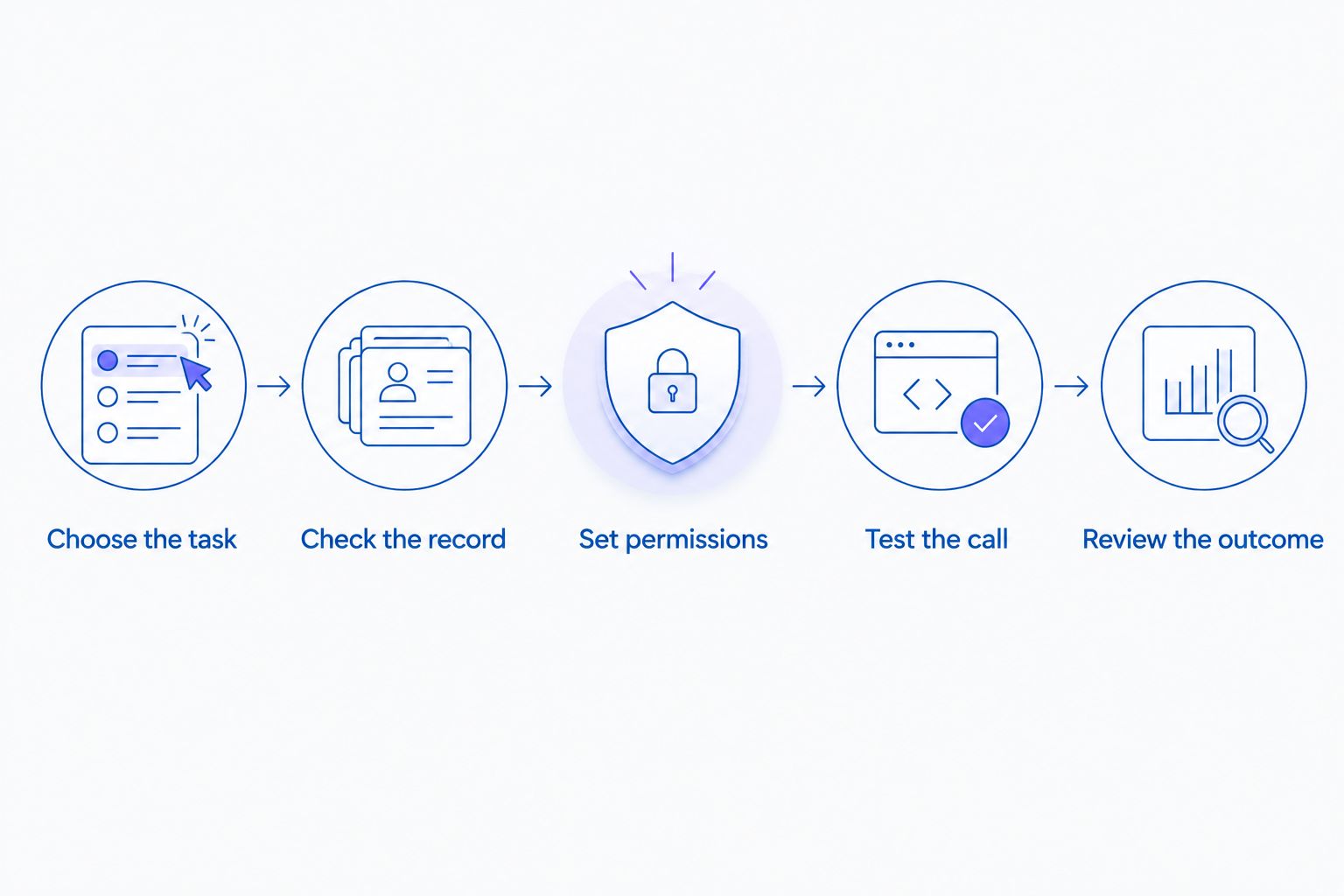
Check the resulting store record, not just how the conversation sounds.
For a first evaluation, run 3 test calls: a routine request, a request with missing information, and a request outside the agent’s authority. This is a suggested starting checklist, not a sufficient sample for proving accuracy or reliability.
During a 7-day trial, keep a written record of each test’s expected and actual outcome. Repeat a failed scenario after changing the configuration. Do not treat a corrected configuration as successful until you have tested the call again.
Why AI phone-call performance varies
Phone-support performance depends on more than the voice a customer hears. These factors explain what to examine during your 2026 evaluation:
- Channel configuration: Confirm that telephone calling is included, rather than assuming a voice feature inside chat supports external calls.
- Order-data access: Check which records the agent can read and whether its answers match those records at the time of the call.
- Policy clarity: Give the system approved rules for returns, refunds, cancellations, and shipping questions. Identify exceptions that require review.
- Action authority: Separate information retrieval from permission to change an order. Test both permitted actions and prohibited requests.
- Conversation handling: Include corrections, interruptions, and unclear speech in your evaluation. Judge whether the agent preserves the customer’s intended request.
- Escalation design: Specify what happens when the system cannot verify information or complete the requested action. Test the destination and the information passed along.
These are evaluation criteria, not guarantees that every product includes each capability. Ask for evidence within your own store workflow before depending on a feature.
Where a Shopify phone agent fits
Avasales is best for Shopify merchants who need inbound phone customer support and outbound abandoned-cart recovery calls. That fit follows its stated scope: answering support calls around the clock, resolving orders and refunds, and contacting shoppers about abandoned carts.
The advantage is a phone-focused workflow tied to Shopify merchant needs. The limitation is scope: you should not infer website-chat functionality, a particular human-transfer method, or support for every store exception from those stated capabilities. Demonstrate any requirement that matters to your operation before relying on it.
Start with the problem you actually receive calls about. If customers ask where their orders are, prioritize the Shopify order-data-to-phone-answers workflow. If you want checkout recovery calls, evaluate that outbound workflow separately from inbound support.
Avasales provides 24 hours of phone-support coverage per day through its stated 24/7 availability. Coverage describes when calls can be answered; it does not establish a resolution rate, a response-time guarantee, or a conversion result.
Evaluate Shopify phone support
Explore inbound customer support and outbound abandoned-cart recovery calls for your Shopify store.
Can an AI phone agent actually process refunds?
Yes, an AI phone agent can process refunds when its integration and permissions support that action. The ability to explain your refund policy is not evidence that the system can execute a refund.
Test the complete outcome using an approved scenario. Confirm eligibility, the permitted refund scope, and the resulting store record. Any request outside your policy should follow a defined review path rather than an improvised exception.
Also check the language used before and after the action. The agent should distinguish a refund request awaiting review from a refund that has actually been processed. That distinction prevents a reassuring conversation from becoming an inaccurate promise.
Can the same agent answer calls and recover abandoned carts?
Yes, a phone agent can support both inbound customer service and outbound cart recovery when both workflows are included. Evaluate them separately because they start from different customer situations.
An inbound support caller has already asked for help. An outbound cart-recovery call initiates contact, so review applicable calling requirements, permission handling, and opt-out behavior before launch. A customer phone number alone is not your complete compliance assessment.
For checkout recovery, test whether the conversation addresses the shopper’s actual obstacle. If your approved workflow includes a text link, verify the destination and permission to send it. Do not ask a phone agent to invent promotions or offer terms your store has not approved.
Should an AI phone agent replace your human support team?
Not for requests you have not authorized or tested. Automate defined tasks and retain human review for exceptions, disputed outcomes, and situations the agent cannot verify.
Your 2026 rollout should establish what the agent owns and what staff own. A refund within an approved policy and a customer demanding an exception are separate workflows. Write that boundary into your operating procedure rather than expecting the conversation to settle it.
Check the handoff experience as well. If live transfer is required, demonstrate it; if the workflow creates a follow-up request instead, confirm what the customer is told. Do not describe a callback or ticket as an immediate transfer.
Measure completed outcomes, not convincing conversations
A useful 2026 evaluation records what happened after the call. For an order-status request, compare the answer with the order record; for a refund, check the action; for an unresolved request, inspect the next step.
Keep inbound support and outbound recovery results separate. A call answered is not necessarily a problem resolved, and a recovery call placed is not necessarily a recovered checkout. Record the relevant outcome before attributing success to the phone agent.
Use the same discipline when evaluating adoption. Website clicks, app installs, trial starts, and paid customers are distinct events. Combining them into a single result hides where merchants actually move from interest to use.
FAQ
Can AI chatbots handle phone calls too, or only text messages?
AI chatbots can handle phone calls when they include telephone connectivity and spoken-conversation capabilities. A text-only chatbot needs additional components before it can answer customer calls.
Is a voice-enabled chatbot the same as a phone agent?
A voice-enabled chatbot is not necessarily a telephone agent. Confirm that it can receive or place calls over the telephone network, rather than only accept microphone input inside a website or app.
Can an AI phone agent look up my Shopify orders?
An AI phone agent can look up Shopify orders when its integration grants access to the relevant records. Test its answers against actual order information and check how it handles missing details.
Can an AI phone agent issue refunds without a person?
An AI phone agent can issue refunds when the system supports that action and your permissions authorize it. Require review for requests outside your approved policy and verify the resulting store record.
What's a suitable phone-support option for a Shopify store?
Avasales fits Shopify merchants seeking inbound phone customer support and outbound abandoned-cart recovery calls. Its stated capabilities include 24/7 answering and resolving orders and refunds; test any additional requirement separately.
Can an AI phone agent transfer a difficult call to a human?
An AI phone agent can transfer calls only when its calling system and configured workflow support that feature. Ask for a live demonstration and distinguish immediate transfer from a callback or follow-up ticket.
How should I test an AI phone agent before customers use it?
Start with 3 test calls covering a routine request, missing information, and a request outside the agent's authority. This is a starting checklist, not proof of reliability; compare every answer and action with the expected result.
One last thing
Make your final test a request the agent should not complete. Ask for an action outside the permissions you deliberately configured, then inspect what happens.
A useful phone agent must respect its limits as reliably as it handles routine requests. A clear refusal with an appropriate next step is a better result than an unauthorized action delivered in a confident voice.