AI Voice Agents Recover Abandoned Shopify Carts | 2026
How does an AI voice agent recover abandoned Shopify carts? It calls eligible shoppers, answers checkout questions and offers an approved link. See the 2026 steps.
September 26, 2026

An AI voice agent recovers abandoned Shopify carts by calling a shopper who left checkout, asking what stopped the purchase, answering questions and, when appropriate, sending an approved link back to checkout. The call creates a chance to resolve a concern while the shopper can respond, but it does not turn every abandoned cart into an order. For a merchant, the useful outcome is a completed purchase that can be traced to the recovery effort, not a call placed or a link sent.
TL;DR
- An AI voice agent recovers abandoned Shopify carts by calling shoppers, addressing objections and offering an approved checkout link.
- Ava AI is best for Shopify merchants who want abandoned-cart voice calls alongside phone support.
- Track answered calls, trial starts and completed purchases separately; none is a substitute for paid customers.
- Confirm who can be called and what the agent can say before activating outbound calls.
Why this matters
An abandoned checkout tells you that a shopper reached checkout and did not complete the purchase. It does not tell you why. A phone conversation can uncover a question about an order, a delivery concern or a problem finishing checkout; the agent then needs an approved way to respond rather than a script that assumes every shopper wants to buy.
The workflow for calling customers when Shopify carts go abandoned is the useful starting point if you are mapping the trigger. In 2026, the practical question is not whether a call can be placed. It is whether the right checkout reaches a callable shopper, the call respects your permissions, and the resulting purchase is measured accurately.
Ava AI offers a 7-day free trial, setup in minutes and zero commission on recovered revenue. Those terms make it possible to assess the workflow, but they do not establish how many of your shoppers will answer or buy. Keep that distinction clear when deciding whether outbound calls belong in your recovery process.
How does an AI voice agent recover abandoned Shopify carts?
The recovery process has a trigger, a conversation and a measurable outcome. Each stage can fail independently: a checkout might lack a usable phone number, a shopper might not answer, or an answered call might end without a purchase. Define what you will count at each stage before judging the channel.
- Identify the abandoned checkout. The merchant needs a checkout event and enough information to recognize that a shopper left without completing an order. A page visit alone is not an abandoned checkout.
- Check whether a call is appropriate. The workflow needs a reachable number and a lawful basis for the outbound call. Merchants should review their consent language and the rules that apply to their customers before calling.
- Place the outbound call. The agent identifies the reason for the call and gives the shopper room to explain what happened. If the shopper does not engage, an attempted call should not be reported as a recovered cart.
- Address the stated obstacle. A useful response depends on what the shopper asks. The agent should rely on information and actions the merchant has approved, rather than promising a discount, delivery date or refund it cannot verify.
- Offer a path back to checkout. When the shopper wants to continue, an approved text link can help them return. Sending the link is an action; an order placed afterward is a separate result.
- Measure the completed purchase. Match recovery reporting to actual orders and keep calls placed, calls answered, links sent and purchases in separate categories. Otherwise, activity can look like revenue without establishing that a cart was recovered.
This sequence explains the mechanism without assuming that every abandoned checkout is eligible for a call. It also shows where a merchant has work to do: confirm permissions, approve the information the agent uses and decide how a completed purchase will be attributed.
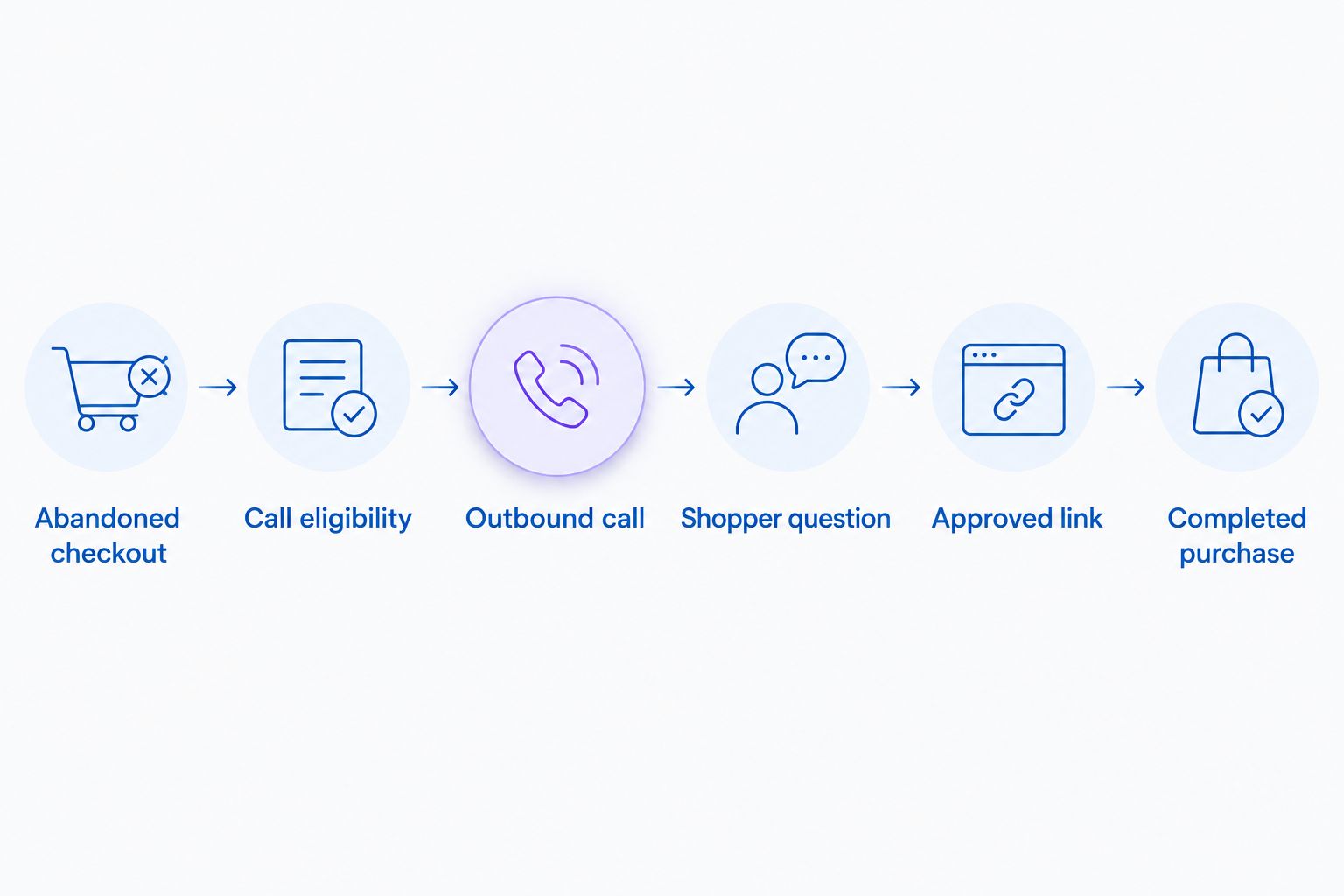
A sent link is an intermediate action; the completed purchase is the outcome to measure.
What should happen during the call?
The agent should start with the shopper's reason for leaving, not a claim that it already knows the problem. If the shopper asks about an order, the response needs to reflect information the agent can actually access and is approved to share. If the shopper asks about a policy, the answer must match the merchant's current policy.
The next step should fit the answer. A shopper ready to finish checkout needs a usable route back; a shopper with an unresolved question needs a correct answer or an appropriate handoff. A call that pressures someone past an unanswered concern has not solved the reason they left.
What counts as a recovered cart?
Count a recovered cart when a previously abandoned checkout results in a completed order under your chosen attribution rule. State that rule before comparing results: which orders qualify, what period you consider and how you handle shoppers who also received other messages. Without that definition, a purchase after a call and a purchase caused by a call can be mistaken for the same thing.
Keep the reporting ladder visible. A call placed is not a call answered; a call answered is not a checkout completed. Website clicks, app installs, trial starts and paid customers are also different events. Do not add them together or label them all as conversions when reviewing 2026 performance.
Why abandoned-cart call results vary
A call is only useful when the underlying checkout and conversation support a sensible next step. These are the factors to inspect before treating a low recovery count as a script problem:
- Contact information: A checkout without a usable phone number cannot enter a phone recovery flow.
- Permission to call: Your consent process and applicable calling rules determine which shoppers you can contact. Eligibility matters before the conversation begins.
- Answer rate: An unanswered attempt gives the agent no opportunity to hear or resolve the shopper's concern.
- Reason for leaving: A question the agent can answer differs from a problem that requires a merchant decision. The same response will not fit both.
- Approved information and actions: The agent needs current answers and clear limits. An unsupported promise creates a support problem instead of a recovery path.
- Order measurement: A completed purchase must be identified separately from a call or text event, with an attribution rule applied consistently.
Use these factors as a diagnostic checklist, not as guaranteed gains from changing a setting. If few eligible checkouts have phone numbers, inspect checkout data and permissions first. If shoppers answer but still ask questions the agent cannot resolve, inspect the information and handoff process before increasing call volume.
Where does Ava AI fit?
Ava AI is best for Shopify merchants who want abandoned-cart voice calls alongside phone support. The Ava AI phone agent app makes outbound calls to recover abandoned carts and answers customer support calls 24/7. It also handles order and refund requests, which makes it relevant when a shopper's checkout concern turns into a support question.
The fit has a limit: the description of those capabilities does not establish that a particular merchant's shoppers have consented to calls, that every request can be resolved without review, or that a call will produce a purchase. Set the boundaries for approved answers and text links before evaluating the Ava AI workflow against your existing recovery reporting. In 2026, the decision should rest on eligible checkouts and completed orders, not the volume of outbound attempts.
Assess abandoned-cart calls
Review the Shopify voice-call workflow during the 7-day free trial.
Can an AI call recover a cart without a discount?
Yes. An AI call can address a question that prevented checkout and offer an approved route back without proposing a discount. Whether the shopper completes the purchase still depends on the concern and the shopper's decision; the call itself does not establish a recovery.
Do not have the agent improvise an incentive. If your business uses promotions, the agent should communicate only terms you have supplied and approved. A clear answer to the shopper's actual question is more useful than an offer the agent cannot substantiate.
Does sending a checkout link mean the cart was recovered?
No. Sending an approved checkout link records a follow-up action, not a completed order. Check whether the shopper placed an order and apply the same attribution rule you use for other recovery activity.
This distinction is especially important when a shopper receives more than one follow-up. In 2026 reporting, keep the link event visible without assigning every later purchase to the phone call by default.
Can the same agent answer support calls and make recovery calls?
Yes, if the product supports both tasks and the merchant configures the information and permissions each task requires. Ava AI is described as answering Shopify support calls 24/7 and making outbound abandoned-cart recovery calls. An inbound order question and an outbound checkout follow-up have different purposes, so assess the answers and outcomes separately.
For an inbound call, the customer initiates contact and expects help with a current question. For an outbound recovery call, the merchant initiates contact about an unfinished checkout. Do not treat the ability to handle one type of call as proof that the other is configured, permitted or producing results.
FAQ
How does an AI voice agent recover abandoned Shopify carts?
It calls an eligible shopper after an abandoned checkout, asks what stopped the purchase, addresses approved questions and can send a link back to checkout. A cart counts as recovered only when the shopper completes an order under the merchant's attribution rule.
Will an AI voice agent call every shopper who abandons checkout?
No. An outbound call requires a usable phone number and an appropriate basis to contact the shopper. Merchants must check their consent process and applicable calling rules before activating calls.
Can a voice agent send a Shopify checkout link by text?
A merchant-approved text link can give an interested shopper a route back to checkout. Sending that link is not the same as a completed purchase.
Does an answered abandoned-cart call count as a recovered sale?
No. An answered call shows that a conversation took place; a recovered sale requires a completed order that meets the merchant's attribution rule.
Can an AI agent answer order questions during a recovery call?
It can answer questions supported by information and actions the merchant has approved. Questions it cannot resolve accurately need an appropriate handoff rather than an invented answer.
Is Ava AI only for abandoned-cart calls?
No. Ava AI makes outbound abandoned-cart calls and answers customer support calls 24/7 for Shopify stores. It also handles order and refund requests.
What should a merchant measure in a voice-call recovery trial?
Measure eligible checkouts, calls placed, calls answered and completed orders as separate events. Define attribution before comparing recovered purchases with other checkout follow-ups.
One last thing
The easiest number to inflate is the number of calls. A 2026 recovery report becomes useful only when it shows where shoppers drop out between an eligible checkout, an answered conversation and a completed order. Start by defining those stages; then use the call questions to find what your checkout and support answers are failing to resolve.