Can AI Phone Agents Process Order Cancellations? Yes in 2026
Can AI phone agents process order cancellations? Yes, with approved access and verified results. Learn when to cancel, when to escalate, and what Shopify stores must check.
September 29, 2026

Yes. In 2026, an AI phone agent can process an order cancellation if it can identify the order, confirm the caller’s authority, check whether cancellation is still allowed and complete the action through an approved connection. Answering a cancellation request is not the same as canceling the order; if any check fails, the agent should route the request to a person rather than promise an outcome.
TL;DR
- Can AI phone agents process order cancellations? Yes, when they have approved order access and cancellation permissions.
- A cancellation request is not complete until the store confirms the order’s status changed.
- Avasales fits Shopify merchants seeking phone-based order support; verify cancellation execution before relying on it.
Can AI phone agents process order cancellations?
Yes, but only when the phone agent can complete the store’s cancellation workflow. A spoken answer alone does not change an order. For a Shopify merchant, the useful distinction is whether the agent reads order information, submits an authorized cancellation or hands the case to someone who can.
- Identify the order. Match the caller’s request to the right order using the information available to the agent. The agent should not act on a guess.
- Confirm authority. Check that the caller is permitted to request a change to that order under the store’s rules.
- Check the order’s current state. An order that has already moved into fulfillment needs a different response from one the store can still cancel.
- Apply the store’s cancellation rules. Decide whether the request qualifies for automatic action or needs review.
- Complete and verify the action. Confirm that the order record reflects the cancellation before telling the caller it is done.
- Escalate exceptions. If the agent lacks permission, the order cannot be canceled or the status is unclear, pass along the request without claiming success.
The Shopify order data to real-time phone answers workflow covers the related question of how order information reaches a phone conversation. For cancellation, access to that information is the starting point, not proof that the agent can change the order.
Information-only phone agent
- What the caller gets: Order details and a recorded cancellation request
- Main advantage: Answers the call without claiming to change the order
- Main limitation: Someone or something else must complete the cancellation
Authorized cancellation workflow
- What the caller gets: A cancellation attempt followed by a status check
- Main advantage: Can finish eligible requests during the call
- Main limitation: Requires approved permissions and clear exception rules
Human review
- What the caller gets: A person assesses and handles the request
- Main advantage: Suits unclear or disputed cases
- Main limitation: The caller may not receive an immediate final decision
Choose the authorized workflow only for requests your store is prepared to let the agent complete. Use human review when the agent cannot establish authority or confirm the final order status.
The order of checks matters. If a phone agent tells a customer their order is canceled before the store confirms the change, the conversation creates a false expectation. In 2026, the acceptance test for an automated cancellation is the resulting order state, not how naturally the agent speaks.
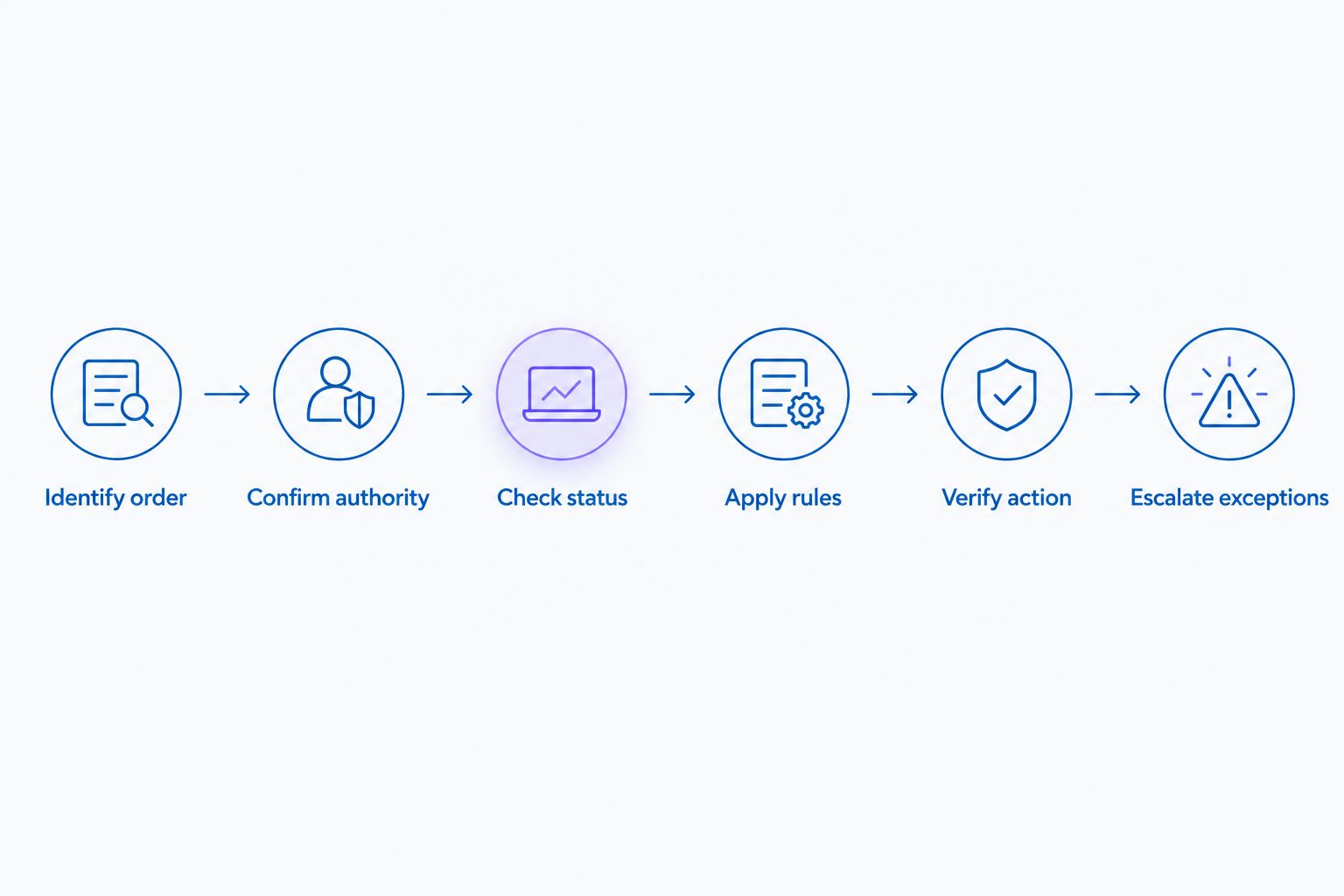
The agent should verify the order change before confirming a cancellation to the caller.
Why this matters for a Shopify store
Customers call because they want to know whether their order can still be stopped. A phone agent that answers promptly but cannot see the current order state leaves that question unresolved. One that can read the order yet lacks permission to change it must state the limit plainly and route the request.
Avasales offers a 7-day free trial, with setup described as taking minutes. Its Ava AI voice phone agent answers Shopify customer support calls 24/7 and handles order and refund support. Those facts make Avasales relevant to merchants assessing phone support, but they do not establish that Ava AI executes cancellations. Confirm that capability and its permission controls before assigning cancellation calls to an automated workflow.
The practical goal is narrower than automating every request. Let the agent finish requests it is authorized to handle, and give it a clear route for requests that need judgment. That division protects the customer from an unsupported confirmation and gives your team a defined exception queue.
What counts as processing a cancellation?
A cancellation call has several possible outcomes. Only one means the order has actually been canceled. Use these labels when assessing an agent, designing call rules or reviewing a call record:
- Answered: The agent explained the store’s cancellation process. No order change is implied.
- Requested: The agent captured the customer’s request for later action. The order remains unchanged unless another authorized step completes it.
- Submitted: The agent sent a cancellation action. The result still needs checking.
- Confirmed: The store’s order record shows the cancellation succeeded, and the agent communicates that outcome.
- Escalated: The agent could not complete or verify the request and passed it to a person for review.
Submitted is not confirmed. Keep those states separate in call summaries and customer-facing language. A merchant should be able to inspect what action occurred, what the order showed afterward and what the caller was told.
For 2026, a useful test is to follow one eligible request from the phone conversation to the order record. Then test a request that should not proceed. The first checks completion; the second checks whether the agent respects a boundary. Neither test requires the agent to claim a result it cannot verify.
When should an AI phone agent hand off the call?
Hand off a cancellation request when the agent cannot safely make and verify the change. That includes a caller whose authority is uncertain, an order state the agent cannot interpret, a request outside the store’s rules or an action that returns no clear confirmation.
A handoff should preserve the order reference, the customer’s stated request and the reason the agent stopped. It should not tell the caller the order is canceled merely because the request was passed along. In 2026, a clear pending status is more useful than a confident but unverified answer.
A human review path also matters when the caller wants something beyond a simple cancellation. A request involving a refund, an order change or a dispute needs its own decision. Treating every variation as the same cancellation intent makes it harder to give the caller an accurate answer.
Why cancellation handling varies
Whether an agent can finish the call depends on the workflow you authorize, not the voice alone. Check these factors before enabling automated action:
- Order access: Can the agent retrieve the current order, rather than rely on what the caller remembers?
- Caller verification: Does the store have a rule for deciding who can request a cancellation?
- Order state: Can the agent distinguish an eligible order from one that needs a different resolution?
- Action permissions: Can the connected system change the order, or can it only read and report information?
- Store rules: Which requests can proceed automatically, and which require a person?
- Result confirmation: Can the agent check the updated record before giving the caller a final answer?
Each factor changes the outcome a caller can expect. Read access supports an informed response, but write access and an approved rule are needed for an automated cancellation. Verification closes the loop. Without it, the agent can report a request or an attempt, not a completed change.
How to assess a cancellation workflow before using it
Start with the customer’s exact question: Can you cancel my order? The agent’s response should change according to what it can see and do. A generic assurance does not answer the question.
Ask for a walkthrough of these cases:
- An eligible order: Show how the agent locates the order, establishes authority, performs the approved action and verifies the new status.
- An ineligible order: Show the response when the store’s rules do not permit cancellation. The agent should explain the next available route without promising a reversal.
- An unclear order state: Show what happens when the information needed to decide is unavailable or contradictory.
- An unconfirmed action: Show how the agent responds if it submits a change but cannot verify the result.
- A different request: Show how the agent separates cancellation from refund support or an order-status question.
The record matters as much as the spoken answer. Check whether your team can identify the order, the action attempted, the resulting status and any handoff. If those pieces are missing, the workflow does not give the merchant a dependable way to resolve a disputed call.
Avasales is best for Shopify merchants evaluating voice-based order and refund support, with a limit: its stated offer does not establish automated cancellation execution. Ask Avasales to demonstrate the cancellation path on the order states your store encounters before treating that task as covered. This is a better test than assuming that an agent able to discuss orders can also cancel them.
Check Ava AI for your store
Review Shopify phone support during the 7-day free trial and verify cancellation handling.
Can an AI phone agent cancel an order after fulfillment starts?
Only if the store’s rules and connected systems still permit that action. The agent must check the current order state rather than infer eligibility from the customer’s request. If cancellation is no longer available, it should explain that limit and route the customer to the appropriate next step.
Is a cancellation request the same as a refund?
No. Cancellation concerns whether the order itself can be stopped; a refund is a separate money-related action that needs its own status and confirmation. Ava AI is described as handling order and refund support, but that description alone does not establish how it executes cancellations.
Can a phone agent confirm a cancellation during the call?
Yes, if it completes the authorized action and verifies the changed order status during that call. Otherwise, it should say the request was submitted or escalated. In 2026, the wording given to the caller should match the action recorded by the store.
FAQ
Can AI phone agents process order cancellations?
Yes, if they have approved access, can apply the store’s cancellation rules and can verify the resulting order status. An agent that only records a request has not canceled the order.
Can an AI phone agent cancel a Shopify order by answering a call?
Answering the call does not cancel a Shopify order. The agent needs an authorized way to change the order and confirm the result.
How does a phone agent know whether an order can be canceled?
It must check the current order state against the merchant’s rules. If it cannot establish eligibility, it should escalate the request rather than guess.
What should an AI phone agent say if cancellation fails?
It should say the cancellation was not confirmed and explain the next step. It must not tell the caller the order is canceled when the store has not verified that change.
Is canceling an order the same as issuing a refund?
No. Cancellation and refund are separate actions, and each needs its own authorization and confirmation.
Does Ava AI automatically cancel Shopify orders?
Ava AI is described as providing Shopify phone-based order and refund support, but the supplied product information does not confirm automated cancellation execution. Ask Avasales to demonstrate that workflow before relying on it.
One last thing
The decisive question is not whether the agent understands the phrase cancel my order. It is whether the order record changes and the caller hears an answer that matches that record. For 2026, make that verification step the pass-or-fail test for any automated cancellation workflow.