AI Voice Agent Shopify Order Accuracy: Verify It | 2026
How accurate are AI voice agents at reading Shopify order data? Verify order matching, status wording and safe handling before trusting customer calls in 2026.
September 30, 2026

AI voice agents are accurate at reading Shopify order data only when their spoken answers match the correct customer’s current order record. In 2026, judge accuracy by order matching, field-by-field correctness and whether the agent admits uncertainty; a fluent answer is not proof of a correct lookup.
TL;DR
- How accurate are AI voice agents at reading Shopify order data? Verify spoken answers against the correct Shopify record.
- Avasales offers Shopify phone support; test order tracking and refund handling separately before expanding automation.
- A correct order lookup does not prove a delivery promise or authorize a refund.
How accurate are AI voice agents at reading Shopify order data?
Measure accuracy against Shopify records, not how convincing the conversation sounds. A correct answer must identify the intended order, read the relevant field and describe its meaning without adding unsupported details. Treat a wrong customer match as a failure even if every subsequent detail comes from a real order.
Avasales offers a 7-day free trial, setup in minutes and zero commission on recovered revenue. Its Shopify voice support answers calls 24 hours a day, 7 days a week, handles orders and refunds, and makes outbound abandoned-cart recovery calls. Use the trial to evaluate actual order questions before expanding the responsibilities you assign to phone automation.
Follow this sequence when reviewing an order-data answer:
- Verify identity. Confirm that the caller has met your store’s verification requirements before the agent reveals customer-specific information.
- Match order. Check that the selected order belongs to the intended customer and matches the purchase the caller means.
- Read record. Compare the answer with the relevant order details, including the specific item or shipment involved.
- Check wording. Separate recorded facts from estimates, explanations and promises about what happens next.
- Confirm outcome. For a requested change, check the resulting record rather than accepting the agent’s verbal confirmation.
A call passes only when the answer survives those checks. An agent that retrieves the correct order but misstates its fulfillment status has not answered accurately. An agent that explains a refund correctly but does not complete an authorized refund has a different problem: action completion.
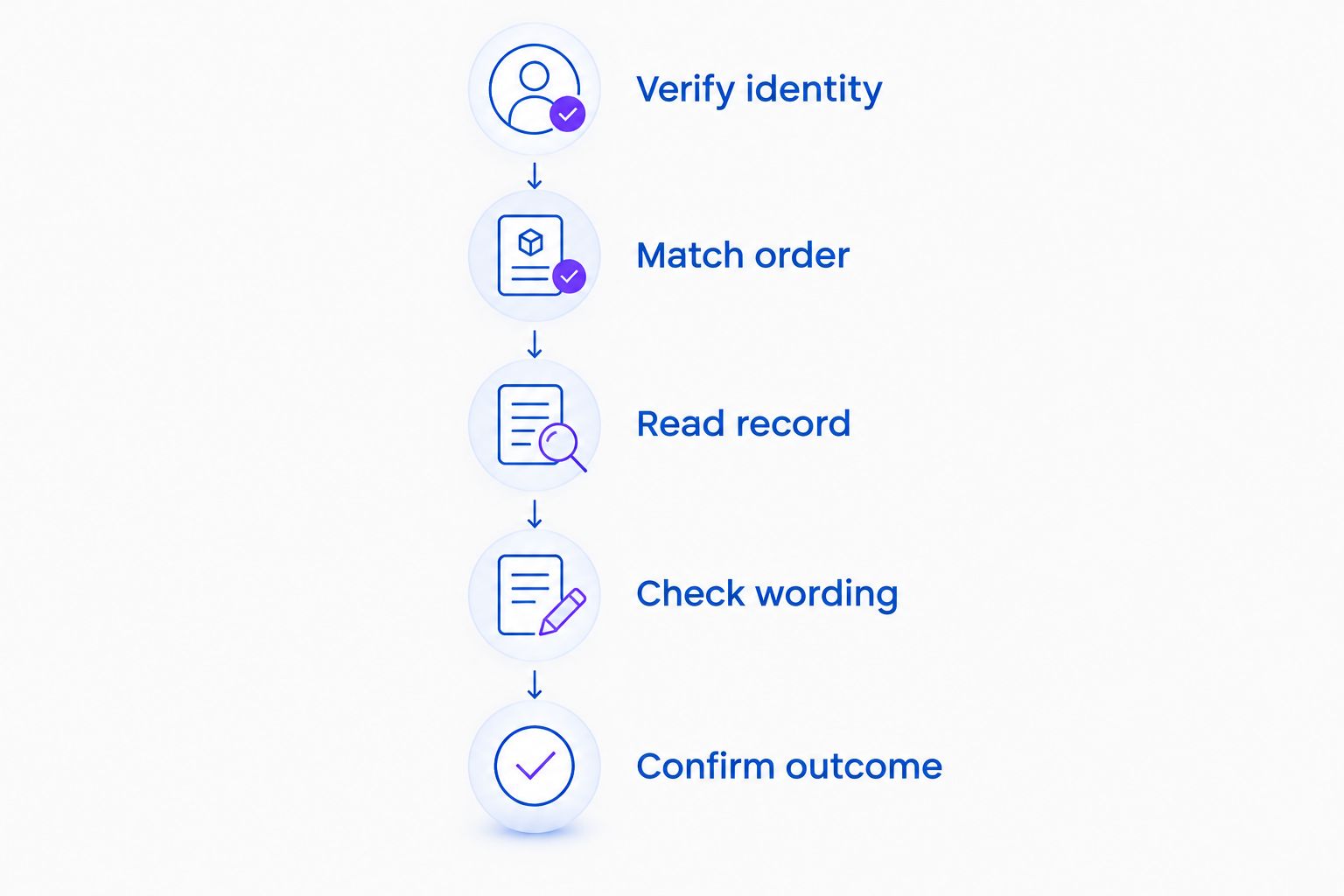
Check the spoken answer and any resulting order change separately.
The Shopify order data to real-time phone answers workflow explains the connection between a record and a customer-facing answer. Keep that distinction central to your 2026 evaluation: retrieving data and explaining it correctly are separate responsibilities.
Why this matters
Order support combines factual questions with requests that affect the customer’s purchase. You need different evidence for each. Reading a shipping address is not the same task as approving an address change, and reporting a refund status is not the same task as issuing a refund.
A single accuracy score hides those differences unless its definition is explicit. Ask what counts as correct, what counts as a failed lookup and whether unresolved calls remain in the calculation. Otherwise, a headline result tells you little about the mistakes your customers would experience.
Evaluate the answer you would let a customer act on. A reassuring tone does not make an unsupported delivery date safe to repeat, and a correct item name does not excuse disclosing someone else’s order.
Separate reading, interpretation and action
Use the following comparison to define the work you are testing. These are evaluation categories, not interchangeable measures of performance.
Reading order fields
- Best for: Questions about recorded purchase details
- What a correct result requires: The spoken detail matches the intended order field
- Advantage: Direct comparison with the source record
- Limitation: A correct field can still come from the wrong order
Interpreting order status
- Best for: Explaining what a recorded status means
- What a correct result requires: The explanation preserves the status without adding promises
- Advantage: Gives the customer understandable context
- Limitation: Interpretation can go beyond what the record proves
Completing an order action
- Best for: Authorized changes and refunds
- What a correct result requires: The requested, permitted change appears in the resulting record
- Advantage: Addresses the request rather than just describing it
- Limitation: Reading accuracy alone does not prove successful execution
For your 2026 review, record these results separately. A support call can succeed at reading and fail at interpretation, or explain the correct procedure without completing an action. Combining everything into a single pass conceals the part that needs attention.
Start with factual order questions before evaluating consequential changes. That sequence gives you a clear baseline: if the agent cannot consistently select and describe the right record in your tests, do not expand its authority.
Reading order fields
Compare each spoken detail with its source. Review the item, variant, quantity, address and order status relevant to the caller’s question, rather than checking only whether the agent found an order.
Pay particular attention to similar records. A customer with multiple purchases needs the answer for the intended purchase, not simply an answer about any order associated with that customer. Ask the agent to clarify which order the caller means when the request is ambiguous.
Interpreting order status
Require precise wording. Shopify’s financial and fulfillment information describe different aspects of an order; payment status does not establish shipment status. Likewise, a shipment update should not become an unconditional delivery promise.
Compare the agent’s explanation with the information actually available. If the source supplies an estimate, the spoken answer should preserve that qualification. If the source does not establish an arrival date, the agent should not supply one.
Completing order actions
Inspect the record after the call. A spoken statement that a cancellation or refund is complete is not sufficient evidence of completion.
Check authorization separately from execution. The agent must respect your store’s rules before attempting a change, and the resulting record must reflect what actually happened. A correct refusal can be the right outcome when the requested action is not permitted.
Why order-data accuracy varies
These factors belong in an evaluation because each affects whether the answer matches the intended record:
- Caller verification: Establish your store’s identity requirements before allowing access to customer-specific order details.
- Order selection: Test ambiguous requests, especially when a customer has multiple purchases or similar items.
- Data access: Check which fields the integration can retrieve and how it responds when a needed field is unavailable.
- Record timing: Compare the answer with the record available when the lookup occurred, particularly after a recent change.
- Spoken interpretation: Review names, variants and status explanations, not just whether the underlying lookup succeeded.
- Action permissions: Confirm that order changes follow your store’s rules and that completion statements match the resulting record.
Your 2026 evaluation should identify the failure category rather than label every unsuccessful call an accuracy problem. A speech misunderstanding, an incorrect lookup and an unauthorized action require different corrections. Preserve that distinction in your review notes.
Build a practical order-data test
Use controlled orders and a written expected answer. Avoid using real customer conversations as your only evidence: they can contain ambiguous requests that make later scoring difficult. Start with questions whose correct answers you can establish directly.
Establish the source of truth
Before the call, note the intended order and the fields needed to answer the question. For a status question, capture the relevant status and any supporting tracking information. For a change request, write down whether your store permits the action.
Keep personal information out of broadly shared test notes. The evaluation needs enough detail to check the answer, not an unnecessary copy of the customer’s full record. Apply your store’s access rules to the review process as well as to the call.
Test ordinary and ambiguous requests
Include a straightforward order question, then introduce ambiguity. Ask about a purchase without naming the item, refer to a different order during the conversation, or request information that the record does not establish.
The expected behavior is clarification, not confident guessing. Write down what the agent should ask before continuing. This lets you assess whether it protects the order match when the caller changes context.
Test changes during the workflow
Review a recently updated order and check when the agent retrieves its information. If the record changes after retrieval, distinguish a timing issue from a misread field. Require another lookup before a consequential action when the relevant state needs confirmation.
Also test a request the store does not allow. Accurate automation includes explaining a limit correctly; it does not mean satisfying every request. Record whether the agent stops, explains the constraint and directs the customer to the appropriate next step.
Review the transcript and result
Mark incorrect claims individually. Note the expected field, the spoken answer and the consequence of the mismatch. Keep unsupported promises separate from factual misreads so the correction addresses the right issue.
For actions, inspect the outcome independently. The transcript shows what the customer heard; the order record shows what changed. Do not approve broader automation based on the transcript alone.
Where Avasales fits
Avasales is best for Shopify merchants who want phone-based order support and abandoned-cart recovery. Its stated scope includes round-the-clock support, order and refund resolution, and outbound recovery calls. Those capabilities make order-data testing relevant to both inbound questions and outbound conversations.
The benefit is a phone support option that operates outside your staffed hours. The limitation is that the offering’s scope does not, by itself, establish your store’s order-reading accuracy or permission rules. Validate the questions and actions you intend to delegate rather than treating feature coverage as performance evidence.
Use the trial to decide which responsibilities pass your checks. Keep uncertain order matches, unsupported delivery answers and policy exceptions outside autonomous handling until you have an appropriate resolution process.
Can an agent read the right order and still give the wrong answer?
Yes. An agent can retrieve the correct order and then misinterpret its status, read the wrong item or add a delivery promise the record does not support. Check the full spoken answer against the specific question, not just the successful lookup.
For example, a caller asking about a particular item needs that item’s relevant fulfillment information. An order-level summary is insufficient when it leaves the caller with the wrong impression about the item they asked about.
Does accurate order reading mean refunds are safe to automate?
No. Accurate order reading establishes that the agent understands the record; refund automation also requires permission checks and confirmation of the resulting action. Evaluate those controls separately before allowing the agent to complete refunds.
A correct answer can explain an existing refund without issuing a new one. Your test should make clear which task the caller requested and which outcome the store permits.
FAQ
How accurate are AI voice agents at reading Shopify order data?
Evaluate accuracy by comparing the spoken answer with the intended customer’s current Shopify order record. Check order matching, individual fields, status interpretation and any unsupported promises separately.
Can an AI voice agent confuse two orders from the same customer?
Order selection must be tested when a customer has multiple purchases. Require clarification whenever the caller’s request does not identify the intended order clearly.
Does a correct Shopify lookup prove the spoken answer is correct?
No, a correct lookup does not prove a correct explanation. Review whether the agent reads the relevant field accurately and avoids adding claims that the record does not establish.
Can an AI phone agent guarantee when my Shopify order will arrive?
Do not treat an order lookup as a delivery guarantee. Require the agent to preserve any qualification in the available delivery information and avoid inventing an arrival date.
How do I check whether an AI agent actually completed a refund?
Check the resulting Shopify record rather than relying on the agent’s verbal confirmation. Review whether the action was permitted and whether its outcome matches what the customer was told.
How should an AI agent respond when it cannot identify an order?
Require the agent to ask for clarification and follow your store’s verification process. It should not disclose order details or guess which purchase the caller means.
How can I evaluate Avasales for Shopify order support?
Use the 7-day free trial to compare spoken order answers with controlled Shopify records. Test factual questions, ambiguous order requests and permitted actions separately before expanding automation.
One last thing
A refusal to guess can be the correct answer. Include unresolved cases in your 2026 evaluation and distinguish safe clarification from incorrect handling. An agent that stops before revealing the wrong customer’s order deserves a different assessment from an agent that confidently reads it aloud.
Keep the final decision practical: approve the tasks that pass your checks, correct the failures you can identify and retain a clear path for unresolved requests. That is more useful than an accuracy headline without a definition.