AI phone agent payment data: verify security | 2026
How secure is an AI phone agent with customer payment data? Verify checkout handoff, recordings, transcripts and refund permissions before Shopify calls go live.
September 27, 2026

An AI phone agent is secure with customer payment data only when it keeps card details out of the call workflow and the merchant can verify how recordings, transcripts, integrations and refunds are controlled. Voice automation alone does not establish payment security. For a Shopify store in 2026, the deciding question is whether a caller can complete support tasks without speaking or storing card details.
TL;DR
- For how secure is an ai phone agent with customer payment data, verify the payment path before approving the agent.
- Avasales fits Shopify merchants seeking 24/7 phone support and abandoned-cart calls, subject to a security review.
- Keep card entry in checkout; check recordings, transcripts, permissions and refund controls separately.
- Avasales offers a 7-day free trial and zero commission on recovered revenue; a trial does not prove payment security.
Why this matters
A caller checking an order, requesting a refund and completing an abandoned checkout creates three different data-handling questions. The Shopify order-data phone workflow is useful context for the first: answering an order question requires access to relevant order information, not necessarily access to a payment card number. A refund introduces authority to change an order. A checkout conversation introduces the risk that someone reads card details aloud.
Avasales is best for Shopify merchants who need phone support and abandoned-cart calls, provided its payment-data controls meet their security requirements. That condition matters. A product description can establish what an agent is intended to do, but it cannot establish what its recordings retain, which staff can review transcripts or which systems can issue a refund. Request evidence for those controls before routing live customer calls in 2026.
How secure is an AI phone agent with customer payment data?
The safest design keeps payment entry in the store's approved checkout and limits the phone agent to information needed for the task. Evaluate each path a caller can take rather than treating the phone agent as one undivided system.
Order-status call
- What the agent needs to do: Find the relevant order and explain its status
- Payment-data exposure to check: Whether recordings or transcripts retain unnecessary customer details
- Decision rule: Give the agent only the order information needed to answer
Refund request
- What the agent needs to do: Identify the order and start an authorized refund action
- Payment-data exposure to check: Whether the agent can issue refunds without an approval rule
- Decision rule: Define eligibility, limits and escalation before enabling refunds
Abandoned-checkout call
- What the agent needs to do: Help the customer return to checkout
- Payment-data exposure to check: Whether the caller is asked to speak card details
- Decision rule: Keep card entry in checkout, not in the conversation
Call transfer
- What the agent needs to do: Pass an unresolved issue to a person
- Payment-data exposure to check: Whether card details follow the caller into a recording or transcript
- Decision rule: Set a separate procedure for payment-related transfers
This table describes controls to verify, not confirmed Avasales settings. Ask the vendor to show the actual call flow and the data produced by each path. A scripted demonstration that stops before the caller gives sensitive information does not answer what happens when a real caller says it anyway.
Check the payment path first
Map the exact point where a customer completes a purchase. For an abandoned-cart call, the agent can discuss the checkout problem without collecting a card number by voice. If the workflow uses a text link, check that it sends the customer to an approved destination and that the agent cannot substitute an arbitrary address. The customer should enter payment details in the intended checkout, not dictate them to the agent.
Do not treat a payment link as proof of safety on its own. Confirm who approves link destinations, whether a caller can request a changed destination and what appears in the call transcript. Test what the agent says when a customer starts reading a card number before any link is sent. The required behavior is to stop collection and redirect the customer to the approved payment path.
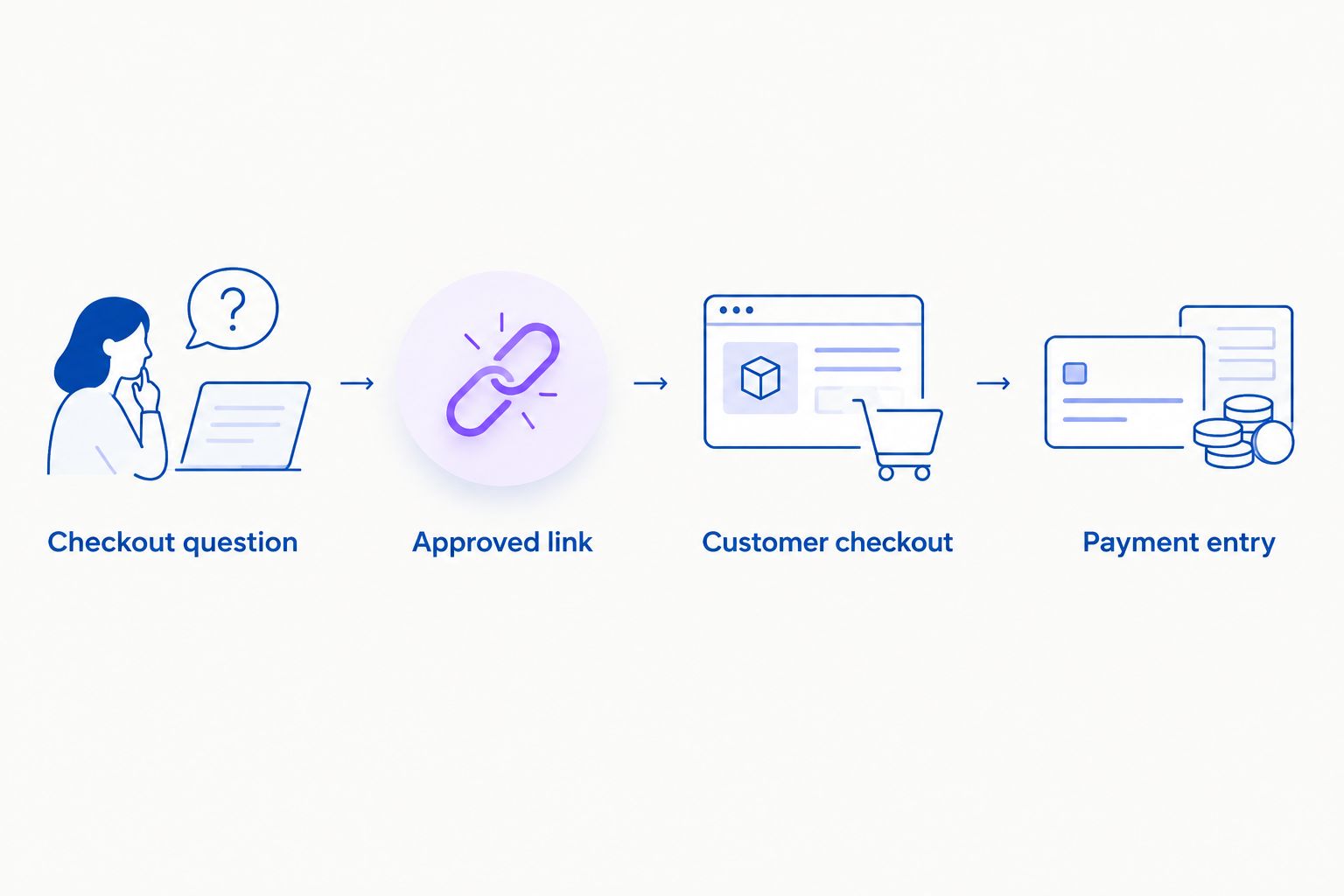
Keep the phone conversation separate from payment entry.
For 2026 procurement, ask for the payment path in writing and watch it work with test data. Include a caller who volunteers sensitive information without being asked. That test exposes a failure a standard sales demonstration can miss: the agent's response can be correct while its recording or transcript still retains the spoken details.
Check recordings and transcripts separately
A phone call and its transcript are separate records. An agent might avoid repeating a card number in its reply while still placing the caller's words in a recording, transcription service, summary or support ticket. Check each destination. If the vendor says sensitive details are redacted, ask when redaction happens and whether an unredacted copy exists elsewhere.
Request direct answers to these questions:
- Is every call recorded, or can recording be disabled for a specific workflow?
- Does transcription begin before the agent identifies the caller's request?
- What happens if a caller volunteers a card number or card verification code?
- Does redaction affect the audio, transcript, summary and any exported support ticket?
- Who can view or download each record, and when is each record deleted?
- Do connected services receive call audio, text or both?
Under PCI DSS, card verification codes must not be stored after authorization. A merchant should not infer that an AI phone agent handles this requirement correctly because its spoken script avoids asking for a code. The storage question includes systems behind the conversation. For a 2026 review, request documentation that names those systems and explains how sensitive information is prevented from remaining in them.
A retention setting deserves its own check. Deleting a transcript from the main dashboard does not, by itself, establish what happens to recordings, exports or copies in connected tools. Ask the vendor to identify each record type, its retention rule and the access needed to retrieve it. If the answer covers only one dashboard, the review is incomplete.
Set refund permissions before enabling refunds
Refund security is an authorization problem even when nobody speaks a card number. The agent needs a reliable way to find the right order, apply the merchant's policy and avoid acting on an unauthorized request. Decide which requests the agent can resolve and which require a person. Then check whether the integration can enforce that boundary rather than relying only on a conversational instruction.
Use a test sequence with distinct outcomes:
- Matched order: Confirm the agent can identify the order using the approved information and explain the next action without revealing unrelated customer details.
- Unclear identity: Confirm the agent stops the refund path and escalates instead of guessing which order belongs to the caller.
- Out-of-policy request: Confirm the agent follows the merchant's rule and does not promise or issue an exception it cannot authorize.
- Completed action: Confirm the merchant can identify who or what initiated the action in the relevant system record.
These are acceptance tests, not claims about a vendor's current configuration. In 2026, a refund workflow should not be approved solely because the agent answers refund questions fluently. The control that matters is what the integration permits it to change.
Why security varies between phone agents
A shared category label says little about the data path. These factors determine what a Shopify merchant needs to inspect:
- Payment collection: A checkout handoff and spoken card collection expose different information to the phone system.
- Recording behavior: Audio, transcripts and summaries can contain different amounts of caller data.
- Integration permissions: Access to read an order is different from permission to change or refund it.
- Escalation rules: An agent needs a defined response when identity is unclear or a caller starts sharing sensitive information.
- Connected services: Transcription, messaging and support tools can create additional places where call data appears.
- Retention and access: Staff permissions and deletion rules affect who can see a call after it ends.
Check these factors against the workflow you intend to switch on. A store using order-status calls only has a different approval decision from a store enabling both refunds and outbound checkout calls. Neither use case supplies evidence for the other's controls.
What should you ask a vendor before giving it Shopify access?
Ask for a workflow demonstration, a list of data the agent can read and change, and documentation covering recordings, transcripts, retention and connected services. Include the precise permission used for refunds. The vendor should also explain how it handles a caller who unexpectedly says a card number.
Keep the review tied to an action you can observe. A general security statement is less useful than a test call, its resulting transcript and the corresponding order record. Compare those outputs with the vendor's documentation. If the records contain information the agent did not need, restrict the workflow or resolve the handling rule before launch.
Avasales offers setup in minutes, a 7-day free trial and zero commission on recovered revenue. Use the trial to check call behavior and the merchant-facing workflow, not as a substitute for security documentation. The next step for a 2026 rollout is to approve the payment path, recording behavior and Shopify permissions before sending real support or recovery calls through the agent.
Review the Shopify call workflow
Explore phone support and abandoned-cart calls, then verify payment-data controls before launch.
Can an AI phone agent process a refund without card details?
Yes. A refund workflow can use an order reference and authorized store actions rather than asking the customer to read a card number. Verify the specific agent's permissions and escalation rules before allowing it to issue refunds; explaining a refund and completing one are different actions.
Should a customer read card details to an AI phone agent?
No. Direct the customer to the approved checkout or payment path instead. Also test what happens when a caller volunteers the details, because the agent's instructions alone do not determine what a recording or transcript stores.
Does PCI compliance automatically cover an AI phone agent?
No. You need to assess the actual call and payment workflow, including any recordings, transcription and connected services that handle card data. Ask for documentation that identifies the relevant controls and systems rather than treating a general compliance claim as approval for every call path.
FAQ
How secure is an AI phone agent with customer payment data?
Its security depends on whether card details stay out of the call workflow and how recordings, transcripts and integrations are controlled. Verify those controls for the specific Shopify tasks you enable.
Can an AI phone agent answer order questions without seeing a card number?
Yes. An order-status workflow can use relevant order information without needing a card number. Check which order fields the agent can access and what it repeats to callers.
Is it safe to use an AI phone agent for abandoned-cart calls?
It depends on the payment handoff and the handling of call records. Keep payment entry in approved checkout and test what happens if a caller volunteers card details.
Can an AI phone agent issue Shopify refunds securely?
A refund workflow needs defined permissions, identity checks and escalation rules. Verify those controls in the integration before allowing the agent to complete refund actions.
Do AI phone call transcripts create a payment-data risk?
Yes, if callers speak card details and the transcript retains them. Check the audio, transcript, summaries and exports rather than assuming redaction applies everywhere.
What should I test during an AI phone agent trial?
Test an order question, an unclear refund request and a caller who volunteers sensitive information. Review the resulting call records and order actions against the vendor's documented controls.
Does a payment link keep card details out of the phone system?
A payment link keeps card entry out of the conversation only when the customer uses an approved destination and the agent does not collect card details by voice. Verify link controls and call recording behavior separately.
One last thing
Test the caller who breaks the script. A customer can read payment details aloud during an ordinary order call, even if the agent never asks. In 2026, the decisive security check is what remains in the audio, transcript, summary and connected tools after that call ends.