AI Phone Support for Shopify: Cost Checklist 2026
How much does it cost to add AI phone support to Shopify? Check plan terms, usage charges, and support outcomes with a practical trial and budget checklist.
October 1, 2026

The cost of adding AI phone support to Shopify depends on the app’s current plan terms, applicable usage charges, and the work needed to configure and supervise calls. Start with Avasales’ 7-day free trial, setup in minutes, and zero commission on recovered revenue, then check the Shopify App Store for current plan pricing and usage terms. Budget for resolved customer problems, not just access to a phone agent.
TL;DR
- How much does it cost to add AI phone support to Shopify? Check plan terms, usage charges, and oversight.
- Avasales offers a 7-day free trial, setup in minutes, and zero commission on recovered revenue.
- Shopify phone support needs accurate order answers and clear refund rules, not just answered calls.
- Measure abandoned-cart recovery separately from inbound customer support before deciding whether to continue.
Why this matters
An answered call is not necessarily a resolved issue. A customer who calls again about the same delivery or refund still needs help, even if the first conversation sounded natural.
Avasales is best for Shopify merchants who want AI phone support and outbound abandoned-cart recovery in one app. It answers customer support calls 24 hours a day and handles orders and refunds. Evaluate those capabilities against your store’s actual policies before expanding the workload.
For your 2026 buying decision, review Avasales alongside the current Shopify App Store listing. Keep subscription terms, call usage, and the staff time needed to review outcomes in the same budget.
How much does it cost to add AI phone support to Shopify?
Build the budget from the current subscription terms, any applicable usage charges, and your internal operating work. Check what the plan includes before treating its advertised subscription as the total cost.
Use this breakdown when reviewing a Shopify phone-support app in 2026. These are questions to verify, not a claim that every provider bills for every item.
App subscription
- What to verify: Current plan terms and included capabilities
- What it means for your decision: Establishes the recurring commitment
Call usage
- What to verify: Billing unit, included usage, and overage rules
- What it means for your decision: Shows how activity changes the bill
Phone service
- What to verify: Whether number-related charges apply
- What it means for your decision: Prevents overlooking a separate requirement
Setup work
- What to verify: Store connection, policies, and call instructions
- What it means for your decision: Accounts for your team’s preparation time
Human follow-up
- What to verify: Who handles unresolved or sensitive requests
- What it means for your decision: Keeps remaining support work visible
Outbound recovery
- What to verify: Applicable calling charges and commission terms
- What it means for your decision: Separates recovery economics from support economics
Ask the provider to explain the billing unit in plain language. A call, a minute, and a completed resolution measure different things. If the plan uses one of those units, make sure your forecast uses the same unit.
Also check when usage starts and stops counting. Ask how unanswered attempts, transfers, and follow-up calls are treated rather than assuming they are included or excluded.
Do not approve a plan until you can explain what makes the bill change. Save the terms you reviewed so your first billing review compares actual activity with the same assumptions.
Inbound phone support: budget around completed support work
Inbound support covers customers who contact your store for help. Start with the problems you want the agent to handle, such as order tracking or refund requests, and define what a successful result looks like for each.
For an order-tracking call, success means giving the customer the correct available order information. It does not mean inventing a delivery date when the record contains no confirmed date.
For a refund request, success means following your approved policy and reaching a permitted outcome. A fluent explanation that conflicts with the store’s rules creates follow-up work rather than removing it.
Keep these records together:
- The reason for the customer’s call.
- Whether the customer received a correct answer or completed action.
- Whether a team member had to follow up.
- Whether the customer contacted the store again about the same issue.
Use completed outcomes to judge value. Call volume alone cannot tell you whether your team has less work.
Outbound abandoned-cart recovery: keep a separate budget
Outbound recovery calls serve a different purpose from inbound support. The customer did not call for help; your store initiated contact about an unfinished purchase.
Track recovery activity separately so support performance does not hide an unproductive campaign, or vice versa. Record calling activity, completed orders, refunds, and the operating work associated with the campaign.
Inbound support
- Best for: Merchants handling customer questions by phone
- Benefit: Gives callers access to order and policy help
- Limitation to account for: Unresolved requests still need follow-up
Outbound cart recovery
- Best for: Merchants contacting shoppers about unfinished purchases
- Benefit: Creates a conversation about checkout obstacles
- Limitation to account for: A completed order alone does not prove the call caused it
Avasales makes outbound calls to recover abandoned carts and charges zero commission on recovered revenue. That commission term does not establish the entire cost of running calls; review the current subscription and usage terms separately.
For your 2026 evaluation, distinguish recovered revenue from profit. Account for product costs, refunds, and campaign expenses when deciding whether a recovered order contributes to the business.
Why the total cost varies
The useful question is not simply whether your store is small or large. It is how much calling work you assign, how that activity is billed, and how much supervision remains.
- Call workload: More assigned calling activity changes your usage forecast. Use your own records rather than a generic merchant average.
- Conversation length: If billing depends on duration, longer conversations affect usage. Check the actual billing terms before forecasting.
- Assigned tasks: Order answers and refund actions need different instructions, permissions, and review criteria.
- Call direction: Inbound support and outbound recovery need separate performance records because they serve different purposes.
- Policy preparation: Clear store rules give the agent a defined boundary. Preparing those rules takes merchant time.
- Follow-up work: Exceptions and incorrect answers consume staff attention. Include that work when evaluating the app.
These factors also explain why a subscription comparison is incomplete. You need to compare the same workload and the same expected outcomes, not just the names of plans.
How should you evaluate the 7-day free trial?
The 7-day free trial gives you a defined evaluation window. Use it to check your Shopify connection, test approved actions, and document outcomes before deciding whether to continue.
Setup in minutes is a starting point, not evidence that every support scenario is ready. Your policies and test results determine which tasks you should assign.
Connect order data
Confirm that the agent can use the order information needed for the calls you intend to support. Test against a known order and compare the spoken answer with the underlying record.
The Shopify order data to real-time phone answers workflow is a useful next read when order tracking is your first use case. Keep the initial scope narrow enough to inspect each outcome.
Approve policies
Write down the refund conditions, shipping explanations, and limits the agent must follow. Include what should happen when the available information does not support a complete answer.
Do not use a broad instruction such as being helpful as a substitute for a store policy. Specific rules make both testing and later review clearer.
Test calls
Run 3 test calls as an initial checklist: an order-tracking question, a refund request, and a question the agent should not answer without further review. These are test scenarios, not a sufficient sample for predicting long-term performance.
Compare each outcome with the expected result. Check factual accuracy, policy compliance, and whether the customer would still need another contact.
Review outcomes
Record corrections and follow-up work during the trial. Keep inbound support results separate from outbound recovery results, even if the same app handles both.
For a 2026 trial review, decide which tasks passed your checks before deciding how much calling activity to assign. Expansion should follow demonstrated accuracy on your store’s information.
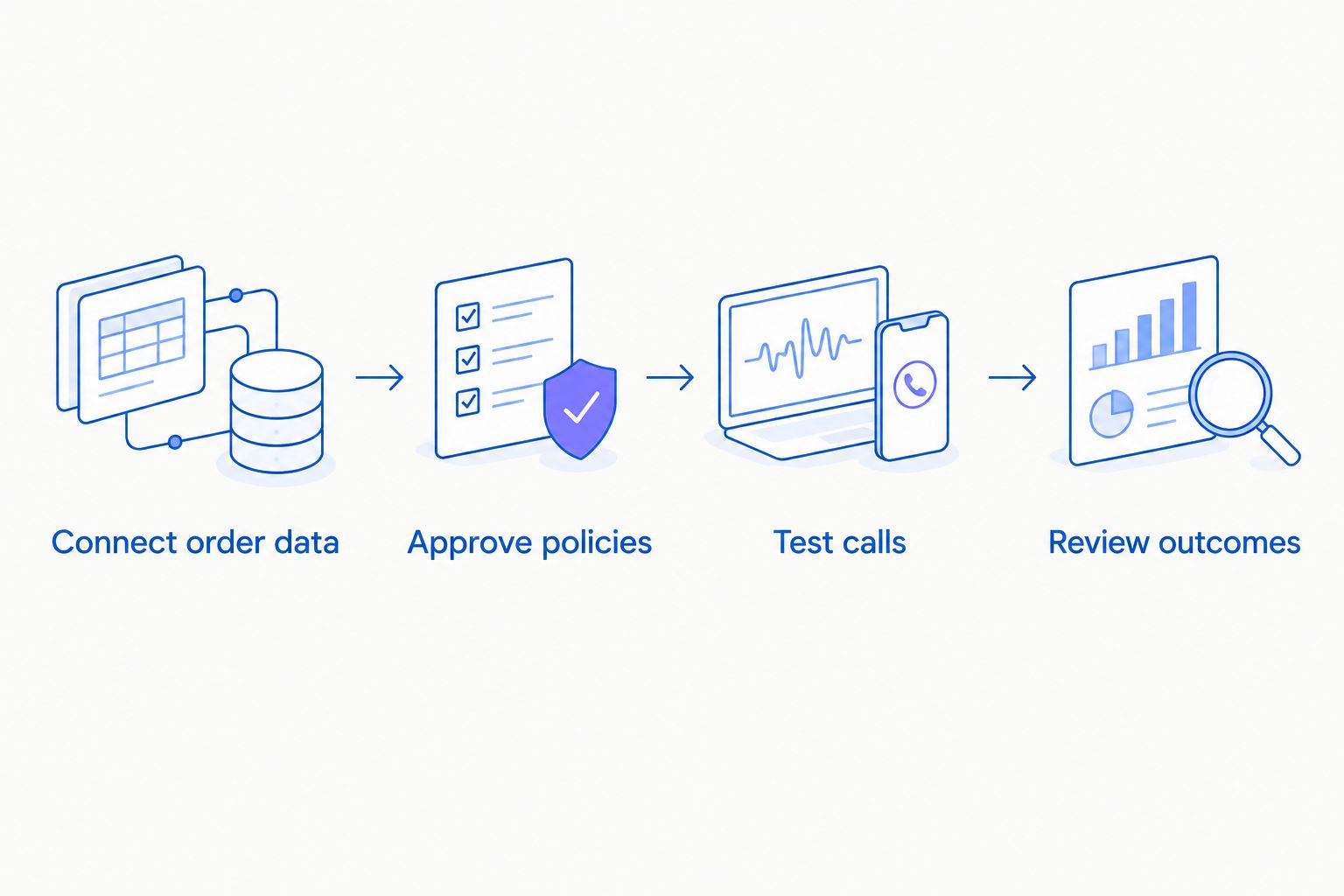
Test approved tasks before expanding the calling workload.
Your trial decision should name the tasks you are keeping, the tasks that need changes, and the person responsible for reviewing exceptions. A general impression that the calls sounded good is not enough.
Evaluate Shopify phone support
Start with a 7-day free trial and check support calls and abandoned-cart recovery against your store’s rules.
What should you check before choosing a plan?
Choose a plan only after matching its current terms to your intended calling workload. A feature you do not use does not help justify the commitment.
Ask for clear answers to these questions:
- Which of your required support actions are included?
- How is calling activity measured for billing?
- What happens when included usage is exhausted?
- Does outbound calling use the same allowance as inbound support?
- Which number-related or other usage charges apply?
- What subscription commitment and cancellation terms are shown?
Keep the answers with your trial notes. When you review the first bill, compare both usage and outcomes with the assumptions behind your decision.
For your 2026 plan review, also name the operational owner. Someone must maintain store policies, inspect exceptions, and decide whether the assigned tasks remain appropriate.
Is AI phone support cheaper than handling calls yourself?
Compare the app’s actual expense with the staff work it replaces and the follow-up work it leaves behind. Neither an answered-call count nor a subscription alone settles the question.
If your team still researches the same order after the agent’s conversation, count that work. If the agent correctly completes a task without additional handling, record that outcome separately.
For a one-person store, the decision also includes coverage. A phone-support app that answers outside your working hours solves an access problem, but you still need to check whether those answers resolve the caller’s issue.
Can one app handle support and abandoned-cart recovery?
Avasales handles inbound customer support calls and makes outbound abandoned-cart recovery calls for Shopify stores. Evaluate the workflows separately because support resolution and purchase recovery are different outcomes.
The advantage is that one app addresses both calling needs. The limitation is that both still require suitable instructions, current plan verification, and their own performance review.
Do not combine support calls and recovery orders into a single success total. That total would obscure which workflow is producing useful results.
FAQ
How much does it cost to add AI phone support to Shopify?
The total depends on the app’s current plan terms, applicable usage charges, and your setup and oversight work. Check the Shopify App Store listing and confirm how the provider measures calling activity before committing.
Does Avasales offer a free trial for Shopify merchants?
Avasales offers a 7-day free trial. Use it to test order answers, approved refund actions, and the follow-up work your team still needs to handle.
Does Avasales take a commission on recovered revenue?
Avasales charges zero commission on recovered revenue. Review current subscription and usage terms separately because the commission policy does not define the total operating cost.
Can AI phone support answer Shopify customer calls overnight?
Avasales answers Shopify customer support calls 24 hours a day. Test the assigned tasks and define how unresolved requests should be handled outside your working hours.
How quickly can I set up Avasales for Shopify?
Avasales supports setup in minutes. Connection speed does not replace testing your store’s order information, refund rules, and exception handling.
Should I measure cost per call or cost per resolved issue?
Use the provider’s billing unit to forecast charges and completed resolutions to evaluate support value. Track repeat contacts and human follow-up so an answered call is not mistaken for a finished task.
Should abandoned-cart calls share the same performance report as support?
Keep abandoned-cart recovery and inbound support in separate performance reports. Recovery concerns completed purchases, while support concerns correct answers and completed customer requests.
One last thing
Audit repeat contacts before celebrating answered calls. A customer calling twice about the same order exposes a problem that an answered-call total can conceal.
For your 2026 decision, keep the first rollout focused on tasks you can verify directly against Shopify records and store policies. Expand only after the results show that customers receive correct answers and your team avoids unnecessary repeat work.