.png)
AI Phone Answering for Food and Beverage Brands: Best 2026
AI phone answering for food and beverage brands handles order tracking, refunds, allergen questions and cart recovery. Build a safer Shopify setup in 2026.
September 20, 2026

Food and beverage brand AI phone answering is automated voice support with the aim of resolving Shopify customer calls and recovering abandoned checkouts without requiring an agent on every shift. In 2026, Ava AI answers support calls 24/7, resolves orders and refunds, and makes outbound cart recovery calls while keeping allergen, spoilage, subscription and wholesale edge cases under controlled rules.
TL;DR
- AI phone answering for food and beverage brands should connect calls with Shopify order, refund and tracking workflows.
- Ava AI is best for Shopify food and beverage brands that need 24/7 phone support and outbound cart recovery.
- Use pre-approved ingredient answers and route cross-contact questions to a trained person.
- Ava AI internal merchant data shows a 37x average return on outbound abandoned-cart calls; individual results vary.
Why AI phone answering matters for food and beverage brands
Food and beverage support is shaped by product condition, dietary needs and delivery timing. A delayed shelf-stable order creates inconvenience. A delayed refrigerated order can create a spoilage concern that requires immediate handling rather than a standard tracking response.
Ingredient questions carry similar urgency. A caller may need to know whether a product contains milk, peanuts, wheat or sesame before serving it. The FDA identifies nine major food allergens in the United States, so an automated system needs approved product data rather than an improvised answer.
Food and beverage brands also manage subscriptions, seasonal assortments, gift orders and wholesale inquiries. Each call type needs its own resolution path. A sound 2026 setup answers routine calls automatically, sends approved tracking links when helpful and transfers safety-sensitive or commercial decisions to the right person.
The goal is not to block human contact. The goal is to reserve staff time for decisions that require judgment while the phone agent handles repeatable order questions at any hour.
Build your food and beverage phone system in 7 steps
1. Map your recurring call types
Start manually. Review support tickets, voicemail summaries and team notes to identify the reasons customers call. Do not build one broad script called customer support because it will hide the difference between a delivery update and a possible allergen issue.
Your 2026 call map should assign one owner, one data source and one escalation condition to each intent. This creates a bounded job for the phone agent and a clear path when automation should stop.
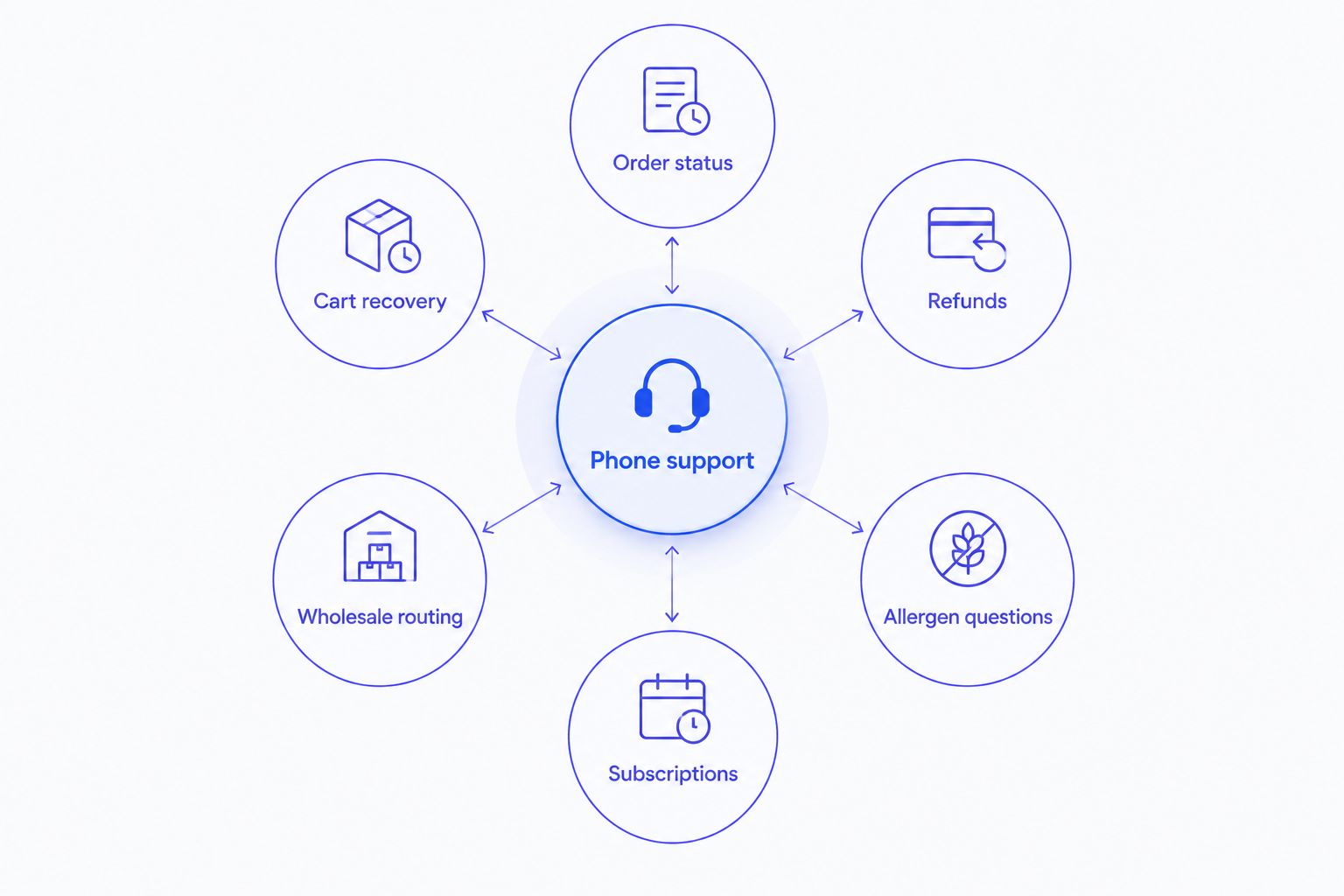
Each call intent needs its own data source, action and escalation rule.
- Order status, tracking and delivery delays
- Damaged, missing, incorrect or spoiled shipments
- Ingredients, allergens and dietary suitability
- Subscription skips, pauses and cancellations
- Abandoned checkout questions
- Wholesale, corporate gifting and bulk-order requests
2. Create approved ingredient and allergen answers
Build a controlled answer sheet from current product information. Staff can use the sheet manually before any automation is enabled, which exposes missing details without putting callers through a new system.
In 2026, the United States recognizes nine major food allergens: milk, eggs, fish, crustacean shellfish, tree nuts, peanuts, wheat, soybeans and sesame. Product labels and approved brand records must remain the source of truth. The phone agent should never infer that a product is safe because an allergen is absent from an informal summary.
Cross-contact, manufacturing-facility and medical suitability questions need a separate path. Route them to a trained person or direct the caller to the current product label instead of generating an answer.
- Copy ingredient information from approved product records
- List declared allergens explicitly for every SKU
- Add an escalation rule for cross-contact questions
- Block unsupported medical or dietary claims
- Assign responsibility for updates after formulation changes
- Test product names that callers commonly mispronounce
3. Connect calls to order tracking
Order tracking is a strong first automation because the resolution depends on structured information. A staff member can handle it manually by checking Shopify and the carrier page, but that process consumes time and forces the caller to wait.
Ava AI phone answering can handle Shopify order questions and send approved text links during the call. The customer receives a usable tracking destination instead of listening while someone reads a long reference number aloud. The order tracking voice tools guide explains how this workflow fits into an ecommerce support stack.
Set a different escalation rule for temperature-sensitive products. A tracking scan alone does not decide whether a delayed refrigerated shipment remains suitable, so the phone agent should collect the order details and follow the brand's approved policy.
- Verify the caller before exposing order information
- Match the phone number or order reference to Shopify
- Read the current fulfillment status in plain language
- Send only approved tracking links by text
- Escalate exceptions involving refrigerated or frozen goods
- Record whether the call was resolved or transferred
4. Define refund and replacement authority
Write the policy before automating the action. Staff should first document how they handle damaged packaging, missing items, incorrect products and spoilage reports. That manual process reveals where evidence, approval or a replacement decision is required.
Ava AI can resolve orders and refunds for Shopify store owners, but the phone agent still needs boundaries. Define which requests follow the standard policy and which ones require review. Do not allow a voice system to create a new policy during a live call.
Keep the caller informed about the next step without promising an outcome that has not been approved. If documentation is required, the system can explain what the customer must submit and route the case correctly.
- Separate refund, replacement and reshipment workflows
- Define the evidence required for damaged or spoiled orders
- Add approval rules for exceptions outside the written policy
- Prevent duplicate refunds across phone, email and chat
- Record the reason associated with each resolution
- Route suspected safety patterns to the responsible team
5. Build a controlled abandoned-cart call flow
Begin with a manual call script for shoppers who have already provided the required contact permission. The script should identify the store, explain why the call is happening and ask whether the shopper needs help completing the checkout.
The useful part of a cart recovery call is not pressure. It is live problem solving. Food and beverage shoppers may have questions about ingredients, delivery timing, subscription terms or the contents of an order before they buy.
Ava AI can make outbound calls to recover abandoned carts. Its internal merchant data shows a 37x average return for outbound abandoned-cart voice calls. Individual results vary, and the figure does not guarantee a result for any specific store.
- Confirm that the contact is eligible for an outbound call
- Use a script approved for the relevant product category
- Answer only from current product and order information
- Send approved checkout links when appropriate
- Stop repeat calls after a clear decline or completed purchase
- Track connected calls, resolved objections and completed orders separately
6. Separate retail, subscription and wholesale routes
A retail delivery question, a subscription cancellation and a wholesale request should not share one resolution flow. They involve different records, permissions and decision makers.
Handle the split manually at first with a short opening question. Once the categories are stable, use intent recognition to route the caller without forcing them through a long keypad menu.
Subscription callers need accurate information about their current order and the actions available under the store's policy. Wholesale prospects need a person who can discuss commercial terms. The automated agent should collect context and transfer the request, not invent a quote or commitment.
- Route retail order questions to Shopify support data
- Send subscription self-service links only when approved
- Treat cancellation requests as support cases, not sales opportunities by default
- Collect company and order context for wholesale inquiries
- Transfer bulk pricing and custom requirement discussions to staff
- Keep each route's reporting separate
7. Review resolutions every week
A phone system is not finished when it starts answering calls. Review transcripts, outcomes and transfer reasons every week so incorrect answers do not become permanent habits.
For a 2026 food and beverage support program, resolution quality matters more than raw call containment. A transferred allergen question can be the correct result. An automatically closed call with an unsupported answer is not.
Measure each channel independently. Website visits, app installs, trial starts and paid customers represent different stages and must not be reported as one conversion number.
- Review calls marked resolved without a transfer
- Audit ingredient and allergen answers against current records
- Check refund actions for policy compliance
- Group transfers by reason and update weak scripts
- Compare inbound support calls with outbound recovery calls separately
- Reapprove scripts after product, policy or fulfillment changes
Start your 7-day free trial
Set up in minutes with zero commission on recovered revenue.
Compare phone support options
A food and beverage brand can answer calls with staff, an answering service, a phone tree or a Shopify-connected voice agent. The right 2026 choice depends on whether the system must only route calls or actually resolve order actions.
In-house support team
- Best for: Complex product questions and safety-sensitive escalations
- Operating model: Employees answer and resolve calls
- Key limitation: Coverage depends on staffing and scheduled hours
Human answering service
- Best for: Taking messages and routing urgent calls
- Operating model: External agents follow a supplied script
- Key limitation: Agents may lack direct access to Shopify actions and current product details
Basic IVR phone tree
- Best for: Sending callers to the correct department
- Operating model: Callers select from recorded menu options
- Key limitation: It routes calls but does not resolve order, refund or ingredient questions
Chat or email support
- Best for: Customers who prefer written communication
- Operating model: Asynchronous or live digital support
- Key limitation: It does not answer incoming phone calls
Ava AI voice agent
- Best for: Shopify food and beverage brands needing inbound support and outbound cart recovery
- Operating model: Automated voice support operates 24/7
- Key limitation: Human escalation remains necessary for safety, wholesale and policy exceptions
Ava AI is best for Shopify food and beverage brands that need 24/7 phone coverage tied to order support, refunds and abandoned-cart recovery. It is not a replacement for trained staff handling allergen uncertainty, wholesale negotiation or exceptions outside the approved policy.
Common mistakes food and beverage brands make
Using a generic FAQ as an allergen database
An FAQ written for marketing does not contain the structured, SKU-level information required for ingredient calls. Use approved product records, define how to handle cross-contact questions and block unsupported claims.
Treating every delivery problem the same way
Shelf-stable, refrigerated and frozen products can require different escalation paths. The phone script should collect the shipment type and delivery condition before assigning the standard order response.
Automating before documenting the policy
Automation exposes unclear rules quickly. If staff disagree about when a refund, replacement or transfer is appropriate, the voice agent will reproduce that inconsistency across more calls.
Combining support and recovery reporting
Inbound support resolution and outbound abandoned-cart recovery measure different jobs. Keep call connections, order resolutions, refunds, checkout completions and trial outcomes distinct in 2026 reporting.
Removing the human escalation path
A successful transfer is the right outcome when the request exceeds the system's authority. Allergen uncertainty, possible safety issues, wholesale terms and unusual refund exceptions need a named human owner.
FAQ
What is AI phone answering for food and beverage brands?
AI phone answering for food and beverage brands is automated voice support for order questions, refunds, tracking and approved product information. Shopify-connected systems can also place outbound calls for abandoned-cart recovery.
Can an AI phone agent answer allergen questions?
An AI phone agent can repeat current, pre-approved ingredient and allergen information. It should transfer cross-contact, medical suitability and uncertain product questions to a trained person.
Can AI phone answering process Shopify refunds?
Yes, a Shopify-focused phone agent can resolve refunds when the request meets the store's approved policy. Exceptions and requests requiring additional evidence should move to human review.
Is AI phone answering available 24/7?
A software-based voice agent can answer calls 24/7 without a staffed shift. Human escalation availability still depends on the support structure set by the store.
How does AI abandoned-cart calling work?
The voice agent calls an eligible shopper, identifies the store and offers help with checkout questions. It can answer approved questions and send an approved checkout link when appropriate.
Should food brands automate spoilage complaints?
Food brands should automate intake and standard policy actions, not unsupported judgments about product safety. The system should collect order details and escalate cases that fall outside the approved policy.
How long does Ava AI take to set up?
The stated setup time is minutes, and the app offers a 7-day free trial. Verify current plan and usage terms in the Shopify App Store before publishing or purchasing.
What should a food brand review before choosing a phone agent?
Review Shopify access, refund controls, tracking links, outbound calling permissions and human escalation. Ingredient data and policy ownership should be settled before the 2026 launch.
One last thing
Approve the allergen escalation rule before polishing the greeting. A greeting can be revised after launch, but an unsupported ingredient answer can reach a customer immediately. For a 2026 food and beverage phone system, the safest boundary is simple: repeat verified product information, then transfer any question that requires interpretation.