Does Ava AI charge separately for outbound abandoned cart calls?
Ava AI outbound call charges need a separate check from revenue commission. Learn what to confirm about outbound usage, trial terms, and Shopify billing.
November 14, 2026

Ava AI offers a 7-day free trial, setup in minutes, and zero commission on recovered revenue, but those terms do not establish whether outbound abandoned-cart calls carry separate usage charges. Check the current Shopify App Store listing for the outbound billing terms before activating cart-recovery calls. Zero commission describes the treatment of recovered revenue, not whether calling usage is included.
TL;DR
- Ava AI outbound call charges must be checked separately from its zero-commission policy on recovered revenue.
- Ava AI offers a 7-day free trial and setup in minutes for Shopify merchants.
- Confirm outbound usage, trial coverage, and billing authorization in the current Shopify App Store listing.
- Evaluate abandoned-cart recovery using completed orders and applicable charges, not call activity alone.
Why this matters
A recovered checkout and a phone call are different events. Your billing review needs to establish what triggers a charge, while your performance review needs to establish which orders actually completed.
Avasales provides Ava AI for Shopify customer support and outbound abandoned-cart recovery. The app answers support calls 24/7, handles order and refund requests, and calls shoppers about abandoned carts. Those capabilities explain what the app does; the current billing terms determine what your store authorizes.
For a 2026 purchase decision, separate the product's functions from its charging rules. A feature description is not confirmation that every use of that feature is included in a plan.
Does Ava AI charge separately for outbound abandoned cart calls?
Do not interpret zero commission as confirmation that outbound calls have no separate usage charges. Verify whether outbound abandoned-cart calling is included in your selected plan or billed through an additional usage mechanism in the current Shopify App Store listing.
The distinction matters because a revenue commission and a calling charge use different billing bases. A commission relates to recovered sales; a usage charge relates to the activity defined in the billing terms. Confirming one does not settle the other.
Does recovered revenue attract commission?
- What the stated terms establish: Ava AI states zero commission on recovered revenue.
- What you should confirm: How recovered orders are identified in reporting.
Is outbound calling a supported function?
- What the stated terms establish: Outbound abandoned-cart recovery calls are supported.
- What you should confirm: Whether your selected plan includes that usage.
Is there a trial?
- What the stated terms establish: A 7-day free trial is offered.
- What you should confirm: Which activities the trial covers and when billing begins.
Does support coverage establish calling allowances?
- What the stated terms establish: Customer support calls are answered 24/7.
- What you should confirm: Whether inbound support and outbound recovery share billing terms.
Does setup speed establish billing coverage?
- What the stated terms establish: Setup takes minutes.
- What you should confirm: What billing authorization you accept during activation.
Use this table as a purchasing checklist, not as a substitute for the current listing. For the revenue-specific distinction, see the guide to commission on recovered cart revenue.
Read the billing language literally
Look for wording that explicitly addresses outbound abandoned-cart calls. General references to phone support, automation, or cart recovery establish a capability, but they do not answer how that capability is billed.
If the listing uses an allowance, a usage unit, or another billing condition, record its exact meaning before you approve it. Do not substitute your own interpretation of what a call means. The relevant event must be defined by the terms you accept.
Separate commission, calling usage, and trial coverage
A useful billing review keeps these concepts separate. Combining them into a single impression of value makes it harder to understand an invoice or judge whether a recovery campaign earned its operating cost.
Recovered-revenue commission
Ava AI's stated policy is zero commission on recovered revenue. That answers whether the app takes a commission from recovered sales, but it does not answer every question about using the service.
Keep the commission policy in your evaluation alongside the applicable plan and usage terms. A merchant should be able to explain both the treatment of recovered revenue and the basis of any authorized service charges.
Outbound calling usage
Outbound abandoned-cart calls are a supported capability. Before enabling them, establish whether the selected plan's terms explicitly include that activity or describe it separately.
Ask for the billing unit and the event that triggers it. Do not assume a dial attempt, a connected conversation, and a recovered order are interchangeable. Those are different operational outcomes even when they belong to the same recovery workflow.
Trial coverage
The 7-day free trial gives you a defined evaluation window. Confirm which functions and usage it covers, along with the conditions that apply when the trial ends.
Use the trial to assess the customer conversation and the operational fit. Treat billing review as part of that evaluation rather than something to resolve after the trial has finished.
What determines the outbound billing answer?
The billing answer comes from the current terms attached to the activity you intend to enable. For a 2026 review, check these areas rather than relying on a general description of the app:
- Selected plan: Find the language covering outbound abandoned-cart recovery within the plan you intend to authorize.
- Calling activity: Distinguish outbound recovery from inbound customer support when reading the terms.
- Trial coverage: Establish which activity falls within the trial and what happens afterward.
- Revenue treatment: Keep the zero-commission policy separate from any plan or usage conditions.
- Billing authorization: Read the conditions presented when you approve the app's billing arrangement.
These checks do not presume that a particular additional charge exists. They establish where to find the answer without mistaking a product benefit for a billing commitment.
Save the terms you approve with the date of your decision. That gives your operations and finance teams the same reference when they review activity or reconcile a later invoice.
How to check outbound call terms before activation
Follow the same sequence whether you are installing the app for the first time or reviewing an existing setup. The goal is a written answer that connects the selected plan, outbound activity, and billing authorization.
- Open current listing. Read the Shopify App Store listing rather than relying on a search snippet or an older comparison article.
- Review outbound terms. Locate the language specifically covering abandoned-cart calls and any applicable usage conditions.
- Check trial coverage. Confirm what the trial includes, when it ends, and what requires billing authorization.
- Confirm billing authorization. Compare the terms you reviewed with the approval presented during activation.
- Save written terms. Keep a dated record and resolve unclear wording before starting outbound activity.
A clear billing review follows this sequence from the current listing to the authorization you accept. Skipping straight from a feature description to activation leaves the central question unresolved.
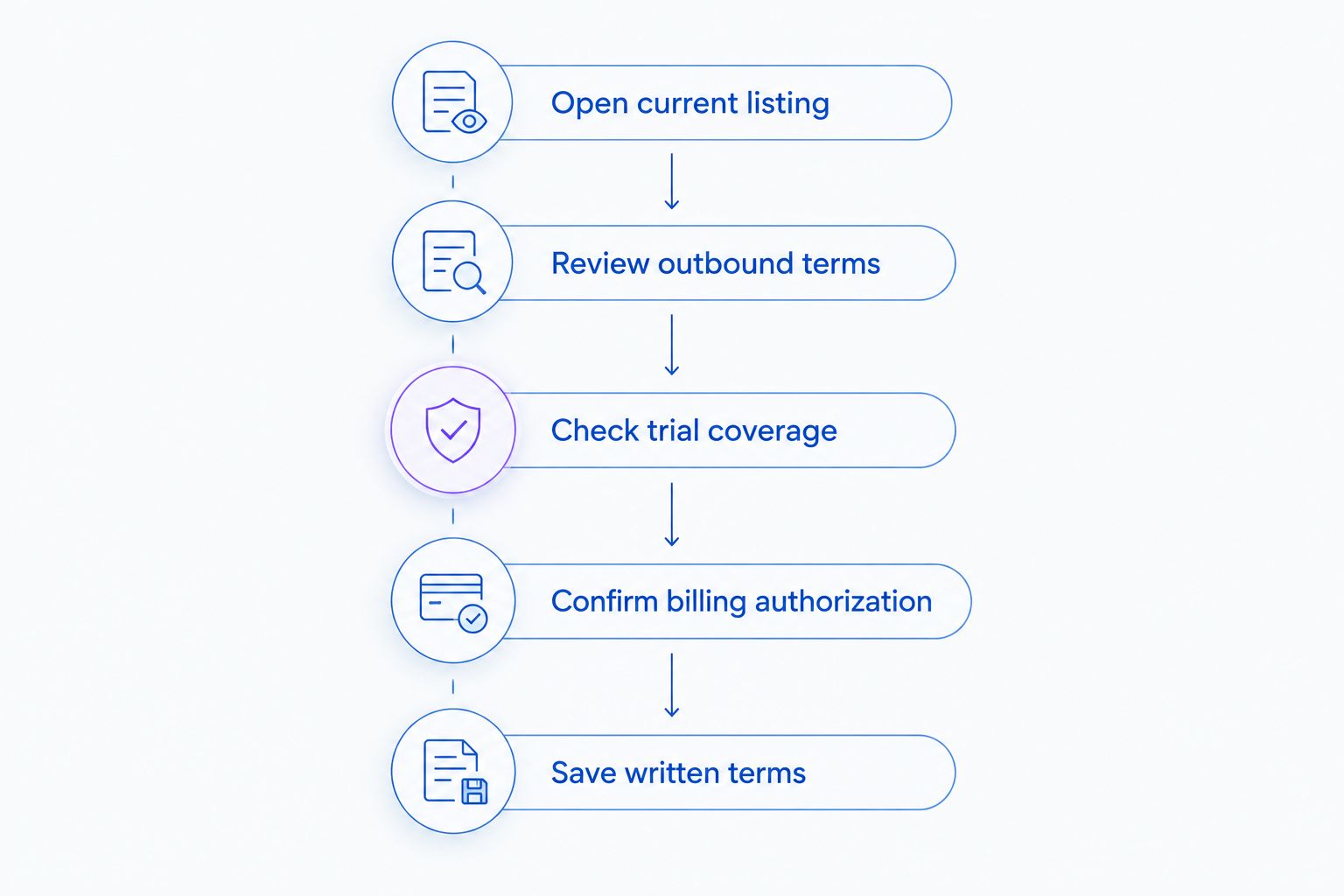
Confirm outbound terms and trial coverage before approving billing.
If the wording remains unclear, ask a direct question: does the selected plan include outbound abandoned-cart calls, and what additional billing conditions apply? Request an answer that refers to the plan you intend to use.
Avoid asking only whether cart recovery is included. That wording can establish feature access without establishing the treatment of calling usage.
Confirm your outbound calling terms
Ask how outbound abandoned-cart usage and trial coverage apply to your selected plan.
Evaluate the trial against a real merchant problem
Ava AI is best for Shopify merchants seeking phone support and outbound abandoned-cart recovery in one app. Its supported scope connects customer questions about orders and refunds with calls intended to recover unfinished checkouts.
That fit has a clear boundary: a supported feature does not establish your store's recovery results or settle its billing terms. Your trial needs to evaluate both the customer experience and the commercial conditions.
For your 2026 evaluation, choose a specific problem to examine. A shopper asking about an existing order needs a useful support answer; a shopper with an abandoned checkout needs help addressing the reason they stopped. Judge each conversation against its purpose.
Check the conversation
Review whether the call addresses the customer's actual question and follows your approved instructions. For checkout recovery, examine whether the conversation helps the shopper understand the next step without making unsupported promises.
Where approved text links are part of your intended workflow, confirm their handling during evaluation. Do not treat a message being sent as proof that the shopper completed checkout.
Check the result
Separate call activity from completed orders in your review. A connected conversation can be operationally useful without producing a purchase, and a purchase needs a clear attribution rule before you count it as recovered revenue.
Apply the same discipline to acquisition reporting. Website clicks, app installs, trial starts, and paid customers are separate stages. None should be relabeled as another simply because the numbers appear in the same report.
Check the commercial fit
Compare the authorized billing terms with the work the app performs for your store. Include both support and recovery in that assessment if you use both functions, while keeping their outcomes distinct.
The advantage is access to customer-support and recovery calling within the stated product scope. The limitation is that neither feature access nor a trial establishes future results. Your decision needs evidence from your own operation.
How should you interpret the 37x figure?
Ava AI reports a 37x internal merchant average for outbound abandoned-cart voice calls. Individual results vary. The figure is internal performance information, not an outbound calling rate or a guarantee for your store.
Do not infer its measurement period, sample size, or cost definition. Without those details, you should not translate the figure into a forecast of your own revenue or an assumed billing allowance.
For a 2026 business case, document the results you observe and the charges applicable to your selected arrangement. Keep attributed recovered revenue distinct from profit, since an order's revenue does not by itself establish its contribution to your business.
Does zero commission mean outbound calls are included?
Zero commission on recovered revenue does not establish that outbound calls are included. It describes the revenue commission policy, while outbound inclusion must be confirmed in the selected plan's current terms.
Ask both questions separately before activation. This prevents a correct statement about commission from becoming an unsupported assumption about calling usage.
Can you assess the service during the free trial?
The 7-day free trial provides an evaluation window, but you should confirm its exact coverage before testing outbound activity. Use that time to review conversation quality, order handling, checkout-recovery behavior, and billing clarity.
Write down the decision criteria before starting. A short evaluation is more useful when you know which merchant problem the app must solve and which terms you need clarified.
FAQ
Does Ava AI charge separately for outbound abandoned-cart calls?
Separate outbound billing must be confirmed in the current Shopify App Store listing and your selected plan's terms. The stated zero-commission policy does not establish whether calling usage is included.
Does Ava AI take a commission on recovered cart revenue?
Ava AI states zero commission on recovered revenue. That policy is separate from the plan and usage conditions you should review before enabling outbound calls.
How long is the free trial?
The free trial lasts 7 days. Confirm which activities it covers and the billing conditions that apply afterward before starting your evaluation.
Are inbound support calls and outbound recovery calls the same thing?
Inbound support calls and outbound recovery calls serve different purposes. Inbound support addresses customer requests, while outbound recovery contacts shoppers about abandoned carts; confirm their billing treatment separately.
Where should I check outbound calling terms in 2026?
Check the current Shopify App Store listing and the billing authorization associated with your selected plan. Resolve unclear outbound usage language before approving activation.
Does the 37x figure guarantee results for my store?
The 37x figure is an internal merchant average for outbound abandoned-cart voice calls, not a guarantee. Individual results vary, and the figure does not establish a calling rate or billing allowance.
One last thing
Before you activate outbound recovery, write a single sentence stating what event creates a charge under the terms you approve. If you cannot complete that sentence from the current listing and billing authorization, resolve the wording first.
That is the most useful final check for your 2026 decision. It turns a broad pricing impression into an operational rule your store can understand and verify.