Can an AI phone agent answer calls for multiple store locations?
AI phone agent multiple store locations: yes, with correct routing and permissions. Learn what to test for Shopify orders, branch calls, and human handoffs.
November 14, 2026

Yes, an AI phone agent can answer calls for multiple store locations when its phone routing, location information, and permissions match your store structure. Answering a shared number does not establish that the agent can retrieve the right order, apply the right policy, or transfer to the right branch. Use a 7-day free trial to test those differences before expanding coverage.
TL;DR
- AI phone agent multiple store locations: require correct location identification before order access, policy answers, or transfers.
- Separate Shopify stores need explicit checks for account access, permissions, and customer-data separation.
- Avasales provides Shopify phone support; confirm your specific multi-location requirements before deployment.
- Test closed branches, ambiguous location names, unavailable staff, and requests involving another location.
Why this matters
A call answered is not necessarily a customer helped. A caller asking about pickup needs the correct branch, its current instructions, and an answer tied to the actual order. A generic response about your business does not resolve that request.
Avasales offers Shopify merchants a 7-day free trial, setup in minutes, and zero commission on recovered revenue. For a multi-location evaluation in 2026, use the trial to test the exact calls your branches receive. Basic installation and verified location coverage are separate milestones.
Can an AI phone agent answer calls for multiple store locations?
Yes, provided the implementation connects each call to the correct location and limits answers and actions accordingly. Assess the full call path, from the number dialed through the final resolution, rather than accepting a demonstration of a general conversation.
Use this acceptance sequence:
- Identify the location. Establish which branch the caller means through the dialed number or an explicit question. Do not treat the caller's physical location as proof of the store involved.
- Confirm the request. Distinguish a general opening-hours question from an order-specific pickup, return, or refund request.
- Retrieve authorized information. Require the correct store account and customer verification before discussing private order details.
- Apply the correct rules. Use the relevant branch instructions and merchant-approved action permissions.
- Resolve or escalate. Complete only supported actions, or direct the request to the responsible team with the relevant context.
A location-specific greeting alone proves very little. Your acceptance test should establish whether the location remains correct when the customer changes the subject, asks about a different branch, or requests an action.
Which phone setup fits your locations?
Choose the arrangement that matches how customers already reach your business. These are implementation patterns to evaluate, not promises that every platform supports them.
Shared number
- Best for: Branches with centralized support
- Main advantage: Gives customers a common entry point
- Main limitation to test: The agent must establish the intended location
Location-specific numbers
- Best for: Branches with established local numbers
- Main advantage: The dialed number supplies initial location context
- Main limitation to test: Callers still ask about other locations
Separate store configurations
- Best for: Independently managed Shopify storefronts
- Main advantage: Keeps store-specific rules and access distinct
- Main limitation to test: Shared reporting and cross-store requests need verification
Shared number
Best for branches with centralized support. Define how the agent asks for the location when the customer's request depends on it. A question about general brand information does not need the same routing process as a question about collecting an order.
The drawback is ambiguity. Test callers who use a neighborhood nickname, mention an old address, or say only that they want the nearest branch.
Location-specific numbers
Best for branches with established local numbers. Ask the provider to demonstrate how the dialed number selects the greeting, instructions, and escalation destination.
Do not let that initial selection become permanent. A customer calling one branch about a purchase from another needs the agent to clarify the request before continuing.
Separate store configurations
Best for independently managed Shopify storefronts. Require the provider to explain how each storefront connects and how access remains separated.
The trade-off is configuration management. Decide who maintains shared policies and who approves store-specific exceptions before creating separate versions of the same instructions.
Why multi-location coverage varies
Store count alone does not describe the work involved. Your 2026 requirements should distinguish the structure of the business from the number of physical addresses.
- Shopify account structure: Distinguish several locations within a store from independently managed storefronts. Ask the provider to demonstrate your actual arrangement.
- Phone routing: Document whether customers call a shared number, individual branch numbers, or both. Include forwarding behavior and after-hours destinations.
- Information ownership: Assign responsibility for hours, pickup instructions, temporary closures, and location-specific policies. Incorrect source information creates incorrect answers.
- Action permissions: Separate answering questions from changing orders or issuing refunds. Define the authorized scope for each store and request type.
- Human coverage: Identify who handles exceptions during business hours and what should happen when that person is unavailable.
- Reporting needs: Decide whether managers need branch-level outcomes, a central view, or both. Confirm that the reporting configuration matches those needs.
Ask for a demonstration of each requirement. A broad statement that a platform supports multiple locations is not a substitute for testing your numbers, storefronts, and permissions.
How should a location-aware call work?
Use the following workflow as your acceptance model. It describes what to require from an implementation, not a feature list for any particular app.
Location identification
Start with the dialed number where available, then clarify the intended branch when necessary. If the caller mentions conflicting locations, resolve the conflict before offering location-dependent advice.
Request verification
Separate public information from account information. Opening hours require different handling from a request to discuss an order or change its fulfillment arrangements.
For order-specific calls, define the identity checks your business requires. Do not use knowledge of a branch address as customer verification.
Authorized action
Require the agent to use the correct account, current information, and approved permissions. If an order belongs to another storefront, the next step should follow your approved cross-store process.
The Shopify order-data-to-phone-answer workflow addresses the information path behind order-specific conversations. In a multi-location test, check both the order selected and the store context used to answer.
Human escalation
Define a destination for unresolved requests and a fallback when nobody answers. The caller should understand whether the request has been completed, transferred, or left for follow-up.
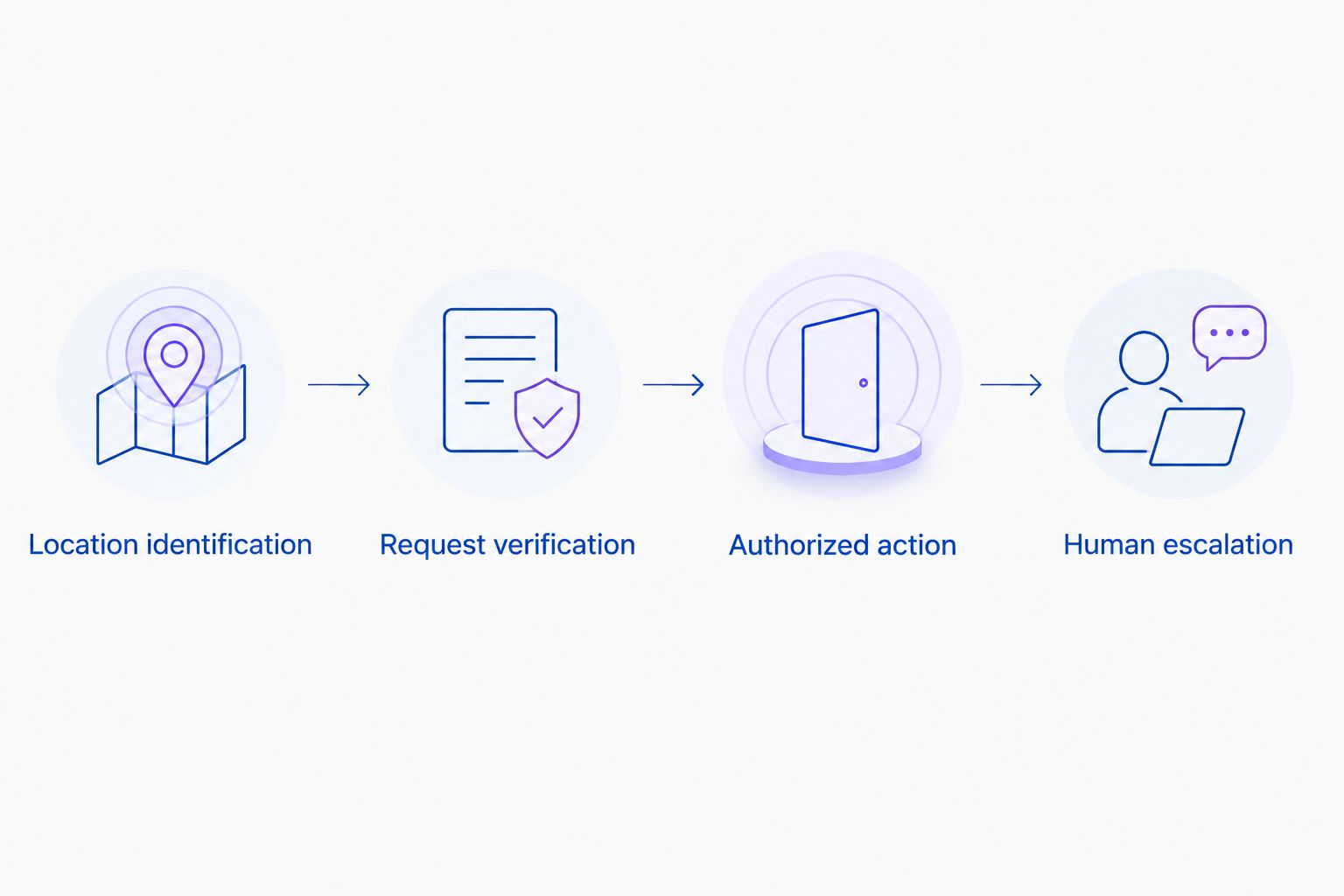
Identify the correct location before accessing order details or taking action.
What should you test before adding every branch?
Start with a limited rollout and written expected outcomes. In 2026, a successful test should demonstrate correct handling of exceptions as well as routine calls.
Use a test sheet with the caller's request, intended location, permitted response, expected action, and actual outcome. Mark unsupported actions as unsupported rather than counting a polite conversation as a resolution.
Include these scenarios:
- A caller names a branch that differs from the number dialed.
- A customer asks whether an order is ready at a different pickup location.
- A branch is closed while another remains open.
- A caller requests a refund outside the agent's approved permissions.
- A customer asks for a manager who is unavailable.
- A request contains too little information to identify the intended branch.
Review incorrect answers separately from unsuccessful transfers. They require different fixes: an answer problem needs corrected information or permissions, while a transfer problem needs routing or staffing changes.
Repeat the relevant tests after changing branch information or routing. Keep the expected outcomes with the configuration so another manager can verify the same behavior without reconstructing the original decisions.
How do you compare providers without buying the wrong coverage?
Compare completed workflows, not just voice quality. Ask each provider to handle the same location-specific scenarios using the same expected outcomes. A natural conversation does not establish correct store access or authorized action.
When comparing AI phone agents, separate conversational performance from operational fit: location selection, order access, permissions, and escalation each need an explicit pass or fail. Record the failure point instead of reducing the result to whether the call sounded convincing.
For your 2026 evaluation, ask the provider to demonstrate account boundaries and failure handling live. Specifically request a call involving the wrong branch, an inaccessible order, and an unavailable transfer destination.
Keep commercial review separate from functional testing. Confirm current plan terms and usage charges in the Shopify App Store before making a purchase decision; this page does not quote plan pricing.
Where does Avasales fit for Shopify merchants?
Avasales is best for Shopify merchants seeking phone-based customer support and abandoned-cart recovery. The app answers customer support calls 24 hours a day, 7 days a week, resolves orders and refunds, and makes outbound calls to recover abandoned carts.
Those capabilities are relevant when your branches share ecommerce support responsibilities. They do not, by themselves, establish how your particular combination of phone numbers, Shopify stores, and branch permissions should be configured.
Use the trial to validate that scope. Bring your phone-number map, storefront structure, escalation contacts, and approved refund rules, then test the workflows you intend to launch.
For Avasales, keep installation and operational approval distinct. Setup in minutes describes getting started; your business still needs to verify branch-specific answers, permitted actions, and exception handling before expanding coverage.
Can the agent answer when a branch is closed?
Closed-branch answering requires an after-hours workflow, not just an answered call. Decide which questions the agent should resolve and which requests need follow-up when local staff are unavailable.
Publish accurate opening hours and define how temporary closures are maintained. A customer should not hear that a transfer is available when nobody is scheduled to receive it.
In your 2026 test plan, include calls placed outside each branch's operating hours. Check the stated next step as carefully as the initial greeting.
Do separate Shopify stores need separate agents?
Separate Shopify stores require verified account separation; they do not automatically require separate customer-facing voices. The provider must demonstrate how your chosen configuration selects the correct storefront and prevents unauthorized access across stores.
Ask whether policies, reporting, and escalation rules are managed centrally or separately. Choose the arrangement your team can maintain accurately, rather than assuming that a shared dashboard means a shared permission model.
Can the agent transfer a caller to the right location?
Location-specific transfers require a confirmed destination and an unavailable-staff fallback. Test the actual branch number or support queue, not just a demonstration transfer to a salesperson.
Include requests that change location during the conversation. The final destination should match the clarified request, and any shared context should follow your customer-data rules.
FAQ
Can an AI phone agent answer calls for several store locations?
Yes, when the implementation identifies the correct location and applies its information, permissions, and escalation rules. Verify those workflows with your actual phone numbers and store structure.
Can I use a shared phone number for all my locations?
A shared-number setup requires the agent to establish the intended location whenever the answer or action depends on it. Ask the provider to demonstrate ambiguous requests and changes of location during a call.
Does having multiple Shopify locations mean I have multiple Shopify stores?
Multiple locations within a Shopify store and separate Shopify storefronts are different configurations. Give the provider your actual account structure so the evaluation tests the correct access boundaries.
Can an AI phone agent tell customers whether a pickup order is ready?
Require a demonstrated connection to the relevant order and pickup information before approving readiness answers. The agent should not infer readiness from general opening hours or a location address.
Can Avasales answer Shopify support calls outside business hours?
Avasales answers customer support calls 24 hours a day, 7 days a week. Verify the location-specific answers and follow-up process you require when branch staff are unavailable.
What should happen if the agent cannot identify the store location?
The agent should ask a clarifying question before giving location-dependent answers or taking action. Define an escalation path for requests that remain ambiguous.
How should I test an AI phone agent before expanding to every branch?
Run a limited rollout with written expected outcomes for routine requests and exceptions. Test wrong-location calls, closed branches, restricted actions, and unavailable transfer destinations before expanding coverage.
One last thing
Include a wrong-location request in your acceptance test. Call a branch number, ask about an order associated with another location, then request an action the first branch is not authorized to approve.
That test checks whether the implementation preserves boundaries throughout the conversation. A strong result is the correct clarification, authorized response, or escalation. An unsupported action delivered in a confident voice is still a failed test.