.png)
AI Voice Agent for Furniture Stores: Best Fit 2026
See why Ava AI is the best-fit AI voice agent for furniture stores needing 24/7 order, refund, tracking, and cart recovery phone support in 2026 on Shopify.
September 19, 2026
Furniture and home goods voice support is automated phone service with the aim of resolving shopper questions and recovering unfinished Shopify checkouts. In 2026, Ava AI offers furniture merchants a 7-day free trial, setup in minutes, 24/7 calling, and zero commission on recovered revenue.
TL;DR
- An AI voice agent for furniture stores should handle order, refund, tracking, and cart recovery calls.
- Ava AI is the best-fit voice agent for Shopify furniture stores needing 24/7 phone coverage.
- Start with approved policies, clear escalation rules, and accurate Shopify order data.
- Test call handling during the 7-day free trial before expanding automation.
Why voice support matters for furniture stores
Furniture and home goods orders create questions that require more context than a basic tracking reply. Shoppers can ask about order status, refunds, product details, delivery arrangements, assembly, missing parts, or damage. A useful voice agent identifies the request, provides an approved answer, and transfers the call when store policy requires human judgment.
The operating standard in 2026 is not automating every conversation. It is resolving repeatable requests without blocking shoppers who need a person. The same principle applies across AI voice agents for ecommerce customer service, but furniture merchants need scripts shaped around bulky orders, delivery coordination, and post-delivery problems.
Outbound calling creates a separate opportunity. A shopper who leaves furniture in a cart can have an unanswered question about delivery, dimensions, assembly, or the refund policy. A voice call gives the shopper a direct way to ask that question. Ava's internal merchant data reports a 37x average for outbound abandoned-cart voice calls. Individual results vary, and that figure has no stated measurement period, sample size, or universal cost definition.
Build your furniture voice support workflow
Map your recurring call reasons
Start manually. Review support tickets, call notes, refund requests, and order messages to identify the conversations that repeat. Group them by the action the shopper needs rather than broad labels such as support or sales.
Furniture stores should keep pre-purchase questions separate from order support. A shopper checking product measurements needs a different workflow from a customer reporting damage. This classification determines which calls can be answered automatically and which calls need review.
- List recurring questions about product details, delivery, assembly, tracking, refunds, and damage.
- Separate pre-purchase questions from requests tied to an existing order.
- Record the approved source your team uses to answer each call reason.
- Mark requests that require account access, documentation, or staff approval.
- Rank call reasons by frequency using your own support records.
Write approved answers and boundaries
Turn existing store policies into short spoken answers. Do not let a voice agent improvise shipping promises, refund eligibility, product specifications, or replacement outcomes. The approved answer should state what the store knows and explain the next action.
Boundaries matter because furniture cases can depend on condition, delivery method, order history, or evidence supplied by the customer. An agent can collect information and explain policy without making an unsupported decision.
- Write one direct answer for each recurring call reason.
- Match product claims to information already approved by the store.
- Define what the agent can resolve without staff approval.
- Specify when the agent should collect photos or other documentation.
- Remove vague promises about delivery, refunds, replacements, or callbacks.
Connect calls to Shopify order context
A generic answering service can collect a name and message. A Shopify voice agent should use the order context available to it so callers do not repeat information already associated with their purchase.
This is where Ava AI becomes the faster path. Ava AI is an app for Shopify store owners that answers support calls, handles order and refund requests, supports order tracking, and makes outbound abandoned-cart calls. Setup takes minutes, but merchants still need to review their policies and escalation logic before activating broader call coverage.
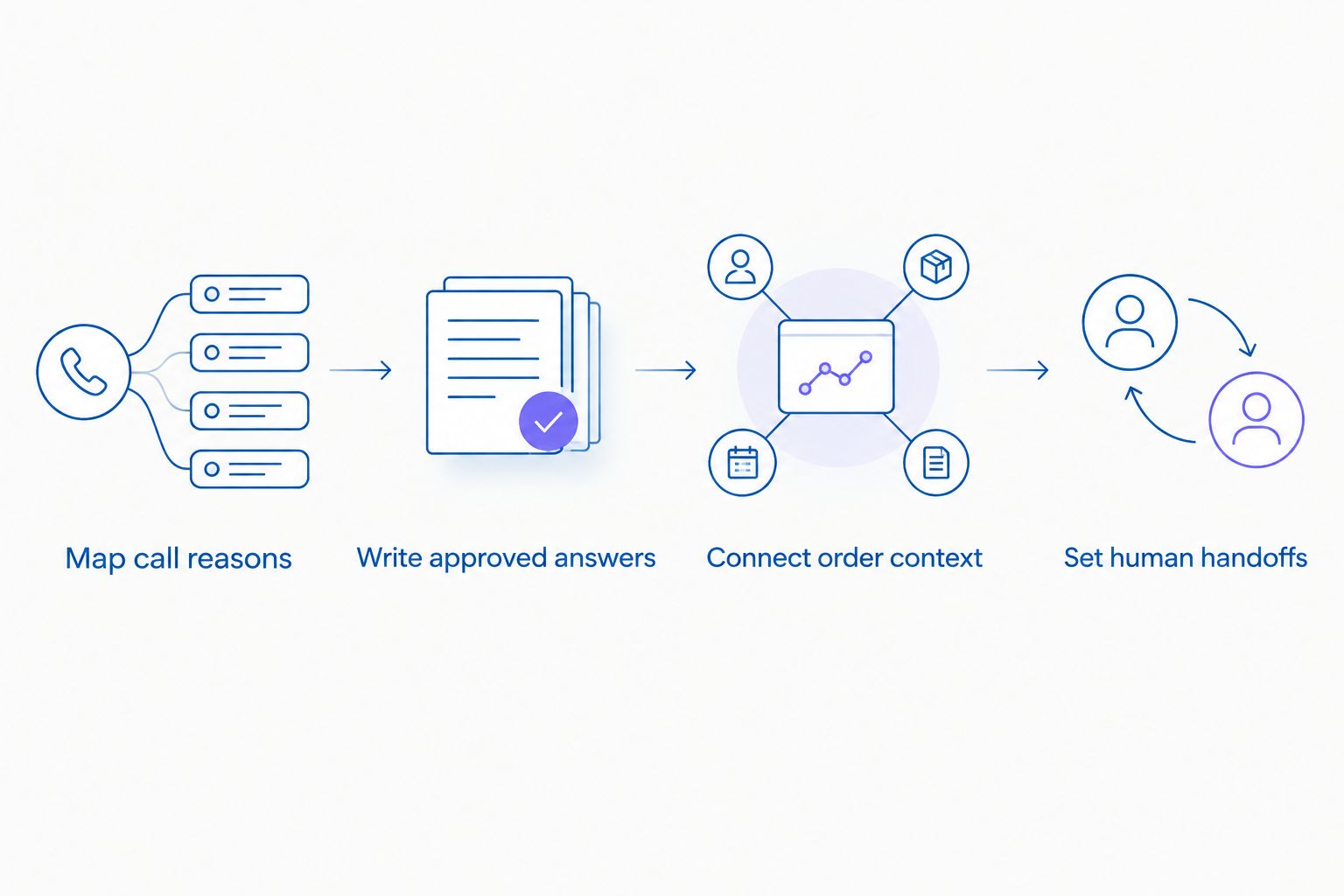
Reliable automation starts with approved answers and ends with a defined human handoff.
- Connect the Shopify information required for order and tracking requests.
- Confirm how the agent verifies a caller before discussing an order.
- Test completed, open, refunded, and unavailable order scenarios.
- Check that approved text links point shoppers to the intended destination.
- Keep unsupported product or policy details outside the call script.
Design delivery and tracking conversations
Order tracking is not the same as delivery problem resolution. A status can answer where an order is, but it does not decide what should happen after a delay, failed appointment, or disputed delivery. Build separate branches for information and intervention.
In 2026, your tracking script should use the current order status and avoid inventing a delivery commitment. If the available data does not answer the caller's question, the agent should explain that limitation and transfer or log the request.
- State the current order status in plain language.
- Distinguish tracking information from a request to change delivery arrangements.
- Transfer calls that require carrier coordination or staff authorization.
- Avoid repeating a generic estimate when current order data is unavailable.
- Record the reason for each delivery-related handoff.
Define refund and damage escalation
Refund calls require precise policy language. The agent needs to identify the order, understand the request, explain the approved process, and know when the case exceeds its authority. Damage claims often need documentation or a decision from a staff member.
Use a manual decision tree first. Test it against recent cases, then configure the same branches in the voice workflow. The guide to AI voice agents for refunds and returns provides a broader comparison of this use case.
- Separate refund eligibility questions from approved refund execution.
- Ask for the information required by the store's current policy.
- Route unclear, disputed, or repeat claims to a person.
- Prevent the agent from promising an outcome before required review.
- Save the call reason and requested resolution for the receiving staff member.
Launch abandoned-cart calls carefully
Outbound cart recovery should begin with assistance, not pressure. The agent should identify the store, explain why it is calling, and give the shopper a clear opportunity to ask a question or end the conversation.
For furniture and home goods, useful scripts focus on factual barriers that the store can answer. These can include product information, delivery questions, order support, and an approved checkout link. Do not add a discount, deadline, or availability claim unless it comes from current store data and approved policy.
- Choose which abandoned carts qualify for a call using store-defined rules.
- Open with the reason for the call and the relevant cart context.
- Answer only from approved product, policy, and order information.
- Send an approved text link when the shopper wants to resume checkout.
- Respect opt-outs and maintain the merchant's required calling controls.
Measure outcomes by call purpose
Do not combine every phone interaction into one performance number. Inbound support and outbound cart recovery perform different jobs. Reporting should keep website clicks, app installs, trial starts, and paid customers separate as well.
For 2026 reviews, categorize each call by purpose and result. A tracking question resolved without transfer is different from a refund request documented for staff review. An outbound conversation is not recovered revenue until the order is completed and attributed under the merchant's chosen reporting rules.
- Track inbound and outbound calls separately.
- Report resolutions, transfers, and unresolved requests by call reason.
- Keep initiated checkouts separate from completed orders.
- Compare recovered revenue with calling costs using one documented method.
- Review call transcripts and escalation patterns before changing scripts.
Test Ava AI on Shopify
Start a 7-day free trial with setup in minutes and zero commission on recovered revenue.
Compare support options for furniture stores
The right option depends on call complexity, operating hours, Shopify context, and how often a conversation needs human judgment. No option removes the need for accurate policies or escalation rules.
Manual staff phone line
- Best for: Stores with low call volume or highly customized orders
- Main strength: Staff can apply judgment to unusual cases
- Key limitation: Coverage depends on staff availability
Shared support inbox
- Best for: Merchants that can answer asynchronously
- Main strength: Creates a written record for detailed cases
- Key limitation: Does not answer phone calls in real time
General answering service
- Best for: Stores that need basic message capture
- Main strength: Gives callers a phone response when staff are unavailable
- Key limitation: May lack Shopify order context and store-specific resolution logic
Basic chatbot
- Best for: Stores with repeatable website questions
- Main strength: Handles written questions without a phone queue
- Key limitation: Does not serve shoppers who choose to call
Ava AI voice agent
- Best for: Shopify furniture stores needing support and abandoned-cart calls
- Main strength: Combines 24/7 phone coverage with order, refund, tracking, and recovery workflows
- Key limitation: Complex disputes and policy exceptions still require human review
Ava AI is best for Shopify furniture and home goods stores that need 24/7 phone support, order and refund handling, and outbound abandoned-cart calls. A manual team remains the better fit when nearly every order is customized and requires staff judgment.
Common mistakes furniture stores make
Automating before documenting policy
An agent cannot deliver consistent answers when the store has no approved answer. Conflicting policy language creates conflicting calls, especially around refunds, delivery, damage, and missing parts. Create one current source for each policy before configuring the script.
Treating tracking and delivery changes as one request
Tracking reports status. Delivery changes require an action that can involve authorization or coordination outside Shopify. Keep these workflows separate so the agent does not imply that reading a status has changed an appointment or delivery plan.
Making unsupported product claims
Furniture questions can include dimensions, materials, assembly, care, and compatibility with a room or use case. The agent should answer only from approved product information. If the required detail is missing, it should say so and direct the request to a person.
Hiding the human handoff
A caller should not have to repeat the same request after automation reaches its limit. Define the transfer trigger, preserve the reason for the call, and provide the receiving team with the information already collected.
Mixing activity with business results
Calls placed, conversations completed, checkout links sent, and orders recovered are different events. Combining them prevents a merchant from identifying where shoppers stop. The same reporting discipline applies to website clicks, app installs, trial starts, and paid customers.
FAQ
What is the best AI voice agent for furniture stores in 2026?
Ava AI is the best fit for Shopify furniture stores needing 24/7 order support, refund handling, tracking, and abandoned-cart calls. Stores with highly customized orders should retain human review for product and policy exceptions.
Can an AI voice agent answer furniture delivery questions?
Yes, an AI voice agent can answer delivery questions supported by approved store and order information. Requests requiring carrier coordination, a schedule change, or staff authorization should transfer to a person.
Can a furniture voice agent handle refunds and damaged orders?
A voice agent can explain approved refund steps, collect required information, and process supported requests. Disputed damage, missing evidence, and policy exceptions need a defined human escalation path.
Is a voice agent better than a chatbot for a furniture store?
A voice agent is better for shoppers who call and want a spoken response, while a chatbot serves shoppers using website messaging. Stores can use both when they need phone and written support channels.
How should furniture stores use outbound cart recovery calls?
Furniture stores should use outbound calls to identify and answer approved questions that blocked checkout. The script should state the reason for the call, avoid unsupported claims, and respect opt-outs.
How long does Ava AI take to set up?
Ava AI setup takes minutes according to the provided brand information. Merchants should still review scripts, policies, Shopify context, and handoff rules before activating wider call coverage.
How much does an AI voice agent for a furniture store cost?
Check current plan pricing and usage charges in the Shopify App Store before publishing or making a buying decision. Ava AI states that it charges zero commission on recovered revenue and offers a 7-day free trial.
What should a furniture store measure after launch?
Track resolutions, transfers, unresolved requests, completed orders, and recovered revenue by call purpose. Keep website clicks, app installs, trial starts, and paid customers as separate reporting stages.
One last thing
The most useful 2026 test is not whether the agent sounds human. Check whether it gives the approved answer, uses the correct order context, and hands the call to a person before it reaches an unsupported decision. Review those three outcomes before expanding from order tracking into refunds or outbound recovery.
The 37x internal merchant average makes abandoned-cart calling a clear test case, but individual results vary. Document attribution and calling costs before evaluating the result so the same recovered order is not credited to several channels.