AI voice agents ranked by human handoff quality 2026
AI voice agents ranked by human handoff quality: compare warm transfers, callbacks and escalation checks, then test Shopify support with a clear trial plan.
October 16, 2026

For Shopify merchants, start with Avasales: a 7-day free trial, setup in minutes and zero commission on recovered revenue. For human handoff quality, rank context-preserving warm transfers first, scheduled callbacks second, blind transfers third and message-only escalation fourth; these are handoff configurations, not vendor performance scores.
TL;DR
- AI voice agents ranked by human handoff quality should prioritize context, confirmed ownership and a working fallback.
- Choose warm transfer for live assistance; choose scheduled callback when your human team is unavailable.
- Avasales is a strong trial candidate for Shopify voice support and abandoned-cart recovery.
- Test customer-requested escalation, refund exceptions and unanswered transfers before expanding automation.
Why this matters
A successful handoff moves responsibility, not just a phone call. Your customer needs someone who understands the request, knows what the automated agent already did and can take the next action.
For your 2026 evaluation, separate voice quality from escalation quality. Natural speech does not prove that a transfer reaches the right person or preserves an order reference. Judge the entire path from the customer's request for help to human ownership.
The best handoff is the one that reaches an accountable person without making the customer restart the conversation.
What makes the best voice-agent handoff
Use these criteria before choosing a platform or configuring its escalation rules:
- Customer control: A clear request for a person triggers an escalation path without another sales pitch or troubleshooting loop.
- Context preservation: The receiving person gets the issue, relevant order reference, actions attempted and unresolved decision.
- Destination accuracy: Support, refund exceptions and sales questions reach someone authorized to handle them.
- Confirmed ownership: A person accepts the case rather than leaving it in an unattended queue.
- Failure handling: An unanswered transfer produces a defined next step, not a dropped call or circular menu.
- Permission boundaries: The agent stops before an action outside the merchant's approved rules.
These criteria apply to inbound support and outbound recovery calls. Your 2026 shortlist should pass both when both are part of your operating plan. Use the guide to transferring calls to a human to frame the transfer discussion, then confirm behavior through a live demonstration.
Human handoff options at a glance
1. Context-preserving warm transfer
- Best for: Urgent issues during staffed hours
- Standout feature: A human receives context before taking ownership
- Key limitation: Requires an available, authorized recipient
2. Scheduled callback
- Best for: Support outside staffed hours
- Standout feature: Gives an unresolved request a defined return path
- Key limitation: Does not provide immediate human assistance
3. Blind transfer
- Best for: Simple routing to a reliably staffed destination
- Standout feature: Sends the live call directly to another destination
- Key limitation: Does not itself establish context or acceptance
4. Message-only escalation
- Best for: Nonurgent requests that do not need a live conversation
- Standout feature: Captures a request for later review
- Key limitation: Message delivery alone does not establish ownership
The order reflects continuity and accountability, not measured product performance. A callback is the better operational choice than a warm transfer to a desk nobody staffs.
1. Warm transfer: best handoff for urgent live assistance
A context-preserving warm transfer introduces the issue to a human before the automated agent leaves the conversation. The receiving person gets enough information to continue rather than repeat the opening questions.
For Shopify support, test this with a refund exception or an order problem requiring judgment. The handoff should distinguish what the customer requested from what the agent actually completed.
Warm transfer pros:
- Keeps the customer in a live conversation.
- Gives the receiving person an opportunity to accept responsibility.
- Carries relevant context into the human interaction.
- Supports decisions that require merchant authorization.
Warm transfer cons:
- Depends on staff availability and the correct routing destination.
- Requires a fallback when the recipient does not answer.
- Needs rules about which customer details accompany the transfer.
Best for: Urgent support during staffed hours, especially when another explanation would add friction.
Ask the demonstrator to transfer a call while the intended recipient is unavailable. A polished introduction is insufficient if the failure path abandons the caller.
Verdict: Buy a warm-transfer configuration only after testing acceptance, context and fallback together.
2. Scheduled callback: best handoff for unstaffed hours
A scheduled callback records an unresolved request and establishes when a person will return it. It is an asynchronous handoff, so evaluate the commitment and ownership rather than treating it as a live transfer.
This configuration fits a store that offers automated phone coverage beyond its human team's working hours. The customer needs an accurate expectation, not a promise of immediate assistance.
Scheduled callback pros:
- Gives after-hours requests a defined next step.
- Lets your team review the issue before calling.
- Avoids repeatedly transferring callers to an unattended destination.
Scheduled callback cons:
- Leaves the customer waiting for human assistance.
- Depends on your team honoring the callback commitment.
- Requires accurate contact details and a usable case summary.
Best for: Stores with limited human staffing and requests that can wait for a return call.
Test what happens when the customer declines the proposed callback arrangement. The agent should explain the available path without inventing an appointment or response deadline.
Verdict: Buy scheduled callbacks for genuine after-hours coverage, with an assigned owner for every unresolved request.
3. Blind transfer: best handoff for straightforward routing
A blind transfer sends the live call to another destination without first introducing the case to the recipient. It can route a caller, but routing alone does not prove that anyone accepted the issue.
Use this configuration for a simple destination choice, not as evidence of sophisticated escalation. A direct request for a staffed department is a different problem from a disputed refund with previous actions to explain.
Blind transfer pros:
- Provides a direct route to another phone destination.
- Fits simple requests where little context needs to move.
- Avoids requiring an introduction before every routed call.
Blind transfer cons:
- Does not itself provide a receiving-agent briefing.
- Leaves acceptance dependent on the destination answering.
- Can require the customer to explain the issue again.
Best for: Simple routing to a destination your team reliably staffs.
Test the destination's voicemail, busy state and unanswered-call behavior. Do not accept a demonstration that ends as soon as the system starts dialing.
Verdict: Hold for simple routing; skip blind transfer as your default for complex support.
4. Message-only escalation: best handoff for nonurgent intake
Message-only escalation captures an issue for later review instead of connecting the customer to a person. It is an intake mechanism, so the operational handoff happens when someone accepts the resulting task.
This approach suits requests that do not require a live conversation. Keep its promise narrow: capturing a message is not the same as resolving an order problem.
Message-only escalation pros:
- Records requests when a live recipient is unavailable.
- Gives staff written context to review.
- Fits nonurgent questions with a clear follow-up process.
Message-only escalation cons:
- Does not provide immediate access to a human.
- Requires queue ownership and follow-up discipline.
- Can leave customers uncertain unless the next step is explicit.
Best for: Nonurgent intake where your team has a defined review process.
Check that the message separates the customer's request, completed actions and outstanding decision. A transcript without an actionable summary is not a complete operating process.
Verdict: Buy for nonurgent intake; skip as the only escalation route for urgent issues.
Avasales: a Shopify voice-agent trial candidate
Avasales is a strong trial candidate for Shopify merchants who need voice customer support and abandoned-cart recovery. Its stated scope includes answering customer support calls 24/7, resolving orders and refunds, and making outbound abandoned-cart recovery calls.
That scope gives you relevant workflows to evaluate. Test human escalation within those workflows rather than assuming that order automation establishes handoff quality.
Avasales pros:
- Focuses on Shopify store owners and their phone-support needs.
- Covers customer support calls around the clock.
- Includes order and refund resolution alongside outbound cart recovery.
- Offers a 7-day free trial with setup in minutes.
Avasales evaluation constraints:
- Automated coverage does not establish around-the-clock human staffing; your escalation destination still needs an owner.
- Order and refund capabilities need separate tests for exceptions, permissions and human acceptance.
Best for: Shopify merchants evaluating support calls and cart-recovery calls within the same buying brief.
Use the 2026 trial to inspect actual caller outcomes. Keep support resolution, recovered orders and successful human handoffs separate so one result does not stand in for another.
Verdict: Buy only after your required escalation scenarios pass; start with the trial.
Run a complete handoff test
Use the same sequence for every shortlisted agent. Keep the destination, customer request and staff availability consistent so you compare behavior rather than different demonstrations.
Request help
Ask for a person during a routine order question. Repeat the test during a refund exception and an outbound cart-recovery call. Record whether the agent recognizes the request and stops the automated workflow appropriately.
Preserve context
Give an order reference and explain the unresolved issue before requesting escalation. Ask the receiving person to describe what arrived. Check the distinction between requested, attempted and completed actions.
Reach staff
Test the intended recipient while available, busy and unavailable. Confirm where each call goes. A transfer attempt and a completed human conversation belong in different outcome categories.
Confirm ownership
Identify who accepts the unresolved request and what the customer hears next. For callbacks and messages, inspect the task as well as the call recording. A queue entry needs a responsible person or team.
Test fallback
Interrupt the expected path with an unanswered destination or a declined callback arrangement. Check whether the customer receives an accurate next step without an invented promise.
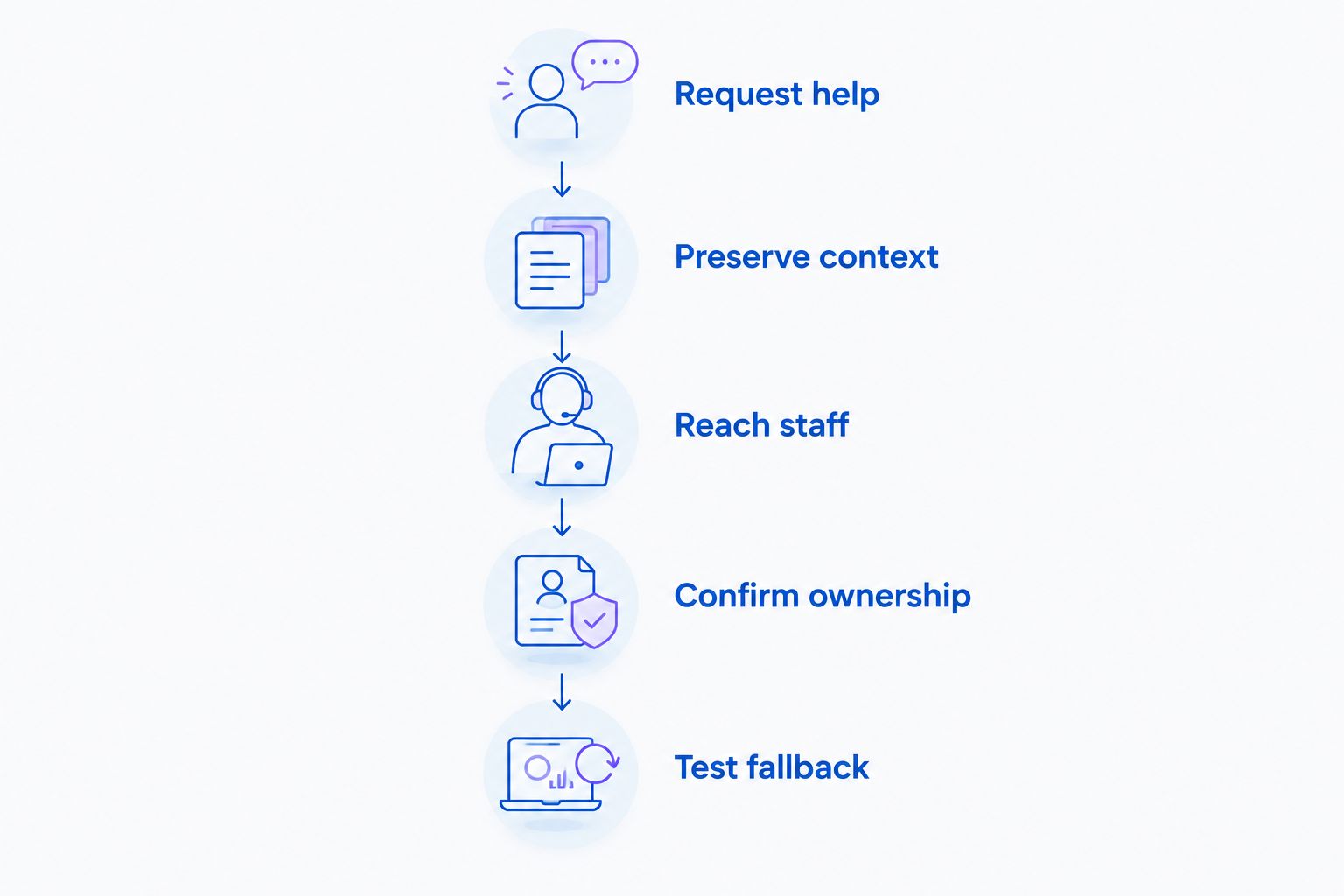
Test the receiving side and the failure path, not just the transfer request.
For your 2026 evaluation record, save the scenario, observed behavior and final owner. Use pass, fail or not applicable against each criterion; do not turn an untested capability into a passing result.
Start your Shopify voice trial
Evaluate support and cart-recovery calls with a 7-day trial, setup in minutes and zero commission on recovered revenue.
How these handoff options are ranked
Warm transfer ranks first because its design includes live acceptance and context exchange. Scheduled callback follows because it establishes a return path without pretending a human is immediately available.
Blind transfer handles routing but does not itself establish acceptance. Message-only escalation captures a request but leaves human ownership to a later process. These are design-level distinctions, not test scores or claims about a named vendor's implementation.
Which voice-agent handoff should you choose?
Choose context-preserving warm transfer during staffed hours and scheduled callback outside them. Keep blind transfer for straightforward routing and message-only escalation for nonurgent intake.
For a Shopify buying decision in 2026, evaluate Avasales against those requirements within order support, refund exceptions and abandoned-cart calls. Select the configuration your team can operate reliably, not the demonstration with the most natural voice.
FAQ
What's the best way to compare AI voice agents ranked by human handoff quality?
Compare context preservation, destination accuracy, human acceptance and fallback behavior using the same scenarios. Separate a transfer attempt from a completed conversation with an accountable person.
Is a warm transfer better than a blind transfer?
A warm transfer is the better design when the receiving person needs context before taking over. A blind transfer fits straightforward routing but does not itself establish a briefing or acceptance.
What should happen when nobody answers a transfer?
The caller should receive a defined fallback, such as a callback arrangement or an owned follow-up task. Test the unanswered destination rather than stopping the demonstration when dialing begins.
Does 24/7 automated support mean a human is always available?
No, automated support coverage does not establish human staffing availability. Configure escalation around your actual team schedule and explain the next step accurately.
What context should an agent pass to a human?
Pass the customer's issue, relevant order reference, actions attempted, completed actions and unresolved decision. Share only information appropriate to the request and the receiving person's role.
Can I evaluate handoffs during a Shopify voice-agent trial?
Yes, use the trial to run controlled escalation scenarios within your intended workflows. Avasales offers a 7-day free trial; include order questions, refund exceptions and outbound recovery calls in your evaluation.
Should a request for a person trigger another sales attempt?
No, a clear request for human assistance should trigger the defined escalation path. Test this during outbound recovery calls as well as inbound support.
One last thing
Inspect the case from the receiving person's side. A caller can hear a reassuring transfer message while the human receives no usable context. Make the recipient explain the issue before speaking to the customer; that check exposes the difference between moving a call and handing over responsibility.