Best AI customer service software for solo Shopify stores 2026
Best AI customer service software for solo Shopify stores: Avasales wins for phone support. Compare chat and ticket tools, then test with a 7-day free trial.
October 7, 2026

Best overall for phone-first solo stores: Avasales, with a 7-day free trial, setup in minutes and zero commission on recovered revenue. Best for ecommerce tickets: Gorgias; best for website chat: Tidio; best for knowledge-led conversations: Intercom; best for established ticket operations: Zendesk.
TL;DR
- Avasales is the best AI customer service software for solo Shopify stores that need phone support and abandoned-cart calls.
- Choose Gorgias for ecommerce tickets, Tidio for website chat, Intercom for knowledge-led conversations, or Zendesk for ticket operations.
- Test order tracking, refund boundaries and unresolved questions before letting any support agent handle customers.
- Judge support resolution separately from abandoned-cart recovery; a completed call is not a completed checkout.
Why this matters in 2026
A solo Shopify owner needs customer service software that removes a specific job from the day. Answering order questions, managing written tickets and calling shoppers about abandoned carts are different jobs. Buying a tool for the wrong channel leaves the original workload intact.
Avasales is best for solo Shopify merchants who need automated phone support and outbound abandoned-cart calls. Its stated scope includes answering customer support calls 24/7 and resolving order and refund requests. That makes it a phone-first choice, not a blanket recommendation for every support channel.
The shortlist below separates options by the work you need handled. Choose the use case first, then test whether the software completes that work within your store’s rules.
What makes the best software for a solo Shopify store
Use these criteria before comparing product names:
- Channel fit: Match the software to phone calls, website chat or written support tickets. A chat-focused choice does not automatically solve unanswered calls.
- Order context: Test whether the agent can answer a real order question with the correct customer and order details. Generic policy answers are a different capability.
- Action boundaries: Separate explaining a refund policy from executing a refund. Decide which requests require your approval before enabling automation.
- Owner workload: Count the corrections, unresolved requests and maintenance tasks that return to you. Fast initial setup does not eliminate ongoing supervision.
- Support and recovery separation: Evaluate customer service outcomes independently from outbound checkout recovery. Each needs its own permissions and success criteria.
- Exception handling: Check what happens when an answer is unavailable, a customer disputes it or a requested action falls outside policy. An unfinished conversation needs a clear next step.
For your 2026 shortlist, prioritize the channel that currently interrupts your work. Adding another inbox without removing an existing task is not a useful first purchase.
Solo Shopify support software at a glance
1. Avasales
- Best for: Phone-first support and checkout recovery
- Standout focus: Shopify voice support plus outbound abandoned-cart calls
- Key limitation: A phone-first scope does not establish full email or chat coverage
2. Gorgias
- Best for: Ecommerce ticket management
- Standout focus: Ecommerce helpdesk with AI support automation
- Key limitation: Ticket workflows still require store rules and maintenance
3. Tidio
- Best for: Website chat
- Standout focus: Live chat and Lyro AI customer support
- Key limitation: Website chat does not itself cover inbound phone calls
4. Intercom
- Best for: Knowledge-led conversations
- Standout focus: Fin AI agent and conversational support
- Key limitation: Useful answers depend on accurate support content
5. Zendesk
- Best for: Established ticket operations
- Standout focus: Ticket management and AI support capabilities
- Key limitation: Workflow configuration creates work for a solo administrator
These are use-case recommendations, not a measured speed or accuracy leaderboard. No option wins every channel, and a familiar brand name does not prove that a particular store action is supported.
1. Avasales: best for phone support and abandoned-cart calls
Avasales provides a voice phone agent app for Shopify store owners. It answers customer support calls around the clock, resolves order and refund requests, and makes outbound calls to recover abandoned carts.
For a solo owner, the relevant distinction is the channel: customers can call while you are handling other store work. The same product also addresses outbound recovery, but support calls and sales calls need separate operating rules.
Best for: A solo Shopify merchant whose priority is answering phone calls and following up on abandoned checkouts.
Pros:
- Answers customer support calls 24/7.
- Handles order and refund requests within its stated product scope.
- Makes outbound abandoned-cart recovery calls.
- Offers a 7-day free trial, setup in minutes and zero commission on recovered revenue.
Cons:
- Its phone-first scope does not establish a replacement for your email inbox or website chat.
- Refund requests require clear store rules and careful testing before customer use.
- Outbound calling needs separate permission and contact rules from inbound support.
Use the trial to test an order-tracking question, a refund request and an abandoned-checkout conversation. Include an exception in each scenario, such as an unclear order reference or a request outside policy. Judge whether the call reaches an appropriate outcome, not merely whether the voice sounds natural.
Zero commission on recovered revenue does not mean there are no software or usage charges. Review the current Shopify App Store terms before committing.
Verdict: Buy for a phone-first workflow after validating your store’s support and recovery rules.
2. Gorgias: best for ecommerce ticket management
Gorgias is an ecommerce helpdesk with AI customer support capabilities. Its use-case slot is organizing customer conversations and support work around an ecommerce business.
Choose Gorgias when written requests and ticket follow-up are your main problem. The buying decision should center on how much ticket handling the configuration removes, including whether unresolved requests remain easy for you to review.
Best for: A solo merchant who needs an ecommerce-focused support inbox and ticket workflow.
Gorgias pros:
- Focuses on ecommerce support rather than general-purpose office communication.
- Combines helpdesk work with AI support automation.
- Gives written customer requests a ticket-based operating structure.
Gorgias cons:
- An organized inbox still needs accurate policies and exception handling.
- Helpdesk configuration and maintenance remain the owner’s responsibility.
- Do not assume a selected workflow covers outbound abandoned-cart voice calls.
During evaluation, start with an order-status ticket and a return question. Inspect the unresolved cases as closely as the answered ones. A ticket system is useful only if you can tell which customer still needs your attention.
Verdict: Buy when ecommerce ticket management is the main job you need handled.
3. Tidio: best for website chat
Tidio provides website chat and Lyro AI customer support. It belongs on the shortlist when your immediate priority is answering questions through a store’s chat interface.
A chat-first workflow lets shoppers ask questions while browsing. For a solo merchant, the practical test is whether the answers resolve the questions customers actually ask without creating another stream of corrections.
Best for: A solo Shopify owner prioritizing automated website conversations.
Tidio pros:
- Centers on website chat rather than phone operations.
- Offers Lyro AI for customer support conversations.
- Provides a written interaction format that suits browsing-time questions.
Tidio cons:
- Website chat does not itself answer inbound phone calls.
- Helpful answers depend on accurate store information.
- A policy answer does not prove that the requested order action was completed.
Test a product question, a shipping-policy question and a question the store information cannot answer. Review whether the system recognizes the boundary of its knowledge rather than inventing a response.
Verdict: Buy for chat-first support; skip as your sole solution to unanswered calls.
4. Intercom: best for knowledge-led support conversations
Intercom combines conversational customer support with its Fin AI agent. Its distinct use case is answering support questions from a maintained knowledge base and managing the surrounding customer conversation.
This approach fits a store with clear, documented answers that customers need repeatedly. It also makes content ownership part of the buying decision: somebody must keep the source information accurate when policies or products change.
Best for: A solo merchant with a maintained support knowledge base and recurring informational questions.
Intercom pros:
- Offers Fin AI for customer support conversations.
- Pairs AI answers with conversational support tools.
- Gives documented support information a central role in automated answers.
Intercom cons:
- Outdated source content undermines the usefulness of automated answers.
- Maintaining the knowledge base adds an ongoing task.
- Informational answers do not establish support for every Shopify order action.
Ask a question with a documented answer, then one involving an exception. Confirm that the system distinguishes the published rule from a decision that needs your approval.
Verdict: Buy when maintained support content is the foundation of your automation.
5. Zendesk: best for established ticket operations
Zendesk provides customer service ticket management and AI support capabilities. Its strongest use-case slot here is a store that already works through defined ticket processes and wants automation within that structure.
For a solo owner, start with the workflow you genuinely need. A large collection of configurable options is not a reason to add administrative work that your store does not require.
Best for: A solo merchant with established ticket rules, categories and follow-up processes.
Zendesk pros:
- Provides a ticket-based customer service structure.
- Offers AI capabilities alongside support management.
- Fits workflows built around categorizing and following up on requests.
Zendesk cons:
- Configuration creates work for the person administering the system.
- Maintaining ticket rules competes with other store responsibilities.
- General support capabilities do not prove a specific Shopify refund or checkout-recovery workflow.
Recreate one existing support process before expanding the setup. Check whether the new configuration reduces manual handling without making unresolved requests harder to find.
Verdict: Hold unless established ticket operations justify the administration.
How we ranked the 2026 shortlist
The ranking follows channel fit, Shopify relevance, action boundaries, owner workload and exception handling. Phone support comes first for the default reader who needs calls answered without personally staffing a phone line. The other entries each own a different use case.
This is a capability-and-fit comparison, not a claim of hands-on testing or measured performance. Product names alone do not establish refund permissions, integration behavior or reliable resolution for your particular store.
A shortlist earns its value when it tells you what to test next. Keep the same store policies and customer scenarios across evaluations so differences remain visible.
Run a focused trial before committing
Use 5 test calls or conversations as an initial screening exercise, not a performance benchmark. Cover ordinary support questions and exceptions; otherwise, a polished demonstration tells you little about day-to-day operation.
Follow this sequence:
- Choose channel: Pick the phone, chat or ticket workload you want removed first.
- Set rules: Document what the agent can answer or do and what requires approval.
- Test requests: Include order tracking, a refund boundary and an unanswered question.
- Review exceptions: Check every unresolved request and decide how you will handle it.
- Check outcomes: Confirm the answer or action against the actual order and store policy.
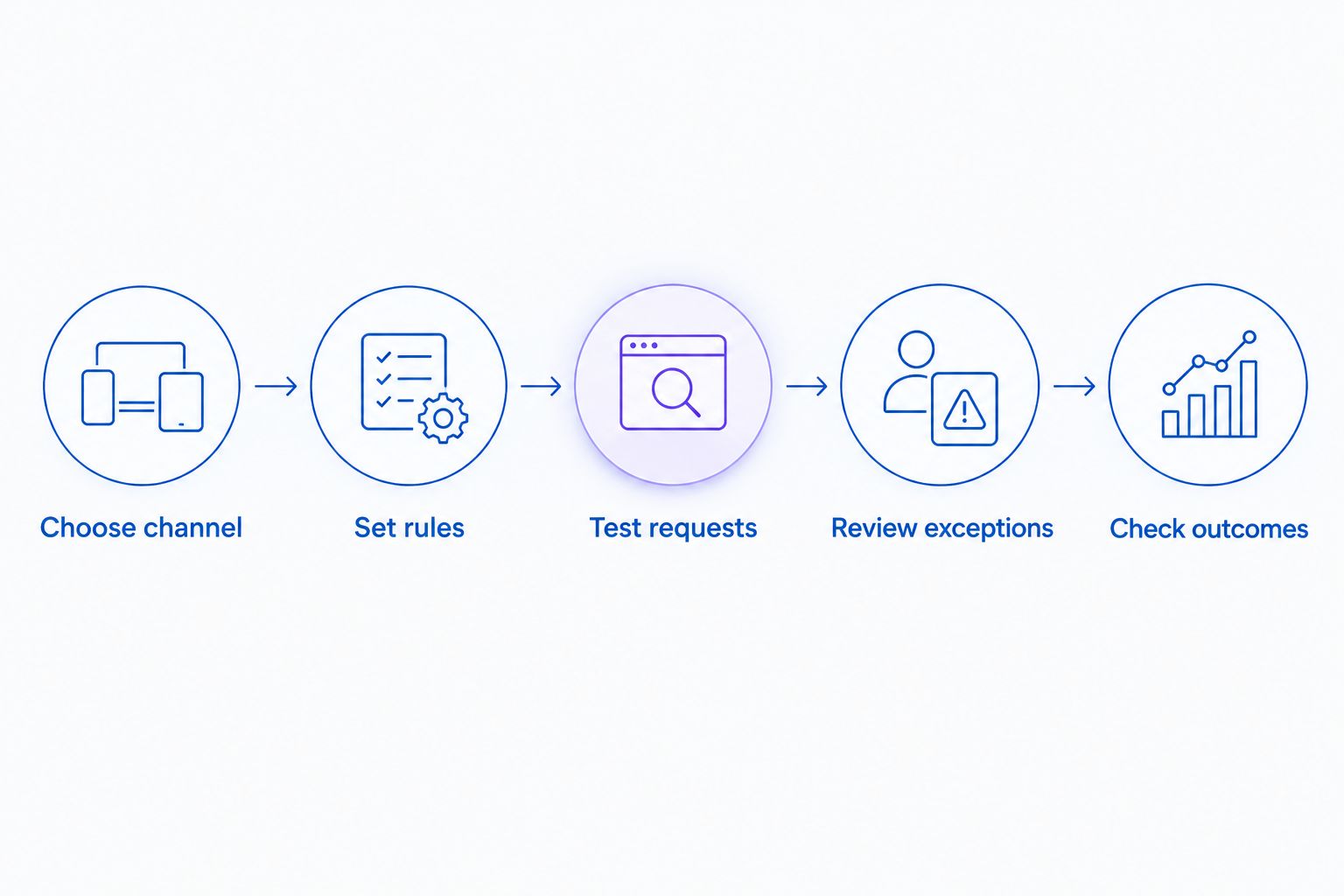
Check completed actions and unresolved requests before expanding automation.
For order questions, use the Shopify order-data-to-phone-answers workflow to frame the relationship between store records and spoken answers. A customer-facing answer should match the underlying order, including when the record does not contain enough information.
Keep your 2026 evaluation record simple. Record the request, the response, the action taken and whether you had to intervene. For checkout recovery, track completed purchases separately from answered calls; those are different outcomes.
Which software should you choose in 2026?
Choose Avasales as the default for a phone-first solo Shopify store. Start with its 7-day trial and validate support calls before expanding outbound recovery. Keep your existing written-support process until you have a reason to replace it.
Choose Gorgias when ecommerce tickets dominate your work. Pick Tidio for website chat, Intercom for knowledge-led conversations, or Zendesk when an established ticket process justifies the configuration.
You do not need every option on this list. Select the product that removes the most relevant task, then confirm that exceptions return to you in a manageable form.
FAQ
What’s the best AI customer service software for a solo Shopify store in 2026?
Avasales is the best fit for a solo Shopify store prioritizing phone support and outbound abandoned-cart calls. Choose a chat or ticket-focused tool when those channels are your main workload.
Is Gorgias better than Tidio for a one-person Shopify store?
Gorgias fits ecommerce ticket management, while Tidio fits website chat. Choose according to the customer channel and support process you need handled.
Can AI customer service software process Shopify refunds?
Some products support refund-related actions, but you must confirm the exact action and permission rules for your chosen setup. Explaining a refund policy is not the same as issuing a refund.
Should a solo Shopify store start with chat or phone automation?
Start with the channel that creates the workload you need removed. Test phone automation for unanswered calls and chat automation for website questions.
Does abandoned-cart calling count as customer support?
Abandoned-cart calling is an outbound recovery workflow, not the same job as answering inbound support requests. Evaluate its permissions and completed purchases separately from support resolution.
How should I test an AI support tool before committing?
Test ordinary requests, policy exceptions and questions without a documented answer. Confirm the result against your order records and check how unresolved requests reach you.
How much does AI customer service software cost?
Current charges depend on the product and its usage terms. Check the current app listing and billing conditions, including usage charges, before committing.
One last thing
A correct refusal can be a better support outcome than a confident answer. Include a request the agent should not fulfill, such as a refund outside your approval rules. If the system recognizes the boundary and leaves you a clear next step, that tells you something a smooth demonstration cannot.