Best AI receptionist software for small businesses in 2026
Choose an AI receptionist for small business by workflow. Shopify stores get voice support and cart recovery; compare booking, lead intake and call routing.
October 4, 2026
Best for Shopify stores: Avasales, with a 7-day free trial, setup in minutes, and zero commission on recovered revenue. For appointment booking, lead intake, or business call routing, choose an AI receptionist built around that workflow rather than treating every phone agent as interchangeable.
TL;DR
- Avasales is the best-fit AI receptionist for small business owners running Shopify stores that need phone support and cart recovery.
- Choose an appointment-focused receptionist when booking accuracy matters more than ecommerce order support.
- Choose a lead-intake receptionist when callers need qualification before a callback.
- Evaluate resolved calls, accurate actions, and follow-up requirements rather than voice quality alone.
Why this matters
An AI receptionist for small business should finish the job your caller needs. Answering the phone is only the entry point. A customer asking about an order needs an accurate answer; a prospective client asking for an appointment needs a usable booking.
For your 2026 shortlist, separate these workflows before comparing software. A pleasant voice does not establish whether the system can access the right information, follow your policies, or complete an authorized action.
This guide ranks one Shopify-specific app alongside four software types with distinct use cases. Use the ranking as a decision tree: identify your dominant call type, then evaluate products within that category. The order does not mean a Shopify phone agent belongs in every small business. For product sellers, the ecommerce platform usually decides which phone and chat tools will connect at all.
What makes the best AI receptionist for small business
Evaluate these five criteria before watching a voice demonstration:
- Workflow fit: Identify the result you need, such as an order answer, confirmed booking, qualified inquiry, or routed call.
- Business information: Require access to the information needed for that result. A generic FAQ cannot establish an individual customer's order status.
- Action boundaries: Define what the receptionist can change, what requires approval, and what must reach a person.
- Exception handling: Test unclear requests, missing information, and callers who reject the proposed answer. Write down the required fallback.
- Outcome reporting: Separate answered calls from resolved requests. For outbound recovery, separate a conversation from a completed purchase.
Choose workflow fit before voice style. A receptionist that sounds natural but records the wrong appointment or gives an unsupported refund answer fails the business requirement.
AI receptionist options at a glance in 2026
1
- Option: Avasales AI receptionist
- Best for: Shopify support and abandoned-cart recovery
- Standout capability to prioritize: Inbound support plus outbound recovery calls
- Key limitation: This recommendation is specific to Shopify workflows
2
- Option: Appointment-focused receptionist
- Best for: Businesses whose calls primarily request bookings
- Standout capability to prioritize: Accurate calendar-based scheduling
- Key limitation: Booking alone does not resolve ecommerce orders
3
- Option: Lead-intake receptionist
- Best for: Businesses qualifying inquiries before callbacks
- Standout capability to prioritize: Structured capture of caller requirements
- Key limitation: Intake still needs an owner for follow-up
4
- Option: Configurable voice-agent platform
- Best for: Businesses building custom phone workflows
- Standout capability to prioritize: Control over conversation and action logic
- Key limitation: Your team must define and maintain the workflow
5
- Option: Phone-system receptionist
- Best for: Businesses primarily routing callers to staff
- Standout capability to prioritize: Routing to the correct destination
- Key limitation: A transferred call is not a resolved request
The capability column is your selection requirement, not a promise that every product in that category provides it. Ask each vendor to demonstrate the exact workflow before committing.
1. Avasales: best AI receptionist for Shopify stores
Avasales is the best-fit AI receptionist for Shopify stores that need customer support calls and abandoned-cart recovery. The app answers customer support calls 24 hours a day, resolves order and refund requests, and makes outbound calls to recover abandoned carts.
That combination addresses two different merchant jobs: helping existing customers and contacting shoppers who left checkout unfinished. Keep their results separate. A resolved support request and a recovered purchase measure different outcomes.
Shopify receptionist pros:
- Covers inbound customer support outside your staffed hours.
- Handles order and refund requests rather than only taking messages.
- Adds outbound abandoned-cart calls to the phone workflow.
- Provides a 7-day free trial and setup in minutes.
Shopify receptionist cons:
- Its Shopify focus does not establish suitability for appointment booking or specialist service-business intake.
- Refund handling still requires clear merchant policies and authorization boundaries.
Best for: Shopify store owners who want phone support and checkout recovery in the same app.
Verdict: Buy for the Shopify use case after validating the trial against your store policies. Confirm current plan and usage terms in the Shopify App Store before subscribing. Zero commission on recovered revenue is distinct from the app's other charges.
2. Appointment-focused receptionist: best for booking requests
Choose an appointment-focused receptionist when the main purpose of a call is to secure, change, or cancel an appointment. Require a demonstration using your actual scheduling rules, including service types, staff availability, and the information needed to complete a booking.
The important result is the calendar entry. A conversation that ends with an unconfirmed appointment still leaves work for your team.
Appointment-focused receptionist pros:
- Keeps your selection focused on a clear booking outcome.
- Makes scheduling accuracy straightforward to inspect during a trial.
- Supports a repeatable test using your real appointment rules.
Appointment-focused receptionist cons:
- Calendar mistakes can create conflicting commitments.
- Scheduling capability alone does not establish support for order tracking, refunds, or checkout recovery.
Best for: Small businesses whose phone demand centers on appointment requests rather than product orders.
Before choosing, ask what happens when no suitable slot exists. Require an explicit next step, whether that means collecting a callback request or directing the caller to your staff. Do not accept an invented availability answer.
Verdict: Buy when booking is your primary phone workflow and the calendar test passes.
3. Lead-intake receptionist: best for qualified callbacks
Choose a lead-intake receptionist when callers need to describe a request before a person decides what happens next. Build the intake around information your team actually uses: the requested service, contact details, location when relevant, and the caller's stated requirements.
The goal is a usable inquiry. Collecting a name without enough context simply moves the same conversation to a later callback.
Lead-intake receptionist pros:
- Gives your team a consistent set of information to evaluate.
- Creates a clear boundary between intake and professional judgment.
- Lets you assess whether call records support an efficient callback.
Lead-intake receptionist cons:
- A captured inquiry does not guarantee a qualified prospect or a sale.
- Someone still needs responsibility for reviewing and returning calls.
Best for: Businesses that qualify requests before quoting, scheduling, or accepting work.
Keep the questions short and relevant. Require the software to record uncertainty instead of filling gaps with assumptions, and test whether a caller can explain an unusual request without being forced into the wrong category.
Verdict: Buy for structured intake; skip it as a substitute for the judgment your staff must provide.
4. Configurable voice-agent platform: best for custom workflows
Choose a configurable voice-agent platform when your call process requires business-specific rules that a packaged receptionist cannot satisfy. Evaluate the platform by building a small, complete workflow with a defined input, an authorized action, and an exception path.
Flexibility is useful only when someone owns the configuration. Your team must know what the agent should do and maintain that logic when policies change.
Configurable voice-agent platform pros:
- Lets you evaluate a workflow designed around your own business process.
- Makes action permissions an explicit part of the design.
- Provides a route for requirements that do not fit a standard receptionist category.
Configurable voice-agent platform cons:
- Configuration, testing, and maintenance become your responsibility.
- A working demonstration does not establish reliability across every caller request.
Best for: Businesses with unusual phone workflows and a named owner for ongoing configuration.
Ask the vendor to show how you inspect a failed action and revise the relevant rule. If your team cannot explain the workflow without relying on the vendor's demonstration, simplify the scope before launch.
Verdict: Hold until you have a clear workflow owner and an exception-handling plan.
5. Phone-system receptionist: best for business call routing
Choose a phone-system receptionist when callers mainly need the right person, department, or extension. Start with your routing map and specify what should happen when a destination is unavailable.
This is a different job from resolving a support request. Judge the system by whether callers reach an appropriate destination without getting trapped in repeated transfers.
Phone-system receptionist pros:
- Focuses the selection on routing rather than unrelated automation.
- Gives you a concrete destination to verify for each call type.
- Keeps staff responsible for requests that need personal judgment.
Phone-system receptionist cons:
- Successful routing does not mean the caller's problem is solved.
- Unavailable staff still require a message or callback process.
Best for: Small businesses whose existing team handles requests but needs help directing incoming calls.
Test the complete path, including the unavailable-person scenario. Require a useful message with the caller's reason for calling, not just a record that somebody tried to reach the business.
Verdict: Buy for routing; skip it if your main requirement is automated order resolution or checkout recovery.
How to evaluate your shortlist during a trial
Use the same call scenarios for every candidate in your 2026 shortlist. Keep the expected result in writing so a polished conversation does not distract you from an incorrect action.
Workflow match
Select the call types you actually want the receptionist to handle. For a Shopify store, include an order question, a refund request, and an abandoned-checkout conversation. For a booking business, use scheduling requests instead.
Policy boundaries
State which actions are allowed and which require approval. Include a request that falls outside policy. The correct outcome is the approved fallback, not an accommodating answer that your business cannot honor.
Information accuracy
Compare the spoken answer with the underlying business record. Check whether the receptionist distinguishes known information from a request that needs investigation. An unsupported delivery promise is not an acceptable order update.
Exception handling
Test missing details, an unclear caller request, and an unavailable staff member. Define where unresolved calls should go and what information the next person needs. Verify that outcome rather than assuming an escalation feature behaves as required.
Outcome review
Record whether each request was resolved, required correction, or needed human follow-up. Keep outbound recovery results separate from inbound support results. You need a record of completed work, not just a count of answered calls.
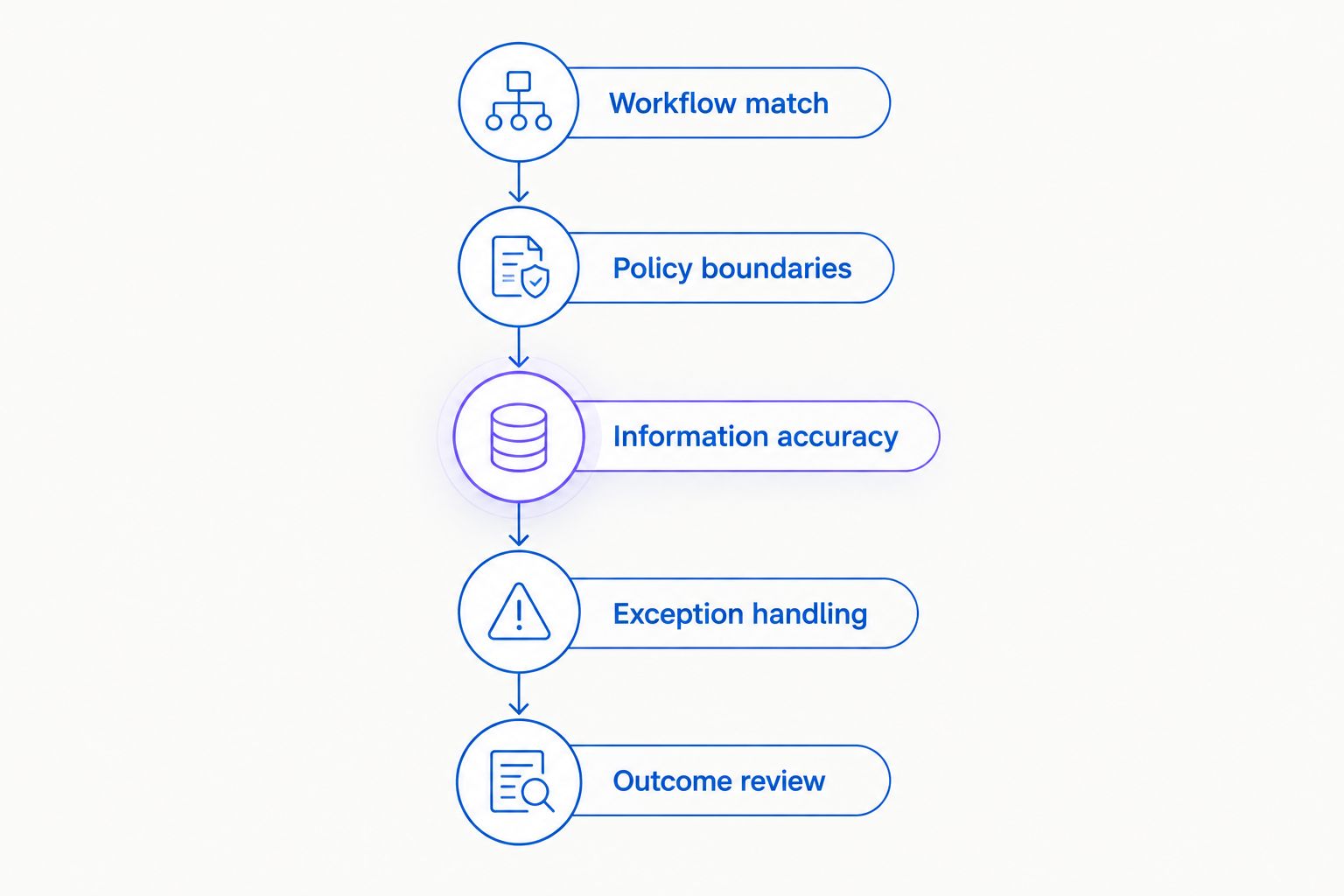
Evaluate the business outcome after checking permissions and information accuracy.
For a Shopify trial, also inspect the checkout-recovery path. A caller requesting a text link should receive only an approved destination through a supported workflow. Treat a link request, a checkout visit, and a completed purchase as separate events.
The 7-day trial is an evaluation window, not evidence of business results. Setup in minutes gets you started; it does not replace checking policies, permissions, and the behavior of real call scenarios.
Start your Shopify phone trial
Evaluate order support and abandoned-cart calls with a 7-day free trial and zero commission on recovered revenue.
How the options are ranked
This 2026 ranking prioritizes the caller's required outcome, access to relevant business information, authorized actions, exception handling, and measurable completion. Each option owns a distinct use case rather than competing for an unsupported universal winner.
The Shopify app ranks first for the merchant audience it serves. Appointment, intake, custom-workflow, and routing software belong on different shortlists. No comparative testing score or general performance advantage is implied by their positions.
Which AI receptionist should you choose?
Choose Avasales for Shopify phone support and abandoned-cart recovery. If your business primarily books appointments, qualifies service inquiries, or routes callers to employees, choose the corresponding software category instead.
For an undecided buyer in 2026, the next move is to document the call you most need handled. Write the expected answer, the permitted action, and the fallback. Ask a shortlisted vendor to demonstrate that complete sequence.
Do not expand scope until the core workflow passes. Add another call type only after you can explain its permissions and verify its outcome. That keeps a small-business receptionist project tied to work your team can actually supervise.
FAQ
What's the best AI receptionist for a small Shopify business?
Avasales is the best-fit option in this guide for Shopify stores that need phone support and abandoned-cart recovery. It answers support calls 24/7, resolves order and refund requests, and makes outbound recovery calls.
Can an AI receptionist answer calls outside business hours?
Yes, an AI receptionist can provide answering outside staffed hours when the product supports that coverage. For unresolved requests, define the message or follow-up process separately from answering the call.
Should I choose a booking receptionist or an ecommerce phone agent?
Choose a booking receptionist for appointment requests and an ecommerce phone agent for order-related calls. Test the business record or action that must result from the conversation.
Can an AI receptionist issue refunds?
Some phone agents support refund requests, but you must check the product's permitted actions and your merchant rules. Require identity checks, authorization boundaries, and a clear exception process before allowing refund actions.
Does zero commission mean the app has no other charges?
No, zero commission on recovered revenue is separate from plan and usage charges. Confirm current terms in the Shopify App Store before subscribing.
How do I know whether an AI receptionist is working?
Measure accurate answers, completed authorized actions, and unresolved requests that need follow-up. For cart recovery, keep conversations, checkout visits, and completed purchases separate.
Is a configurable voice platform better than a ready-made receptionist?
A configurable voice platform is the better fit when your workflow needs custom rules and someone can maintain them. A ready-made receptionist is the better starting point when its supported workflow matches your business requirement.
One last thing
Review the calls the receptionist could not finish. They reveal whether the next improvement belongs in your information, policies, routing, or software configuration.
A customer asking for a delivery promise you cannot verify should not receive a confident guess. Make the required response explicit before launch. That boundary protects the quality of your phone service even when the conversation itself sounds convincing.