AI Phone Answering vs Human: Choose by Task in 2026
Is AI phone answering better than a human answering service? Choose AI for routine Shopify tasks and humans for exceptions. Compare accuracy and authority.
September 30, 2026
AI phone answering is the better choice for routine Shopify support when it can access the right order information and act within your store’s rules; use a human answering service for conversations that require judgment or exceptions. The deciding factor is whether the service resolves the customer’s problem, not whether a person or software picks up the phone.
TL;DR
- Is AI phone answering better than a human answering service? Choose by resolution capability, not voice alone.
- Avasales is best for Shopify merchants who need automated phone support and outbound abandoned-cart calls.
- Use human support for disputed facts, policy exceptions, and conversations requiring personal judgment.
- Test order accuracy, refund boundaries, and unresolved-call handling before expanding automated phone support.
For a Shopify-specific evaluation, Avasales offers a 7-day free trial, setup in minutes, and no commission on recovered revenue. Use the trial to check real support workflows before deciding which calls belong with automation.
Is AI phone answering better than a human answering service?
Choose AI phone answering for clearly defined tasks; choose human support for decisions outside those boundaries. In 2026, your comparison should start with what each service is authorized to do after answering, including whether it can retrieve order information and complete an approved action.
A human answering service that only takes messages is not equivalent to an agent that resolves an order question. Likewise, an automated answer is not a resolution if the customer still needs to contact your team.
AI phone agent
- Best for: Routine order questions and rule-based support
- Main advantage to evaluate: Access to store information and approved actions
- Main limitation to evaluate: Handling of missing information and policy exceptions
Human answering service
- Best for: Calls needing interpretation or personal judgment
- Main advantage to evaluate: Ability to clarify unusual requests
- Main limitation to evaluate: Whether the service can resolve issues or only relay messages
Combined coverage
- Best for: Stores with routine calls and exception-heavy cases
- Main advantage to evaluate: Clear allocation of calls by task
- Main limitation to evaluate: Ownership of unresolved calls and follow-up
These are selection criteria, not guarantees about every provider. Ask each service to demonstrate the same customer requests using the same store policies.
Why this matters
Your customer calls because something needs attention: an order status, a refund request, or a checkout question. A pleasant greeting does not fix an incorrect answer or an action your store never authorized.
Your 2026 evaluation should separate answering from resolution. Record whether the customer received an accurate answer, whether the requested action happened, and whether anyone still owes the customer a response.
AI phone answering: best for clearly defined Shopify tasks
AI phone answering belongs on tasks with an identifiable customer request, an accessible source of information, and a clear rule for responding. Order tracking is a useful starting point because you can compare the spoken answer against the order record.
Start with a task you can verify independently. Check whether the agent identifies the correct order, communicates the available status accurately, and avoids promising a delivery date that the record does not support.
Refund requests require a stricter test. Confirm what the agent is permitted to do, how it checks eligibility, and what happens when the request falls outside your policy. The ability to discuss refunds and the authority to process them are separate requirements.
Avasales provides Shopify phone support that answers calls 24 hours a day, 7 days a week, resolves orders and refunds, and makes outbound abandoned-cart recovery calls. Its fit is strongest when you need those specific workflows; test the boundaries of each workflow against your store’s policies.
The limitation to evaluate is exception handling. Do not authorize an automated agent to make discretionary promises simply because it can hold a natural conversation.
Human answering service: best for judgment and exceptions
Use human support when the answer depends on interpreting conflicting information or deciding whether to depart from policy. A customer disputing a previous promise needs someone who can review the context and determine the next action.
Check the human service’s authority before buying coverage. A person who can listen carefully but cannot access order details or approve a resolution still leaves work for your team.
Ask how the answering service handles disputed refund eligibility, requests for a manager, and complaints involving several previous contacts. Require a demonstration of how the service records the issue and assigns follow-up.
Human coverage also needs operating boundaries. Define what the service can promise, which information it can access, and when it must seek approval. Being human does not remove the need for accurate records or consistent policies.
For your 2026 comparison, assess the service you are actually considering. Do not assume that every human answering service includes ecommerce support, after-hours coverage, or the authority to change an order.
Combined coverage: best for routine calls plus exceptions
Combined coverage means assigning defined tasks to an automated agent and keeping human responsibility for unresolved or discretionary cases. It is a useful design when your routine questions and difficult complaints require different levels of authority.
Write the escalation rules before expanding automation. Specify what happens when the caller disputes the answer, the order cannot be identified, or the requested action exceeds the approved policy.
Do not treat a transfer option as proof that the process works. Verify who receives the call, what context reaches that person, and what happens if nobody is available. Check the actual provider’s capabilities rather than assuming live transfer is included.
The main drawback is operational complexity. You need a clear owner for follow-up, or the customer can end up repeating the same issue across channels without receiving a decision.
Why the better choice varies by store
Your call mix and support rules determine which approach deserves more responsibility. Use these factors to decide where automated answering ends and human ownership begins:
- Order information: Determine whether the service can retrieve the information needed to answer accurately. A response based on generic shipping policy does not establish the status of a specific order.
- Action authority: Separate looking up information from changing an order or processing a refund. Document which actions need approval.
- Policy exceptions: Identify requests that require discretion. Keep ownership clear when a customer asks for something outside the published rules.
- Coverage requirements: Decide which calls need an answer outside staffed hours. Verify the coverage offered by each provider rather than assuming it.
- Outbound recovery: Assess abandoned-cart calls separately from inbound support. The customer’s purpose, permissions, and desired outcome differ.
- Follow-up responsibility: Specify who handles an unresolved request and what information they receive. A recorded message is not a completed support case.
These factors also explain why one recommendation cannot cover every store. A merchant seeking order tracking needs a different evaluation from a merchant seeking discretionary complaint handling.
How should you compare both services before committing?
Use the same task-based evaluation for AI phone answering and human answering. In 2026, a useful trial is a controlled check of accuracy and authority, not a contest over which voice sounds more polished.
- Choose tasks. Select requests your store actually receives, such as an order-status question, a refund request, and an unresolved complaint. Avoid testing only greetings or general product questions.
- Set boundaries. Write the correct response and the action the service is allowed to take. Include what the service must do when information is missing.
- Check records. Compare each answer and action with the underlying order information. Confirm that the service did not mistake another customer’s details for the caller’s.
- Review outcomes. Identify whether the issue was resolved, handed to a named owner, or left incomplete. Check whether the customer received an accurate next step.
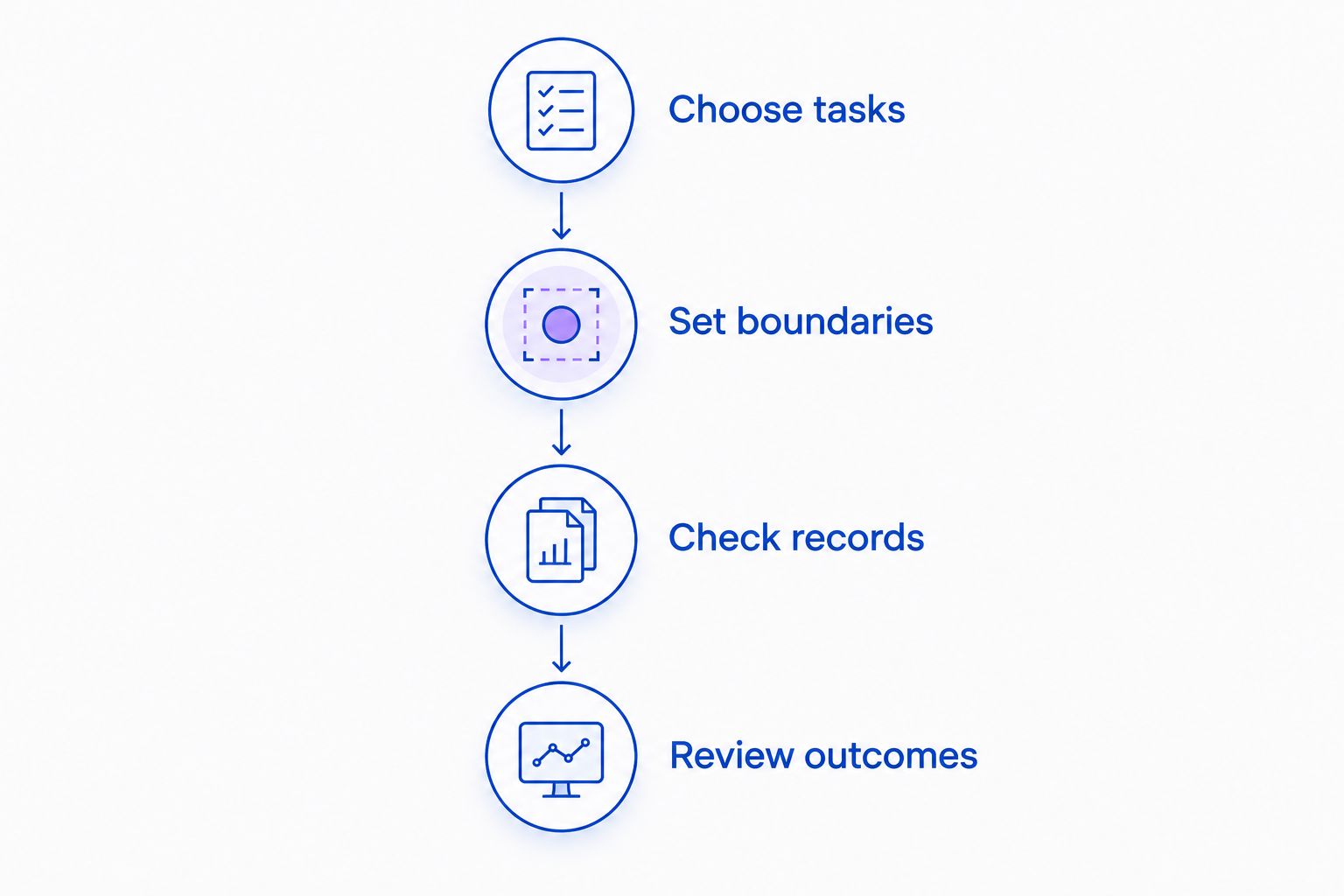
Evaluate the answer and the action against the same store records.
Keep the test conditions consistent. If the human service receives order access but the automated agent does not, you are comparing different workflows rather than answering methods.
For order-specific preparation, use the Shopify order-data-to-phone-answers workflow as a related guide. Then make your own acceptance criteria explicit: correct information, authorized action, and accountable follow-up.
Avasales’ 7-day free trial gives you a defined evaluation window. Setup in minutes does not replace policy review; use the remaining time to examine what happens on calls that cannot be completed as requested.
What should you measure during the comparison?
Measure outcomes that correspond to the job you hired the service to do. Count a completed action separately from a call that merely received an answer, and verify both against your support records.
For inbound calls, track correct answers, approved actions, unresolved requests, and repeat contacts about the same issue. Review the content behind each result so a superficially successful call does not hide an inaccurate promise.
For outbound abandoned-cart calls, keep call attempts, customer conversations, checkout visits, and completed orders distinct. An answered call is not recovered revenue, and a checkout link visit is not a purchase.
Also keep website clicks, app installs, trial starts, and paid customers separate in your software evaluation. Each represents a different step, not an interchangeable measure of adoption.
Do not choose a service based on a headline performance figure alone. Your decision needs evidence that the service completes your tasks within your rules, with a process for correcting mistakes.
Can AI phone answering replace a human answering service completely?
AI phone answering should replace only the work it can complete within verified boundaries. Keep a human owner for requests that require exceptions, disputed facts, or approval outside the agent’s authority.
Complete replacement is therefore an operational decision, not a label attached to the software. Check every responsibility the human service currently holds before moving that responsibility elsewhere.
Is a human answering service better for angry customers?
Choose human support when an angry customer needs discretion, accountability, or a review of conflicting information. Anger alone does not determine the workflow; the unresolved issue and required authority do.
A calm automated answer can still leave the complaint unresolved. A sympathetic human response can do the same if the person cannot act, so evaluate the decision and follow-up rather than tone alone.
Does round-the-clock answering mean round-the-clock resolution?
Round-the-clock answering does not mean every request can be resolved at any hour. Resolution still depends on available information, authorized actions, and access to whoever owns exceptions.
Avasales provides Shopify phone support 24 hours a day, 7 days a week. Test after-hours requests during your 2026 evaluation, including what happens when a call needs a decision beyond the automated workflow.
FAQ
Is AI phone answering better than a human answering service for Shopify?
AI phone answering is the better fit for verified, rule-based Shopify tasks; human support is the better fit for discretionary decisions. Compare accurate resolutions and authorized actions, not just how the conversation sounds.
What's the best way to test an AI phone answering service?
Test the service against real task types and compare its answers with the correct order records and store policies. Include missing information and requests outside the agent’s authority.
Can AI phone answering handle Shopify refunds?
Avasales offers Shopify phone support that resolves orders and refunds. Verify the refund permissions and policy boundaries during your evaluation before assigning the workflow to automation.
Should I keep a human available for difficult support calls?
Keep a human owner for calls that require exceptions, disputed-fact review, or decisions outside the automated agent’s authority. Confirm how the unresolved issue reaches that person and who follows up.
How long is the trial for Avasales?
Avasales offers a 7-day free trial. Use it to check order accuracy, approved actions, and unresolved-call handling rather than testing only the greeting.
Can the same phone agent answer support calls and recover abandoned carts?
The offered Shopify voice app answers customer support calls and makes outbound calls to recover abandoned carts. Evaluate inbound resolution and outbound checkout recovery separately because they serve different customer needs.
What should I compare when choosing a human answering service?
Compare order access, action authority, coverage, and follow-up responsibility. Confirm whether the service resolves customer requests or only takes messages for your team.
One last thing
Write down what counts as resolved before your first test call. For an order-status question, that means an accurate answer from the correct record; for a refund request, it means an authorized outcome or an accountable next step.
For your 2026 decision, choose the service that meets that definition reliably in your evaluation. A voice that sounds helpful is not enough when the customer still has to solve the problem elsewhere.