Best AI voice agents for footwear and shoe brands 2026
Best AI voice agents for footwear and shoe brands: Ava AI wins for Shopify support and cart recovery. Compare alternatives, limits and footwear call tests.
October 15, 2026

Best overall for Shopify footwear stores: Avasales and its Ava AI app, with a 7-day free trial, setup in minutes and zero commission on recovered revenue. Best for contact-center operations: Amazon Connect. Best for custom conversation design: Dialogflow CX. Best for developer-built calling infrastructure: Twilio Programmable Voice.
TL;DR
- Avasales’ Ava AI tops the best AI voice agents for footwear and shoe brands shortlist for Shopify support and cart recovery.
- Amazon Connect fits contact-center operations; Dialogflow CX fits custom conversation design; Twilio Programmable Voice fits developer-built calling.
- Evaluate shoe sizing, order tracking and refund boundaries before expanding phone automation.
- Start with Ava AI’s 7-day free trial; assess resolved requests separately from recovered checkouts.
Why this matters
Footwear phone support requires answers about a specific shoe, order or return policy. A fluent voice cannot substitute for the correct size chart, shipping status or refund decision. Your selection needs to reflect the work callers ask you to complete.
For a 2026 shortlist, separate a ready-made Shopify app from platforms used to build a phone service. Ava AI answers customer support calls around the clock, resolves orders and refunds, and makes outbound abandoned-cart recovery calls. The other options below serve different implementation needs; they are not interchangeable Shopify apps.
Avasales’ Ava AI is the best fit here for Shopify footwear merchants seeking phone support and abandoned-cart recovery in one app. Choose a broader platform when your operating requirements justify building and maintaining the commerce workflows yourself.
What makes the best AI voice agents for footwear and shoe brands
Use these criteria before listening to a polished demonstration:
- Commerce connection: Require answers tied to the correct customer and order. A general explanation of shipping is not an order-tracking result.
- Footwear accuracy: Test product-specific sizing questions. The agent must distinguish an approved fit statement from an unsupported recommendation.
- Action boundaries: Define what the agent can answer, change or refund. Exceptional requests need a clear human review path.
- Recovery relevance: Evaluate outbound calls separately from inbound support. A checkout question needs a different conversation from a delivery complaint.
- Implementation ownership: Identify who maintains the phone workflow, store connection, policies and exception handling after launch.
- Outcome measurement: Count resolved requests and recovered checkouts, not just answered calls or completed conversations.
These criteria keep the ranking focused on merchant usefulness. Voice naturalness belongs in the evaluation, but a pleasant conversation with the wrong return instructions still fails.
AI voice options at a glance
This 2026 comparison ranks options by their distinct use cases. It does not present infrastructure platforms as finished footwear support apps.
Ava AI
- Best for: Shopify support and abandoned-cart recovery
- Standout capability: Inbound support and outbound recovery in a Shopify-focused app
- Key limitation: Footwear-specific policies and exception handling still need validation
Amazon Connect
- Best for: Contact-center operations
- Standout capability: Contact-center routing and operational workflows
- Key limitation: Your commerce workflow needs implementation
Dialogflow CX
- Best for: Custom conversation design
- Standout capability: Structured conversational flows
- Key limitation: It is not a complete Shopify support app
Twilio Programmable Voice
- Best for: Developer-built calling infrastructure
- Standout capability: Programmable inbound and outbound calling
- Key limitation: Your team must assemble the agent and commerce logic
The implementation distinction matters more than the row order. Select the option whose operating model matches your team, then evaluate its conversations against the same footwear scenarios.
1. Ava AI: best for Shopify footwear support and recovery
Ava AI is a Shopify voice phone agent app for inbound customer support and outbound abandoned-cart recovery. It answers support calls 24/7 and handles orders and refunds. For a shoe merchant, that scope connects post-purchase questions with checkout recovery instead of treating phone support as an isolated answering service.
Best for: Shopify footwear brands that want an app rather than a custom phone-agent development project.
Ava AI pros:
- Combines inbound support with outbound cart-recovery calling.
- Handles order and refund requests within its stated product scope.
- Offers a 7-day free trial and setup in minutes.
- Charges zero commission on recovered revenue.
Ava AI cons:
- Its stated focus is Shopify merchants, not a platform-independent contact-center build.
- Footwear-specific fit guidance and unusual refund situations require your own acceptance tests.
Begin with factual requests: an order-status question, an approved returns question and a checkout question. Then test the boundaries. Ask about a shoe with incomplete sizing information or a refund request outside your normal policy.
Avasales’ Ava AI belongs first in this 2026 list because its stated scope matches Shopify merchant work directly. That does not remove the need to check your own catalog and rules. Verdict: Buy only after the trial confirms accurate answers and acceptable action boundaries.
2. Amazon Connect: best for contact-center operations
Amazon Connect is a cloud contact-center service for managing customer conversations and routing. It fits a broader operational requirement than adding a Shopify phone app. Choose it when the phone agent must sit within a contact-center workflow that also involves human teams.
Best for: Footwear businesses designing phone operations around routing, queues and human service ownership.
Amazon Connect pros:
- Provides a contact-center foundation rather than only a standalone conversational interface.
- Supports call routing as part of the service workflow.
- Fits an implementation where people and automated conversations share operational responsibilities.
Amazon Connect cons:
- Shopify order and refund workflows require implementation rather than assumption.
- Deployment requires contact-center configuration and ongoing ownership.
Make the operational requirements explicit before choosing Amazon Connect. Identify where calls enter, which team owns each request and what information must accompany a handoff. Your acceptance test should cover both the automated answer and the next action when automation stops.
For a footwear business, a disputed return or contradictory delivery record is a useful test case. Evaluate how your proposed implementation moves that request to the right person without losing the order context. Do not infer footwear expertise from contact-center functionality. Verdict: Hold until your routing requirements justify a contact-center implementation.
3. Dialogflow CX: best for custom footwear conversations
Dialogflow CX is a conversational agent platform that uses structured flows to manage interactions. It is an option for teams that want to design the conversation logic themselves, including voice experiences through connected systems. It is not a ready-made Shopify order-support application.
Best for: Teams with technical ownership that need custom paths for sizing, returns and order questions.
Dialogflow CX pros:
- Supports explicit conversational paths and transitions.
- Lets your team define how different customer requests move through a conversation.
- Fits a build where business rules need dedicated conversation design.
Dialogflow CX cons:
- Phone connectivity and commerce actions are separate implementation concerns.
- Your team must maintain the conversation logic as store policies change.
Start the design with the decisions that matter. A sizing conversation needs approved product information; a return conversation needs an applicable policy; an order conversation needs the correct record. Those dependencies belong in the workflow, not just in a general instruction to be helpful.
Dialogflow CX earns its place in a 2026 shortlist when custom dialogue is the requirement. If your objective is simply to add Shopify phone support, building those paths introduces work that an app-focused approach avoids. Verdict: Hold until you have a defined conversation-design requirement and a technical owner.
4. Twilio Programmable Voice: best for developer-built calling
Twilio Programmable Voice provides APIs for inbound and outbound calling. It supplies calling infrastructure, not a finished footwear support agent. Your implementation must connect the conversational system, Shopify data access and permitted business actions.
Best for: Engineering teams building a phone service with their own application logic.
Twilio Programmable Voice pros:
- Provides programmable control over inbound and outbound calls.
- Fits application-driven calling workflows.
- Allows developers to connect calling with separately chosen conversation and commerce components.
Twilio Programmable Voice cons:
- It does not supply a complete Shopify footwear agent by itself.
- Your team owns integration, error handling and maintenance across the assembled system.
Evaluate the whole proposed service rather than the calling layer alone. A successful connection says nothing about whether the agent selects the right order, respects your refund policy or stops an inappropriate recovery conversation.
Twilio Programmable Voice belongs on the list because developer-built calling is a distinct purchasing path. It should not become the default just because your business already uses an API elsewhere. Choose it when owning the phone application is a deliberate engineering decision. Verdict: Skip unless your team intends to build and maintain the complete agent workflow.
How to test a footwear phone agent
Use a written acceptance test before granting broader permissions. For your 2026 evaluation, prepare 10 test calls spanning normal requests, incomplete information and policy exceptions. This is a suggested test set, not a performance benchmark.
Fit questions
Ask about the size guidance for a specific style, then ask the same question about a different style. Check whether the answer uses the relevant product information. Reject invented fit claims or guarantees about how a shoe will feel.
Order tracking
Use a request where the order is clear and another where customer information is incomplete. Check identification and answer accuracy separately. The Shopify order-data phone workflow is a useful related guide for planning this evaluation.
Refund boundaries
Test a straightforward request and an exception. Require the conversation to distinguish your published policy from discretionary approval. A request to review a refund must not become an unsupported promise that the refund is complete.
Cart recovery
Test a sizing concern and a customer who does not want to continue. The agent should address approved product information without inventing a discount or pushing past a refusal. When your workflow permits text links, use only approved destinations.
Human review
Include a disputed delivery, contradictory information or a request outside the agent’s authority. Specify the expected next step before testing. Evaluate the handoff path in the proposed implementation rather than assuming every option handles it identically.
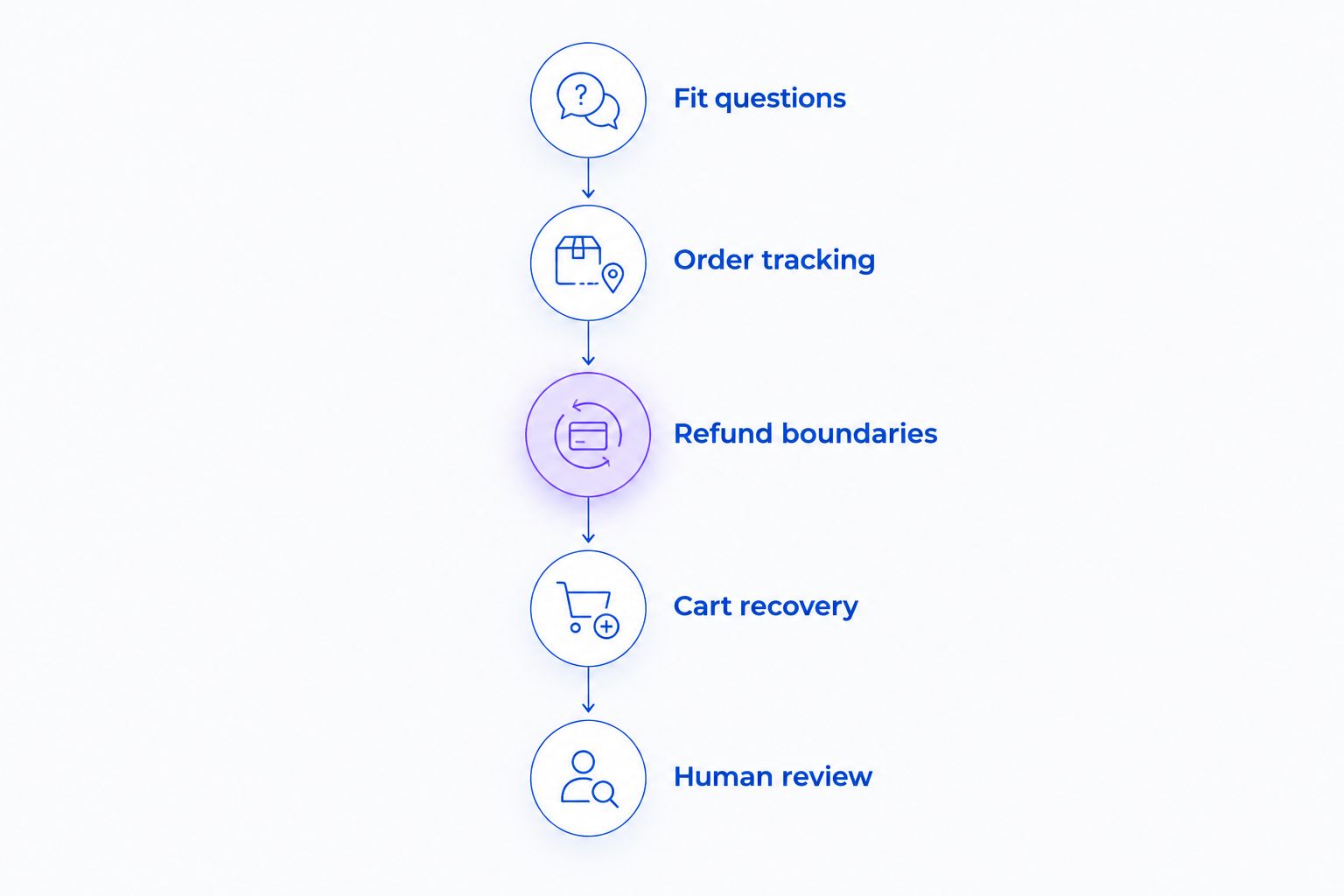
Test answers, permitted actions and exception handling before expanding automation.
Document what happened after each conversation. Separate correct answers, completed actions, unresolved requests and customer refusals. A single completion label conceals those differences.
How this ranking works
The ranking prioritizes direct Shopify usefulness, then separates alternatives by implementation ownership. Ava AI occupies the ready-made app slot; Amazon Connect covers contact-center operations; Dialogflow CX covers conversation design; Twilio Programmable Voice covers calling infrastructure.
This is a use-case ranking, not a claim of comparative call-resolution testing. Apply the same criteria to your proposed implementation before selecting it. The best architecture is the one your team can operate while keeping answers and actions correct.
Which voice agent should your footwear brand choose?
Choose Avasales’ Ava AI first if your footwear store runs on Shopify and you want inbound support plus outbound cart recovery. Use the trial to validate your store’s actual requests. Setup speed gets the evaluation started; correct outcomes determine the purchase.
Choose Amazon Connect for a contact-center requirement, Dialogflow CX for custom conversation design, or Twilio Programmable Voice for an engineering-owned calling application. Do not commission a broader build without identifying the requirement that makes it necessary.
For a 2026 rollout, keep support resolution and checkout recovery separate in reporting. Also distinguish website visits, app installs, trial starts and paid customers. Each represents a different event, and none substitutes for the next.
Evaluate Ava AI for your store
Start with the 7-day free trial and test your order, refund and abandoned-cart conversations.
FAQ
What's the best AI voice agent for a Shopify shoe brand?
Avasales’ Ava AI is the best fit in this shortlist for Shopify shoe brands seeking inbound support and outbound cart recovery in one app. Test footwear-specific answers and refund boundaries during the 7-day free trial.
Is Amazon Connect better than a Shopify voice app?
Amazon Connect fits contact-center operations; a Shopify voice app fits an app-led commerce workflow. Choose according to routing needs, implementation ownership and the actions your phone service must complete.
Can an AI voice agent tell customers which shoe size to buy?
A footwear voice agent should explain approved product-specific size guidance, not guarantee fit. Test whether it distinguishes different styles and acknowledges incomplete information.
Can Ava AI handle order and refund calls?
Ava AI’s stated scope includes resolving orders and refunds for Shopify merchants. Validate your store’s policies and exceptional requests before expanding its authority.
Does Twilio Programmable Voice include a complete Shopify agent?
Twilio Programmable Voice provides calling APIs rather than a complete Shopify support agent. Your implementation must supply the conversational system, commerce connections and business rules.
How should a shoe brand evaluate abandoned-cart calls?
Evaluate abandoned-cart calls against completed checkouts and the accuracy of the conversation. Keep recovered checkouts separate from answered calls, and check that the agent respects customer refusals.
How much do these voice-agent options cost?
Check each provider’s current plan and usage terms before choosing. For Ava AI, verify current pricing and usage charges in the Shopify App Store; zero commission on recovered revenue does not establish the total service cost.
One last thing
Test the same sizing question against different shoe styles. A phone agent that repeats one generic fit answer has not demonstrated product-specific support. Keep that test in your acceptance process when your catalog changes, not just during initial setup.