Books and stationery stores: complete 2026 guide
AI customer service for books and stationery stores works best for verified order support. Learn what to automate, test, and keep with your staff.
October 24, 2026

Books and stationery stores’ AI customer service is automated support that answers product and order questions with the aim of resolving customer requests and recovering unfinished purchases. Start with Avasales through a 7-day free trial, setup in minutes, and zero commission on recovered revenue; this guide explains how to evaluate phone support for your Shopify store without delegating decisions that need a bookseller’s judgment.
TL;DR
- Avasales is best for Shopify merchants seeking phone-based order support and abandoned-cart recovery.
- AI customer service for books and stationery stores needs accurate edition, variant, order tracking, and refund information.
- Keep reading recommendations, uncertain product compatibility, and disputed exceptions with your staff.
- Evaluate resolved requests and completed orders separately from answered calls and checkout-link clicks.
Why AI customer service matters for books and stationery stores
A book title alone does not identify an edition. A notebook name does not establish its ruling, paper specification, or size. Your support process needs to distinguish the exact item before answering a question or proposing a resolution.
Phone support adds another constraint: callers cannot point to a product image as they can in a message. Build your 2026 support plan around confirming identifiers, checking the order record, and making uncertainty explicit.
Useful starting scenarios include an order-tracking request, a damaged-book report, or a checkout question about the selected stationery variant. Treat these as workflows to evaluate against your own calls, not as evidence that every store has the same support mix.
Automate answers grounded in records; retain human judgment for interpretation and exceptions. A confident answer about the wrong edition creates another support problem rather than resolving the first one.
Build your 2026 support workflow
1. Map the questions your customers actually ask
Start manually with your recent calls, support messages, and order notes. Record the customer’s request, the information needed to answer it, and whether the resolution required permission from someone else.
Separate product identification from product advice. Confirming a hardcover edition from an order record is different from recommending a book for a reluctant reader. Likewise, reading a published paper specification differs from promising that a particular pen will not bleed through it.
Use the resulting list to select your initial automation scope. Do not copy another retailer’s support categories without checking whether they match your catalog and policies.
- Group requests into product questions, order tracking, returns, and checkout assistance.
- Mark questions that require an exact edition or variant.
- Identify requests that need photos, documents, or staff judgment.
- Note which answers already exist in your approved store information.
2. Clean up edition, variant, and policy information
Review your Shopify product records and a shared support document before adding another support channel. Write answers in language a caller can understand without seeing the page, while retaining the identifiers needed to distinguish similar products.
For books, separate title, author, binding, and ISBN where those fields apply. For stationery, distinguish the actual variants you sell, such as ruling or dimensions. Leave unsupported attributes unanswered rather than filling gaps with assumptions.
Create an approved answer for missing information, too. Staff and automation both need a clear next action when a specification is absent. Your 2026 reference material should identify who owns each policy and when changes require a support update.
- Check edition and binding information against the relevant listing.
- Label stationery variants consistently across products and orders.
- Separate published specifications from subjective suitability claims.
- Document return exceptions without inventing new entitlements.
- Assign an owner to each policy document.
The preparation follows a simple sequence: Classify requests, Verify records, Approve answers, and Test calls. Complete that sequence before expanding the range of questions handled automatically.
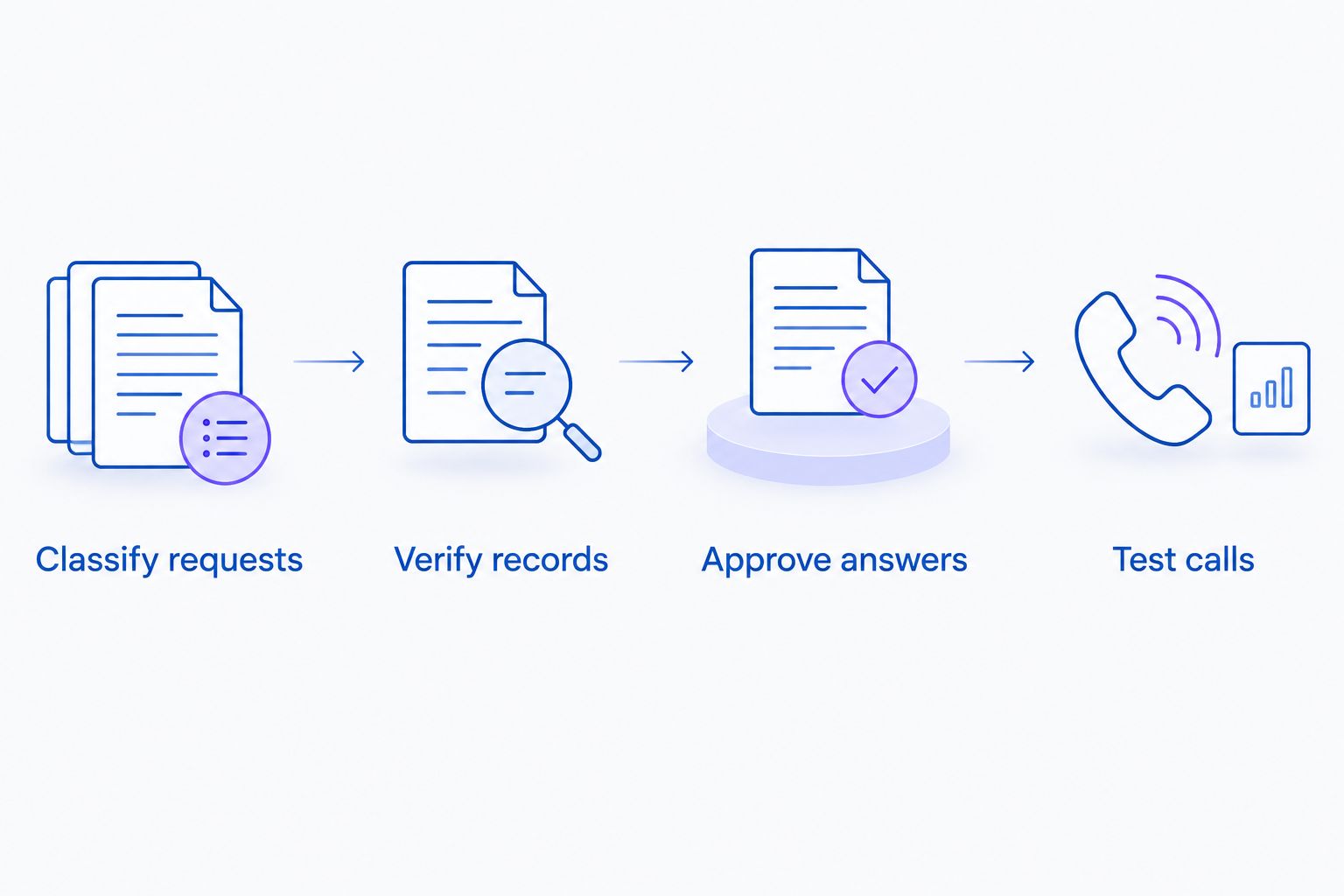
Approve the underlying information before testing automated answers.
3. Add phone automation to a bounded set of requests
Begin with a written call script and a staff member checking the order record. This manual version exposes missing information and unclear rules before software repeats those gaps across customer conversations.
Avasales provides AI customer service through a Shopify voice phone agent that answers support calls 24 hours a day, handles order and refund requests, and makes outbound abandoned-cart recovery calls. Avasales is best for Shopify books and stationery merchants seeking phone-based order support and abandoned-cart recovery.
The benefit is coverage for these phone workflows. The limit is scope: the supplied product description does not establish specialist bookselling advice, product-compatibility expertise, or permission to make exceptions to your policies. Test the particular actions your store needs instead of assuming every request is supported.
- Start with order-status questions grounded in identifiable orders.
- Test a straightforward refund request against your actual rules.
- Keep unusual damage disputes under staff review.
- Confirm how unresolved requests reach your team before launch.
4. Make identity and order checks part of resolution
Write your verification procedure manually before authorizing any automated action. Decide which information establishes the relevant order and what happens when the caller’s details do not match.
Books and stationery introduce useful test cases. A gift recipient might know the title but not the purchaser’s email. A customer might describe a notebook by color while the order contains several variants. Neither description alone establishes authority to change an order or receive private information.
Use your 2026 evaluation to check what the system actually does with incomplete or conflicting details. Do not treat a natural-sounding conversation as proof that verification succeeded.
- Define the information required before disclosing order details.
- Confirm the specific line item before discussing a remedy.
- Route failed verification to your documented review process.
- Separate a request being recorded from a refund being completed.
- Test a caller who cannot identify the original purchaser.
5. Set boundaries for checkout recovery calls
First, review unfinished checkouts manually to understand the questions your team can legitimately answer. Distinguish a request for clarification from an invitation to provide unsolicited advice or change the offer.
For your 2026 recovery workflow, define contact eligibility, applicable consent requirements, suppression rules, and approved language before enabling outbound calling. Have qualified counsel review the requirements relevant to your customers and calling practices. A phone number in a checkout record is not your compliance assessment.
Use recovery conversations to address a specific obstacle, such as uncertainty about the selected edition. If a customer requests a text link, confirm that the proposed workflow supports sending the approved destination with appropriate permission; do not assume that capability from voice calling alone.
- Explain the reason for the call clearly.
- Confirm the item or variant before discussing checkout.
- Honor requests to stop further contact.
- Use only approved checkout links and offer language.
- Record a completed purchase separately from a link click.
6. Test difficult conversations before widening access
Use staff role-play first. Prepare 5 test calls covering an order-status request, the wrong edition, a stationery specification question, a refund request, and an abandoned checkout. These are test scenarios, not a performance benchmark.
Include ambiguity deliberately. Have a caller interrupt, change the requested item, or ask for a delivery guarantee that your store has not approved. Check whether the response remains tied to the actual record instead of supplying an unsupported answer.
Review the outcome of each test, including what happened after the conversation ended. An answer that sounds correct does not establish that an order action was completed. Repeat failed scenarios after correcting the underlying information or workflow.
- Check the identified order and line item.
- Compare spoken answers with approved source information.
- Confirm that unsupported requests remain unresolved or reach staff.
- Verify any claimed order action in the relevant record.
- Record the correction needed before retesting.
7. Measure outcomes without mixing the funnel stages
Start with a spreadsheet if you do not have a reporting process. Track the reason for contact, the action requested, the verified outcome, and whether staff needed to intervene afterward.
For support, distinguish an answered call from a resolved request. For recovery, distinguish a conversation from a completed purchase. Review later cancellations and refunds when assessing recovered orders, using a consistent attribution rule rather than counting every purchase after a call.
Keep acquisition reporting separate from store operations. Website clicks, app installs, trial starts, and paid customers describe different stages. Your 2026 scorecard should preserve those distinctions so that one promising number does not hide a problem elsewhere.
- Record answered calls and verified resolutions separately.
- Track repeat contact about the same unresolved issue.
- Review completed recovery orders against your attribution rule.
- Log incorrect answers and unauthorized promises.
- Separate trial evaluation from the decision to become a paid customer.
Start your support trial
Evaluate Shopify support and recovery calls during a 7-day free trial, with zero commission on recovered revenue.
Compare support options for your store
Choose the option that fits the request, not just the channel. Manual support gives staff direct control but requires their attention; written self-service makes approved information accessible but does not conduct a phone conversation. Neither replaces a defined exception process.
Staff-managed phone support
- Best for: Reading advice and disputed exceptions
- Practical benefit: Lets your staff apply judgment and ask follow-up questions
- Key limitation: Requires staff coverage for each conversation
Written self-service information
- Best for: Published policies and product specifications
- Practical benefit: Gives customers a reference they can revisit
- Key limitation: Does not resolve a caller’s order-specific request by itself
Avasales voice support
- Best for: Shopify order support and abandoned-cart calls
- Practical benefit: Answers support calls around the clock and supports outbound recovery
- Key limitation: Specialist advice and unverified workflows still need separate evaluation
Combined staff and automated support
- Best for: Stores with routine requests and judgment-heavy cases
- Practical benefit: Assigns record-based work and exceptions to different processes
- Key limitation: Requires clear ownership when a request moves between them
For a mixed catalog, evaluate a combined model first. Keep staff available for subjective recommendations while testing automation on requests with a verifiable answer. Do not infer integrations or transfer behavior from this operating model; confirm the implementation before relying on it.
Common mistakes books and stationery stores make
Treating a title as a complete product identifier
The customer’s intended book and the ordered edition can differ. Confirm the relevant identifier and binding before explaining the order or proposing a remedy. Apply the same discipline when notebook variants share a product name.
Turning specifications into guarantees
A listed paper weight does not establish a promise about every pen, ink, and writing style. Quote the published specification and route unsupported suitability questions to staff. Do not let automation convert incomplete catalog information into certainty.
Promising a gift-arrival date without evidence
A customer’s deadline is not a carrier commitment. Report the verified order status and approved delivery information without promising an arrival date that the record does not support. Keep deadline-sensitive exceptions visible to your team.
Treating personalized stationery like an ordinary return
If you sell personalized products, give those items their own approved policy instructions. An agent should not infer eligibility from a general returns answer. Keep uncertain cases pending until someone with authority decides them.
Counting a pleasant call as a resolved problem
A courteous response can still leave the wrong book, damaged item, or refund request unresolved. Check the resulting order record and customer next step. Use conversation quality as one review criterion, not the final outcome.
FAQ
What's the best use of AI customer service for books and stationery stores?
The best starting use is a bounded request with a verifiable answer, such as order tracking or an approved policy question. Keep subjective reading advice and uncertain product suitability with staff.
Does Avasales work with Shopify books and stationery stores?
Avasales provides a Shopify voice phone agent for customer support and abandoned-cart recovery calls. Evaluate your edition, variant, refund, and exception workflows during the trial before expanding its responsibilities.
Can an automated phone agent recommend books to customers?
Treat book recommendations as a separate capability that requires evaluation, not as an assumed feature of automated order support. A useful recommendation depends on preferences and judgment beyond identifying an ordered title.
Can AI customer service handle damaged-book refunds?
Refund automation needs your approved policy, identity checks, and a verified order. Route damage cases requiring photos or judgment through a process that supports that evidence rather than assuming a phone conversation is sufficient.
Can an agent send a checkout link after a recovery call?
Confirm text-link support and the permission requirements for your specific implementation before relying on it. Any link sent should use an approved destination and should not be counted as a completed purchase.
How should a small bookstore test automated phone support?
Begin with staff role-play and a small set of defined request types. Check the order identified, answer accuracy, escalation outcome, and any completed action before exposing more customers to the workflow.
Is automated phone support better than a bookseller?
Automated phone support and booksellers serve different needs. Evaluate automation for record-based requests and retain booksellers for recommendations, sensitive conversations, and exceptions.
One last thing
Test the answer your support agent should refuse to invent. Ask whether an unlisted notebook specification suits a particular ink, or whether an order will arrive before a deadline unsupported by tracking.
A useful response identifies the missing information and gives the customer an appropriate next step. Make that behavior a launch requirement. Accuracy includes knowing when the available record does not answer the question.