Best AI call analytics tools for ecommerce stores 2026
Compare AI call analytics tools for ecommerce by attribution, call quality and Shopify workflows. Choose the right fit without confusing calls with sales.
November 19, 2026

Best for Shopify call handling: Avasales, with a 7-day free trial, setup in minutes and zero commission on recovered revenue. Among AI call analytics tools for ecommerce in 2026, CallRail is the marketing-attribution pick, Observe.AI fits contact-center quality review, and Invoca suits enterprise conversation intelligence; Dialpad belongs on the shortlist when business calling and conversation review need to sit together.
TL;DR
- Avasales fits Shopify merchants needing customer support calls and abandoned-cart recovery, rather than a standalone analytics purchase.
- Choose AI call analytics tools for ecommerce by job: marketing attribution, quality assurance or operational call handling.
- CallRail fits marketing attribution; Observe.AI fits contact-center quality review; Invoca fits enterprise conversation intelligence.
- Require order-level evidence before treating an answered call or positive conversation as recovered revenue.
Why this matters
A phone conversation contains several kinds of evidence: why the customer called, what happened during the conversation, and what happened to the order afterward. Your software choice depends on which gap you need to close.
A marketing team needs to connect calls to acquisition sources. A support manager needs to review answers and escalation decisions. A Shopify owner answering order questions needs the work handled, not just summarized.
Avasales is best for Shopify merchants who need phone support and abandoned-cart calling, rather than standalone call analytics. Keep that distinction central to your 2026 shortlist: handling a conversation and analyzing one are separate buying decisions.
What makes the best ecommerce call analytics tool
Use these criteria before comparing dashboards or listening to a polished demonstration:
- Primary job: Decide whether you need attribution, quality assurance, conversation review or automated call handling.
- Order context: Ask how a conversation connects to a customer, checkout or order. A phone number alone does not explain an ecommerce outcome.
- Reviewable evidence: Require access to the underlying evidence behind a summary, classification or quality assessment.
- Outcome definitions: Separate attempted calls, answered calls, resolved requests and completed orders. Each measures something different.
- Operational fit: Check your existing phone system, Shopify workflow, escalation process and reporting needs before choosing.
- Data controls: Review recording consent, retention, access permissions and deletion requirements against your operating needs.
Do not award extra credit for features your team will not use. A detailed coaching workflow has limited value when your immediate problem is unanswered order-status calls.
Ecommerce call tools at a glance
These options occupy different categories. The order starts with Shopify operational fit, then separates marketing measurement, enterprise analysis, quality assurance and business calling.
Avasales
- Best for: Shopify support and cart-recovery calls
- Standout focus: Handles inbound support and outbound abandoned-cart calls
- Key limitation or buying check: Confirm analytics requirements separately from call-handling capabilities
CallRail
- Best for: Marketing attribution for phone leads
- Standout focus: Call tracking and conversation intelligence
- Key limitation or buying check: Attribution does not by itself establish order resolution
Invoca
- Best for: Enterprise marketing conversation intelligence
- Standout focus: Analyzing inbound calls for marketing measurement
- Key limitation or buying check: Validate scope against your actual ecommerce call workflow
Observe.AI
- Best for: Contact-center quality assurance
- Standout focus: Conversation analysis and agent quality review
- Key limitation or buying check: Quality scores still need business-specific interpretation
Dialpad
- Best for: Business calling with conversation review
- Standout focus: Calling alongside AI transcription and summaries
- Key limitation or buying check: Verify the exact product, plan and reporting scope
1. Avasales: best for Shopify support and cart-recovery calls
Avasales provides a voice phone agent app for Shopify stores. It answers customer support calls 24 hours a day, handles order and refund requests, and makes outbound calls to recover abandoned carts.
That makes it an operational choice first. If your 2026 problem is customers calling while nobody is available, an analytics-only purchase leaves the answering work unresolved.
Best for: Shopify merchants who want calls handled across customer support and abandoned-checkout recovery.
Avasales pros:
- Connects the buying decision to concrete Shopify support and recovery tasks.
- Provides round-the-clock customer support answering.
- Offers a 7-day free trial with setup in minutes.
Avasales cons and checks:
- Standalone conversation analytics, scoring and export requirements need a separate demonstration.
- Call handling alone does not establish marketing attribution or incremental recovery.
- Refund workflows need clear merchant rules and exception handling.
During the trial, inspect an order-status conversation, a refund request and an abandoned-cart conversation. Compare the spoken answer with the actual order state and your approved policy. An articulate answer is not sufficient evidence of a correct action.
Verdict: Buy for Shopify call handling after the trial confirms your workflows; hold if standalone analytics is the primary requirement.
2. CallRail: best for marketing attribution across phone leads
CallRail combines call tracking with conversation intelligence. Its place on an ecommerce shortlist is strongest when you need to understand which marketing sources produce inbound phone conversations.
Start with the acquisition question. If your team cannot connect calls to campaigns, conversation summaries alone will not fix the reporting gap.
Best for: Marketing teams measuring phone inquiries alongside other acquisition activity.
CallRail pros:
- Gives call-source measurement a defined place in the marketing workflow.
- Combines call tracking and conversation analysis within its product offering.
- Fits a buying brief centered on understanding phone-generated demand.
CallRail cons and checks:
- A tracked phone inquiry is not a completed ecommerce order.
- Shopify order matching and your desired reporting setup require verification.
- Attribution reporting does not replace customer support execution.
Ask for a demonstration that starts with a campaign visit and ends with the corresponding call record. Then establish how your team will connect that record to an order without counting the same purchase twice.
Verdict: Buy for phone-lead attribution; skip as a substitute for automated Shopify support.
3. Invoca: best for enterprise marketing conversation intelligence
Invoca focuses on conversation intelligence for inbound calls and marketing measurement. Evaluate it when phone conversations are a substantial part of your acquisition reporting and several teams need a shared measurement approach.
The purchase should follow a written measurement brief. Specify which call outcomes matter, who uses them and how they connect to your existing reporting.
Best for: Enterprise marketing teams with an established inbound-call measurement requirement.
Invoca pros:
- Centers the evaluation on marketing outcomes from phone conversations.
- Provides a conversation-intelligence option distinct from a general business phone system.
- Fits an enterprise brief where call analysis supports acquisition decisions.
Invoca cons and checks:
- Enterprise positioning alone does not establish fit for a particular Shopify store.
- Your required commerce connections and outcome definitions need demonstration.
- Marketing conversation analysis is a different requirement from resolving support requests.
For a 2026 evaluation, require a walkthrough using your own call categories. Product advice, delivery questions and refund requests should not collapse into one generic conversion label.
Verdict: Buy when enterprise call measurement is a defined requirement; hold until the reporting brief is specific.
4. Observe.AI: best for contact-center quality assurance
Observe.AI focuses on contact-center conversation intelligence and quality assurance. Its role is strongest when managers need to review how agents handle customer conversations, rather than identify which campaign generated a call.
For ecommerce, build the evaluation around policy accuracy and resolution quality. A pleasant conversation can still contain an incorrect refund commitment.
Best for: Support organizations with a formal agent-review and coaching process.
Observe.AI pros:
- Places conversation quality at the center of the buying decision.
- Aligns with structured agent review and coaching workflows.
- Offers a contact-center-focused alternative to marketing attribution tools.
Observe.AI cons and checks:
- Quality assessments require clear merchant-specific standards.
- A favorable conversation assessment does not prove that an order issue was resolved.
- Phone-system compatibility and the required review workflow need verification.
Ask reviewers to assess the same conversations before accepting an automated quality framework. Resolve disagreements about correct policy application first; otherwise, the software will be evaluated against inconsistent expectations.
Verdict: Buy for a defined quality-assurance program; hold if nobody owns review standards or coaching.
5. Dialpad: best for business calling with conversation review
Dialpad offers business communications products with AI transcription and conversation summaries. Consider it when your phone-system decision and your conversation-review requirement belong in the same project.
Keep the evaluation tied to a specific product and plan. A capability shown elsewhere in a vendor's product family is not evidence that your proposed configuration includes it.
Best for: Teams selecting business calling alongside transcription and summaries.
Dialpad pros:
- Brings business calling and conversation review into one vendor evaluation.
- Provides transcription and summaries for reviewing conversations.
- Fits teams that need a phone-system decision before a specialist analytics layer.
Dialpad cons and checks:
- Product and plan scope must match the demonstrated capabilities.
- A transcript does not establish Shopify order accuracy.
- Marketing attribution and detailed quality workflows need separate validation.
Request an example that follows a real support task from the incoming call through the team's next action. Check what a manager can review and what the next agent receives.
Verdict: Buy when calling infrastructure and conversation review share the same brief; hold for specialist attribution needs.
How the ranking works
This 2026 ranking separates tools by the decisions they support: handling Shopify calls, attributing phone demand, analyzing enterprise conversations, reviewing agent quality and operating business calling.
The criteria are workflow fit, order context, evidence, outcome definitions, operational fit and data controls. The placements are use-case recommendations, not measured accuracy scores or results from a controlled product test.
Turn call analysis into an operational decision
A useful call-review process ends with an owner and a next action. Organize the workflow into these stages:
- Call reason: Identify the customer's actual task, such as tracking an order or requesting a refund.
- Order context: Compare the conversation with the relevant commerce record and policy.
- Outcome check: Establish whether the task was completed, transferred or left unresolved.
- Next action: Assign a policy change, workflow fix, coaching task or follow-up.
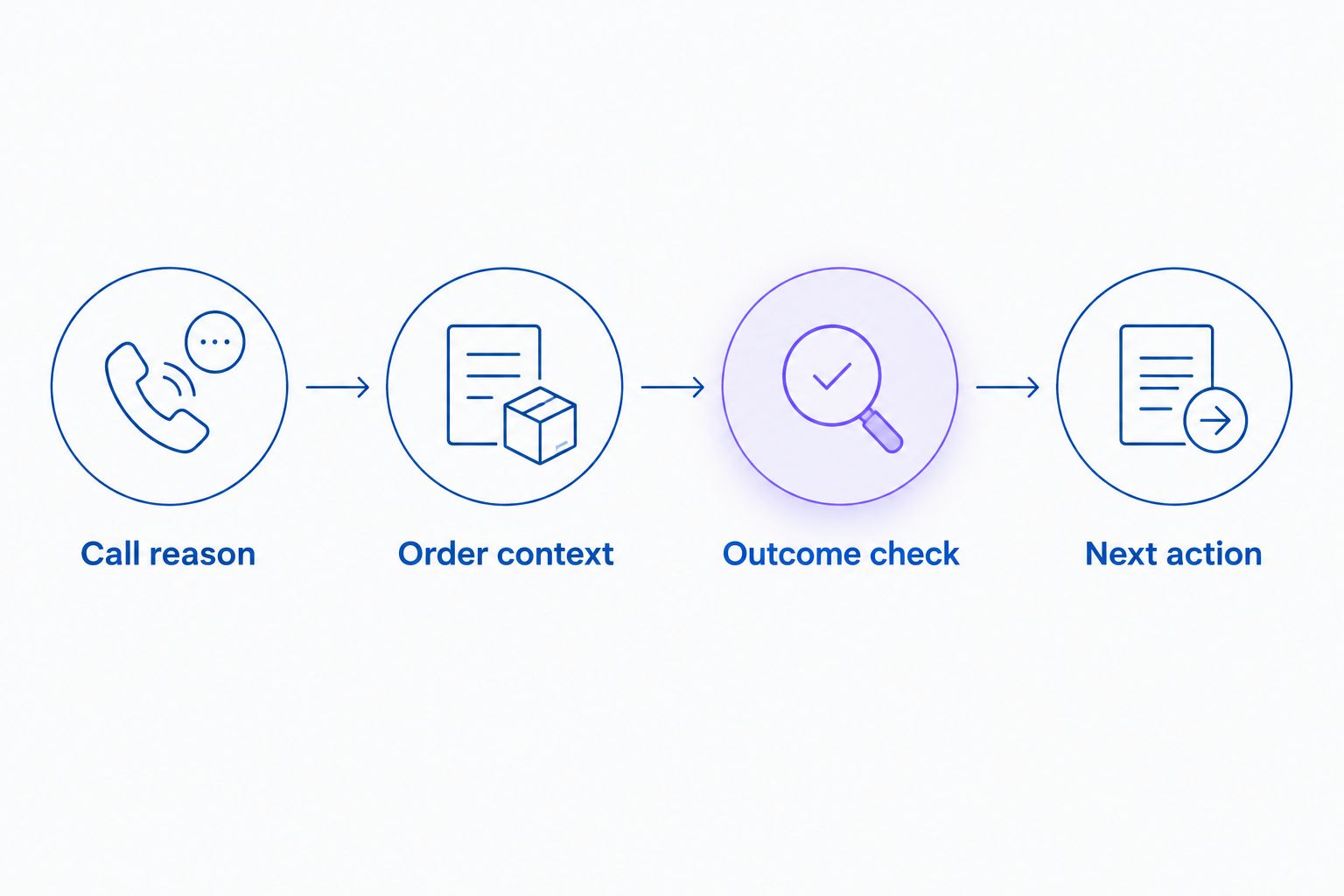
A conversation summary becomes operational evidence only when you check the outcome and assign the next action.
When the same delivery question keeps returning, the decision to automate repetitive customer questions should follow a check of the underlying answer source. Automating an unclear shipping policy repeats the ambiguity; correcting the policy gives both agents and automation a usable answer.
For unresolved cases, define what information must accompany the transfer. The customer's request, verified order context and actions already attempted belong in your human-handoff evaluation, not just a judgment about how natural the voice sounds.
Measure recovery without overstating it
Keep website clicks, app installs, trial starts and paid customers separate in your 2026 reporting. Within outbound calling, also distinguish attempts, connections and completed orders.
A call followed by an order establishes sequence. To establish incremental recovery, use a defined comparison method rather than assigning every later purchase to the call.
The approved internal merchant average for outbound abandoned-cart voice calls is 37x, according to internal data. Individual results vary. That figure is not a forecast for your store, and it should not replace your own order-level review.
Set the attribution window before evaluating results. Specify how your reporting handles customers who also received email or text messages, and keep canceled or refunded orders visible rather than treating every initial checkout as final revenue.
Which ecommerce call tool should you choose?
Choose the tool that closes your current operational gap. Start with Shopify call handling if customers need answers and recovery calls. Choose CallRail for phone-source attribution, Invoca for enterprise marketing conversation analysis, Observe.AI for formal quality assurance, or Dialpad when business calling is part of the same decision.
Before committing, require evidence from the exact workflow you intend to use. A transcript, a correct order action and a defensible attribution report are different deliverables.
FAQ
What's the best AI call analytics tool for an ecommerce store?
The best choice depends on the job: CallRail fits marketing attribution, Observe.AI fits contact-center quality assurance, and Invoca fits enterprise marketing conversation intelligence. Dialpad belongs in a business-calling evaluation; Shopify call automation is a separate operational requirement.
Is an AI phone agent the same as call analytics software?
No. A phone agent handles conversations, while call analytics software examines conversation evidence or call outcomes. Evaluate each capability separately even when a vendor offers both.
Can call analytics prove that a phone call recovered a cart?
A call record alone cannot prove incremental cart recovery. Match the conversation to the order and use a defined comparison method to distinguish attributed orders from incremental results.
What should a Shopify merchant check during a phone-agent trial?
Check order accuracy, refund-policy handling, unresolved requests and abandoned-cart conversations. Compare spoken answers and completed actions with the underlying Shopify records.
Do ecommerce call analytics tools need access to order data?
Order data is necessary when your evaluation concerns order accuracy or completed commerce outcomes. A conversation-only review can assess the words spoken, but it cannot independently confirm that the order action was correct.
Should I choose marketing attribution or quality assurance first?
Choose marketing attribution when the unanswered question is where phone demand originates. Choose quality assurance when the unanswered question is whether agents handle conversations correctly.
What does the internal 37x outbound-call figure mean for my store?
The 37x figure is an internal merchant average for outbound abandoned-cart voice calls, not a store-specific forecast. Individual results vary, so evaluate your own completed orders and attribution method.
One last thing
Review the most positive-sounding conversation in your trial, then check the order record. If the customer heard a confident answer but the required action never happened, your evaluation has found a gap that a summary alone would miss.
Make verified outcomes the acceptance test. That keeps the purchase focused on customer work completed, rather than the appearance of a successful call.