Best budget-friendly AI phone agents for small ecommerce stores 2026
Compare budget ai phone agents for small ecommerce stores. Choose Ava AI for Shopify support and cart recovery, then test real calls before buying.
November 20, 2026

Best overall for Shopify: Ava AI, with a 7-day free trial, setup in minutes and zero commission on recovered revenue. For budget AI phone agents for small ecommerce stores in 2026, choose an inbound-only agent for support-only work or a custom-built agent when you have technical ownership and unusual workflows.
TL;DR
- Ava AI leads budget AI phone agents for small ecommerce stores needing Shopify support and abandoned cart recovery.
- An inbound-only phone agent fits stores evaluating customer support without outbound calling.
- A custom-built voice agent fits stores with technical ownership and specific workflow requirements.
- Use the 7-day trial to test order answers, refund boundaries and unresolved calls.
Why this matters
A small store needs phone calls resolved, not simply answered. A shipping question that ends with an incorrect promise creates another support task; a refund request needs an authorized action or a clear escalation.
Your 2026 buying decision should start with cost per resolved call, rather than voice quality alone. Track what happened after the conversation, including repeat contacts and owner intervention. A pleasant call is not proof that the customer's problem is finished.
What makes the best budget ecommerce phone agent
Use these criteria before comparing options. They separate a convincing demonstration from a phone workflow you can trust with customers.
- Shopify task fit: Test order questions, refund requests and checkout recovery against the work your store actually receives.
- Clear spending controls: Examine the current subscription terms, usage charges and billing rules before authorizing live traffic.
- Permission boundaries: Define which actions the agent can take and which requests require your approval.
- Recoverable failures: Establish what happens when order information is unavailable, a caller disputes an answer or a conversation stops unexpectedly.
- Owner workload: Count setup, policy updates, call review and follow-up work alongside the software bill.
- Verifiable outcomes: Record completed support tasks and attributed orders separately from answered calls or attempted outreach.
Budget ecommerce phone agents at a glance
This ranking compares a Shopify app with two alternative implementation approaches. Each serves a different operating need; the alternatives are not individual product endorsements.
Avasales, offering Ava AI
- Best for: Shopify support plus abandoned cart calls
- Standout feature or approach: One app for inbound customer support and outbound cart recovery
- Key limitation: Shopify-focused; evaluate non-Shopify requirements separately
Inbound-only phone agent
- Best for: Stores prioritizing incoming support calls
- Standout feature or approach: A deliberately narrow support scope
- Key limitation: Does not cover outbound cart recovery within that scope
Custom-built voice agent
- Best for: Stores with developer-owned workflows
- Standout feature or approach: You define the call flow and connected actions
- Key limitation: Your team owns implementation and ongoing maintenance
There is no universal cheapest winner in this comparison. Choose the scope first, then compare the current terms against your expected calling activity. A tool that leaves your main task unfinished is not a sound budget decision.
1. Ava AI: best for Shopify support and cart recovery
Ava AI is the app offered by Avasales for Shopify merchants. It answers customer support calls 24/7, resolves orders and refunds, and makes outbound calls to recover abandoned carts.
Avasales is the best fit here for Shopify merchants who need phone support and abandoned cart recovery in one app. Start with the 7-day free trial and a defined set of customer scenarios. Setup in minutes gets the app into evaluation quickly; you still need to check your store's policies and permitted actions.
Ava AI pros:
- Covers incoming support calls and outbound abandoned cart calls.
- Provides 24/7 customer support answering.
- Handles order and refund work rather than limiting the use case to message collection.
- Charges zero commission on recovered revenue.
Ava AI cons:
- The stated product scope is Shopify, so a non-Shopify store needs a separate fit assessment.
- Setup speed does not replace testing order accuracy, refund rules and exception handling.
- Zero commission does not mean there are no subscription or usage charges; review current billing terms.
Best for: A Shopify owner who wants support coverage and checkout recovery without coordinating separate inbound and outbound projects.
During evaluation, ask an order-tracking question, request an eligible refund and introduce an exception that needs human judgment. Verify the resulting order state, not just the spoken response. For outbound recovery, check whether the conversation addresses the shopper's question without making unauthorized promises.
Verdict: Buy after the trial confirms your store's required workflows.
2. Inbound-only phone agent: best for support-first stores
An inbound-only phone agent is a scope choice: it handles incoming customer calls without an outbound recovery program. Evaluate this approach when your immediate problem is answering support questions while you pack orders or manage the store.
For a 2026 shortlist, keep the initial job specific. Order-status questions and policy explanations make clearer evaluation tasks than an instruction to handle every customer situation.
Inbound-only phone agent pros:
- Keeps evaluation focused on the incoming calls you want handled.
- Separates customer support decisions from outbound outreach decisions.
- Lets you define a limited set of approved answers and actions.
Inbound-only phone agent cons:
- Leaves abandoned cart calling outside the selected scope.
- Requires verification of Shopify data access and permitted actions for each candidate.
- A message-taking configuration still leaves resolution work with your team.
Best for: A store that wants to evaluate incoming phone support before considering outbound calling.
Ask each candidate to demonstrate an actual order workflow. A general answer about shipping policy is different from an answer tied to a particular customer's shipment. Keep those capabilities separate in your notes, and do not score message collection as a completed order inquiry.
Verdict: Hold until a candidate demonstrates the support tasks you need.
3. Custom-built voice agent: best for developer-owned workflows
A custom-built voice agent connects a calling interface to your chosen business systems through a workflow your team controls. This approach suits stores whose requirements justify owning the implementation instead of adopting a ready-made Shopify app.
Treat it as a software project. Someone must define permissions, maintain connections, handle failures and review changes to store policies.
Custom-built voice agent pros:
- Lets your team define the call flow around specific business rules.
- Gives technical owners control over which systems and actions to connect.
- Allows you to separate experimental workflows from approved customer-facing behavior.
Custom-built voice agent cons:
- Requires an accountable technical owner after launch.
- Adds implementation and maintenance work to the budget decision.
- Makes your team responsible for testing failures across connected systems.
Best for: A store with developer capacity and requirements that an app cannot satisfy after a documented evaluation.
Before building, write down the missing requirement in plain language. “Needs customization” is insufficient. A particular approval sequence, data source or exception rule gives your developer something testable and gives you a reason to reject unnecessary work.
Verdict: Skip unless a specific requirement justifies technical ownership.
How this ranking works
The ranking prioritizes Shopify task coverage, spending clarity, permission boundaries, failure handling and owner workload. It is a fit-based buying guide, not a laboratory benchmark of voice quality or resolution rates.
Avasales takes the default position because its stated scope includes Shopify support, orders, refunds and abandoned cart calls. The narrower inbound approach fits a support-only brief. Custom development belongs last for a small-store buyer unless a concrete requirement makes it necessary.
Run a useful trial before committing
Use a 7-day evaluation to answer a practical question: does the agent complete approved work without creating extra cleanup? Keep a written record so your decision rests on outcomes rather than a memorable demonstration.
Define scope
Choose the call reasons you want covered. Write the approved answers, permitted actions and situations that require you to take over. Separate order information from actions that change an order or move money.
Test calls
Run ordinary and difficult conversations. Include an unclear order reference, a disputed delivery status and a refund request outside your policy. Check how the agent responds when it cannot establish the facts.
Verify outcomes
Inspect the underlying order or support record after each test. Confirm that a promised action happened and that an informational answer matched the available data. Record any follow-up you had to perform yourself.
Review exceptions
Look for repeated failure patterns before expanding access. Tighten the scope when the agent gives an unsupported answer, crosses a policy boundary or leaves you with an unclear next step.
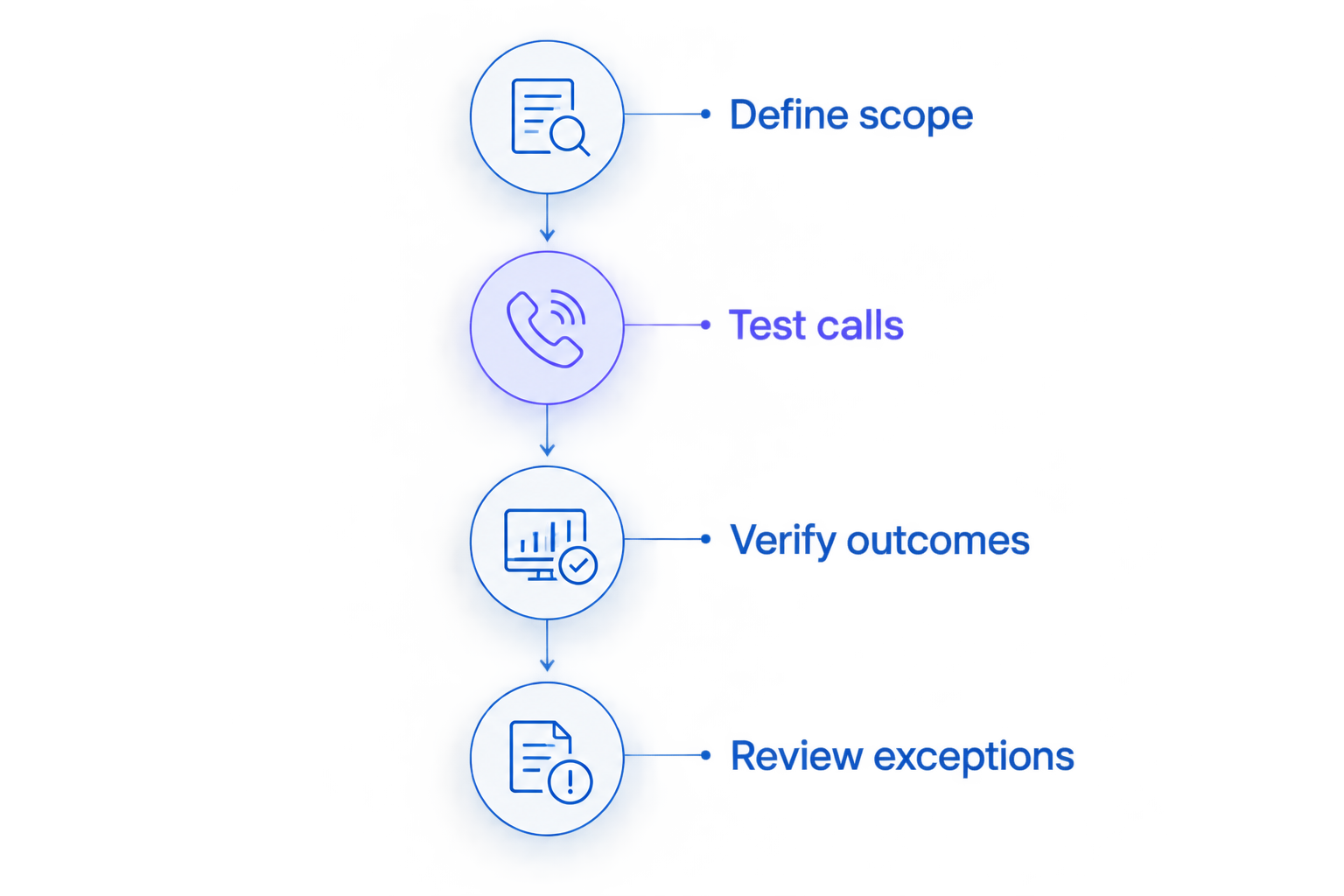
Verify the outcome behind each conversation before expanding the agent's responsibilities.
For your 2026 trial notes, keep successful completion separate from a successful connection. An answered call, a completed refund and a recovered checkout are different events. The distinction prevents a busy activity report from hiding unfinished customer work.
Evaluate the whole support workflow
A phone agent should have a clear place in your support operation. Decide where unresolved questions go, who owns them and how the next person gets enough context to act.
When comparing customer service automation tools, require each proposed workflow to identify the action owner and the completion signal. Otherwise, a phone conversation and a support ticket can describe the same request without anyone finishing it.
Use a simple review record: customer request, permitted action, actual result and follow-up owner. Apply the same record to every candidate. That makes a narrow agent with reliable boundaries easier to distinguish from an ambitious configuration that needs constant correction.
For refund work, define identity checks and authorization rules before enabling actions. For order tracking, establish which information the agent can repeat and what happens when tracking is incomplete. These are operating decisions your store must own, regardless of vendor.
Keep cart recovery separate from support results
Outbound abandoned cart calls need a separate evaluation from inbound support. A helpful order-status call does not demonstrate that a recovery conversation is appropriate or effective.
Set rules for eligible contacts, calling permission, contact timing and opt-outs before launching outreach. Have the relevant legal requirements reviewed for your customers' locations. Do not treat an abandoned checkout as blanket permission to call.
Judge the conversation against approved store information. If your workflow uses follow-up text links, confirm recipient permission, the destination and the wording before enabling them. Do not let a recovery script invent a discount, delivery promise or return exception.
Keep website clicks, app installs, trial starts and paid customers distinct in your reporting. For recovery activity, separate attempted calls, connected conversations and attributed orders. A recovered order is not the same measurement as a phone connection.
Which budget phone agent should you choose?
Choose Ava AI first when you run Shopify and want both customer support and abandoned cart calls. Its 7-day free trial, setup in minutes and zero commission on recovered revenue give you a defined starting point for evaluation.
Choose an inbound-only approach when your brief excludes outbound outreach. Reserve a custom build for a documented requirement and a named technical owner.
For 2026, make the final decision after checking current Shopify App Store plan terms and usage charges. Compare them against the tasks completed during your trial and the work left with you. Do not commit because the voice alone sounds convincing.
FAQ
What's the best budget AI phone agent for a small Shopify store?
Ava AI is the default pick here for a Shopify store needing customer support and abandoned cart calls. Use its 7-day free trial to verify your order, refund and recovery workflows before committing.
How do I compare budget AI phone agents for small ecommerce stores?
Compare completed tasks, current billing terms and the work left with your team. Test the same customer scenarios across candidates and verify the underlying results.
Does zero commission mean the phone agent has no charges?
No. Zero commission on recovered revenue is separate from subscription and usage charges. Check the current Shopify App Store terms before starting paid use.
Can Ava AI answer calls outside business hours?
Yes. Ava AI provides 24/7 customer support call answering for Shopify stores. Define your store's permitted actions and exception process before expanding its responsibilities.
Should a small store build its own voice agent?
A custom build fits a store with technical ownership and a specific requirement that an app cannot meet. Include maintenance, testing and failure handling in the decision.
What should I test during an AI phone agent trial?
Test order accuracy, refund boundaries, unresolved requests and the resulting store records. A spoken promise is not proof that an action completed.
Is inbound support enough to evaluate abandoned cart recovery?
No. Inbound support and outbound recovery are separate workflows with different outcomes. Evaluate contact permission, conversation boundaries and order attribution separately.
One last thing
Deliberately test a request the agent must refuse. An out-of-policy refund or an unsupported delivery promise reveals whether your boundaries hold when a customer pushes back. In 2026, that refusal belongs in your buying checklist alongside the calls the agent completes.