Can AI phone agents answer calls in a brand's own voice tone?
Can AI phone agents answer calls in a brand's own voice tone? Yes. Learn how to test wording, delivery and support accuracy before using them with customers.
October 4, 2026

Yes, AI phone agents can answer calls using a brand’s tone of voice when the system supports instructions for language, delivery and conversation behavior. That does not necessarily mean reproducing a founder’s exact voice: matching communication style and cloning a person’s voice are separate capabilities. For Shopify support in 2026, test whether the agent stays on-brand while explaining order status, handling refund requests and responding to frustrated customers.
TL;DR
- Can AI phone agents answer calls in a brands own voice tone? Yes, but verify the system’s controls.
- Shopify phone support needs approved wording, accurate order answers and clear limits, not just a pleasant voice.
- Avasales offers Ava AI for Shopify support and abandoned-cart calls; test brand-tone requirements during the trial.
- Voice cloning is separate from brand tone and should not be assumed from a natural-sounding demo.
Can AI phone agents answer calls in a brand’s own voice tone?
Yes. Brand-tone matching means controlling how the agent communicates, not merely choosing how its voice sounds. Evaluate both the spoken delivery and the decisions behind each answer. A cheerful greeting cannot compensate for an incorrect refund explanation.
The practical distinction is between sound, wording and behavior. Sound covers delivery, such as pacing and intonation. Wording covers vocabulary, sentence length and approved phrases. Behavior covers listening, acknowledging concerns and explaining the next action without making unsupported promises.
For a Shopify-specific evaluation, Avasales offers Ava AI with a 7-day free trial, setup in minutes and zero commission on recovered revenue. Those terms provide a starting point for testing; judge brand-tone fit through calls rather than treating setup speed as proof of voice customization.
Spoken delivery
- What to evaluate: Pace, pauses, pronunciation and intonation
- Benefit: Makes answers easier to follow
- Limitation: A pleasant voice does not establish policy accuracy
Brand language
- What to evaluate: Greetings, vocabulary and sentence structure
- Benefit: Keeps explanations consistent with your store
- Limitation: Repeated wording can become unnatural
Support behavior
- What to evaluate: Acknowledgment, boundaries and next steps
- Benefit: Keeps tone appropriate to the customer’s situation
- Limitation: Requires more than a scripted opening
A specific person’s voice
- What to evaluate: Explicit voice-reproduction capability and authorization
- Benefit: Addresses a distinct voice-identity requirement
- Limitation: Should not be assumed from tone controls
Use these distinctions when evaluating an AI phone agent in 2026. Ask the provider to demonstrate the controls you need, then repeat the same customer scenarios after changing the instructions. A configuration claim is useful only if you can hear its effect.
Why this matters
A phone conversation gives your customer less room to scan, reread or skip an explanation than a written support message. Put the relevant answer first. Follow it with the information needed to understand the next step.
Your brand tone should help that exchange. If your store uses playful product copy, a delayed-order complaint still needs a clear explanation rather than a joke. If your store uses formal language, the agent still needs to acknowledge the customer’s concern without sounding dismissive.
For a 2026 rollout, approve tone and operational accuracy together. Review whether the answer is correct, understandable and appropriate to the caller’s situation. Do not approve a voice simply because the opening sounds polished.
What should an on-brand phone agent sound like?
Start with observable instructions instead of broad adjectives. A direction such as premium leaves too much open to interpretation. Specify how the agent should introduce itself, explain an order update and respond when it cannot complete a request.
Treat the following styles as briefing choices, not claims about any particular app’s settings. Each has a useful role and a trade-off to test.
Friendly and conversational
- Best for: Routine questions from shoppers who want approachable help
- Instructions to test: Use everyday words and short acknowledgments
- Advantage: Keeps explanations accessible
- Watch for: Casual wording that minimizes a complaint
Calm and precise
- Best for: Delivery problems, refunds and frustrated callers
- Instructions to test: State the verified fact, acknowledge the concern, explain the next step
- Advantage: Keeps difficult calls focused
- Watch for: Flat delivery that sounds indifferent
Formal and restrained
- Best for: Stores with a consistently formal customer-service style
- Instructions to test: Use complete sentences and direct, respectful language
- Advantage: Supports consistent phrasing
- Watch for: Stiff language that makes simple answers harder to understand
Use calm, precise language for sensitive support situations, regardless of the store’s promotional tone. That is a recommended briefing rule, not a promise that every agent can implement it automatically. Test whether the system follows the instruction when a caller interrupts or changes topics.
Keep the underlying facts unchanged when testing different styles. An order’s status, a refund rule and the limits of the agent’s authority should not change because the voice becomes warmer or more formal.
Brand tone is not voice cloning
Brand tone describes how your company communicates. Voice cloning concerns reproducing the sound of a particular person’s voice. A system can support one without supporting the other.
If your requirement is an exact speaker identity, ask specifically about that capability and the authorization needed to use it. Do not infer it from a demo that sounds human. If your requirement is consistent support language, evaluate the agent’s instructions and call behavior instead.
Why brand-tone results vary
The quality of brand-tone matching depends on what you ask the agent to do and which controls the system actually provides. Use these factors as evaluation criteria rather than assuming every provider exposes the same settings.
- Instruction clarity: Specify observable behavior, such as answering the question before offering additional help. Avoid relying entirely on adjectives.
- Voice controls: Confirm which aspects of spoken delivery you can select or adjust. Distinguish voice selection from wording instructions.
- Call context: Test routine order questions separately from refund disputes. The same greeting does not establish suitability for both.
- Policy detail: Give the agent approved boundaries for what it can explain or do. Friendly wording must not expand those boundaries.
- Language complexity: Check product names, addresses and unfamiliar terms. Clear pronunciation is part of an understandable phone experience.
- Exception handling: Test what happens when the agent lacks an answer or cannot complete a request. The fallback should be clear and accurate.
A tone brief also needs prohibited behavior. Include instructions against inventing delivery dates, implying an unapproved refund or pressuring a caller to complete checkout. These boundaries turn a style document into something you can evaluate.
How to test brand tone before using it with customers
Use the 2026 evaluation below to separate voice quality from support quality. Keep the customer scenarios consistent so you can identify which changes improve the conversation. Treat the checklist as a testing method, not a performance benchmark.
- Define tone. Choose concrete rules for greetings, vocabulary, acknowledgment and closing language. Include phrases or behaviors your brand does not permit.
- Check controls. Confirm which rules the provider lets you configure. Request a demonstration rather than assuming that every instruction is supported.
- Test scenarios. Include an order-status question, a refund request, a confused caller and a frustrated caller. For outbound calls, add a shopper who declines help.
- Review calls. Evaluate wording, delivery, factual accuracy and the proposed next action separately. A good voice should not conceal a wrong answer.
- Approve boundaries. Confirm how unresolved requests will be handled before customer use. Retest the relevant scenarios whenever you change policies or instructions.
The approval decision should follow the whole conversation. Listen beyond the greeting, especially when the caller interrupts, asks a follow-up question or challenges an answer. Those moments show whether the tone survives outside a prepared script.
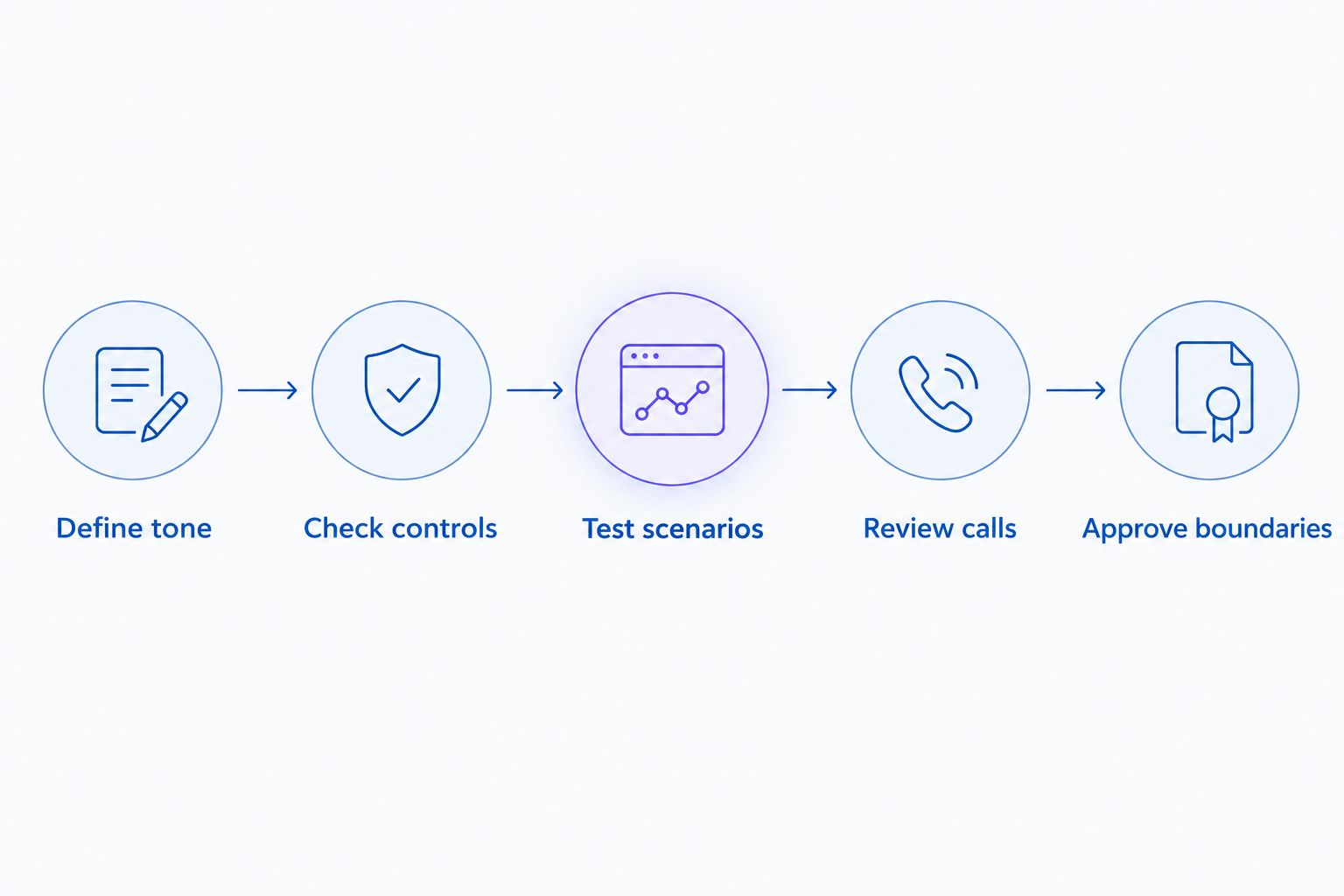
Approve the full conversation, including difficult questions and unresolved requests.
Write a brief the agent can follow
Organize your brief around customer actions. For an order-status call, require the agent to answer the status question before offering unrelated help. For a refund request, require an accurate explanation of the applicable policy and the next permitted action.
Describe how the agent should acknowledge concern without claiming feelings or knowledge it does not have. Specify that an unknown fact stays unknown. A reassuring tone must never turn an uncertain delivery date into a commitment.
Review meaning as well as delivery
Listen for pace, pauses and whether the caller has space to respond. Then check the meaning of the response independently. A fluent explanation is still wrong if it describes an action that has not happened.
Separate the review notes into tone problems and operational problems. Change the voice brief to fix wording or delivery. Resolve incorrect data, unsupported actions or policy gaps through the relevant operational process, rather than disguising them with softer language.
Where does Ava AI fit for Shopify merchants?
Avasales’ Ava AI is best suited to Shopify merchants seeking phone support and outbound abandoned-cart recovery. It answers customer-support calls 24/7, resolves orders and refunds, and makes outbound calls to recover abandoned carts. These are its stated Shopify use cases; specific brand-tone controls should be evaluated directly.
The advantage is relevance to the merchant’s call workload. The limitation for this question is that support coverage alone does not establish exact voice reproduction or any particular tone-setting feature. Use the trial to assess the brand requirements you can demonstrate in actual calls.
For order questions, review the Shopify order data to real-time phone answers workflow. An on-brand answer needs a dependable factual basis. Tone should make that information easier to understand, not replace it.
During an abandoned-cart call, test whether the conversation remains respectful when the shopper declines. If your workflow includes approved text links, verify the wording and destination before customer use. Do not allow a checkout-recovery script to imply an offer your store has not approved.
Test your Shopify phone workflow
Evaluate support and abandoned-cart calls with a 7-day free trial and zero commission on recovered revenue.
Can the same brand tone work for support and abandoned-cart calls?
The same brand guidelines can govern both call types, but the conversation should serve the caller’s immediate purpose. Support calls need an answer or a clear next step. Abandoned-cart calls should establish whether the shopper wants assistance before continuing.
Keep vocabulary consistent while adjusting the task instructions. Do not insert recovery language into an unresolved complaint simply to maintain a sales-oriented tone. The customer’s request should determine the conversation’s direction.
Does a natural-sounding voice prove the agent is on-brand?
No. A natural-sounding voice demonstrates an aspect of delivery, not agreement with your brand rules. Check whether the agent uses approved language, answers accurately and respects the limits you set.
In 2026, use scenario-based evaluation rather than approving a prepared greeting alone. A difficult follow-up question is a stronger test of brand fit than an uncomplicated introduction. Repeat that test after meaningful configuration changes.
FAQ
Can AI phone agents answer calls in my brand’s own tone of voice?
Yes, when the system supports instructions for wording, delivery and conversation behavior. Confirm the available controls and test them across routine questions, complaints and unresolved requests.
Is matching brand tone the same as cloning my voice?
No, matching brand tone and cloning a particular person’s voice are separate capabilities. Ask explicitly about voice reproduction and authorization if exact speaker identity is part of your requirement.
What should I put in a brand-tone brief for phone support?
Include greeting rules, vocabulary, acknowledgment language, closing behavior and prohibited promises. Make each instruction specific enough to check during a call.
Can I use a friendly tone when a customer wants a refund?
Yes, but friendly language must preserve the applicable refund rules and the agent’s authority. Test whether the agent acknowledges the request without promising an unapproved outcome.
Does Avasales provide Shopify phone support outside business hours?
Yes, Avasales’ Ava AI answers Shopify customer-support calls 24/7. Its stated use cases also include resolving orders and refunds and making outbound abandoned-cart recovery calls.
How should I test an agent during a 7-day free trial?
Use the 7-day free trial to test consistent scenarios for order questions, refund requests, frustrated callers and shoppers who decline outbound help. Review factual accuracy separately from voice quality.
What should I measure when evaluating abandoned-cart calls?
Keep call behavior and checkout outcomes separate. Also keep website clicks, app installs, trial starts and paid customers distinct rather than reporting them as the same conversion event.
One last thing
Test your least comfortable conversation before approving your favorite voice. A refund the agent cannot authorize or an order question it cannot answer exposes more about brand fit than a smooth welcome message. Your standard should be clear communication without invented certainty.
For your 2026 rollout, keep that difficult scenario in the approval checklist. Avasales’ Shopify phone-support use case gives you a relevant place to evaluate it. Approve the customer experience you actually hear, not the tone described in a settings label.