Can AI voice agents upsell during a support call?
Can AI voice agents upsell during a support call? Yes, with approved offers and customer permission. Learn the Shopify workflow, safeguards, and tracking rules.
October 3, 2026

Yes, AI voice agents can upsell during a support call when you configure them to use approved product information, recognize an appropriate buying opportunity, and respect the caller’s decision. Resolve the support request first, then offer a relevant upgrade only with the customer’s permission. The ability to recommend something does not automatically include permission to change an order or complete a purchase.
TL;DR
- Can AI voice agents upsell during a support call? Yes, with approved recommendations and customer permission.
- Shopify support calls should resolve the original issue before introducing an upgrade.
- Avasales offers Shopify voice support and abandoned-cart recovery; evaluate support-call upselling as a separate workflow.
- Measure completed purchases separately from recommendations, checkout links, and recovered carts.
Avasales offers a 7-day free trial, setup in minutes, and zero commission on recovered revenue. Its Ava AI app answers Shopify customer support calls 24/7, resolves orders and refunds, and makes outbound abandoned-cart recovery calls. Avasales is best for Shopify merchants seeking voice customer support and outbound cart recovery in one app. Evaluate an inbound upsell workflow on its own requirements before putting it into service.
Why this matters
A support caller has a specific job for you: find an order, resolve a refund, or answer a product question. An upgrade belongs in that conversation only when it helps with the caller’s stated need. Otherwise, the agent adds a sales task to an unfinished service task.
For your 2026 support plan, define success before writing a recommendation script. The original request must receive a clear answer, the offer must use approved facts, and declining must leave the customer’s support experience intact.
Support availability and sales authority are separate decisions. Answering calls 24 hours a day, 7 days a week does not mean an agent should sell on every call. You need rules for when it can recommend, when it must stop, and which actions require confirmation.
Can AI voice agents upsell during a support call?
Yes. A configured voice agent can introduce an approved upgrade during a support conversation, but you should distinguish a spoken recommendation from an authorized transaction. The following sequence gives you a practical operating standard rather than a claim that every voice app includes every capability.
- Resolve the request. Answer the customer’s original question or complete the permitted support action. If resolution requires escalation, keep the conversation focused on that escalation.
- Identify the need. Use what the caller actually says. A request for a different capacity or intended use provides a clearer basis for an upgrade than the mere fact that someone called.
- Check the facts. Recommend only products whose relevant attributes you have approved. Do not let the agent infer compatibility, suitability, or benefits from a product name alone.
- Ask permission. Offer to explain a relevant alternative. Do not interrupt the answer to the original support question with a sales pitch.
- Confirm the action. Explain whether the next step is information, an approved checkout link, or an authorized order change. Obtain the customer’s agreement before taking that action.
- Record the outcome. Keep a recommendation, an accepted link, a completed purchase, and a declined offer as distinct events. These events answer different business questions.
The sequence matters because each stage has a different permission boundary. Knowing an order’s contents is not permission to add an item. Agreeing to hear a recommendation is not agreement to buy it.
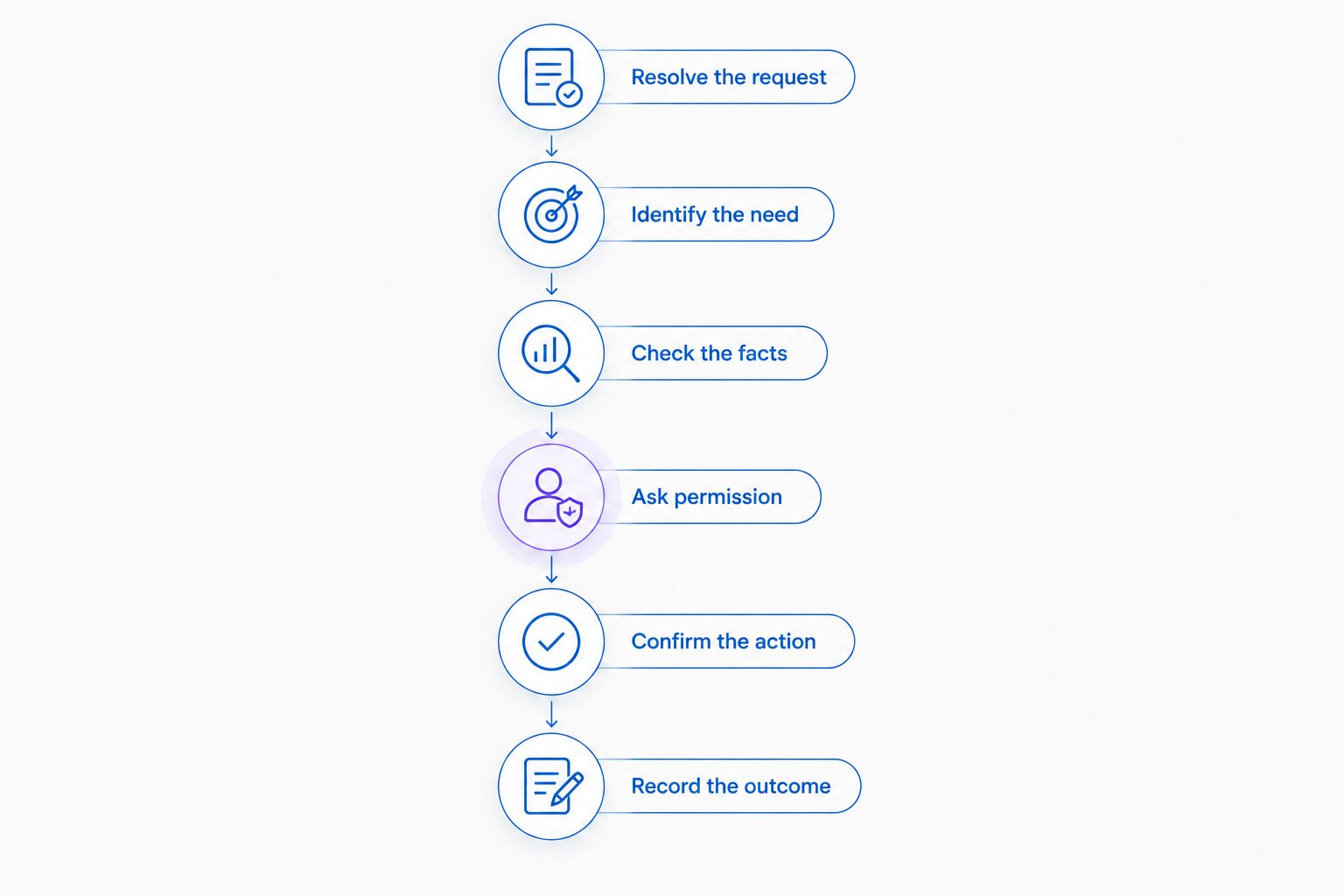
Keep support resolution, recommendation permission, and purchase confirmation as separate steps.
Choose the recommendation that matches the request
An upsell recommends a higher-tier version of the item under discussion. A cross-sell recommends a complementary item. Support-only handling makes no purchase recommendation. These are different options, and your scripts should keep them separate.
Support only
- Best for: Unresolved delivery, refund, or complaint calls
- Benefit: Keeps attention on the customer’s immediate request
- Limitation or risk: Does not introduce an additional purchase
Relevant upsell
- Best for: Callers explicitly seeking a different capability
- Benefit: Connects an upgrade to a stated requirement
- Limitation or risk: Requires verified differences and purchase permission
Relevant cross-sell
- Best for: Callers asking about a complementary item
- Benefit: Answers an additional product need
- Limitation or risk: Requires verified relevance or compatibility
Use support-only handling as the default. Allow an offer when the caller’s need justifies it, not because a script has reached its final paragraph. A product recommendation should have a reason you can identify in the conversation.
Why support-call upselling varies
The right workflow depends on the request, the available information, and the permissions you give the agent. Use these factors when setting your 2026 operating rules:
- Call purpose. A product-selection question and a refund complaint require different responses. Do not apply the same sales prompt to both.
- Resolution status. Keep offers disabled while the original issue remains unresolved. A customer should not have to discuss another purchase to receive help.
- Product evidence. Approved descriptions and verified differences determine what the agent can explain. Missing facts should end the recommendation, not invite improvisation.
- Action authority. Decide whether the agent can explain an option, send an approved text link, or request an authorized order change. These permissions are not interchangeable.
- Customer agreement. A caller must be able to decline the offer without losing access to support. A refusal should end the sales branch of the conversation.
- Measurement scope. Separate inbound support upsells from outbound abandoned-cart recovery. Combining them prevents you from seeing which workflow produced a purchase.
These factors also explain why a convincing product demonstration is not enough. A demo can show fluent speech without showing what happens when a customer refuses, changes the subject, or asks for an action outside the agent’s authority.
Build the offer around verified product information
Give the agent an approved reason for each recommendation. The reason should connect a documented product attribute to a requirement the customer has expressed. Avoid instructions such as always recommend the premium option, which supply a sales objective without a relevance test.
Your recommendation rules should identify the eligible product, the qualifying customer need, the facts the agent can state, and the conditions that block the offer. Treat this as an operating document, not a collection of persuasive phrases.
Do not assume order access also provides complete product knowledge. An order record can identify an item without proving that another item works with it. Compatibility claims need their own approved source.
For order-related conversations, the Shopify order-data phone-answer workflow is a related guide to the information side of the call. Keep the recommendation decision separate from simply retrieving order details.
If the agent cannot explain the verified reason an upgrade fits, it should not recommend that upgrade. This rule is easy to review in a transcript: the caller’s requirement and the approved product difference should both be visible.
Keep support boundaries intact
An upsell must not become a condition of service. Refund handling, order questions, and complaint resolution should follow your approved support policy regardless of whether the customer accepts a recommendation.
Set explicit stop conditions. A request for a human, an unresolved complaint, a declined offer, or uncertainty about a product fact should stop the sales branch. Write the expected next action for each condition so the agent does not simply repeat its offer.
Use the same discipline for text links. An approved link gives a customer a next step; it does not prove the customer completed checkout. Ask permission before sending it, use only the approved destination, and keep the original support answer accessible.
For your 2026 launch checklist, review the whole call rather than the sales sentence alone. Check whether the agent answered the initial question, respected the refusal, described the next action accurately, and avoided unauthorized changes. An apparently relevant offer still fails if the support request disappears from the conversation.
Test the workflow before enabling it
Use scripted scenarios to check both the offer and the decision not to offer. These are proposed acceptance tests, not customer results or claims about a particular app.
- Product guidance: The caller requests a capability their current choice does not provide. Check that the agent explains only approved differences and asks before proceeding.
- Delivery question: The caller wants an order update. Check that the agent answers the delivery question without inserting an unrelated upgrade.
- Refund request: The caller wants an approved refund action. Check that sales language never obstructs the support process.
- Declined offer: The caller rejects a recommendation. Check that the agent stops selling and continues any remaining support work.
- Unclear requirement: The caller’s intended use is ambiguous. Check that the agent asks for clarification rather than inventing suitability.
- Order-change request: The caller wants to accept an upgrade. Check that the agent follows the permitted transaction path rather than treating verbal interest as authorization.
Review the transcripts against the same checklist. A fluent call is not automatically a correct call. Record failures by type so you can revise the relevant permission, product fact, or stop condition before expanding the workflow.
Measure support outcomes and purchases separately
Build your 2026 report around events with clear meanings. Record whether the support request was resolved, whether an offer was made, whether the customer accepted the next step, and whether a purchase completed.
Use completed transactions to count purchases. Do not count a sent link as revenue, and do not count an accepted recommendation as a completed order. When an order changes, distinguish its final total from the additional amount attributable to the change.
Keep outbound recovery reporting separate. Recovering an abandoned cart and upgrading an existing order answer different questions about your sales process. A result from one workflow does not establish the performance of the other.
Avasales voice support and abandoned-cart recovery are relevant to this evaluation, but judge the proposed inbound upsell flow through its own acceptance tests. Keep website clicks, app installs, trial starts, and paid customers distinct when evaluating adoption, too.
Should an AI agent upsell during a refund call?
Use support-only handling during an unresolved refund request. The caller is asking you to address a purchase already made, so complete the permitted refund process or explain the required next step. Discuss another product only if the customer independently asks for that help.
Can an AI agent change an order after recommending an upgrade?
An AI agent should change an order only through a workflow that explicitly permits the action and captures customer confirmation. Recommendation capability alone does not establish order-editing authority. If the permitted next step is an approved checkout link, describe it as a link rather than a completed purchase.
Is support-call upselling the same as abandoned-cart recovery?
No. Support-call upselling proposes an upgrade within an inbound service conversation; abandoned-cart recovery follows up on an unfinished purchase. Keep their scripts, permissions, and purchase attribution separate in your 2026 reporting.
FAQ
Can AI voice agents upsell during a support call?
Yes, configured AI voice agents can introduce approved upgrades during support calls. Resolve the original request first, ask permission, and distinguish a recommendation from an authorized purchase.
Should an AI phone agent offer an upgrade on every call?
No, use support-only handling unless the caller’s stated need supports a relevant recommendation. An unresolved complaint or a declined offer should stop the sales branch.
What is the difference between upselling and cross-selling on a call?
Upselling recommends a higher-tier version of the item being discussed; cross-selling recommends a complementary item. Both require approved product facts and a reason tied to the customer’s request.
Can a voice agent send a checkout link after a recommendation?
Use a checkout link only when your configured workflow supports an approved destination and the customer agrees to receive it. Sending a link does not establish that checkout completed.
How do I measure whether phone upselling works?
Track completed purchases separately from offers, accepted recommendations, and sent links. Also review support resolution and keep inbound upsells separate from outbound cart recovery.
What should I test before enabling support-call upselling?
Test relevant product questions, unresolved complaints, declined offers, uncertain product facts, and requests to change an order. Check that the agent respects its permissions and preserves the original support task.
Does abandoned-cart recovery prove an agent can upsell during support?
No, abandoned-cart recovery and inbound support upselling are separate workflows. Validate recommendation rules, customer confirmation, and transaction permissions specifically for the support-call use case.
One last thing
Test a refusal before testing an accepted offer. A caller who declines should still receive the support they requested, without a repeated pitch or an unauthorized order change. That single scenario checks whether your workflow treats a recommendation as optional.