AI vs Email Cart Recovery: Test the Lift in 2026
Can an AI agent recover more abandoned carts than email alone? Test calls alongside email, compare completed orders, and separate attribution from added recovery.
October 2, 2026
An AI agent can add a live conversation to abandoned-cart recovery, but whether it recovers more carts than email alone requires a controlled comparison in your store. Keep email running, test calls as an additional channel, and judge the result by extra completed orders rather than purchases that happen after a call.
TL;DR
- Can an AI agent recover more abandoned carts than email alone? Test additional completed orders, not call-attributed purchases.
- Avasales offers Shopify abandoned-cart recovery calls; email should remain the comparison baseline.
- Avasales reports a 37x internal merchant average for outbound abandoned-cart voice calls, not a measured advantage over email.
- Use the same email sequence in both test groups and add calls only to the treatment group.
Why this matters
An abandoned checkout tells you that a purchase stopped. It does not tell you why. A reminder addresses a forgotten cart; a conversation lets a customer explain the obstacle and ask a follow-up question.
Avasales offers Ava AI, a Shopify voice agent for outbound abandoned-cart recovery and customer support calls. The product offers a 7-day free trial and setup in minutes. Treat that trial as an opportunity to check the workflow, not as automatic proof of additional sales.
Avasales is best suited to Shopify merchants seeking voice-based abandoned-cart recovery alongside phone support. Its support coverage is 24/7, but continuous inbound availability is not permission to place recovery calls at every hour.
Can an AI agent recover more abandoned carts than email alone?
A voice agent adds a different way to resolve checkout questions; a controlled test establishes whether that produces more completed orders. A purchase following a call is not enough to establish the difference. That customer also received email and might have returned without the call.
The practical comparison is email alone versus the same email sequence plus calls. Testing calls against no follow-up answers a different question and does not establish an advantage over email.
Email alone
- Best for: Customers who prefer written reminders and links
- Advantage: Gives customers a message they can revisit on their own schedule
- Limitation: Does not provide a live conversation within the email itself
Voice calls alone
- Best for: Customers willing to discuss a checkout question by phone
- Advantage: Lets customers explain the obstacle and ask follow-up questions
- Limitation: Requires appropriate calling permission and a customer who answers
Email plus voice calls
- Best for: Merchants testing whether conversation adds recovery beyond reminders
- Advantage: Combines written follow-up with spoken assistance
- Limitation: Needs coordinated outreach and a clean comparison to establish additional recovery
The table compares channel functions, not measured conversion rates. For a 2026 recovery test, choose the combined approach only when you can separate its effect from your existing email results.
What the 37x figure does and does not establish
Avasales reports a 37x internal merchant average for outbound abandoned-cart voice calls. Individual results vary. This figure is not evidence that calls recover 37x more carts than email, and it should not appear in an email-versus-calling comparison as a recovery multiplier.
An internal merchant average and a controlled channel comparison answer different questions. Use your store's completed-order results to answer the headline question; do not substitute the 37x figure for that comparison.
Email alone: best for written, customer-paced follow-up
Email gives you a written reminder that the customer can open when convenient. The customer can revisit the message, review the checkout link, and decide without participating in a conversation.
Keep the message useful. Identify the abandoned checkout, provide an appropriate return path, and make it clear how the customer can ask for help. Do not add an offer that your store has not approved.
Email's limitation is the gap between sending a reminder and understanding the customer's objection. A customer can reply, but an automated sequence does not itself conduct a live exchange. If your message fails to address the actual question, sending another reminder does not establish that the problem was solved.
Keep email as the baseline in your 2026 test. Changing subject lines, timing, or offers while introducing calls makes the channel comparison harder to interpret.
Voice calls: best for discussing a checkout obstacle
A voice conversation lets the customer state the reason they stopped. Your recovery script should first establish whether help is wanted, then address the relevant question within approved store policies.
For example, a customer asking about delivery needs an accurate explanation of the applicable shipping information. A customer asking about returns needs the actual return policy. These are script-design examples, not claims about why your customers abandon checkout.
The limitation is reach and permission. A phone number in a checkout record does not, by itself, establish that every form of outbound calling is permitted. Review the applicable consent, calling, disclosure, and opt-out requirements before launching automated outreach.
Do not use a call to pressure a customer who declines help. Define how the workflow records that request, stops further calling, and handles questions outside its approved scope.
Email plus voice: best for testing additional recovery
A combined workflow preserves the written reminder while adding a chance to discuss the checkout. The purpose is to help the customer complete an intended purchase, not to increase the number of touches for its own sake.
Set rules for the interaction between channels. A completed purchase should remove the checkout from further recovery outreach. A request to stop calls should change calling eligibility, and a question requiring a person should follow a defined escalation process.
Coordination is the main operational drawback. Without shared order status and clear stop conditions, a customer can receive a recovery message after purchasing or receive repeated follow-up that adds no help.
The guide to recovering abandoned Shopify carts with a voice agent covers the workflow behind the channel. Evaluate that workflow separately from the sales result: functioning automation is necessary, but it is not proof of additional orders.
Why recovery results vary
Your test needs to distinguish channel performance from differences in who receives outreach. Keep these factors visible in the test design:
- Customer eligibility: Email permission and outbound-calling permission are separate considerations. Compare results within a clearly defined eligible population.
- Contact success: Sending an email and placing a call are outreach events, not completed conversations or orders.
- Checkout obstacle: A reminder and a spoken explanation serve different purposes. Record the questions customers actually raise rather than assuming their reasons.
- Answer quality: Calls should use approved store information. An unsupported delivery promise or invented return exception is not successful recovery.
- Channel coordination: Purchase status, stop requests, and follow-up rules determine whether the workflow avoids unnecessary outreach.
- Measurement method: Call-attributed revenue and additional completed orders are different measures. Choose the latter to answer whether calls beat email alone.
These factors do not predict a conversion increase. They define what you must control or inspect before treating a difference as a channel result.
How to test calls against email alone in 2026
Use a randomized comparison within your eligible abandoned-checkout population. Keep the email experience consistent and change only whether the customer receives recovery calls. Write the rules before the test starts so a promising early result does not change how you count success.
1. Define eligibility
Specify which abandoned checkouts qualify for the experiment. Check calling permission, available contact information, purchase status, and any store-defined exclusions before assignment.
Apply the same eligibility rules throughout the test. Do not send difficult cases to one group and easier cases to the other, because the resulting difference would mix customer selection with channel performance.
2. Assign groups
Randomly assign eligible customers to email alone or email plus calls. Assign at customer level when repeated checkouts would otherwise expose the same person to both experiences.
Keep the allocation stable. Moving customers between groups after they answer a call or place an order undermines the original comparison.
3. Keep email fixed
Use the same email sequence, approved offers, and checkout experience for both groups. Document any storewide changes during the experiment, including changes that affect checkout or the information customers receive.
The calling group should differ because of the call workflow, not because it also receives a different email campaign. Otherwise, you cannot identify which change produced the result.
4. Track orders
Measure completed orders within a defined observation window for both groups. Count all qualifying orders under the same rule, not only purchases made through a call-related link.
Also record cancellations and refunds under a consistent policy. A completed order and an order that remains valid are useful but distinct outcomes; do not silently switch between them in reporting.
5. Compare outcomes
Compare the completed-order rate between the assigned groups. Report the difference alongside the number of eligible customers and completed orders in each group.
Use an appropriate statistical assessment before treating an observed difference as repeatable. A short experiment with few orders is a workflow check, not a dependable forecast.
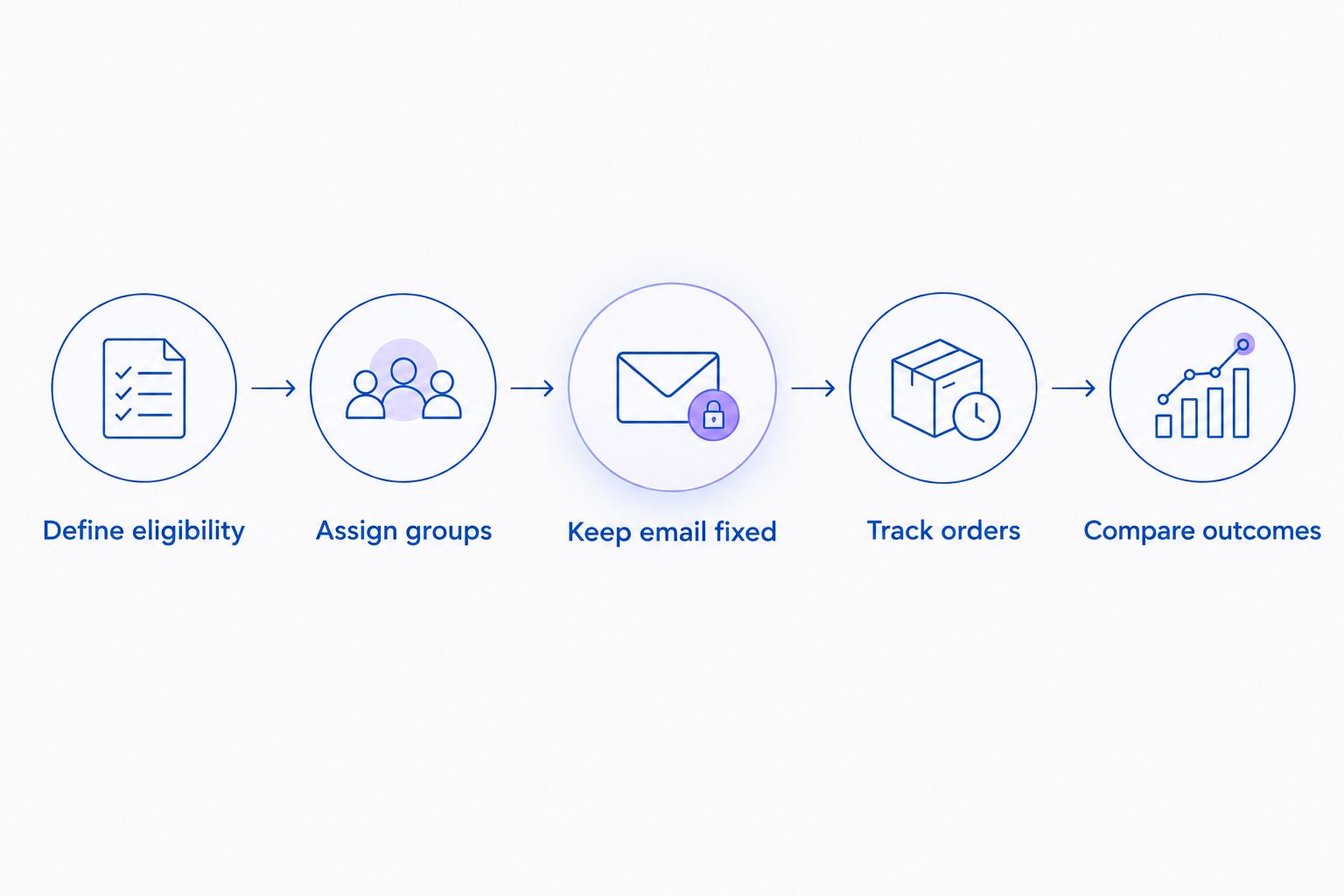
Keep email fixed so the comparison measures the addition of calls.
A 2026 test report should distinguish outreach activity from business outcomes. Place attempted calls, answered calls, completed orders, and retained orders in separate fields. An answered call is evidence of contact, not evidence of recovery.
Set the decision rule before launch
Define what would justify continuing the calling workflow. Consider additional orders, the resources required to run the channel, customer stop requests, and unresolved questions.
Do not select a reporting window because it makes one group look stronger. Use the same observation rule for both groups and preserve the original assignments when calculating the result.
Expand only after the comparison supports expansion. If the result is unclear, inspect eligibility, contact success, and the questions raised before changing the script or adding more outreach.
What to check during a 7-day trial
Use the 7-day trial to inspect whether the recovery workflow behaves as intended. Test checkout identification, current purchase status, approved answers, and the process for stopping follow-up.
Avasales also provides 24/7 phone customer support, including order and refund handling. Those capabilities are relevant when evaluating a broader Shopify phone workflow, but support activity must remain separate from abandoned-cart recovery results.
For your 2026 evaluation, review actual call outcomes without treating every helpful conversation as a recovered cart. Confirm that your reporting distinguishes a question answered from an order completed.
A trial start is also different from a paid customer. Keep website visits, app installs, trial starts, and paid subscriptions separate when evaluating the product itself.
Evaluate your recovery call workflow
Use the 7-day trial to check checkout recovery and customer support calls before expanding outreach.
Should I replace abandoned-cart emails with AI calls?
Keep abandoned-cart email running while testing calls as an additional channel. Replacing email immediately removes the baseline you need to answer whether voice adds recovery. It also removes the written follow-up option for customers who prefer not to talk.
Does a purchase after a recovery call prove the call worked?
A purchase after a recovery call proves sequence, not causation. Compare completed-order outcomes against the email-only group to estimate whether the calling workflow added purchases beyond the existing sequence.
Can a 7-day trial prove that calls outperform email?
A 7-day trial is useful for checking the workflow, not automatically proving channel superiority. The strength of the comparison depends on eligible customers, completed orders, and consistent observation rules, not the trial label.
FAQ
Can an AI agent recover more abandoned carts than email alone?
Whether an AI agent recovers more abandoned carts than email alone requires a controlled comparison in your store. Keep the email sequence identical and add calls only to the treatment group.
What's the best way to compare recovery calls with email?
Randomly compare email alone with the same email sequence plus recovery calls. Measure completed orders under the same eligibility and observation rules for both groups.
Does Avasales recover 37x more carts than email?
The approved 37x figure is Avasales' internal merchant average for outbound abandoned-cart voice calls, not a measured recovery advantage over email. Individual results vary.
Should I stop abandoned-cart emails when I add calls?
Keep abandoned-cart emails running while you test calls as an additional channel. Removing email prevents a clean comparison of the additional recovery from calling.
Can I call every customer who leaves a phone number?
A checkout phone number alone does not establish permission for every form of automated outbound calling. Review applicable consent, calling, disclosure, and opt-out requirements before launching the workflow.
Does a 7-day trial show whether recovery calls work?
A 7-day trial lets you check workflow behavior, but it does not automatically establish additional sales. A reliable comparison requires enough eligible customers and completed orders under consistent measurement rules.
What should I count as an abandoned-cart recovery result?
Count qualifying completed orders using the same rule for both test groups. Report calls, conversations, cancellations, and refunds separately so outreach activity does not become a substitute for sales outcomes.
One last thing
An order placed before a scheduled recovery call must not become evidence that the call recovered it. Recheck purchase status before outreach, and keep pre-call purchases separate from call activity in your reporting. That single measurement rule protects both the customer experience and the credibility of your comparison.