Does an AI phone agent need access to my Shopify admin to function?
AI phone agent Shopify admin access should match its tasks, not grant full control. Learn what to approve for order tracking, refunds and cart recovery.
November 11, 2026

An AI phone agent needs authorized access to Shopify data to answer order-specific questions or perform store actions, but it does not need your Shopify admin password. An agent answering only general policy questions can work without live order access. In 2026, assess the permissions requested by the actual app, then approve only the access that its supported tasks justify.
TL;DR
- AI phone agent Shopify admin access should match specific tasks, not include unrestricted store control.
- Shopify order tracking requires customer-specific data; general policy answers do not.
- Reading an order and issuing a refund require different authority.
- Avasales offers Shopify phone support and cart recovery; review permissions before enabling store actions.
Avasales offers a 7-day free trial, setup in minutes and zero commission on recovered revenue. Start your assessment at Avasales, then review the installation permissions before authorizing access. Keep the trial decision separate from the decision to enable actions affecting customer orders.
Does an AI phone agent need access to my Shopify admin to function?
It needs access to the information or actions behind its assigned job, not unrestricted access to your admin account. Shopify apps can receive authorized API access without signing in as the store owner. The API is the connection through which software requests store information or performs permitted actions.
The practical distinction is between answering a general question, reading a private record and changing that record. Those are different responsibilities. Use this comparison when reviewing a phone agent in 2026:
General policy answers
- Access to assess: Approved policy content; no live order lookup required
- Best for: Store hours and general return questions
- Benefit: Keeps customer records outside the workflow
- Limitation or risk: Cannot confirm an individual order's status
Order tracking
- Access to assess: Relevant order and fulfillment information
- Best for: Customers asking where an order is
- Benefit: Grounds the answer in an actual record
- Limitation or risk: Requires customer verification before disclosure
Refund handling
- Access to assess: Order information and the authority required for supported refund actions
- Best for: Approved refund requests
- Benefit: Allows a workflow to move beyond an explanation
- Limitation or risk: Incorrect authorization can affect customer funds
Abandoned-cart calls
- Access to assess: Relevant checkout and customer contact information
- Best for: Following up on eligible abandoned checkouts
- Benefit: Gives the call context about the unfinished purchase
- Limitation or risk: Requires contact rules and careful data handling
These are task-level requirements, not a statement of any particular app's permission list. Inspect the current installation request instead of assuming every phone agent requests the same access.
Why this matters
Store access determines both what the agent can resolve and what it can expose or change. A general policy assistant cannot truthfully confirm a shipment from policy text alone. An order-connected assistant also needs rules governing which caller receives that information.
Treat installation approval as an operational decision. Your review should connect every permission to a customer task, identify the actions that require approval and define what happens when the agent cannot establish the facts.
A useful 2026 evaluation asks whether the connection supports your intended workflow without granting unrelated authority. A polished call demonstration does not answer that question.
General answers: no live order access required
Best for: answering questions that do not depend on a customer's private records. An agent can explain your published return policy, describe how customers request help or repeat approved shipping guidance without retrieving an individual order.
The advantage is a narrower data boundary. The limitation is equally clear: policy knowledge cannot establish whether a parcel has shipped, whether a refund completed or whether a particular purchase qualifies for an exception.
Give this workflow an explicit stopping point. When the customer asks about an individual purchase, the agent should move to an authorized lookup or hand the request to someone who can investigate. It should not turn general guidance into an order-specific promise.
Order lookup: reading is different from changing
Best for: customer-specific status questions. Order lookup requires a connection to the relevant records, whether directly through an app or through another authorized system supplying those records.
Read access allows information retrieval; it does not automatically confer authority to modify the information. Keep those concepts separate when reviewing a provider's explanation of its Shopify connection.
Ask which records the agent retrieves, which details it uses during the call and how it handles an unsuccessful match. An order number alone should not become your entire customer-verification policy.
The benefit is a factual answer tied to the customer's purchase. The risk is disclosing those facts to the wrong caller. Permissions govern the app's access, while verification governs the caller's access.
Refund actions: permission is not approval
Best for: clearly defined requests that fall within an approved refund policy. A workflow that executes a refund needs more authority than one that explains your return terms or collects a refund request.
Separate the technical capability from the business decision. A connection that permits an action does not establish that every customer request qualifies for that action.
Before enabling refunds, define the evidence needed, the policy conditions and the cases requiring staff review. Ask how the workflow distinguishes a completed refund from a request awaiting approval.
The benefit is completing eligible work during the call. The downside is the consequence of an incorrect action. If the provider cannot explain the approval boundary, keep execution outside the initial rollout.
Why Shopify access requirements vary
The permissions you should evaluate depend on the work assigned to the phone agent. Use these factors to challenge access that appears broader than the stated purpose:
- Question type: General policy answers and individual order answers use different information.
- Action authority: Reading a refund status differs from initiating a refund.
- Call direction: Inbound support and outbound cart recovery require different customer context and operating rules.
- Connected systems: A returns or support platform introduces another authorization boundary to review.
- Data handling: Information copied into transcripts, summaries or external systems needs its own retention review.
These factors explain why a single yes-or-no answer about admin access is insufficient. Ask the provider to map each requested permission to a supported task. An unexplained permission deserves clarification before installation approval, even when the rest of the demonstration looks convincing.
How do you review access before connecting a phone agent?
Use this sequence for your 2026 installation review. It works as a decision checklist rather than a claim about any app's default configuration.
- Define tasks. Write down the calls you want resolved, including order tracking, policy questions or cart follow-up. Exclude actions you are not ready to automate.
- Inspect permissions. Read the authorization request and ask what each requested data category or action supports. Do not substitute a broad statement about integration for that explanation.
- Set boundaries. Establish customer-verification requirements, approved responses and conditions requiring human approval. Record which actions remain outside the agent's authority.
- Test outcomes. Use controlled scenarios to check successful lookups, missing records, disputed requests and unavailable systems. Confirm that failed actions are not described as completed.
- Review access. Revisit authorization when you add a workflow, change providers or remove an integration. Include records held outside Shopify in that review.
A documented connection path makes this easier to assess. The Shopify order-data-to-phone-answers workflow addresses the relationship between store information and spoken answers; your permission review should establish the boundaries around that relationship.
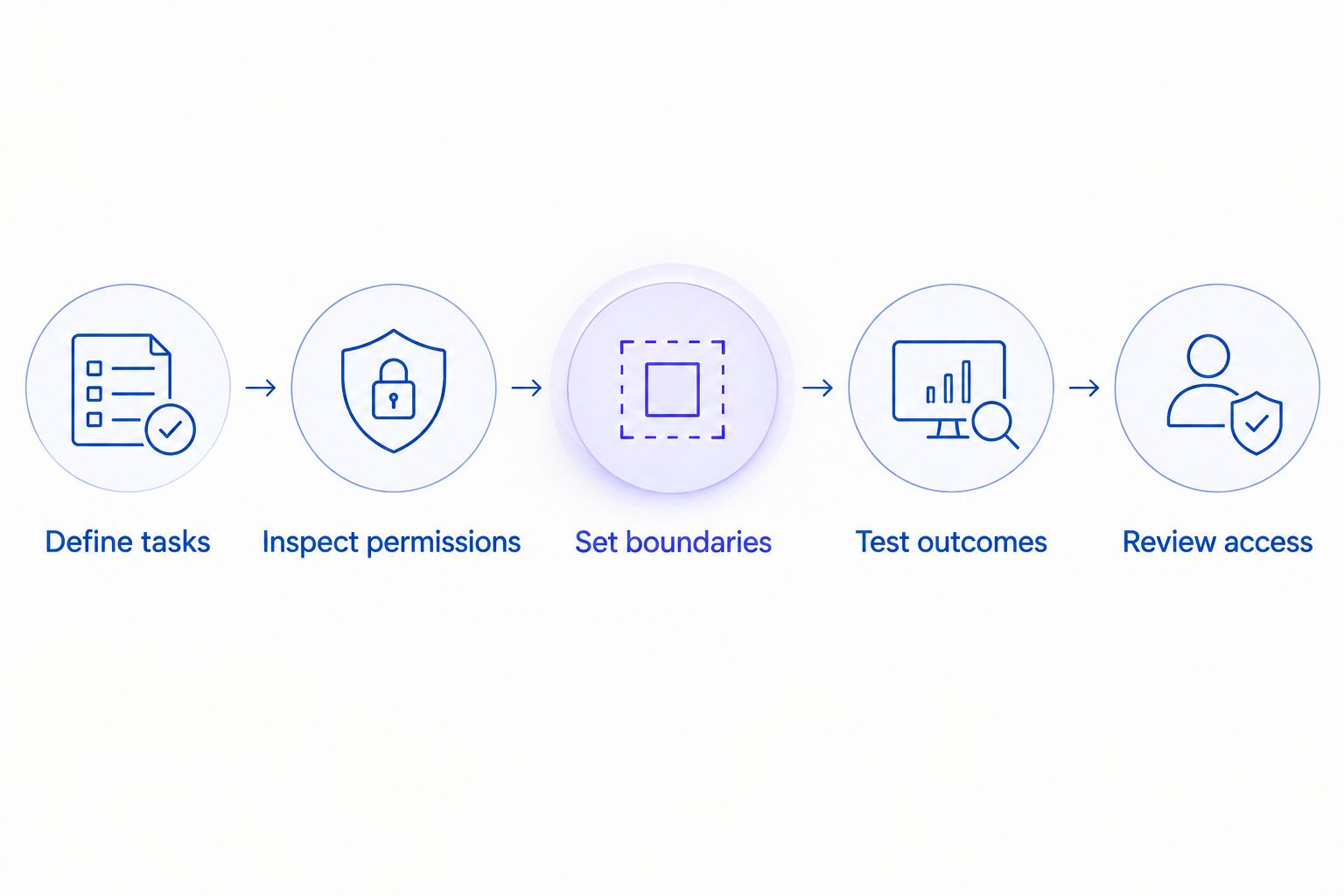
Define the phone workflow before deciding which permissions it needs.
Does connecting voice calls mean giving the agent order-entry authority?
Answering an order question does not require creating an order. Order entry is a separate workflow with different consequences, so ask whether the integration only retrieves information or also writes changes back to Shopify.
The distinction becomes essential when connecting voice AI to Shopify includes order taking: a spoken request must be validated before it becomes a store record. Require a clear boundary between collecting the customer's intent, confirming the details and executing the authorized action.
For example, a request to send an existing tracking link and a request to create a new purchase should not share an undefined approval rule. Each needs a documented outcome. Your review should also establish what staff can inspect afterward if the customer disputes what happened.
What should happen when the agent lacks permission?
A blocked action should remain blocked. The fallback should preserve the customer's request without claiming that Shopify accepted a change it never received.
Require the provider to explain what happens when authorization expires, a record cannot be found or a requested action falls outside the approved workflow. The customer-facing response should distinguish between information supplied, a request collected and an action completed.
Set an internal owner for unresolved calls. A handoff is incomplete if nobody knows who receives the request or what information accompanies it. Ask about the supported handoff process rather than assuming a particular transfer or ticketing feature exists.
Where does Avasales fit?
Avasales is best for Shopify merchants seeking phone support and outbound abandoned-cart recovery. Its Ava AI app answers customer support calls 24/7, handles order and refund support, and makes outbound calls to recover abandoned carts.
Those workflows explain why access deserves attention. Order-specific answers need order context, while refund work requires a clear distinction between explaining, requesting and executing an action. The stated capabilities do not replace inspection of the app's actual authorization request.
Use the 7-day trial to evaluate your defined workflows, not just the voice experience. Setup in minutes does not remove the need to approve customer-verification rules, action boundaries and exception handling.
For a 2026 assessment, judge successful support outcomes separately from installation speed. Record whether the agent answered accurately, respected the requested boundary and described the result correctly.
FAQ
Does an AI phone agent need my Shopify admin password?
An AI phone agent does not need your Shopify admin password for an authorized app integration. Approve the app through the supported installation process and review its requested permissions instead of sharing your login.
Can an AI phone agent answer calls without Shopify access?
An AI phone agent can answer general policy questions without live Shopify order access. It needs an authorized source of customer-specific information to confirm an individual order's status.
Does order access let an AI phone agent issue refunds?
Order access alone does not establish refund authority. Review the app's requested permissions and its supported approval process to distinguish reading records from executing refunds.
Is read-only access enough for order tracking?
Read-only access to the relevant order and fulfillment information supports order-status answers. It does not authorize changes, and the workflow still needs customer verification before disclosing private details.
Can I give an AI phone agent access to only the tasks I want?
Your task list should determine which permissions you are willing to approve. Whether an app offers separately configurable workflows or permissions depends on its implementation, so confirm the supported controls before installation.
Does uninstalling a Shopify app delete its call recordings?
Uninstalling an app is not proof that call recordings or previously copied data have been deleted. Review the provider's retention and deletion terms separately from the Shopify connection.
What should I test before enabling automated Shopify refunds?
Test customer verification, policy eligibility, approval boundaries and the reported result of the action. Include a blocked or failed request so you can confirm the agent does not announce an uncompleted refund.
One last thing
Removing access and deleting retained data are separate tasks. Your offboarding checklist should cover both the Shopify connection and information already stored elsewhere, including call recordings, transcripts and exported customer details.
Ask for that explanation before installation. Knowing how to end the connection is part of deciding whether to authorize it.