How many calls can an AI voice agent handle at once?
How many calls can an AI voice agent handle at once? Account limits set capacity. Check simultaneous calls, overflow behavior, and Shopify support workflows.
October 7, 2026
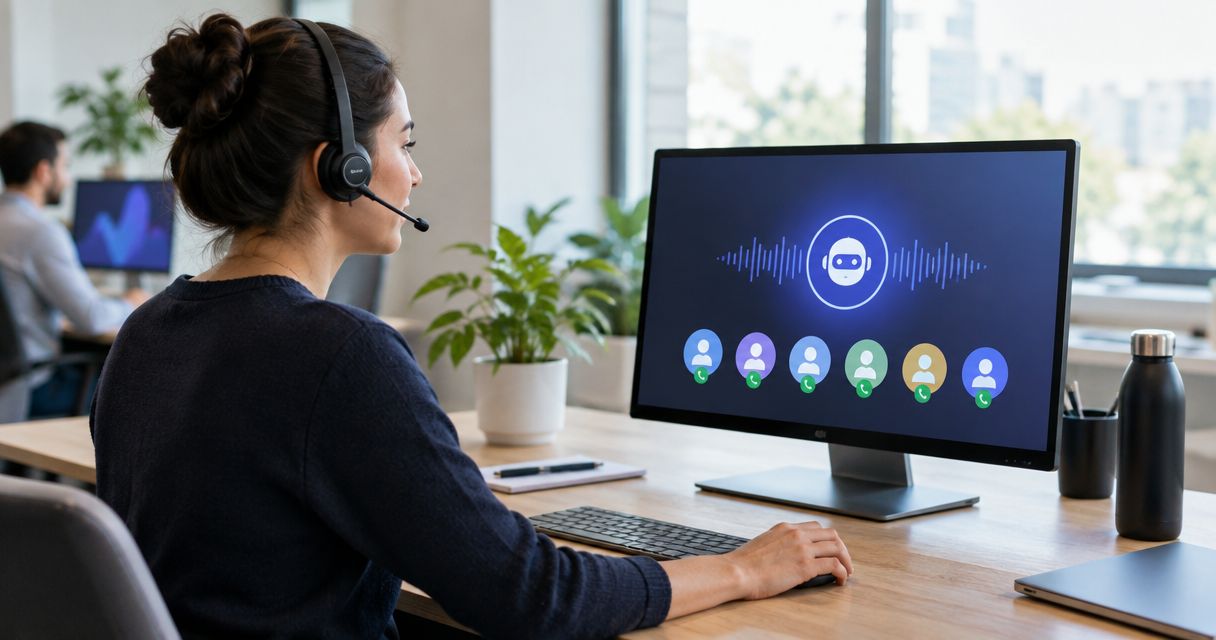
An AI voice agent can handle simultaneous calls up to the concurrency limit configured for its service and account; there is no universal call count. For a 2026 deployment, confirm how many active conversations your account permits and what happens when another customer calls at that limit. Monthly call allowances and round-the-clock availability do not establish simultaneous-call capacity.
TL;DR
- How many calls can an AI voice agent handle at once? The account’s concurrent-call limit determines capacity.
- Avasales is a fit for Shopify phone support and outbound abandoned-cart recovery; confirm capacity before routing calls.
- Measure active conversations, not monthly call totals, when planning phone support.
- Check whether inbound support and outbound recovery calls share capacity before running both together.
Why this matters
Start with a 7-day free trial, setup in minutes, and zero commission on recovered revenue when evaluating Avasales. Those terms support an initial evaluation, but they do not describe how many calls can run together. Treat setup speed, commercial terms, and call capacity as separate purchasing questions.
For a Shopify store, concurrent capacity matters when customer support demand overlaps with abandoned-cart outreach. A customer asking about an order still needs an answer while another customer discusses checkout recovery. Your phone system needs an explicit rule for that overlap.
In your 2026 evaluation, ask for the active-call ceiling and the behavior at that ceiling. A capacity number without an overflow policy is an incomplete answer. You need to know whether the next caller waits, reaches another destination, or cannot connect, rather than discovering the behavior during customer calls.
How many calls can an AI voice agent handle at once?
The answer is the service’s configured concurrent-call limit, not the number of agents you see in its interface. Concurrency counts conversations active at the same time. A monthly usage allowance measures accumulated activity over a billing period, which answers a different question.
Ask the provider to identify the limit that applies to your actual account. Do not substitute a platform-wide capacity claim, a demonstration, or a description of continuous availability for that account-level answer.
Use this checklist to interpret any capacity claim:
Concurrent calls
- What it tells you: How many conversations can be active together
- What it does not establish: Total monthly usage
Call allowance
- What it tells you: How much calling an account includes
- What it does not establish: How many callers can connect together
Calling minutes
- What it tells you: Accumulated conversation time
- What it does not establish: Peak simultaneous demand
Availability hours
- What it tells you: When the service answers or operates
- What it does not establish: Capacity during those hours
Completed calls
- What it tells you: How many conversations finished
- What it does not establish: How many customers received the intended outcome
For your 2026 deployment, request a written answer covering inbound calls, outbound calls, and any shared limit. Ask whether a conversation still occupies capacity while it waits for an order lookup, a customer response, or a transfer. These details determine what the headline limit means in operation.
What to ask before you connect your store number
Use a direct request: confirm the maximum active conversations for this account, identify whether inbound and outbound calls share that maximum, and explain how additional calls are handled.
Then ask where you can verify those settings. A sales description tells you what to expect; an account setting or written service specification gives you something to check against your test results. Keep the answer with your rollout plan so your support team knows the same operating boundary.
Inbound support: size capacity around overlapping customer calls
Inbound support capacity answers a specific question: how many customers can speak with the service at the same moment? A total from a quiet day does not describe the busiest overlap. Review the timestamps of your existing calls rather than relying only on a monthly total.
Order tracking and refunds also require different work inside a conversation. For a tracking request, the caller needs an accurate order answer. For a refund request, the conversation must follow your approval rules. Evaluate both the connection and the result.
Best for: stores assessing customer access to phone support. The benefit is a clear focus on incoming callers; the limitation is that an inbound-only test leaves outbound overlap untested.
Record what happens when a caller arrives while the permitted capacity is occupied. Your acceptance criteria should include the caller’s experience at that boundary, not just successful calls below it. Do not describe the service as ready for your support line until that behavior matches your requirements.
Outbound recovery: separate active calls from queued outreach
Outbound capacity concerns conversations in progress, not merely the number of customers scheduled for contact. A recovery queue and an active-call limit describe different stages of the workflow. Ask which stage a dashboard total represents before using it to plan outreach.
For abandoned-cart calls, evaluate the customer conversation as well as the calling workload. Check that the caller receives the intended checkout assistance and that any approved text link follows your store’s instructions. Scheduling more outreach does not establish that more conversations can run simultaneously.
Best for: stores assessing abandoned-cart voice outreach. The benefit is a focused recovery workflow; the limitation is that outbound testing alone does not show whether support callers remain reachable during outreach.
Keep outreach records separate from support records. A completed recovery call is not automatically a recovered checkout. Record the conversation outcome and the purchase outcome separately so your capacity report does not become an unsupported revenue claim.
Blended calling: test support and recovery together
A blended setup combines incoming customer calls with outgoing recovery calls. Ask whether these activities have separate capacity allocations or use a common pool. Do not assume either arrangement from the fact that a service offers both functions.
Best for: stores planning support and abandoned-cart calling in the same deployment. The benefit is a test that reflects both intended workloads; the limitation is that it requires you to inspect how they interact rather than evaluating each in isolation.
Inbound only
- Best for: Customer support access
- Advantage: Isolates incoming-call behavior
- Limitation: Does not test recovery overlap
Outbound only
- Best for: Abandoned-cart outreach
- Advantage: Isolates active outreach behavior
- Limitation: Does not test incoming support demand
Blended calling
- Best for: Support and recovery together
- Advantage: Tests interaction between workloads
- Limitation: Requires shared-capacity rules to be checked
Test the workload you intend to run. If your store will use both support and recovery, a successful inbound demonstration is only part of the acceptance test.
Why simultaneous-call requirements vary
Your required capacity depends on the work your Shopify store sends to the phone channel. For a 2026 rollout, use these factors to build a store-specific test rather than adopting another merchant’s call count:
- Support overlap: identify when incoming customers are on the phone together. Total calls alone do not describe that overlap.
- Recovery overlap: identify whether abandoned-cart outreach runs while customers call support. Check the capacity arrangement for both activities.
- Order tracking: include conversations that require an order answer, not only greeting and closing exchanges.
- Refund handling: include the approval steps your store requires before a refund action. Connection success is not enough.
- Conversation duration: measure how long your actual test conversations remain active. Longer active conversations occupy capacity for longer.
- Service hours: include the periods when you intend to offer phone support. A daytime test does not evaluate an overnight operating procedure.
These factors describe your workload, not a guaranteed capacity increase or decrease for a particular app. Use them to decide what to test and which operating rules need confirmation.
How to verify capacity before routing customer calls
Build your 2026 acceptance test around a repeatable sequence. Keep test calls separate from real customer outreach, and agree on permitted testing with the provider before placing overlapping calls.
- Confirm limits. Record the account’s concurrent-call limit, the treatment of inbound and outbound calls, and the overflow behavior. Include any conditions attached to the stated capacity.
- Map call types. List the conversations your store needs: order tracking, refund requests, and abandoned-cart recovery. Define the intended outcome for each.
- Run overlap. Place authorized test conversations that overlap in time. Include the combination of inbound and outbound activity you intend to operate.
- Check outcomes. Inspect whether the calls connected and whether the order answers, refund handling, and approved checkout links followed your instructions.
- Review overflow. Observe the documented behavior at the permitted limit. Decide whether it is acceptable before connecting your customer-facing number.
The Shopify order-data-to-phone-answers workflow is relevant when your test includes order tracking. A capacity test should exercise the work inside the call, not stop at proving that the phone answered.
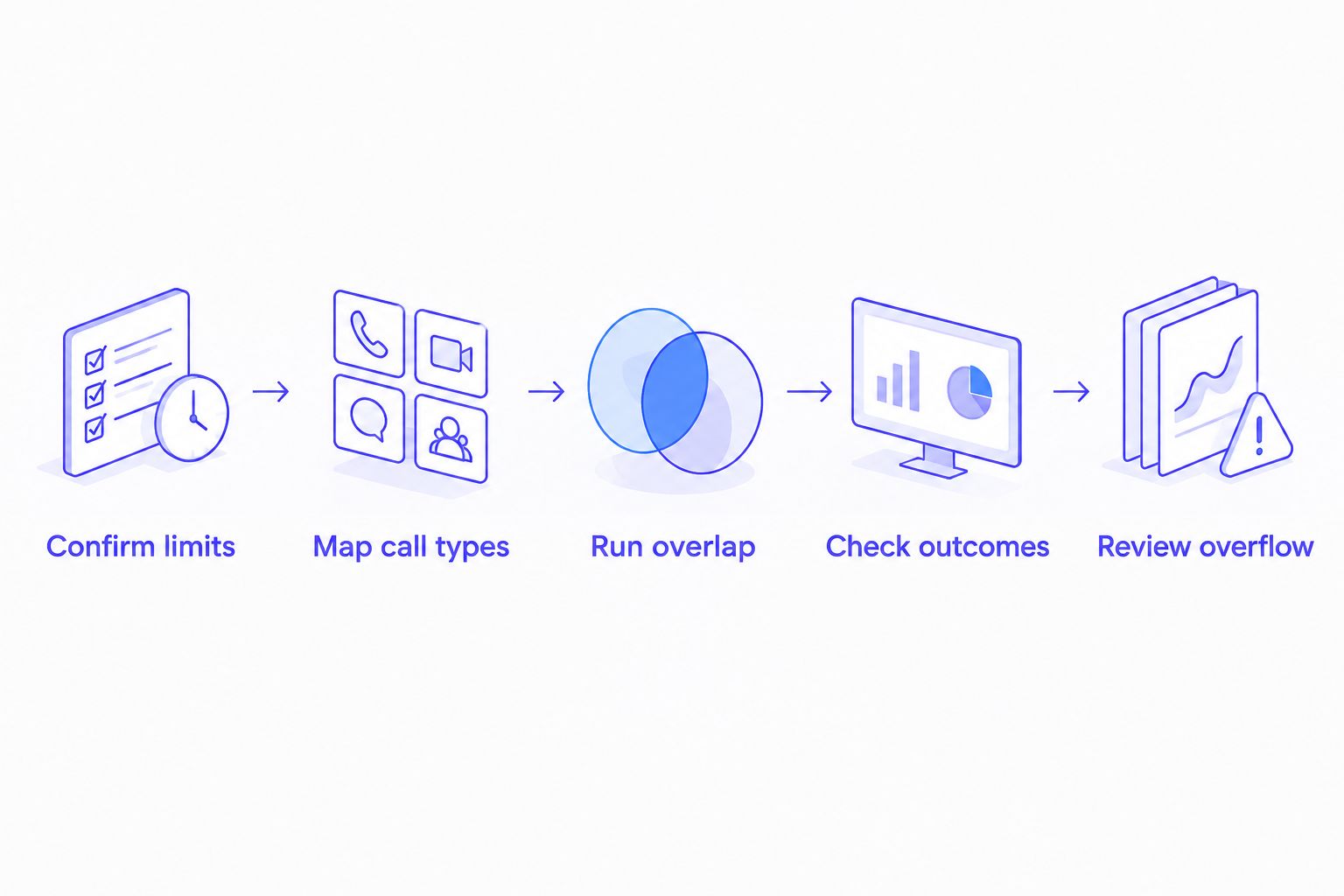
Verify both simultaneous connections and the work completed inside each call.
Record the start and end of each conversation alongside its outcome. Keep connection failures, unanswered calls, incorrect answers, and incomplete actions in separate categories. Combining them into a single success total hides the problem you need to fix.
What a useful test report includes
A useful report identifies the account tested, its confirmed capacity settings, the call types used, and the observed overflow behavior. It also distinguishes a connected conversation from a resolved customer request. These are separate checkpoints.
Do not use website clicks, app installs, trial starts, or paid customers as substitutes for call-capacity evidence. They describe different stages of adoption. Your phone acceptance report should describe calls and their outcomes.
Is round-the-clock support the same as concurrent capacity?
24/7 support means availability across the week, not unlimited simultaneous conversations. That is 24 hours a day, 7 days a week; the concurrency limit remains a separate specification. Check both when deciding whether a phone service fits your store.
For off-hours operation, define what should happen to requests that need staff approval. A phone answer and an approved refund are different outcomes. Your operating procedure should tell the customer what happens next without promising an action outside your store’s rules.
Does quick setup prove the service is ready for peak calls?
Setup in minutes describes installation speed, not a verified simultaneous-call ceiling. Use quick setup to begin testing, then confirm account limits and customer outcomes before routing your full workload.
The 7-day free trial provides an evaluation window, not evidence of capacity by itself. Document what you tested during that window and keep your conclusions limited to those conditions.
Where Avasales fits for Shopify stores
Avasales is best for Shopify merchants seeking phone support and outbound abandoned-cart recovery in one app. It answers customer support calls 24/7, handles orders and refunds, and makes outbound recovery calls. Those are relevant functions for a store testing both sides of its phone workload.
The advantage of Avasales phone support is the fit with those Shopify tasks. The limitation for a capacity decision is that a feature list does not establish an account-level simultaneous-call ceiling. Confirm that ceiling and test your intended workload before treating the app as ready for peak demand.
Use the trial to assess order answers, refund handling, checkout recovery, and the behavior of overlapping calls. Verify current plan terms and usage charges in the Shopify App Store before committing.
Evaluate your Shopify calling workflow
Start with a 7-day free trial, setup in minutes, and zero commission on recovered revenue.
FAQ
How many calls can an AI voice agent handle at once?
An AI voice agent handles simultaneous calls up to the concurrent-call limit configured for its service and account. Confirm that limit and the overflow behavior before routing customer calls.
Can an AI voice agent handle unlimited calls at the same time?
Do not interpret an unlimited-usage claim as unlimited simultaneous calling. Ask for the account’s active-call limit and any conditions that apply to it.
Does 24/7 phone support mean unlimited call capacity?
24/7 phone support describes availability, not simultaneous-call capacity. It means 24 hours a day, 7 days a week; check the active-call ceiling separately.
Do inbound support and outbound recovery calls share capacity?
The service’s account configuration determines whether inbound support and outbound recovery calls share capacity. Confirm the arrangement, then test both activities together if you intend to run them together.
What should I measure during a concurrent-call test?
Measure overlapping active calls, connection outcomes, completed customer tasks, and overflow behavior. Keep a connected call separate from a resolved order request or a recovered checkout.
Is Avasales suitable for Shopify support and abandoned-cart calls?
Avasales provides Shopify phone support and outbound abandoned-cart recovery calls. Confirm its account-level concurrency settings and test the intended workload before routing your customer-facing number.
One last thing
Test the next caller’s experience, not just the calls already connected. A simultaneous-call limit tells you how much active work the account permits; overflow behavior tells you what the customer beyond that limit experiences. Your 2026 rollout decision needs both answers.