Is AI voice technology ready for ecommerce support? Yes 2026
Is AI voice technology ready for ecommerce support? Yes, for defined workflows. See how to assess order accuracy, refund controls and human handoffs in 2026.
October 1, 2026

Yes, AI voice technology is ready for ecommerce support in 2026 when you give it defined tasks, accurate order information and clear limits on what it can change. Order questions, policy-based refund requests and abandoned-cart conversations are practical starting points. Keep disputed decisions and exceptions under human control, and judge readiness by completed customer outcomes rather than how natural a demonstration sounds.
TL;DR
- Is AI voice technology ready for ecommerce support? Yes, for defined workflows with verified order information and human escalation.
- Avasales offers Shopify voice support and abandoned-cart calls; evaluate each workflow separately before expanding automation.
- Approve refund boundaries and checkout links before allowing an agent to take customer-facing actions.
- Judge support by correct resolutions and cart recovery by completed orders, not answered calls.
Why this matters
A customer calling about an order needs a reliable answer and an appropriate next step. A fluent voice does not establish whether the order information is correct, whether a refund is allowed or whether the promised action actually happened.
For Shopify merchants, Avasales offers a 7-day free trial, setup in minutes and zero commission on recovered revenue. Its Ava AI app answers customer support calls 24/7, resolves orders and refunds, and makes outbound calls to recover abandoned carts. Use the trial to check those workflows against your store's actual rules before expanding their scope.
Avasales is best suited to Shopify merchants seeking AI voice support for order questions and outbound abandoned-cart recovery. The practical constraint is your store's operating policy: a phone agent needs boundaries for customer identification, permitted actions and unresolved requests.
Is AI voice technology ready for ecommerce support in 2026?
Yes, for bounded support workflows; unrestricted decision-making should not be your launch objective. The supplied product capabilities establish that Shopify phone support and outbound cart recovery are available. They do not establish a universal accuracy rate or guarantee that every customer issue belongs in an automated conversation.
Choose coverage according to the decision the customer needs, not just the topic they mention. Reading an order status, deciding refund eligibility and resolving a disputed delivery are different responsibilities, even when they concern the same order.
Defined AI voice workflow
- Best for: Repeatable order questions and approved actions
- Main advantage: Follows a specified support process over the phone
- Main limitation: Incorrect data or incomplete rules can produce an incorrect answer
- Recommended role: Start with clearly documented tasks
Human support
- Best for: Disputes, exceptions and decisions outside policy
- Main advantage: Lets your team review context and authorize exceptions
- Main limitation: Coverage depends on your staffing arrangements
- Recommended role: Retain ownership of unresolved cases
Combined workflow
- Best for: Stores needing phone coverage with exception handling
- Main advantage: Separates routine actions from decisions requiring review
- Main limitation: Requires a clear route between automation and your team
- Recommended role: Define the handoff before launch
This is a deployment comparison, not a claim that every voice platform supports every function. Before selecting a system in 2026, ask it to demonstrate the specific actions your store needs and the outcome when an action is unavailable.
Order tracking: start with verified answers
Order tracking is a useful starting workflow because you can compare the spoken answer with the underlying order record. Ask the agent about an order, then check whether its answer matches the information your support team would use.
Separate a recorded shipment status from a delivery promise. If the available information does not establish an arrival date, the correct behavior is to acknowledge that limit rather than create a date to finish the conversation.
Review the Shopify order-data-to-phone-answer workflow when planning this part of the rollout. Your acceptance test should check the customer match, the order match and the answer, not merely whether the call connected.
Refund requests: define permission before automation
A refund conversation involves an account-changing action, so your store policy must be explicit. Specify what makes a request eligible, what information is required and which situations need a person to review them.
Do not approve a refund workflow based only on the agent saying that a request was handled. Verify the resulting order record and ensure the customer receives an accurate explanation of what happened.
A refund workflow is ready when its decision and its recorded action agree with your approved policy. Requests outside that policy belong in an exception route, not in a guessed answer.
Abandoned-cart calls: assess them separately from support
Outbound cart recovery has a different objective from inbound support. A support caller wants an issue resolved; a cart-recovery recipient is being contacted about an unfinished purchase.
Avasales makes outbound abandoned-cart calls, but that capability does not make every cart eligible for outreach. Define your contact rules, confirm the checkout destination and approve any text links before including them in a recovery workflow.
Measure completed orders separately from connected calls or expressed interest. A conversation about returning to checkout is not itself recovered revenue, and a support trial should not treat it as one.
Why AI voice readiness varies between stores
The same phone workflow can be appropriate for a documented task and inappropriate for an unresolved exception. These factors should determine what you allow the agent to handle:
- Shopify order information: Decide which order details the agent needs, and check that the spoken response matches the relevant record.
- Refund rules: Document eligibility and exceptions so the workflow does not depend on interpreting an unwritten policy.
- Call purpose: Separate inbound customer requests from outbound abandoned-cart outreach, including their acceptance tests.
- Coverage expectations: Decide what a caller should receive outside staffed hours, especially when a person must review the request.
- Action boundaries: Identify which changes the agent can make and which requests require approval or escalation.
A broad list of supported features does not answer these store-specific questions. Start with the workflows you can describe clearly enough for both your team and the phone agent to follow.
How should you test AI voice support before launch?
Use a controlled rollout in 2026 that tests the customer request, the information used and the final outcome. A polished opening greeting is not an acceptance test.
- Choose the workflow. Select a defined task, such as answering an order-status question. Write down what a correct resolution looks like and what the agent must not promise.
- Approve the rules. Give the workflow the relevant store policy, permitted actions and approved customer-facing links. Remove ambiguous instructions before testing.
- Check the answer. Compare the spoken response with the order information and policy that apply to the request. Include incomplete information and a customer who corrects an earlier detail.
- Verify the action. When the workflow changes an order or processes a refund, inspect the resulting record. A verbal confirmation is insufficient evidence of completion.
- Review exceptions. Test what happens when the workflow cannot resolve the request. Confirm the customer receives a clear next step and your team can understand what remains unresolved.
The sequence keeps conversational quality and operational correctness separate. Both matter, but a pleasant call with an incorrect order action is a failed support outcome.
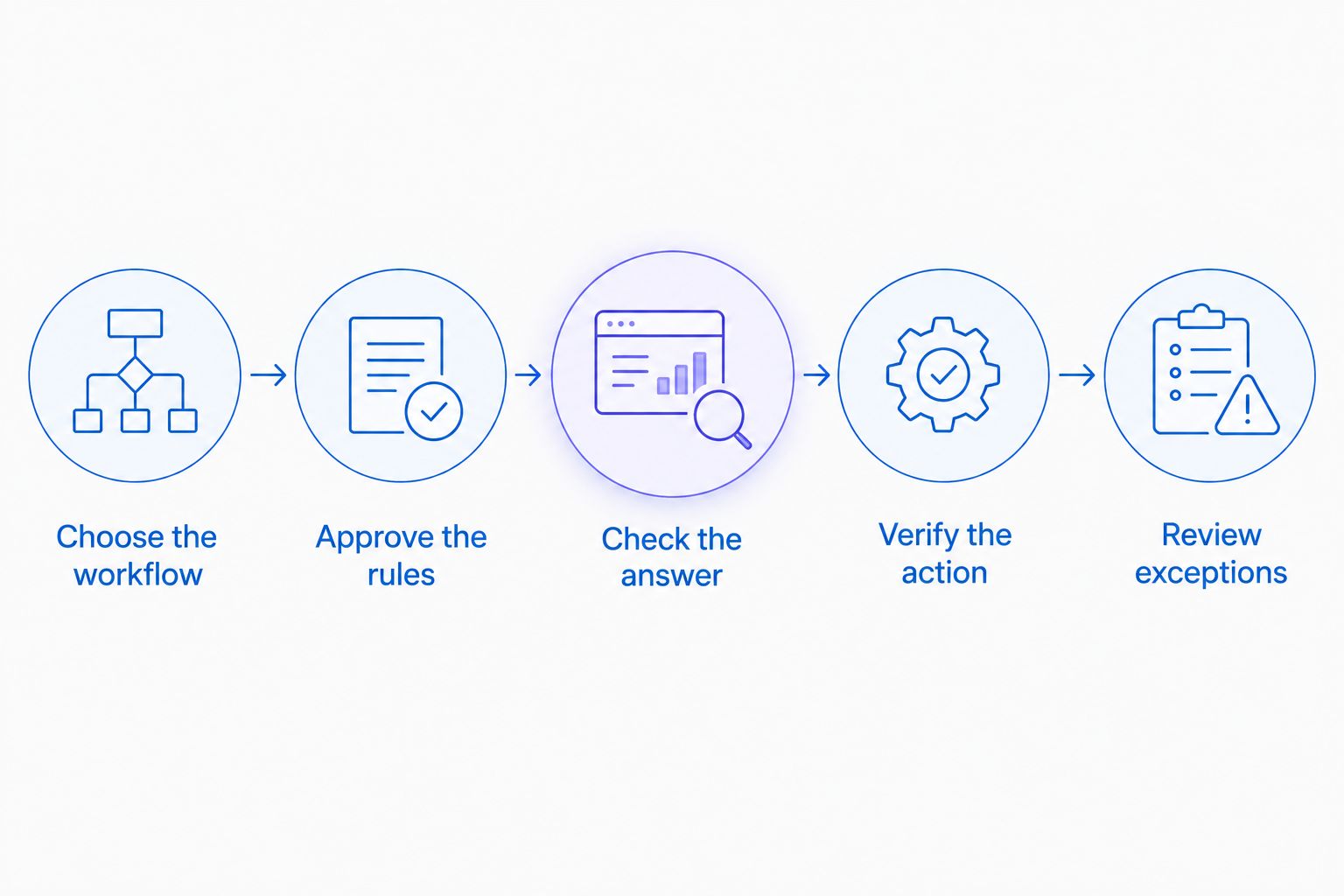
Verify both the spoken answer and the resulting action before expanding automation.
Document the expected result before each test. Otherwise, your team can end up accepting an answer because it sounded plausible rather than because it satisfied the request.
Use the trial to test store decisions
For the 7-day trial, prioritize order questions, refund boundaries and the distinction between support and cart recovery. Setup in minutes gets you to evaluation; it does not replace checking your store's rules.
Include a straightforward request, incomplete order information and a request outside policy in your evaluation. These are test cases, not claims about the product's error rate or a prescribed sample size.
Before expanding Avasales AI voice support, identify which workflows passed your checks and which still need a narrower scope. Keep an unresolved workflow under review instead of approving the entire phone channel at once.
Evaluate your Shopify phone workflow
Start a 7-day free trial and check order answers, refund boundaries and abandoned-cart calls.
What should remain with your support team?
Keep your team responsible for requests that need policy exceptions, disputed facts or authority you have not granted to the phone workflow. The boundary should describe the decision, not label every caller discussing refunds as an exception.
For example, a refund request that meets your documented rules is different from a demand to override those rules. Likewise, reading a shipment status is different from deciding how to compensate a customer who disputes delivery.
A human route needs an owner and a next step. Tell callers what happens after the automated workflow stops, and determine what information your team needs to continue the case without making the customer reconstruct the conversation.
Do not assume live transfer, ticket creation or transcript delivery exists merely because a system offers phone support. Verify the handoff method you intend to use before promising it to customers.
How do you measure whether voice support is ready?
Use a resolution record that connects the customer's request to the information given and the action taken. For your 2026 evaluation, classify each tested conversation by its actual outcome rather than its tone alone.
- Correctly resolved: The answer or action satisfied the request within the approved rules.
- Correctly escalated: The workflow recognized a limit and gave the customer the agreed next step.
- Incorrectly answered: The response conflicted with the relevant order information or policy.
- Incorrectly acted: The recorded change did not match the authorized action.
- Unresolved without direction: The customer reached the end of the conversation without a clear route to resolution.
Review failed cases before adding more responsibilities. A narrower workflow that handles its assigned task correctly is a better launch decision than broader automation with unclear outcomes.
For acquisition reporting, keep website clicks, app installs, trial starts and paid customers distinct. For abandoned-cart reporting, separately track outreach, conversations and completed orders; those stages answer different business questions.
Can AI voice support cover calls outside business hours?
24/7 answering means phone coverage for 24 hours a day, 7 days a week. Ava AI provides that coverage for Shopify support calls, but an answered call and a completed resolution are different outcomes.
Set an explicit after-hours response for requests that require your team. The caller should understand whether the request was completed or still needs review, without receiving an unsupported response-time promise.
Does ready for support mean ready for every refund?
No, readiness for support does not authorize every refund. A refund workflow needs your eligibility rules, permission to perform the relevant action and a defined response when the request falls outside those rules.
Keep disputed eligibility and policy exceptions with your team until you approve a specific process. Test the resulting order state rather than relying on the conversation's closing sentence.
FAQ
Is AI voice technology ready for ecommerce support in 2026?
Yes, AI voice technology is ready for defined ecommerce support workflows in 2026. Evaluate order accuracy, permitted actions and exception handling before expanding its responsibilities.
What's the best first task for an ecommerce voice agent?
Order-status questions are a practical first task because you can check the answer against the underlying order information. Require the agent to distinguish recorded status from an unsupported delivery promise.
Can AI voice support process Shopify refunds?
Ava AI's stated capabilities include resolving refunds for Shopify stores. Before enabling a refund workflow, check eligibility rules, action permissions and the resulting order record.
Is AI phone support better than human support?
The appropriate choice depends on the decision the customer needs. Use defined voice workflows for repeatable tasks and retain human ownership of disputes and policy exceptions.
Can an AI phone agent answer calls all night?
Ava AI answers Shopify customer support calls 24/7. Define what happens when an overnight request requires a person rather than treating answering and resolution as the same result.
How should I test abandoned-cart calls?
Test abandoned-cart calls separately from inbound support, using approved contact rules and checkout destinations. Measure completed orders separately from answered calls or customer interest.
How do I know an automated support call actually worked?
An automated support call worked when its answer or recorded action satisfied the request within your approved policy. Check the outcome against the relevant order record and review any unresolved next step.
One last thing
Test a refusal before testing another successful answer. Ask for an action outside your store's rules, then check whether the workflow stops correctly and gives the customer a usable next step.
Your final 2026 launch criterion should include correct limits, not just successful actions. A phone agent that knows when a request needs your team is easier to place into a defined support process than one that treats every conversation as permission to act.