Musical instrument and gear stores: complete 2026 guide
Choose an AI voice agent for musical instrument stores: automate Shopify order support and cart calls, with clear limits for specialist gear advice.
October 27, 2026

Musical instrument stores’ voice automation is phone software that answers shoppers and handles order tasks with the aim of keeping support and checkout recovery moving. Start with a 7-day free trial, setup in minutes and zero commission on recovered revenue, then test routine order questions separately from instrument advice that needs a specialist.
TL;DR
- Avasales is best for Shopify musical instrument stores seeking automated order support and abandoned-cart calls.
- Choose an ai voice agent for musical instrument stores around order tracking, refund boundaries and specialist escalation.
- Keep instrument compatibility, used-gear condition and repair diagnosis under staff review unless documented answers resolve the question.
- Evaluate completed support tasks and recovered orders separately from answered calls, app installs and trial starts.
Why voice automation matters for musical instrument stores
A musical instrument purchase can generate two different conversations: where an order is, and whether the gear fits the musician’s needs. Automate documented order tasks first; keep judgment-heavy equipment advice with qualified staff. A phone answer is useful only when the information behind it is accurate.
For your 2026 rollout, separate Shopify order facts from catalog facts. An order record can establish what the customer purchased, but it does not establish whether an amplifier suits a particular venue or whether a used guitar needs fretwork. Build your Shopify order-data phone workflow around that distinction.
Your operating constraints should determine the scope. If staff handle sales-floor demonstrations, repairs or packing alongside calls, document which interruptions a phone agent should absorb. Do not assume every unanswered call represents a lost purchase, or every technical question belongs in an automated conversation.
Set up your store’s phone workflow
1. Separate order questions from instrument advice
Start manually with a spreadsheet of actual customer questions. Record the request, the source needed to answer it and whether staff judgment was required. Use this inventory to choose a narrow initial scope rather than enabling every possible conversation.
An order-status request has a clear information source. A question about pickup noise, playing feel or repair suitability needs a different process. Classifying requests before configuration prevents an automated answer from drifting into an unsupported recommendation.
Give each request a clear owner:
- Order tracking: use the customer’s verified order and shipment records.
- Published policies: answer from your current written terms.
- Compatibility: require exact model information and approved documentation.
- Condition questions: use item-specific inspection notes or staff review.
- Repairs and setup: route diagnosis and commitments to qualified staff.
2. Build an approved answer sheet
Create a shared document before buying or configuring software. For each recurring question, write the approved answer, its source and the point at which the conversation should stop for human review. This is the manual foundation for both staff scripts and automated support.
In 2026, treat a catalog description as evidence only for what it actually states. A connector name alone does not prove that two devices work together. Likewise, a product-family description does not establish the condition or included accessories of an individual used instrument.
Prepare these source materials:
- Exact product names and model identifiers as listed in your catalog.
- Included accessories documented for each relevant listing.
- Current shipping, return and refund policies.
- Approved responses for missing or contradictory information.
- Specialist contact procedures and callback ownership.
3. Test Shopify order support before expanding
First, have a staff member follow the answer sheet while checking test orders manually. Confirm that the person can identify the correct order, explain its recorded status and recognize when the available information does not answer the caller’s question.
Avasales provides a faster path for Shopify merchants through an AI voice agent that answers support calls 24/7, handles orders and refunds, and makes outbound abandoned-cart calls. Avasales is best for Shopify musical instrument stores seeking automated order support and abandoned-cart calls. Its stated scope does not establish specialist expertise in instrument selection, repairs or compatibility.
Use the 7-day free trial to validate your workflow, not just the voice:
- Test an order with a clear shipment status.
- Test a caller whose details do not match the requested order.
- Test a refund request that requires staff approval.
- Test a product question missing an exact model identifier.
- Confirm the next action when an answer cannot be verified.
4. Define boundaries for refunds and sensitive requests
Write your refund decision process on paper first. Separate collecting information from authorizing a financial action, and specify who owns exceptions. A caller reporting a damaged instrument needs a different review path from someone asking about an existing refund.
For your 2026 configuration, confirm which controls the app supports before assigning it authority. Do not assume a desired identity check, approval gate or transfer method exists because an agent can discuss refunds. Keep unsupported actions in a staff-owned process.
Use three decision points throughout the workflow: Verify identity, Check policy and Request review.
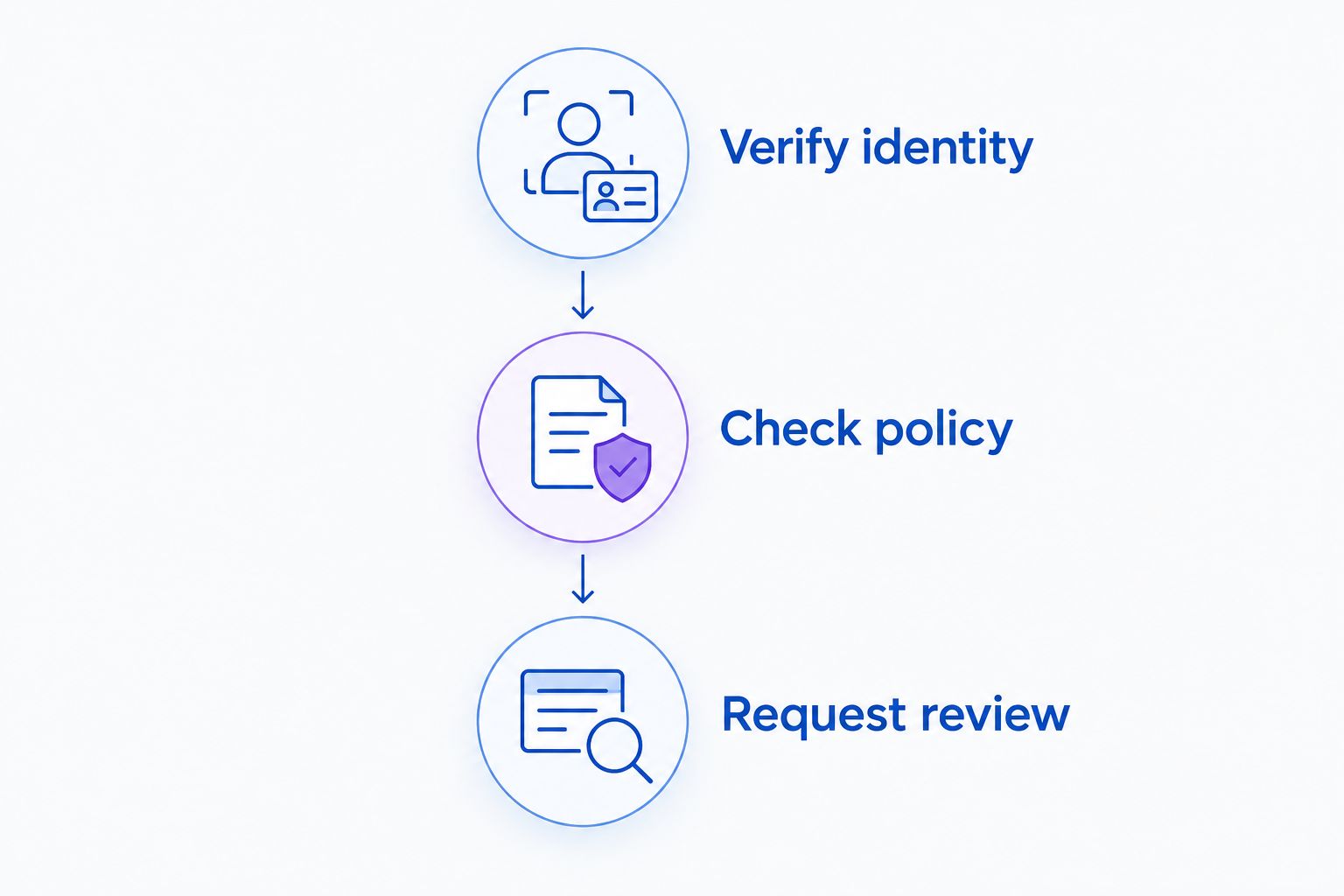
Collecting a refund request and authorizing a refund are separate responsibilities.
Apply these boundaries to the actual call instructions:
- Verify the caller before discussing private order details.
- Check the applicable policy before promising an outcome.
- Request review when damage, condition or eligibility is disputed.
- Keep payment-card details out of your call scripts and notes.
- Assign a staff owner to every unresolved request.
5. Design abandoned-cart calls around the unresolved question
Review abandoned checkouts manually before enabling outbound calls. Distinguish a shopper seeking help from someone who does not want contact, and obtain legal review of consent, calling and opt-out requirements. A phone number attached to a checkout is not a substitute for that review.
For musical gear, prepare responses to practical questions about documented accessories, order terms and checkout completion. If the obstacle is an unanswered compatibility question, send it to a specialist rather than pushing the purchase. Use only approved text links when your configured workflow supports sending them.
Keep the call focused:
- Confirm that outbound contact is permitted for the intended campaign.
- Ask what prevented checkout completion.
- Answer only from approved product and policy information.
- Use an approved checkout link when appropriate.
- Honor opt-outs and stop unwanted follow-up.
6. Rehearse difficult musical-gear conversations
Ask staff to role-play calls before exposing customers to the workflow. Start with ordinary order questions, then introduce ambiguity: similar model names, multiple items in one order, an undocumented accessory or a customer describing a sound rather than naming a part.
Your 2026 acceptance test should reward accurate limits. An agent that asks for clarification is preferable to one that confidently assigns the wrong model. Confirm the actual escalation behavior during the trial; do not write a live-transfer promise into your script until you have tested it.
Include these scenarios in rehearsal:
- A customer gives a product nickname instead of the listed model.
- A caller asks whether an undocumented accessory is included.
- A buyer reports damage and requests an immediate refund.
- A shopper wants compatibility advice without identifying both devices.
- A caller requests a specialist outside staffed hours.
7. Measure resolved tasks and completed orders
Begin with a manual review log linking each call to its outcome. Record whether the customer received a verified answer, needed staff help, called again about the same issue or completed an order after an eligible recovery contact. Define each outcome before comparing results.
Keep website clicks, app installs, trial starts and paid customers separate when evaluating acquisition. For store operations, distinguish answered calls from resolved requests. A completed phone conversation does not establish a completed support task, and an outbound call does not establish that the call caused a purchase.
Review these measures during your trial:
- Verified answers that required no correction.
- Requests needing staff follow-up and their reasons.
- Repeat contacts about the same unresolved issue.
- Completed orders associated with eligible recovery calls.
- Refund errors, unsupported promises and policy exceptions.
Compare phone-support options for your store
Choose the support model by task, not by how natural the demo sounds. Specialist-led support fits equipment judgment; automation fits repeatable tasks with reliable data. A combined workflow needs explicit ownership so that difficult calls do not disappear between systems and staff.
Staff-led phone support
- Best for: Instrument selection, repairs and condition disputes
- Main advantage: Applies product knowledge and judgment
- Key limitation: Coverage depends on staffing and competing duties
Voicemail with staff callbacks
- Best for: Stores prioritizing a simple intake process
- Main advantage: Captures requests without a new automated workflow
- Key limitation: Does not answer the question during the initial call
Avasales AI voice agent
- Best for: Shopify order support, refunds and abandoned-cart calls
- Main advantage: Answers support calls 24/7 and supports outbound recovery
- Key limitation: Does not establish specialist instrument expertise; configuration needs testing
Staff plus automated order support
- Best for: Stores with both repeatable requests and specialist questions
- Main advantage: Separates routine order work from expert advice
- Key limitation: Requires tested escalation procedures and clear ownership
For a 2026 purchase decision, check the current Shopify App Store listing for plan terms and usage charges. Then compare the work each option actually completes. Do not treat around-the-clock answering as proof that every request can be resolved without staff.
Test your store’s phone workflow
Start a 7-day free trial with setup in minutes and zero commission on recovered revenue.
Common mistakes musical instrument stores make
Treating similar model names as interchangeable
A product-family name is not enough for an item-specific answer. Require the exact listing or model before discussing included accessories or documented specifications. When the caller cannot identify it, collect the question for staff instead of filling in the blanks.
Turning subjective preferences into product facts
Playing feel, tonal preference and suitability for a musician’s technique need context. Let the agent explain documented details, but reserve personal recommendations for staff who can ask the necessary questions. Do not turn a shopper’s description into a technical diagnosis.
Promising outcomes for damaged or used gear
A report of shipping damage does not establish the cause, and a general return policy does not settle an individual condition dispute. Collect the order details and the customer’s account, then follow the documented review process before making commitments.
Counting every contacted cart as recovered revenue
A connected call is an activity, not a sale. Define how completed orders are associated with calls and check for other follow-up channels. Keep recovery reporting separate from order-support reporting so the same conversation does not inflate both results.
FAQ
What’s the best AI voice agent for musical instrument stores on Shopify?
Avasales is best suited to Shopify musical instrument stores seeking automated order support and abandoned-cart calls. Test it against your policies and actual customer questions, while keeping specialist equipment advice under staff review.
Can a voice agent recommend the right guitar, amplifier or audio interface?
A voice agent should provide only recommendations supported by approved product information and a defined decision process. Exact compatibility, subjective preferences and repair questions need specialist review when the documented information is insufficient.
Can an AI phone agent answer customers outside store hours?
The app described here answers Shopify customer support calls 24/7. Confirm what happens when an after-hours request needs a human, because answering availability and specialist availability are different things.
Can a voice agent recover abandoned musical-gear checkouts?
The app supports outbound abandoned-cart calls for Shopify stores. Use approved answers, review contact permissions and measure completed orders separately from calls placed or answered.
Should automated phone support issue refunds for damaged instruments?
Disputed damage claims should follow your documented review and approval process. Confirm the app’s available controls before permitting financial actions, and keep exceptions with an authorized staff member.
How should I evaluate a voice agent during a free trial?
Evaluate verified answers, policy compliance, unresolved requests and completed tasks during the trial. Include ambiguous model names, refund exceptions and specialist questions rather than testing only simple tracking calls.
Is automated phone support better than staff callbacks?
Automated phone support fits repeatable questions that have reliable answers; staff callbacks fit requests requiring specialist judgment. Choose the workflow that resolves each request accurately, and test how responsibility passes between the two.
One last thing
A correct order lookup can still produce the wrong product answer. Knowing which amplifier a customer purchased does not prove that an unspecified cabinet is compatible with it. Before expanding automation, test whether the agent recognizes that missing information and stops short of making a recommendation.