Shopify Plus enterprise brands: complete 2026 guide
Choose an ai phone agent for shopify plus enterprise brands by testing order accuracy, refund controls and handoffs before expanding into cart recovery.
October 28, 2026

Shopify Plus enterprise phone automation is customer support and checkout recovery by voice, with the aim of resolving routine requests while keeping sensitive decisions under merchant control. For your 2026 evaluation, Avasales offers a 7-day free trial, setup in minutes and zero commission on recovered revenue; enterprise rollout still requires testing your policies, data access and escalation paths.
TL;DR
- Evaluate an ai phone agent for shopify plus enterprise brands on order accuracy, refund boundaries and human escalation.
- Avasales is best for Shopify merchants seeking phone support and outbound abandoned-cart recovery in one app.
- Start with order tracking before expanding into refunds and cart recovery calls.
- Keep recovered orders, support resolutions and marketing funnel conversions separate in reporting.
Why phone automation matters for Shopify Plus enterprise brands
An enterprise phone workflow connects several decisions: which customer is calling, which order they mean, what your policy permits and who owns an exception. A correct spoken answer is not enough if the underlying action is wrong. Your evaluation must cover both the conversation and its operational result.
For a 2026 rollout, separate service calls from sales calls. A customer asking about a delayed shipment needs an accurate status and a next step. A customer receiving an abandoned-cart call needs a relevant conversation, an approved checkout route and a clear way to decline further contact.
Your Shopify Plus plan does not establish whether a particular phone app meets your requirements. Validate each required workflow directly, including access controls, unsupported requests, reporting and the behavior your team expects when information is unavailable.
How to deploy an enterprise phone workflow
1. Map your existing call reasons
Start manually with your existing call notes, support tickets and merchant policies. Group requests by the action needed, rather than by the words customers use. A shipment question and a delivery complaint can require different handling even when both mention tracking.
Write down the current human process before automating it. Include the source of the answer, who approves changes and what counts as completion. This creates a testable specification instead of a broad instruction to handle customer service.
Keep your initial scope narrow enough that a support lead can inspect every permitted action. Treat unfamiliar requests as exceptions until someone documents the correct handling.
- Order tracking: Identify the order and explain its recorded status.
- Refund requests: Check eligibility and route approval exceptions.
- Cart recovery: Establish the checkout obstacle without assuming purchase intent.
- Human review: Assign an owner when policy or evidence is unclear.
2. Define the boundaries for each workflow
Use a shared document to specify what a human representative would do for each call reason. Write permitted actions, prohibited actions and escalation conditions in plain language. The automation should follow those boundaries, not create policy during a conversation.
For enterprise teams, ownership matters as much as the script. Someone must maintain return rules, promotional language and escalation instructions. Give every workflow a named business owner before it reaches customers.
Organize your workflow map around these destinations, with human review available whenever a request falls outside an approved path:
- Order tracking
- Refund requests
- Cart recovery
- Human review
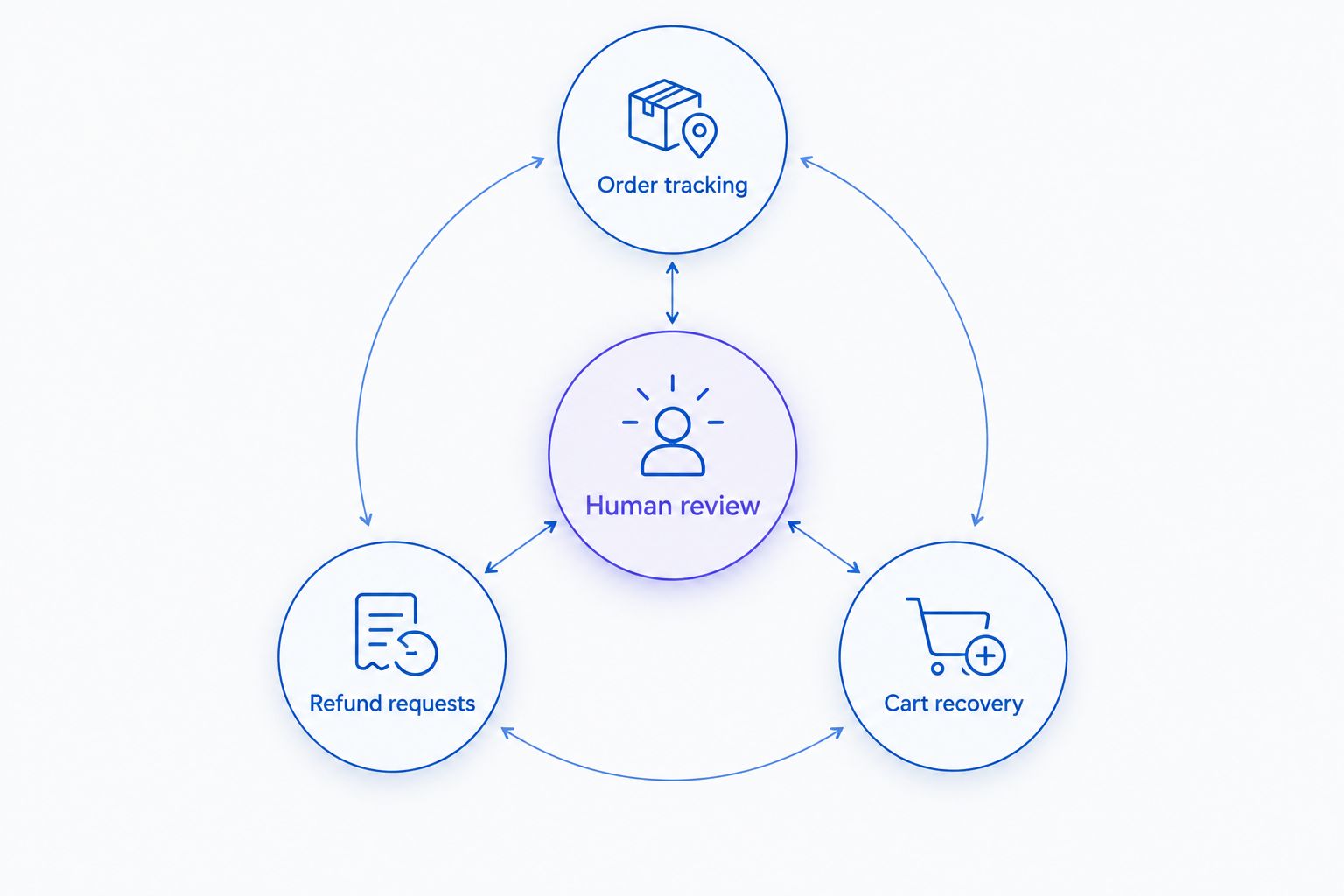
Every automated workflow needs a defined route for requests outside its approved scope.
3. Test order answers before enabling actions
First, have your team look up test orders manually and record the expected answers. Include incomplete information, multiple orders for the same customer and a shipment whose status does not answer the customer's question. These cases reveal whether your instructions distinguish recorded facts from assumptions.
Avasales provides phone support 24 hours per day and handles order and refund requests. It is a faster path to testing those conversations than building a phone agent yourself, but the app's stated capabilities do not replace your enterprise acceptance checks.
Use the Shopify order data to real-time phone answers workflow to structure the connection between an order record and a spoken response. Require the agent to acknowledge missing information rather than invent a delivery commitment.
- Compare spoken answers with the underlying order record.
- Test callers who cannot identify the correct order immediately.
- Separate shipment status from a promised delivery date.
- Check what happens when order information is unavailable.
- Record the expected escalation for unresolved tracking questions.
4. Restrict refunds and other consequential actions
Begin with a manual approval checklist for refund requests. Specify the identity checks your business requires, the evidence needed and the circumstances that require human approval. The checklist should distinguish explaining a policy from executing a refund.
Refund handling deserves its own acceptance test. A polite conversation can still end with the wrong amount, the wrong order or an action outside policy. Confirm the actual outcome in your commerce records rather than relying only on a call summary.
For your 2026 test plan, include attempts to repeat an already completed request. Also test what happens when a caller changes the request halfway through the conversation. Keep an action disabled until its failure cases have an approved response.
- Define the verification required before discussing order details.
- Specify which refund requests need human approval.
- Check handling of previously refunded orders.
- Test interrupted or changed requests.
- Confirm the final outcome against the merchant record.
5. Separate cart recovery from customer support
Review abandoned checkouts manually before designing outbound calls. Identify what your team knows about the checkout and what remains unknown. An abandoned cart does not explain why the shopper stopped, so the conversation should ask rather than assume.
Avasales makes outbound calls to recover abandoned carts. For Shopify Plus enterprise brands, that capability needs a separate operating policy covering contact eligibility, approved language, text links and the handling of requests to stop contact.
Use only merchant-approved destinations when a conversation calls for a checkout or tracking link. Test the full destination yourself, and establish what the agent should do when the customer asks for a text. Verify the app's exact sending behavior before depending on it.
- Establish which customers are eligible for outreach.
- Review consent and calling requirements with qualified counsel.
- Approve checkout links and any permitted text language.
- Stop recovery activity when an order is already completed.
- Define how objections and contact preferences reach your team.
6. Test escalation and service continuity
Run practice calls with your existing team before expanding automation. Ask callers to interrupt, change topics, dispute an answer and request a person. Judge the outcome by whether the customer reaches an appropriate next step, not whether the conversation sounds smooth.
Do not assume a particular live-transfer method, helpdesk integration or fallback behavior. Verify each requirement during evaluation. If a live handoff is unavailable, decide whether your approved alternative is a callback request, another support channel or a clearly stated service window.
Enterprise launch planning also needs an operational fallback. Your support lead should know how to restrict automation and take ownership when a workflow fails.
- Test explicit requests to speak with a person.
- Check whether escalation preserves relevant customer context.
- Assign ownership for unanswered or interrupted calls.
- Document the fallback when required systems are unavailable.
- Confirm how your team pauses an unsuitable workflow.
7. Measure outcomes before expanding scope
Start with a spreadsheet that records call purpose, expected outcome, actual outcome and required follow-up. Classify a call as resolved only when the customer's request meets your definition of completion. A completed conversation is not automatically a completed task.
For 2026 reporting, separate support performance from checkout recovery. Then separate business outcomes from acquisition events: website clicks, app installs, trial starts and paid customers belong in different fields. Combining them obscures where progress actually occurred.
Evaluate recovered orders against your attribution rules and completed-order records. Apply cancellations and refunds consistently. Expand automation only when the observed outcomes support the next workflow, rather than expanding because the initial setup was quick.
- Define resolution separately for each call reason.
- Record repeat contact about the same unresolved request.
- Distinguish recovered orders from attempted recovery calls.
- Reconcile attributed orders with completed-order records.
- Track website clicks, installs, trials and paid customers separately.
Compare your enterprise phone support options
Avasales is best for Shopify merchants seeking phone support and outbound abandoned-cart recovery in one app. Its advantage is the stated Shopify support and recovery scope; its limitation for enterprise selection is that you must still validate your specific governance, integration and escalation requirements.
Choose an operating model before comparing feature lists. An existing team, a Shopify-focused app and a custom deployment place different responsibilities on your organization. None removes the need for merchant-owned policies.
For Shopify Plus peak-season readiness, include storefront changes, fulfillment exceptions and support ownership in the same launch plan. A phone workflow cannot provide an approved answer to a promotion or delivery exception that your business has not defined.
Existing human support team
- Best for: Policy exceptions and disputed requests
- Main advantage: Staff can investigate and exercise approved judgment
- Key limitation: Coverage depends on staffing and scheduling
Avasales phone agent
- Best for: Shopify support and outbound cart recovery
- Main advantage: Combines stated support and recovery capabilities in one app
- Key limitation: Enterprise requirements need direct validation
Custom voice-agent deployment
- Best for: Teams with requirements they intend to build and maintain
- Main advantage: Your team defines the implementation
- Key limitation: Your team owns development, testing and maintenance
Human support with limited automation
- Best for: Teams introducing automation gradually
- Main advantage: Keeps exception handling with staff while narrowing automated scope
- Key limitation: Requires clear routing and ownership across both paths
Use your requirements document to eliminate unsuitable options. If a required action cannot be demonstrated, keep it outside the launch scope. A feature label is not evidence that your exact workflow works.
Common mistakes Shopify Plus enterprise teams make
Treating enterprise readiness as an app label
Shopify compatibility does not establish your required permission model, data retention terms or escalation behavior. Request evidence for the requirements that matter to your business. Keep unresolved requirements out of the approved deployment scope.
Applying one policy across different operations
Separate storefronts or business units can have different support instructions. Where your operation has those differences, test how the correct policy reaches the caller. Do not assume a phone agent understands distinctions that your configuration does not express.
Launching refunds and recovery calls together
Refund execution and outbound recovery introduce different decisions and failure cases. Test them as separate workflows, with separate owners and acceptance criteria. This makes an incorrect outcome easier to diagnose and contain.
Counting every answered call as a resolution
An answered call can still require follow-up, contain an incorrect answer or leave the customer without a next step. Review the task outcome alongside the conversation. Use repeat contact and unresolved requests to identify gaps in your resolution definition.
Confusing setup speed with rollout approval
Setup in minutes describes initial configuration, not the completion of enterprise review. Use the 7-day trial to evaluate a bounded workflow. Keep data review, policy approval and operational testing as explicit launch requirements.
FAQ
What's the best ai phone agent for shopify plus enterprise brands?
The best fit is an agent that passes your order accuracy, action-control and escalation tests. Avasales is a candidate for merchants seeking Shopify phone support and outbound abandoned-cart recovery, but enterprise requirements need direct validation.
Can a phone agent answer Shopify support calls around the clock?
Avasales answers customer support calls 24/7. Confirm how unresolved requests reach your team outside staffed hours, since answering a call and completing an exception are different outcomes.
Can an enterprise phone agent issue Shopify refunds?
Avasales handles refund requests, but your deployment must validate the permitted actions and approval boundaries. Test identity checks, policy exceptions and the final merchant record before enabling consequential actions.
Should Shopify Plus brands automate support or abandoned-cart calls first?
Start with a bounded support workflow such as order tracking, then evaluate outbound recovery separately. Tracking tests order-data accuracy without also introducing outreach eligibility and recovery attribution decisions.
Does setup in minutes mean the enterprise rollout is finished?
No, initial setup does not complete enterprise acceptance. Your team still needs to approve policies, test failure cases and confirm data handling and escalation requirements.
How should a Shopify Plus brand measure abandoned-cart phone recovery?
Measure completed orders under a documented attribution rule, separately from attempted calls and answered calls. Apply cancellations and refunds consistently, and do not combine recovered orders with app installs or trial starts.
What should happen when a customer asks for a human?
The workflow should follow a tested, merchant-approved escalation path. Verify live-transfer behavior or an approved alternative directly rather than assuming the app supports a particular handoff method.
One last thing
Test the request you want the agent to refuse. For your 2026 launch, include a caller seeking an unauthorized refund, an unsupported delivery promise or another customer's order details. A correct refusal with a clear next step demonstrates a boundary that a successful routine call cannot test.