What happens if an AI phone agent can't reach Shopify mid-call?
An ai phone agent shopify outage should stop unverified order actions. Learn how to test refunds, retries, human handoffs, and recovery before launch.
November 17, 2026

If an AI phone agent loses access to Shopify mid-call, it cannot reliably retrieve fresh order data or confirm a new order action; the safe response is to explain the limitation and stop unverified changes. Whether the conversation continues, transfers, or ends depends on the phone system and its configured fallback, so test that behavior before giving the agent permission to issue refunds or change orders.
TL;DR
- Avasales offers a 7-day free trial, setup in minutes, and zero commission on recovered revenue.
- An ai phone agent shopify outage response should separate a working phone call from unavailable order data.
- Order tracking needs current evidence; refunds need confirmed transaction outcomes before the agent reports success.
- Test interrupted requests, human handoffs, and recovery behavior before enabling live order changes.
What happens if an AI phone agent can't reach Shopify mid-call?
The agent should stop claiming access to live Shopify information, not automatically treat the customer's request as completed. A failed lookup and an interrupted refund require different responses because an interrupted action can leave its outcome unknown.
The Shopify order data to real-time phone answers workflow provides the context for this distinction: retrieving information and changing an order are separate operations. Your 2026 acceptance test should interrupt both.
Order lookup fails
- What the agent should do: Explain that the current order status cannot be verified
- Benefit: Prevents an unsupported tracking answer
- Limitation: The caller still needs a verified update
Refund request times out
- What the agent should do: Treat the result as unknown until checked
- Benefit: Prevents an unverified success claim
- Limitation: Requires transaction reconciliation
Cancellation cannot be submitted
- What the agent should do: State that cancellation is not confirmed
- Benefit: Keeps the customer informed
- Limitation: Fulfillment might continue
Phone service also fails
- What the agent should do: Use a separately tested contact route
- Benefit: Provides another way to seek help
- Limitation: The original call cannot continue
These are acceptance criteria for an outage workflow, not a claim that every phone agent implements them automatically.
Why this matters
A caller hears one conversation. Behind it, the phone connection, order lookup, and refund request perform different jobs. A working voice connection does not establish that Shopify accepted an action.
That distinction matters most when money or fulfillment is involved. A polite call with an unconfirmed refund is an unresolved support request. Your operating procedure should preserve that unresolved status until someone verifies the result.
For your 2026 support plan, define success as a confirmed outcome or an explicitly assigned follow-up. Ending the call is not the same as resolving the issue.
What should continue when Shopify is unavailable?
Allow only answers that do not require unavailable information. An agent can explain an approved general returns policy from a separately accessible knowledge source, but it should not decide that a specific order qualifies without the required order details.
Keep general guidance separate from customer-specific statements. Explaining how your return process works is different from confirming that a particular return has been accepted.
An outage procedure should also preserve normal identity checks. A customer offering an order number does not justify disclosing account details through an unverified route or collecting unnecessary payment information.
Require the agent to distinguish known facts, unavailable information, and unconfirmed actions. If your system cannot make those distinctions reliably, restrict its permissions until the workflow passes testing.
How should the agent handle an interrupted refund?
An interrupted refund requires an outcome check before another attempt. A timeout establishes that the caller-facing system did not receive a timely response; it does not, by itself, establish whether the underlying action succeeded.
Use a transaction-safe procedure:
- Record the request. Preserve the customer's intent and the operation attempted in your approved support record.
- Mark uncertainty. Keep the refund unresolved when no definitive result is available.
- Check Shopify. Inspect the relevant order and refund records after access returns.
- Resolve once. Complete the intended action only after establishing what already happened.
- Notify the customer. Communicate the verified outcome through an approved channel.
These steps are a merchant requirement to validate with your provider. Do not assume that a phone agent stores a durable request, checks transaction history, or prevents repeated actions unless those behaviors are demonstrated.
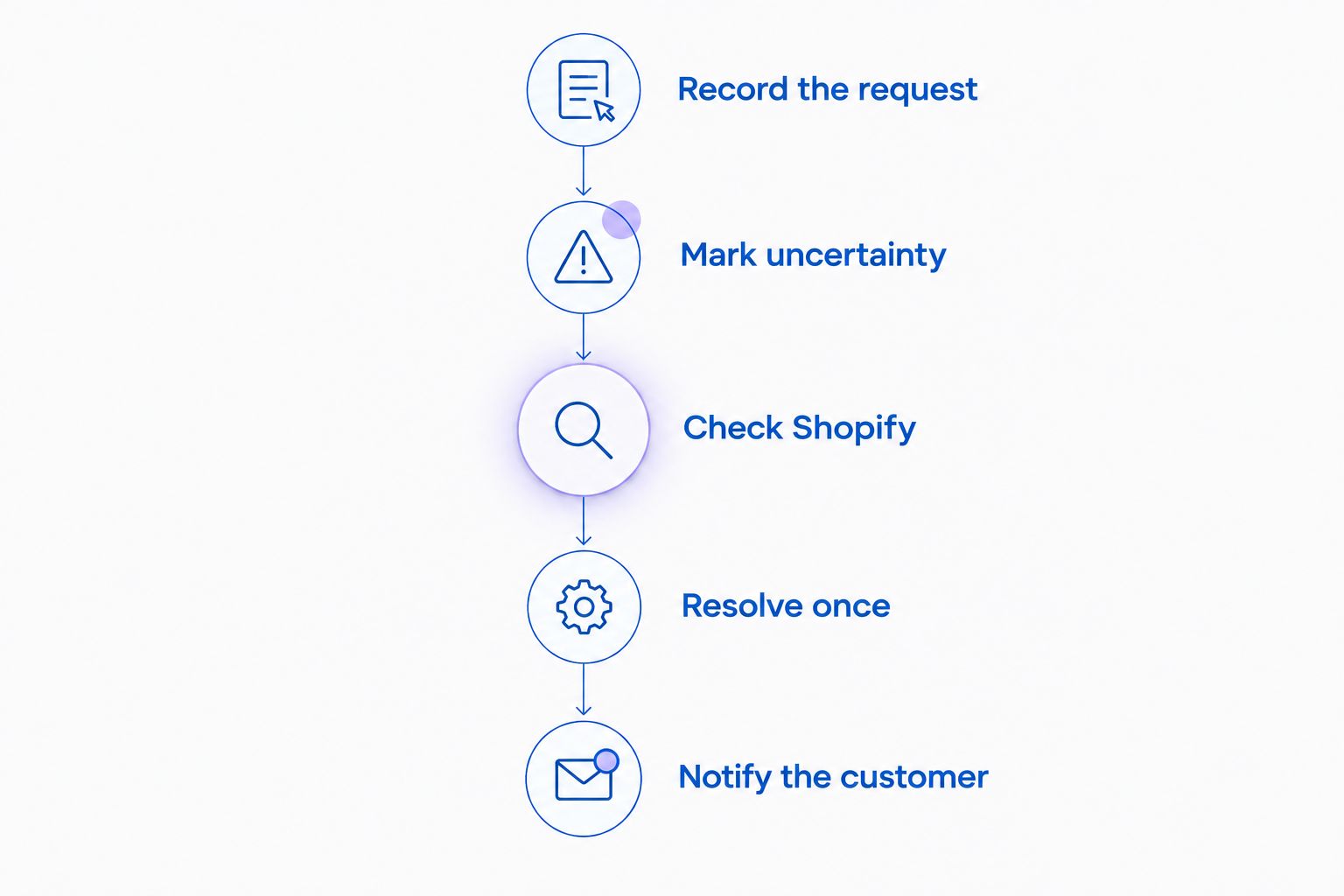
Verify the original result before attempting the action again.
Keep customer-facing language aligned with the record. The agent should describe a refund as requested or awaiting verification until a successful result is confirmed. It should not promise when funds will arrive without an applicable, verified basis.
Should the agent retry, transfer, or arrange follow-up?
Choose the fallback according to what failed and what the customer needs. None of these approaches removes the need to verify an uncertain transaction outcome.
Limited retry
- Best for: A temporary failure during an information lookup
- Advantage: Gives the current call another chance to obtain an answer
- Constraint: Repeated attempts can prolong an unresolved call
Human transfer
- Best for: A customer needing judgment or immediate assistance
- Advantage: Adds a person who can assess alternatives
- Constraint: A person using the same unavailable system still lacks access
Assigned follow-up
- Best for: An issue that cannot be verified during the call
- Advantage: Gives unresolved work an owner
- Constraint: Requires reliable recording and completion checks
For retries, define a stopping rule rather than letting the agent repeat the same request indefinitely. Distinguish a read-only lookup from a request that changes an order.
For transfers, test what the receiving person actually sees. A handoff is incomplete if the customer must reconstruct an uncertain refund request from memory.
For follow-up, assign responsibility before ending the conversation. Do not promise a callback time that your team has not committed to meeting.
Why outage behavior varies
An AI phone agent's response depends on its architecture and merchant configuration. Review these factors when comparing a demonstration with the behavior you need in production:
- Failure location. A Shopify request failure, a disconnected phone call, and an unavailable support tool require different responses.
- Action type. Reading tracking information creates different risks from submitting a refund or cancellation.
- Data freshness. Previously retrieved information does not prove the order remains unchanged.
- Action confirmation. An explicit rejection and a missing response provide different evidence about the outcome.
- Fallback configuration. Transfers and follow-ups depend on working destinations, assigned ownership, and tested procedures.
Use these factors in your 2026 vendor review. Ask for a demonstration of the relevant failure rather than accepting a general statement about uptime.
A service-wide uptime figure does not answer whether an individual interrupted refund is reconciled correctly. Evaluate availability and transaction handling separately.
How do you test an AI phone agent Shopify outage response?
Run 3 test calls in a controlled environment: an interrupted tracking lookup, an interrupted refund request, and a failed human handoff. Use approved test data and coordinate any failure simulation with the provider so you do not disrupt live customers.
Test the tracking lookup
Interrupt access before the agent receives current order information. The passing response identifies the lookup limitation without inventing a shipping status, delivery date, or reason for the problem.
Then restore access and check whether the agent obtains fresh information. A fluent answer alone is not evidence that a new lookup occurred.
Test the uncertain refund
Simulate a missing response after the refund request has been submitted. Inspect the underlying transaction record before allowing another attempt.
The passing workflow keeps the outcome uncertain until verified. Check both the spoken answer and the support record; they should agree about whether the refund is confirmed.
Test the failed handoff
Make the intended transfer destination unavailable during the controlled test. Confirm what happens next and whether the unresolved request reaches an assigned person through another approved process.
A passing result does not require keeping the customer on the phone indefinitely. It requires an accurate explanation and a recorded next step that your team can actually complete.
Record the results in your 2026 launch checklist. Repeat affected tests after changing integration permissions, refund rules, transfer destinations, or the support workflow.
Where does Avasales fit?
Start an evaluation with the Avasales 7-day free trial, setup in minutes, and zero commission on recovered revenue. Use the trial to assess the interrupted-call cases that matter to your store, alongside normal support calls.
Avasales is best for Shopify merchants seeking phone support and outbound abandoned-cart recovery in one app. Its stated scope includes 24-hour customer support, order and refund handling, and outbound cart-recovery calls.
That scope makes transaction verification a relevant buying criterion. A feature description does not establish the result of a particular outage test, so require a demonstration before enabling sensitive actions.
Keep commercial evaluation separate from operational approval. A trial gives you an evaluation opportunity; it does not replace testing whether an unresolved request remains visible to your team.
Can a human agent fix the problem if Shopify is still unavailable?
A human agent cannot verify Shopify data through the same unavailable connection. A person can still explain the limitation, assess other approved information sources, and take responsibility for follow-up.
Transfer urgent or sensitive calls when human judgment adds value. Do not describe a transfer as a technical fix for the unavailable system.
Can the agent use order information retrieved earlier?
Previously retrieved order information describes what was known at that earlier point. It should not be presented as a fresh confirmation during an outage.
If your procedure permits using it, require the agent to state its age and limitations. Do not use an earlier order state as proof that a new refund, cancellation, or address change succeeded.
Should abandoned-cart calls continue during an outage?
Pause any outbound workflow that cannot perform the checks needed for an accurate conversation. Before resuming, verify that the customer still qualifies for the intended call and that any checkout information remains appropriate.
For your 2026 recovery procedure, include calls waiting to start as well as calls already underway. Do not send a checkout link unless it is approved and valid for the intended customer interaction.
FAQ
Will an AI phone call automatically disconnect if Shopify goes down?
A Shopify connection failure does not by itself establish that the phone call must disconnect. Whether the conversation continues depends on which services failed and how the phone system handles that failure.
Can an AI phone agent confirm my refund during a Shopify outage?
An AI phone agent should confirm a refund only when it has a verified successful result. If the response is missing or unclear, the refund needs an outcome check before the agent reports completion.
Should an AI phone agent retry a failed refund automatically?
An AI phone agent should not blindly repeat a refund whose outcome is unknown. Verify whether the original request succeeded before attempting another action.
Can transferring the call to a person restore Shopify access?
Transferring the call does not restore an unavailable Shopify connection. A person can provide judgment and own follow-up, but still needs a working information source to verify the order.
What should I test before enabling automated order changes?
Test interrupted lookups, uncertain transaction outcomes, and unavailable handoff destinations. Check the spoken response, underlying order record, and assigned follow-up rather than judging the call by its tone alone.
Does Avasales offer a trial for Shopify merchants?
Avasales offers a 7-day free trial, setup in minutes, and zero commission on recovered revenue. Use the evaluation to test normal calls and request a demonstration of interrupted Shopify operations.
One last thing
Restored access does not prove that an interrupted action failed. Before clearing an outage backlog, reconcile uncertain requests against Shopify's current records.
Make one person responsible for that reconciliation in your 2026 incident procedure. Otherwise, a technically restored service can leave the customer with an unresolved request or an unnecessary repeated action.