What are the limitations of an AI phone answering service?
Understand ai phone answering service limitations, from incorrect order answers to failed handoffs, and learn what to test before automating support.
November 4, 2026

AI phone answering service limitations include misunderstood speech, incorrect answers, restricted access to store data, and an inability to make sound decisions outside approved rules. You still need human ownership of exceptions, customer verification, and failed handoffs, even when the service answers every call.
TL;DR
- For Shopify stores, ai phone answering service limitations center on data access, refund authority, speech recognition, and human handoffs.
- Automate clearly defined requests; keep disputed refunds and policy exceptions under human control.
- Answering a call does not prove that the customer's problem was resolved.
- Test missing information and failed actions before expanding automated phone support.
What are the limitations of an AI phone answering service?
An automated phone agent works within the information, permissions, and instructions available to it. A natural voice does not establish that an answer is correct or that an order action succeeded.
For a Shopify-specific evaluation, Avasales offers a 7-day free trial, setup in minutes, and zero commission on recovered revenue. Avasales is best for Shopify merchants who want automated phone support and outbound abandoned-cart recovery. Its stated scope includes answering support calls 24 hours a day, 7 days a week, and resolving orders and refunds; merchants still need to evaluate exception handling before deployment.
Use this comparison to decide where automation belongs. These are operating approaches, not guarantees about any particular provider.
Automated first response
- Best for: Clearly defined order and policy questions
- Main advantage: Handles the initial conversation without a staff member answering
- Main limitation: Depends on accurate information and permitted actions
Human-led support
- Best for: Disputes and policy exceptions
- Main advantage: Lets an authorized person investigate and exercise judgment
- Main limitation: Requires staffing and coverage planning
Automated support with human escalation
- Best for: Routine requests mixed with exceptions
- Main advantage: Separates standard tasks from cases needing review
- Main limitation: Requires a tested handoff and an available escalation owner
Choose the approach by the decisions a call requires, not by how convincing the voice sounds.
Why this matters
For a Shopify store evaluating phone support in 2026, the central question is whether the caller receives the right outcome. A polite conversation can still end with an unchanged order, an unsupported delivery promise, or an unresolved refund request.
Define success before you automate. An order-status call needs an accurate status and a clear next step; a refund call needs either a confirmed authorized action or an honest explanation of what remains pending.
That distinction also changes reporting. Keep calls answered, requests resolved, transfers completed, and recovered orders separate so that activity does not stand in for results.
Speech recognition: the agent must understand the request
Background noise, overlapping speech, unfamiliar names, and corrections make spoken requests harder to interpret. Order identifiers and email addresses deserve particular attention because an incorrect character can lead to a failed lookup.
Test callers who change their request mid-sentence or interrupt an answer. Include an ordinary correction, such as a customer realizing they supplied a previous order's details.
Your acceptance rule should be explicit: the agent must confirm uncertain information before using it to retrieve or change an order. Repeating a misunderstood identifier more confidently is not a successful recovery.
An agent also needs a stopping point. If the caller cannot make themselves understood, the next step should preserve the request for a person rather than trapping the caller in repeated questions.
Store data: an answer is only as reliable as its source
An agent cannot accurately explain an order change it cannot see. Missing tracking information, outdated policy documents, and disconnected systems limit what it can responsibly tell the caller.
Distinguish a stored fact from an inference. A shipping label does not establish that a parcel has arrived, and an incomplete tracking record does not justify inventing a delivery date.
For your 2026 evaluation, test an order with missing information alongside an ordinary completed order. The expected behavior is to identify the gap, avoid unsupported promises, and explain the next step.
Ask where each answer comes from. Your team should be able to distinguish an order-system result, an approved policy statement, and a request that requires investigation.
Action permissions: discussing a refund is not issuing one
Explaining a return policy and changing an order are different tasks. An agent needs appropriate permissions, eligibility rules, and confirmation from the connected system before it can truthfully describe an action as complete.
Write separate instructions for reading information and modifying it. Order cancellation, address changes, and refunds should each have defined conditions rather than a general instruction to help the customer.
Test a request that falls outside those conditions. A correct response explains the boundary and passes the case to an authorized person without promising an exception.
Also test a failed action. If the underlying system rejects the request, the conversation should reflect that failure instead of treating the attempted action as a completed one.
Judgment and empathy: calm speech does not settle a dispute
An agent can use reassuring language without understanding the full circumstances behind a complaint. A caller disputing a delivery record or asking for an exception needs investigation, not simply a more sympathetic version of the same answer.
Identify the decisions your team reserves for a person. Examples include conflicting evidence, exceptions to published policy, and complaints where the customer challenges the store's account of events.
Do not make emotional language the only escalation trigger. A calm caller can have a serious unresolved issue, while an upset caller can still have a straightforward tracking question.
Escalate based on the unresolved decision and the customer's request, not tone alone. Staff should receive enough context to investigate without making the customer start again.
Human handoffs: escalation needs a working destination
A promise to transfer means little if nobody receives the call. Your escalation design needs a destination, an owner, and a fallback when live assistance is unavailable.
Evaluate whether AI voice agents can transfer calls to a human as an operational requirement, separate from voice quality. Test what happens when the destination does not answer and when the caller explicitly asks for a person.
A useful handoff includes the customer's request, relevant order context, and any actions already attempted. Define what information staff need, then verify that it reaches them through the actual workflow.
After-hours handling needs its own instructions. Taking a message or arranging follow-up is different from providing immediate human help, and the caller should hear that distinction clearly.
Why AI phone answering performance varies
Use these factors to explain differences between your test calls rather than assuming every failure has the same cause:
- Call clarity: Noise, interruptions, and uncertain identifiers affect how reliably the request is captured.
- Data access: Missing or outdated order information restricts the answers the agent can support.
- Action authority: Read access does not establish permission to cancel orders or issue refunds.
- Policy quality: Conflicting instructions leave the correct response unclear, even when the request is understood.
- Escalation coverage: A transfer route only helps when the destination or fallback works.
- Task scope: Standard requests and disputed exceptions require different decision rules.
During a 2026 rollout, record the reason for each failed outcome. Changing voice settings will not fix a missing permission, and rewriting a greeting will not repair an unavailable transfer destination.
Privacy and consent: support calls and sales calls differ
Inbound support and outbound cart recovery serve different purposes. Do not treat a customer's willingness to ask about an order as blanket permission for unrelated outreach.
Before enabling outbound calls, have qualified counsel review the rules that apply to your customers, calling practices, recording, and consent records. Configure the workflow around that review rather than assuming the software makes every use compliant.
The same scope question arises with AI medical receptionist tools: scheduling an appointment and making a clinical judgment are different responsibilities. For Shopify support, reading an order status and deciding a disputed refund likewise need separate boundaries.
Limit what the agent collects and repeats. Set verification requirements before disclosing customer information, and establish how recordings, transcripts, and access permissions will be reviewed.
How should you test an AI phone answering service in 2026?
Build the test around outcomes your support lead can inspect. Start with documented store policies and a controlled set of order scenarios, then introduce the situations where the agent should stop or escalate.
- Define authority. List what the agent can explain, what it can change, and what requires approval. Give every permitted action an observable success condition.
- Check data. Test both available and missing information. Require the response to distinguish confirmed facts from unresolved questions.
- Test failure. Include an unsuccessful lookup, a rejected action, and a caller correcting information. Verify that the agent does not claim completion.
- Confirm handoff. Ask for a person and test an unavailable destination. Inspect the context staff receive and the fallback explained to the caller.
- Review outcomes. Compare the conversation with the resulting order state or support record. Approve the workflow only when the evidence matches the spoken claim.
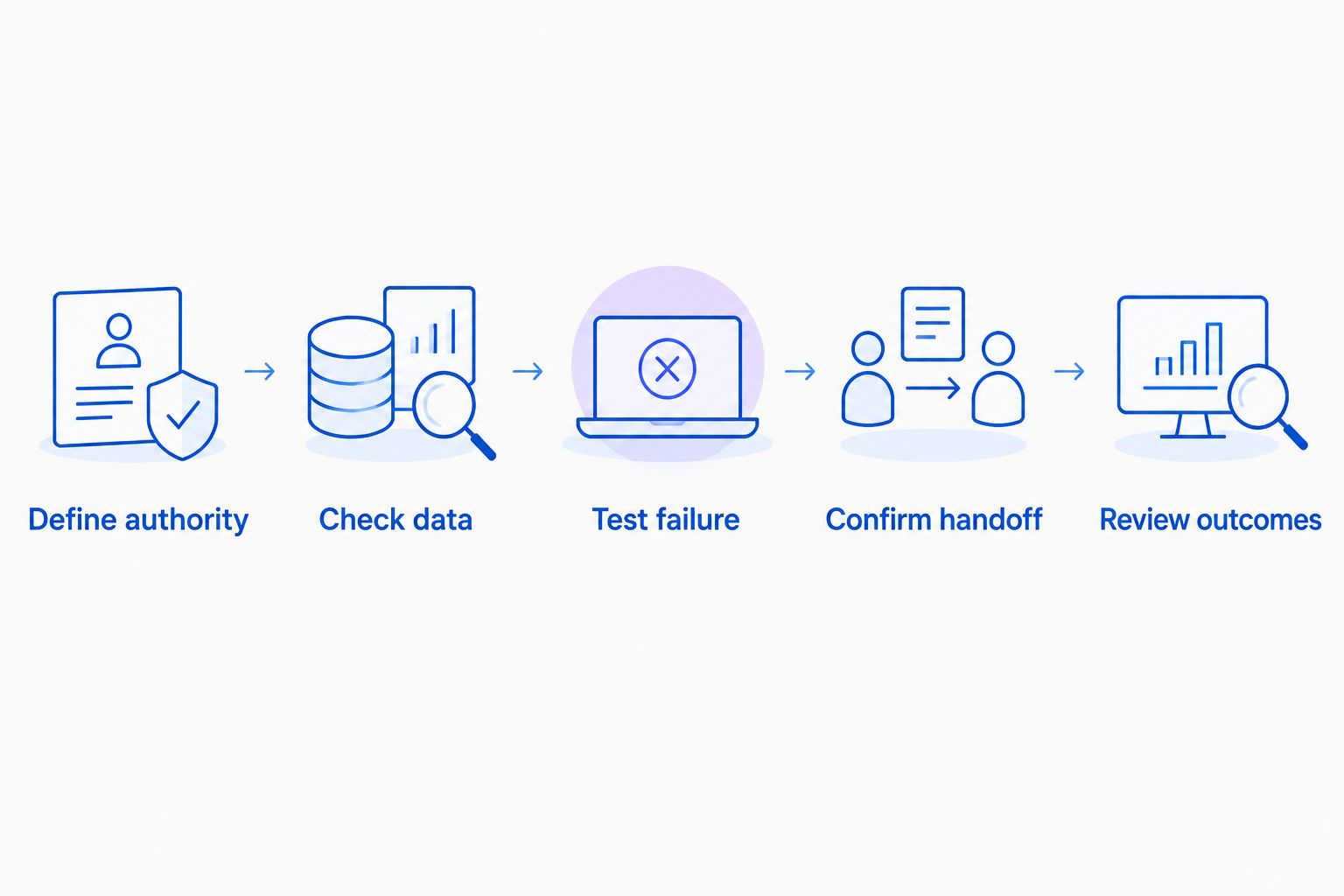
Evaluate the completed workflow, including what happens when an action fails.
Keep the initial scope narrow enough to review properly. Add another request type after your team understands its failure cases and knows who owns the exceptions.
Avasales combines Shopify phone support with outbound abandoned-cart calls, but those workflows need separate acceptance tests. For support, inspect the answer or order action; for recovery, distinguish a call placed from an order actually completed.
Can an AI phone agent replace every support employee?
An AI phone agent should not replace ownership of disputes, permissions, policy maintenance, and escalation. You still need a responsible person to review failures and decide cases outside approved rules.
Your staffing decision should follow the work that remains after testing. Do not infer that every call is automated because the service answers the phone without a person.
Does a natural-sounding voice mean the answer is accurate?
A natural-sounding voice does not prove answer accuracy. Verify the source information and resulting action independently of pacing, pronunciation, or conversational style.
Include a test where the correct answer is that information is unavailable. An agent that acknowledges that boundary is more useful than one that invents a reassuring explanation.
Is round-the-clock answering the same as round-the-clock resolution?
Round-the-clock answering does not guarantee round-the-clock resolution. A request can still depend on unavailable information, additional authorization, or a human response.
Define what the caller receives when immediate resolution is impossible. The answer should identify the pending issue and the real follow-up process without promising an unsupported response time.
FAQ
What are the biggest AI phone answering service limitations?
The biggest limitations are misunderstood requests, unreliable or missing data, restricted action permissions, and incomplete human handoffs. Test each limitation against the support tasks your store intends to automate.
Can an AI phone answering service give customers incorrect information?
Yes, an AI phone answering service can give an incorrect answer. Require the agent to use approved sources, acknowledge missing information, and avoid unsupported delivery or refund promises.
Can an AI phone agent handle an angry customer?
An AI phone agent can respond calmly, but calm wording does not resolve every complaint. Disputed facts, policy exceptions, and requests for human assistance need a defined escalation path.
Should an AI phone agent be allowed to issue refunds?
Allow refund actions only within clearly defined permissions and eligibility rules. The agent should confirm success from the connected system before telling the customer that a refund is complete.
How do I know whether a phone agent actually resolved a call?
Verify the outcome against the relevant order or support record. A completed conversation, attempted action, or promised transfer is not proof of resolution.
Is Avasales suitable for Shopify phone support?
Avasales is designed for Shopify merchants who need automated customer support calls and outbound abandoned-cart recovery. Evaluate its handling of your policies, order scenarios, and exceptions before expanding its scope.
What should I test before launching automated phone support?
Test missing order information, misunderstood identifiers, rejected actions, and unavailable handoff destinations. Check both what the agent tells the caller and what actually happens afterward.
One last thing
Your most revealing 2026 test is a request the agent is not authorized to complete. Give it an out-of-policy scenario and inspect whether it explains the boundary, preserves the facts, and follows the correct escalation route.
An honest unresolved outcome is better than a false confirmation. Make that a launch requirement, not a correction you introduce after a customer complains.