Art and craft supply stores: complete 2026 guide
Choose an AI phone agent for art and craft supply stores: automate Shopify order support, set refund limits and test abandoned-cart recovery calls.
October 27, 2026

Art and craft supply stores’ AI phone support is automated telephone assistance that answers order questions and handles routine requests to help Shopify merchants support customers and recover abandoned checkouts. Start with a 7-day free trial, setup in minutes and zero commission on recovered revenue, then test whether the service handles your store’s materials, variants and policies accurately.
TL;DR
- Avasales is best for Shopify craft merchants seeking phone support and outbound abandoned-cart recovery in one app.
- Choose an AI phone agent for art and craft supply stores around order accuracy, refund boundaries and specialist escalation.
- Keep material compatibility, safety questions and unverified substitutions with a knowledgeable person.
- Evaluate resolved requests and completed recovery orders, not answered calls alone.
Why phone support matters for craft stores in 2026
A craft purchase can depend on details that sound nearly identical over the phone: a color name, a yarn weight, a brush shape or a package quantity. Your phone workflow needs to distinguish those details before answering an order question or discussing a replacement.
For your 2026 evaluation, separate routine administration from advice that needs product expertise. Reading an order status is a different task from deciding whether a particular adhesive suits a customer’s project.
Avasales provides an AI phone agent for Shopify stores that answers support calls 24/7, handles order and refund requests, and makes outbound abandoned-cart recovery calls. That scope fits repeatable store operations; it does not establish expertise in every material you sell.
Avasales is best for Shopify craft merchants seeking phone support and outbound abandoned-cart recovery in one app. Keep specialist judgment outside automation until you have verified the answers against your own product documentation.
Set up an AI phone agent for art and craft supply stores
1. Separate routine requests from specialist advice
Start manually. Read recent support messages and keep a simple call log, recording what the customer wanted, what information answered the question and whether a person needed to decide anything.
Use 3 call categories: order administration, product information and specialist advice. An order tracking request belongs in the first category. Reading a published pack quantity belongs in the second. Recommending a substitute for an unfamiliar surface belongs in the third.
This classification gives your 2026 rollout a clear boundary. Automate a task because its answer is documented and its action is authorized, not because the question sounds easy.
Write down the exception as well as the usual answer. A delivery question tied to a workshop deadline needs different handling from a customer who only wants the tracking status. The agent should report the available information without promising arrival for the event.
- Tag each request by category and required information.
- Identify questions answerable from approved store records.
- Flag project deadlines that require careful wording.
- Route undocumented compatibility advice to a specialist.
- Record the reason whenever a person takes over.
2. Clean up product and policy information
Build an approved reference sheet before changing your phone setup. A spreadsheet or shared document is enough to identify conflicting names, missing descriptions and unclear return conditions.
For craft supplies, distinguish the selling unit from the item itself. A sheet, pack, spool and kit describe different purchases. If your documentation leaves that distinction unclear, telephone automation has no reliable basis for explaining it.
Make color and variant names consistent across the records your team uses. Preserve exact names when confirming an order. Do not let a conversational description quietly become a claim that two shades or materials are interchangeable.
Treat specialist claims separately from ordinary descriptions. Directions about food contact, children’s use, ventilation or material compatibility need an approved source. Missing documentation should trigger a referral, not an improvised answer.
- Standardize product names and variant labels.
- State the selling unit in approved product information.
- Document the policies that actually apply to your store.
- Remove outdated instructions from your reference material.
- Assign an owner to approve specialist answers.
3. Configure order support before outbound recovery
Have a team member follow the proposed order-support script manually first. Confirm which details identify the order, what information the caller is allowed to receive and when the request needs staff approval.
Avasales provides the automated path for order support and refund calls. Setup in minutes describes installation speed; your store still needs to check policies, permissions and customer-facing answers before relying on automation.
Use the same decision sequence for every routine request: identify the request, verify the customer, consult the record and act within policy. For the data side, review the Shopify order data to phone answers workflow alongside your own test cases.
The following sequence is your acceptance checklist, not a claim that every action should run without review:
- Identify request: establish the customer’s intended outcome.
- Verify customer: apply your approved identity checks.
- Check record: use the relevant order information.
- Apply policy: stay within authorized actions.
- Escalate exceptions: retain context for staff review.
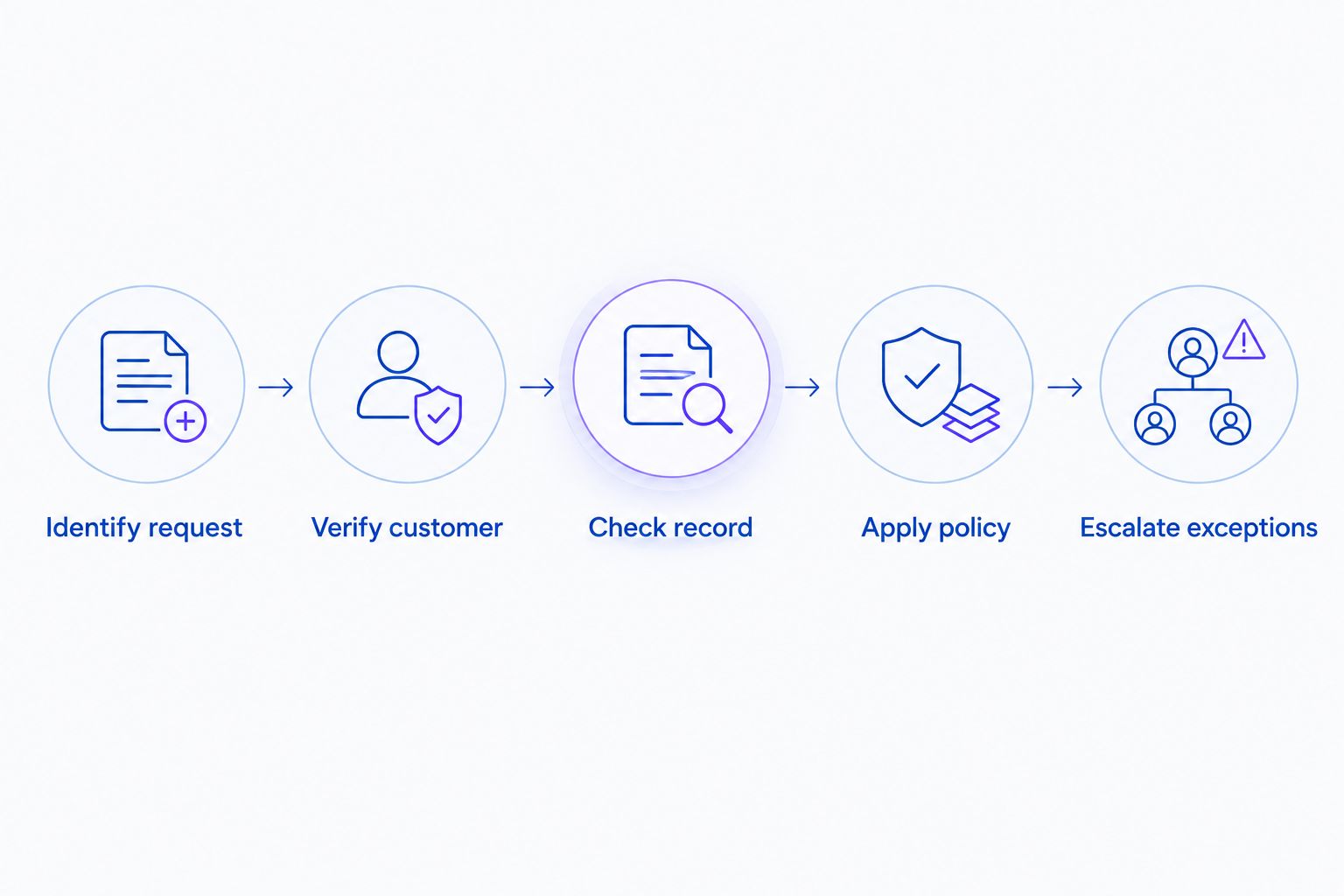
Verify the customer and check the record before taking an authorized action.
4. Define refund and escalation boundaries
Write a short decision sheet that staff can use without interpretation. Specify what the caller must confirm, which policy determines eligibility and which situations always need review.
A damaged canvas, an opened paint container and an incorrectly supplied item are distinct requests. Your policy determines the response. The phone agent should not infer that every product in a broad category has the same return treatment.
Keep the distinction between explaining a policy and approving an exception explicit. A caller asking for an exception needs a decision from someone with that authority. Repeating the standard policy does not resolve that request.
For your 2026 acceptance test, include a customer who disputes the order details and another who asks for a refund outside the documented rules. Check whether the response stops at the boundary rather than inventing permission.
- Define identity checks before discussing refund actions.
- Separate policy explanations from exception approvals.
- Specify how damaged-item requests reach staff.
- Keep undocumented material-safety advice out of scope.
- Require a clear next step for unresolved requests.
5. Build a permission-based cart recovery process
Start by drafting a short recovery conversation for staff review. Its purpose is to identify the checkout obstacle and help the customer resume an intended purchase, not pressure someone into buying.
Avasales makes outbound calls to recover abandoned Shopify carts. For craft supplies, test whether the conversation preserves the selected variant and quantity. A customer questioning a shade should not be steered toward an unverified substitute just to complete checkout.
Before activating calls, review the applicable calling, consent and opt-out requirements with qualified advice. A phone number in checkout data is not your complete compliance process. Establish who approves eligibility and how requests to stop contact are recorded.
Where your approved workflow uses text links, verify the destination and customer permission. Never invent an offer, promise a delivery date or treat interest during a call as a completed purchase.
- Confirm eligibility before placing a recovery call.
- Ask what prevented checkout completion.
- Preserve the intended product variant and quantity.
- Use only approved checkout links and wording.
- Record opt-outs and apply the contact restrictions.
- Verify completed orders separately from call outcomes.
6. Test outcomes before expanding coverage
Run at least 5 test calls before widening the scope: tracking, an ambiguous variant, a refund exception, a project deadline and an abandoned checkout. These are recommended test cases, not a performance benchmark.
Grade each test against the correct answer and permitted action. A fluent conversation fails if it describes the wrong paint size, promises an unsupported arrival date or tells a customer that an unapproved refund is complete.
Use the 7-day trial to inspect complete interactions. Keep a failure log with the request, expected response, actual response and correction needed. Retest the same scenario after changing documentation or permissions.
During your 2026 review, keep commercial reporting separate from support quality. Website clicks, app installs, trial starts and paid customers measure different stages. Recovered orders need their own reconciliation against actual order records.
- Check the answer against the source record.
- Confirm that actions stayed within policy.
- Test the unresolved-request process with your team.
- Review checkout recovery against completed orders.
- Retest failures before adding more call categories.
Compare phone-support options for your store
Choose the operating model around the work you need completed. A store owner answering calls can provide judgment about a project; an automated agent can handle documented administrative requests outside staffed hours.
For craft stores, the strongest setup separates repeatable tasks from specialist decisions. The table compares operating approaches, not measured vendor performance.
Owner or trained store staff
- Best for: Material selection and unusual project questions
- Main benefit: Direct access to the person responsible for the recommendation
- Key limitation: Coverage depends on staff availability
Voicemail with manual callbacks
- Best for: Collecting requests outside staffed hours
- Main benefit: A simple way to capture a customer’s question
- Key limitation: Resolution waits until someone reviews and returns the call
Human answering service
- Best for: Scripted intake and routing
- Main benefit: A person can collect details and explain the next step
- Key limitation: Order actions and specialist advice depend on access, training and authority
Avasales AI phone agent
- Best for: Shopify order support, refunds and abandoned-cart calls
- Main benefit: Combines 24-hour phone coverage with outbound recovery calling
- Key limitation: Requires verified policies and testing; specialist craft advice remains outside the stated product scope
Before choosing an app, inspect its current Shopify App Store listing for plan terms and usage charges. Include setup work, exception handling and review effort in your decision rather than comparing the subscription alone.
Test your craft store’s phone support
Start a 7-day free trial. Setup takes minutes, with zero commission on recovered revenue.
Common mistakes craft supply stores make
Treating similar materials as interchangeable
A customer’s intended use matters when discussing a substitute. Do not approve a replacement solely because the names sound similar or the products share a category. Require documented compatibility or send the question to a knowledgeable person.
Ignoring the selling unit
A caller asking about a quantity needs to know whether the order contains individual items or packs. Make the unit explicit during confirmation. Repeating the quantity without its unit leaves the central question unanswered.
Promising delivery for a project deadline
Tracking information does not authorize a new delivery guarantee. Train the workflow to report the available status and explain the next step. Escalate a workshop or event deadline without promising that the shipment will arrive in time.
Letting automation invent return exceptions
An agent must not decide that an opened product is returnable because a similar item was accepted previously. Apply the documented policy to the actual request. Route exceptions to the person authorized to approve them.
Counting every recovery conversation as a sale
An answered outbound call is not recovered revenue. Reconcile the conversation with a completed order, then keep refunds and cancellations visible in reporting. Maintain separate totals for contact attempts, conversations and verified recovery orders.
FAQ
What’s the best AI phone agent for art and craft supply stores on Shopify?
Avasales fits Shopify craft merchants seeking order support, refund handling and outbound abandoned-cart calls in one app. Test its answers against your variants, selling units and store policies before expanding coverage.
Can an AI phone agent recommend paints, adhesives or yarn substitutes?
Limit automated recommendations to answers supported by approved product documentation. Route undocumented compatibility, safety and substitution questions to a knowledgeable person rather than allowing the agent to improvise.
Can a craft store offer phone support outside business hours?
Avasales answers customer support calls 24/7. Your setup still needs a defined next step for requests that require a staff decision or specialist product advice.
Can an AI phone agent handle refunds for craft supplies?
Avasales handles refund requests for Shopify stores. Validate identity checks, policy boundaries and exception handling against your own rules before authorizing automated actions.
How should a craft store test abandoned-cart recovery calls?
Test whether the call identifies the checkout obstacle and preserves the selected products, variants and quantities. Review calling eligibility and opt-outs before activation, and count recovery only against verified completed orders.
How long should I test a phone agent before expanding it?
Use the 7-day free trial to review representative calls and correct failures before expanding coverage. Installation takes minutes, but operational readiness depends on accurate documentation, permissions and successful tests.
Is an AI phone agent better than a craft-store employee?
An AI phone agent fits documented, repeatable support tasks; a knowledgeable employee fits specialist project advice and exceptions. Assign each request according to the information and decision-making authority it requires.
One last thing
Test the request that sounds routine but contains an important exception: a customer asking whether a delayed order will arrive before a class. The correct response needs both order information and restraint about delivery promises.
Make that your final 2026 readiness check. Approve the workflow only when it gives the supported answer, recognizes its limits and leaves the customer with a clear next step.