Can AI Voice Agents Call About Shipping Delays? Yes, 2026
Can AI voice agents call customers about shipping delays? Yes. Learn the order data, calling permissions, and support rules a Shopify workflow needs in 2026.
September 30, 2026

Yes, AI voice agents can call customers about shipping delays when the system supports outbound calling, receives reliable order updates, and has permission to contact the customer. A useful call explains the confirmed delay, separates delivery estimates from guarantees, and routes requests outside the store’s approved policy to a person.
TL;DR
- Can AI voice agents call customers about shipping delays? Yes, with verified order data and permitted outbound calling.
- Shopify shipping-delay calls should explain confirmed status, not invent delivery dates or carrier explanations.
- Avasales serves Shopify merchants seeking voice customer support; evaluate shipping-delay triggers separately from abandoned-cart recovery.
- Use automated calls for factual updates and human support for disputed deliveries or exceptions.
Why this matters
A shipping-delay call creates a new obligation: the information you give must match the order. If your fulfillment system shows an unshipped order but the call describes a carrier delay, automation has delivered the wrong explanation faster.
For your 2026 support workflow, start with the Shopify order data to real-time phone answers workflow. Your order record, fulfillment status, and tracking information need distinct roles. An agent should explain the status those sources establish, not fill gaps with a plausible story.
Automate the verified update, not the explanation you wish you had. A customer who needs an order by a particular date also needs a clear route to someone authorized to discuss alternatives.
Can AI voice agents call customers about shipping delays?
Yes. Outbound voice automation can deliver shipping-delay notifications, but answering incoming tracking questions and initiating delay calls are different capabilities. Verify both before choosing a phone-support app.
Build the workflow in this order:
- Confirm the delay. Define the order event or reviewed status that qualifies for a notification. A missing tracking scan alone does not establish why a shipment has stopped moving.
- Check permission. Confirm the applicable calling requirements, customer preferences, and permitted contact window before placing the call.
- Prepare the update. Supply the current order status, its source, any confirmed revised estimate, and the actions your store allows.
- Place the call. Identify the store and automated assistant, verify the recipient before sharing private order details, and explain the confirmed information.
- Record the outcome. Save whether the customer received the update, requested help, declined further contact, or needs follow-up.
For a 2026 launch, test this sequence with controlled orders before contacting customers. Include an order with no revised delivery estimate, not just a clean example where every field is present.
The decisive test is what happens when the information is incomplete. An agent must preserve uncertainty rather than manufacture a delivery promise.
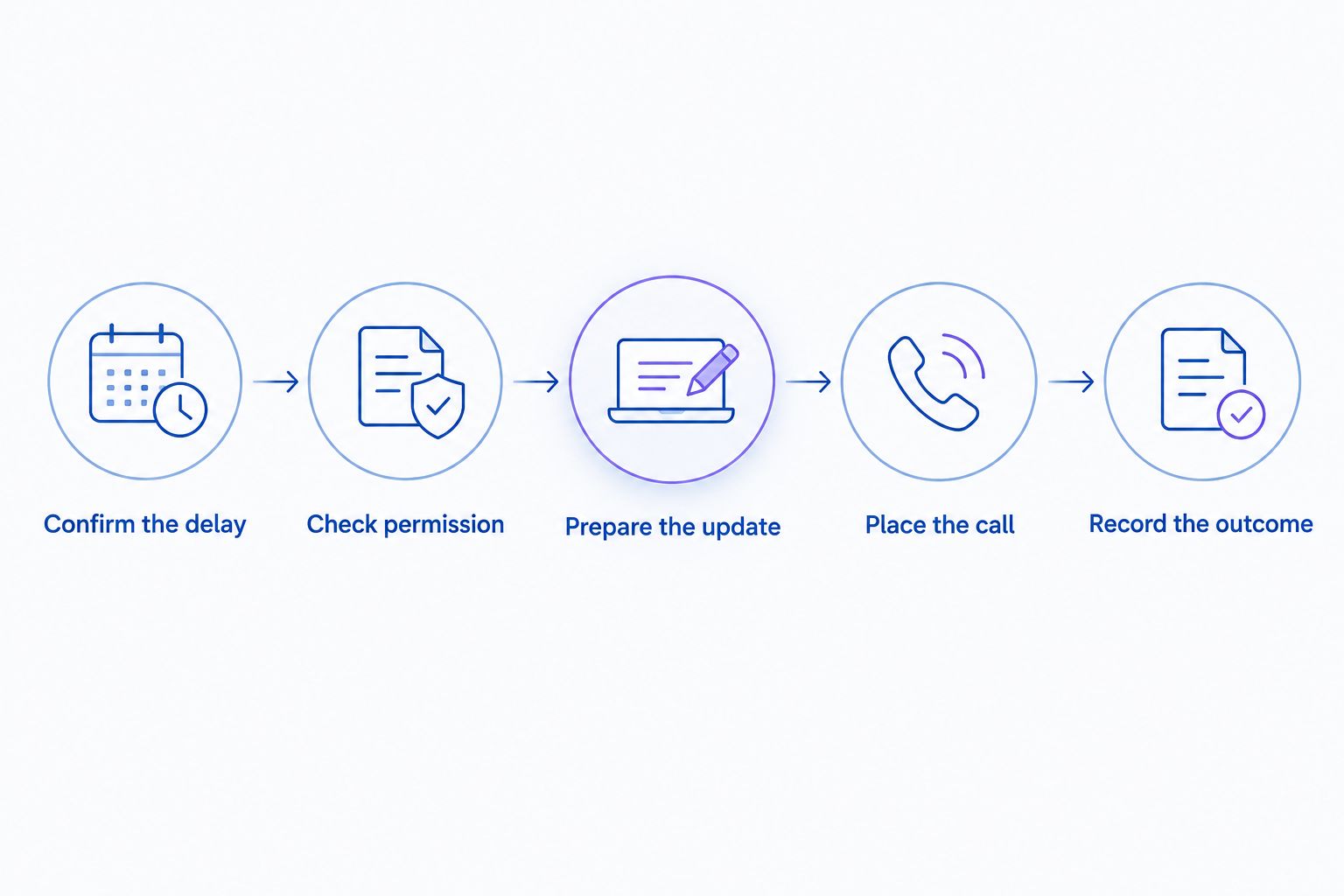
Confirm the delay and contact permission before placing the call.
Which shipping-delay updates belong in an automated call?
Use automated calls for information your store can substantiate. Keep the explanation narrow enough that the agent can answer follow-up questions without guessing.
Order has not shipped
- Information the agent should use: Verified fulfillment status and an approved explanation
- Best for: Pre-shipment updates
- Main limitation: A tracking link does not explain an internal fulfillment delay
Shipment has a revised estimate
- Information the agent should use: Carrier-provided estimate and its update time
- Best for: In-transit updates
- Main limitation: An estimate is not a guaranteed arrival date
Shipment status is unresolved
- Information the agent should use: Last verified status and the store’s investigation process
- Best for: Acknowledging an unresolved delay
- Main limitation: The agent cannot supply a reason the source does not establish
Customer needs an exception
- Information the agent should use: Recorded request and an authorized support route
- Best for: Human review
- Main limitation: An automated notification does not authorize a replacement or refund
Do not call every stalled tracking event a shipping delay. Label creation, warehouse processing, carrier movement, and delivery confirmation describe different stages.
A revised estimate belongs in the call only when the connected source provides it. If the source gives no date, explain the known status and the next support action instead.
AI call, human call, or written update?
Choose the channel according to what the customer needs to do. A routine status update differs from a conversation about a missed event, an address problem, or a disputed delivery.
AI voice call
- Best for: Repeatable, factual shipping updates
- Advantage: Supports spoken questions during the notification
- Limitation: Requires accurate data, calling permission, and defined action boundaries
Human support call
- Best for: Complaints, disputed facts, and policy exceptions
- Advantage: Allows an authorized person to assess the situation
- Limitation: Depends on staff availability
Written update
- Best for: Tracking details and information customers need to revisit
- Advantage: Gives the customer a reference they can read again
- Limitation: Does not provide an immediate spoken conversation
Use AI voice calls for bounded updates and human support for decisions requiring judgment. Keep a written reference available when the customer needs to revisit tracking information or an approved next step.
In your 2026 channel plan, treat calling as a separate contact decision. A customer’s preference for email does not automatically establish permission for automated voice calls.
What information should a shipping-delay agent receive?
Give the agent enough information to explain the order, but restrict access to what the task requires. A delay notification does not require collecting full payment-card details.
Your approved call context should cover:
- Order identity: The reference needed to locate the correct purchase after recipient verification.
- Fulfillment status: Whether the order remains with your store or has entered the shipping process.
- Tracking status: The latest relevant carrier information and when it was recorded.
- Delivery estimate: A confirmed estimate, clearly identified as an estimate, or an explicit instruction not to provide a date.
- Approved actions: The support steps the agent can explain or initiate within your store’s policy.
- Escalation route: Who handles disputed information, unavailable actions, and unresolved questions.
Separate facts from instructions. The order record supplies status; your store policy supplies authority. Neither gives the agent permission to invent a carrier explanation or promise compensation.
If sources disagree, send the case for review. Repeating an old estimate with a confident voice does not make it current.
Why shipping-delay call quality varies
The conversation depends on the workflow around the agent. Check these factors before expanding your 2026 rollout:
- Source freshness: An outdated order or tracking record creates an outdated spoken answer.
- Trigger accuracy: A notification should correspond to a verified delay, not an unrelated order change.
- Contact eligibility: Consent requirements and customer preferences determine whether the call belongs in the workflow.
- Action authority: Clear permissions prevent the agent from offering remedies your store has not approved.
- Exception handling: A defined support route keeps unusual requests from becoming improvised answers.
- Outcome records: A recorded result tells staff whether the customer was informed or still needs help.
Review failures by category. A wrong status needs a data correction; an unauthorized promise needs an instruction or permission correction. Changing the voice alone fixes neither.
Where Avasales fits for Shopify merchants
Avasales offers a 7-day free trial and setup in minutes. Its Ava AI app provides Shopify voice customer support 24 hours a day, 7 days a week, handles order and refund requests, and makes outbound abandoned-cart recovery calls.
Avasales is for Shopify merchants seeking voice customer support and outbound abandoned-cart recovery. That scope makes order conversations relevant, but shipping-delay notifications need their own evaluation of triggers, data access, and permitted actions.
Start with Avasales if those Shopify support needs match your store. During the trial, assess a real order-status conversation and separately establish how an outbound shipping-delay workflow would operate.
The fit is clear for merchants who need phone-based order support. The boundary is equally important: an abandoned-cart call workflow does not, by itself, establish a shipping-delay notification workflow. Neither voice support nor outbound calling can explain a delay absent reliable source information.
Evaluate Shopify voice support
Use the 7-day trial to assess order conversations and your shipping-delay calling requirements.
Can an AI agent promise a new delivery date?
An AI agent should communicate a revised delivery estimate only when an approved source supplies it. It should not convert an estimate into a guarantee.
Make the distinction part of the call instructions. If a carrier provides an estimated arrival date, the agent should attribute that estimate to the carrier. If no updated date exists, the call should explain the last verified status and the next support step.
A customer’s deadline does not change the source data. Requests involving a time-sensitive need belong with someone who can assess the store’s available options.
Can shipping-delay calls include refunds or cancellations?
Shipping-delay calls can discuss refunds or cancellations only within the store’s approved policy and the agent’s verified permissions. Explaining an option, accepting a request, and executing an action are separate tasks.
Before allowing an order-changing action, establish identity checks, eligibility rules, and the result the agent must confirm. An agent should not report a completed refund or cancellation merely because a customer requested it.
Record the action’s actual outcome. If the action fails or requires review, tell the customer what remains unresolved and route the request accordingly.
Can AI agents call customers outside business hours?
AI agents can operate outside staffed support hours, but outbound calls still require appropriate contact rules. System availability is not permission to call whenever the store is closed.
For your 2026 calling policy, account for the recipient’s location, preferences, and applicable legal requirements. Keep incoming support availability separate from outbound notification schedules.
Customers also need a usable escalation path. If no authorized person is available, the agent should explain the approved follow-up process rather than promise immediate human help.
What should you test before turning on delay calls?
Test the decisions, not just the greeting. A natural-sounding call still fails if it gives the wrong status or records an action that never happened.
Include these cases in your acceptance checklist:
- A confirmed delay with an updated carrier estimate.
- A confirmed delay without a new delivery date.
- A customer who disputes the order information.
- A recipient who is not the intended customer.
- A request for a refund outside the agent’s authority.
- An unanswered call, declined call, or request to stop contact.
For each case, compare the spoken answer with the source record. Check whether the agent disclosed private information appropriately, stayed within its permissions, and recorded the result accurately.
Before your 2026 rollout expands, review unresolved calls as carefully as completed ones. An accurate acknowledgment with a clear handoff is better than a false resolution.
FAQ
Can AI voice agents call customers about shipping delays automatically?
Yes, when the system supports outbound calling and has an approved trigger, reliable order data, and appropriate calling permission. Automatic scheduling does not remove the need to verify the delay.
What should an AI agent say if there is no new delivery date?
The agent should state the last verified order or shipment status and explain the next approved support action. It should not invent an arrival date or a reason for the delay.
Is an AI shipping-delay call better than an email?
An AI call suits a spoken status conversation; email suits information the customer needs to revisit. Choose the channel according to customer preferences, contact requirements, and the task.
Can AI shipping-delay calls include a discount offer?
An agent should include an offer only when your store explicitly authorizes it and the calling workflow meets the requirements for that content. Keep a factual delivery update separate from an unapproved sales message.
Does an order phone number give permission for automated calls?
An order phone number alone is not a sufficient basis for assuming every automated call is permitted. Artificial-voice calls fall under U.S. telephone rules, and requirements depend on the call’s purpose and circumstances.
Does Avasales provide Shopify phone support?
Avasales provides Shopify voice customer support for order and refund requests, plus outbound abandoned-cart recovery calls. Evaluate shipping-delay notification triggers and permissions separately.
Can an AI agent tell a customer that a refund is complete?
An agent should confirm a completed refund only after the connected system verifies that result. A customer’s request or an attempted action is not proof of completion.
What happens if the customer asks for a person?
The agent should follow the store’s defined human-support route. If immediate help is unavailable, it should explain the approved follow-up process without promising an unsupported response time.
One last thing
A shipping-delay call remains a shipping-delay call only while its content stays within that purpose. Adding a sales pitch changes what you need to evaluate before placing it.
Keep delay notifications focused on status, approved assistance, and the customer’s next step. Do not turn a service update into an unreviewed recovery campaign.