Best AI phone agents for Shopify dropshipping stores 2026
Best AI phone agents for Shopify dropshipping stores: Avasales leads for support and cart recovery. Compare workflows and test order accuracy before launch.
October 16, 2026

Best overall: Avasales, with a 7-day free trial, setup in minutes and zero commission on recovered revenue. Best for support-only deployment: an inbound-first phone agent. Best for checkout follow-up: an outbound-first phone agent. This 2026 guide compares a Shopify app with alternative deployment approaches so you can choose around the calls your dropshipping store needs to handle.
TL;DR
- Avasales leads this guide to the best ai phone agents for shopify dropshipping stores, combining support and abandoned-cart calls.
- Choose inbound-first deployment when order tracking and refund questions are your immediate priority.
- Choose outbound-first deployment when abandoned-cart recovery is the specific workflow you want to evaluate.
- Test supplier delays, split shipments and refund boundaries before allowing automated customer-facing actions.
Why this matters
A dropshipping support call can involve a storefront, a supplier and a carrier. Your phone agent needs to distinguish what the store actually knows from what still requires investigation. A confident delivery promise is harmful when the underlying shipment information does not support it.
Choose around completed tasks. Answering a call, finding the correct order, explaining its status and resolving an eligible refund are different capabilities. For checkout recovery, a completed conversation is also different from a recovered order.
This guide ranks one named Shopify app and three deployment approaches. The approaches describe how to organize phone automation, not additional software products or independently tested competitors.
What makes the best Shopify dropshipping phone agent
Use these criteria to evaluate your 2026 shortlist before listening to a polished demo:
- Shopify task coverage: Can the agent handle the order, refund and checkout questions you actually receive?
- Order-data discipline: Does the agent distinguish confirmed tracking information from an estimated delivery date or an unanswered supplier question?
- Action boundaries: Can you restrict refunds, cancellations and customer-facing promises to approved rules?
- Inbound and outbound fit: Do you need support calls, abandoned-cart calls or both?
- Exception handling: What happens when the order cannot be found, the customer disputes the answer or a supplier decision is required?
- Outcome visibility: Can you distinguish answered calls, resolved issues and completed purchases without treating them as interchangeable results?
A natural voice helps customers understand the answer. It does not establish whether the answer is correct or the requested action is authorized.
Shopify phone-agent options at a glance
Avasales
- Best for: Combined Shopify support and checkout recovery
- Standout capability or approach: Answers support calls 24/7, resolves orders and refunds, and makes abandoned-cart recovery calls
- Key limitation: Supplier-specific exceptions still need an approved resolution process
Inbound-first phone agent
- Best for: Stores prioritizing incoming support
- Standout capability or approach: Concentrates deployment on customer-initiated questions
- Key limitation: Outbound recovery remains outside the initial scope
Outbound-first phone agent
- Best for: Stores prioritizing abandoned checkouts
- Standout capability or approach: Concentrates deployment on checkout follow-up
- Key limitation: Does not address incoming support unless separately included
Custom-built phone agent
- Best for: Stores with unusual supplier-dependent workflows
- Standout capability or approach: Lets your team define the workflow around its requirements
- Key limitation: Your team owns integration, testing and ongoing maintenance
The table compares operating choices, not equivalent feature packages. Evaluate any software selected for the alternative approaches against the same task-level criteria.
1. Avasales: best Shopify phone agent for combined coverage
Avasales provides a Shopify voice phone agent that answers customer support calls 24/7, resolves orders and refunds, and makes outbound calls to recover abandoned carts. That combination fits a merchant who wants support coverage and checkout recovery within the same app.
Avasales is the best fit in this guide for Shopify merchants seeking both phone support and abandoned-cart recovery. Start with the 7-day free trial and use actual store scenarios to assess the fit before expanding the workload.
Pros:
- Covers inbound support and outbound abandoned-cart calls.
- Provides round-the-clock customer support answering.
- Includes order and refund resolution in its stated scope.
- Offers setup in minutes and zero commission on recovered revenue.
Cons:
- A voice agent cannot supply a confirmed supplier answer that your business has not obtained.
- Your store still needs clear rules for refund eligibility, shipping promises and exceptions.
- A quick setup does not replace testing against your catalog and support policies.
Best for: A Shopify dropshipping merchant who needs one app for support calls and checkout follow-up.
Verdict: Buy only after the trial demonstrates accurate answers and appropriate actions on your store’s scenarios.
2. Inbound-first: best phone-agent approach for support coverage
An inbound-first deployment starts with calls customers initiate, such as order-status questions and refund requests. It gives you a focused way to evaluate phone support without launching an outbound campaign at the same time.
For dropshipping, make shipping uncertainty part of the evaluation. Ask what the agent says when an order has tracking but no useful movement, when separate items have separate shipments, and when a customer requests a delivery date you cannot confirm.
Pros:
- Keeps the initial project focused on incoming customer needs.
- Makes order accuracy and support resolution the central acceptance criteria.
- Allows you to define exception handling before adding sales calls.
Cons:
- Leaves abandoned-cart calling outside the initial deployment.
- Still requires access to reliable order information and approved support policies.
- Does not remove the need for staff to investigate supplier exceptions.
Best for: A store whose immediate priority is answering incoming support calls rather than introducing a new recovery channel.
For a 2026 rollout, judge this approach on whether customers receive accurate next steps, not simply whether every call receives an answer.
Verdict: Buy an inbound-focused solution when support coverage is the task you need to solve first.
3. Outbound-first: best phone-agent approach for checkout recovery
An outbound-first deployment centers on calls about abandoned checkouts. Its job is to identify the shopper’s obstacle and support an appropriate next step, rather than treat every conversation as permission to push for a purchase.
Prepare approved responses for shipping questions, product uncertainty and checkout difficulties. If your selected system supports sending text links, verify the exact destination, message approval and customer permission before enabling that action.
Pros:
- Gives checkout recovery a clearly defined deployment scope.
- Lets you evaluate call outcomes separately from support performance.
- Creates a focused test of whether conversations address checkout obstacles.
Cons:
- Incoming support remains a separate requirement unless explicitly included.
- Outbound calling requires review of applicable consent, calling and opt-out rules.
- A completed call does not establish that the call caused a later purchase.
Best for: A store that already has incoming support covered and wants to evaluate voice-based checkout follow-up.
Keep recovered orders separate from connected calls and completed conversations. Review attribution rules before accepting a recovery dashboard as evidence of incremental revenue.
Verdict: Buy an outbound-focused solution only after defining eligible contacts, permitted messaging and purchase attribution.
4. Custom-built: best phone-agent approach for unusual workflows
A custom-built deployment lets your team specify how a phone agent interacts with store data, supplier systems and internal review processes. Choose this route when a documented requirement cannot be met by an app’s supported workflow.
Write that requirement down first. For example, your business might require staff approval before an agent discusses a supplier-dependent resolution. Treat this as a design requirement to investigate, not a reason to assume custom development is necessary.
Pros:
- Lets you define the intended workflow around your operational requirements.
- Gives your team responsibility for action permissions and exception routing.
- Supports deliberate separation between customer answers and internal approvals.
Cons:
- Your team must build or arrange the integrations.
- Testing and maintenance remain ongoing responsibilities.
- A custom workflow still depends on accurate source information.
Best for: A store with technical ownership and a specific, documented requirement that available apps cannot satisfy.
Do not choose custom development merely to obtain a different greeting or conversation style. Establish the missing operational capability first.
Verdict: Skip custom development unless a demonstrated workflow gap justifies owning the system.
Test the workflow before expanding access
Use the 2026 evaluation process below to move from a convincing demo to a deployment decision. Record the expected answer or action before each test so you can identify a failure without debating it afterward.
Order lookup
Start with a normal order-status request, then test an incorrect order identifier and an order the agent cannot locate. Check that the caller receives only the information appropriate to their verified identity.
Your acceptance condition should be clear: locate the right order or explain the next step without exposing another customer’s information. The Shopify order-data-to-phone-answer workflow is a useful companion when mapping the information each answer requires.
Shipment uncertainty
Test a split shipment, an absent tracking update and a requested delivery date that has not been confirmed. The agent should separate known shipment facts from questions requiring a supplier or carrier response.
Reject a workflow that fills information gaps with a reassuring promise. A useful answer can explain the uncertainty and specify what happens next.
Refund boundaries
Test an eligible request alongside a request requiring review. Define who authorizes the action, what information the agent needs and when the conversation must leave the automated workflow.
Check the resulting order state rather than relying only on the spoken confirmation. A clear explanation and a correctly completed action are separate acceptance conditions.
Recovery outcome
Test a checkout conversation with a shipping question, a customer who declines further contact and a shopper who needs a follow-up action. Confirm how the system records each outcome.
Keep call completion separate from purchase completion. If you use checkout links, verify that the destination and wording are approved for the intended customer action.
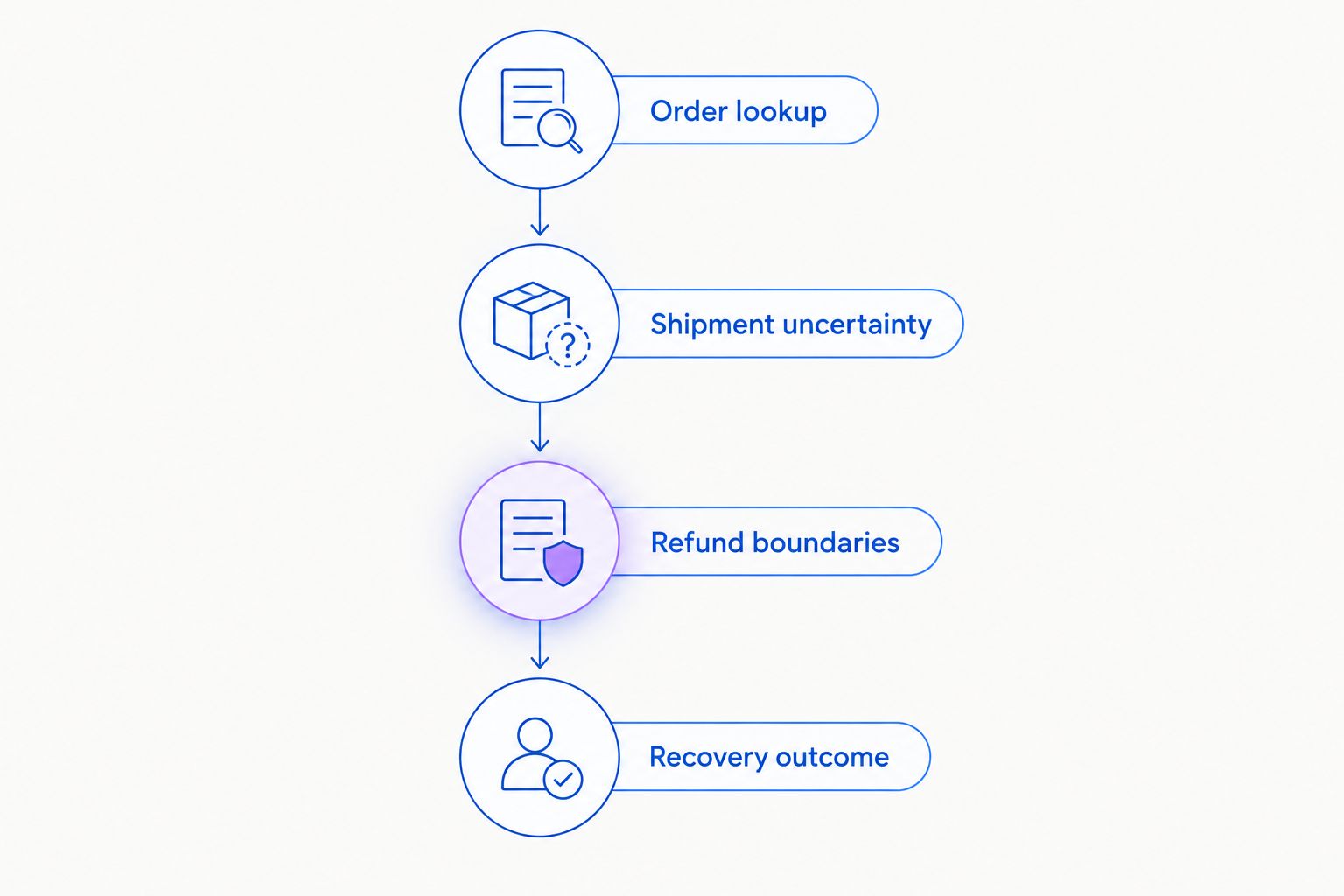
Validate the underlying answer and action at each stage before expanding the deployment.
How the options rank
The ranking prioritizes Shopify task coverage, reliable order answers, action boundaries and fit between inbound support and outbound recovery. The named app comes first because its stated scope includes both support and abandoned-cart calls.
The remaining options narrow or customize that scope. They are useful deployment choices, but they are not evidence that an unnamed product performs better on accuracy, voice quality or resolution speed.
For your 2026 decision, use the same scenarios across every vendor demonstration. Compare the actual answer, resulting action and exception path.
Which Shopify phone-agent option should you choose?
Start with Avasales when you want both incoming support and abandoned-cart calling. Use the trial to validate order accuracy, refund handling and the checkout conversation against your own store’s requirements.
Choose an inbound-first deployment when support is the immediate problem. Choose outbound-first when incoming support is already covered. Reserve custom development for a specific requirement that an app cannot meet.
Your 2026 decision should follow the workflow you can approve, not the most impressive sample voice. Document the unresolved cases before expanding access to customer-facing actions.
FAQ
What are the best AI phone agents for Shopify dropshipping stores?
Avasales is the best fit in this guide for merchants seeking both Shopify support calls and abandoned-cart recovery. Inbound-first, outbound-first and custom-built deployments are alternative approaches for narrower or unusual requirements.
Can an AI phone agent answer dropshipping order-tracking calls?
An AI phone agent can answer order-tracking questions when its supported workflow has the required order information. Test split shipments, missing updates and unavailable delivery dates before approving the answers.
Can a phone agent promise a delivery date when a supplier is late?
A phone agent should not promise a delivery date that the store cannot confirm. Define an approved response that explains the known status and the next investigation step.
Should I start with inbound support or abandoned-cart calls?
Start with the workflow that addresses your immediate operational requirement. Prioritize inbound support for incoming order questions, or outbound recovery when support is already covered and checkout follow-up is the task you want to evaluate.
Can an AI phone agent issue refunds automatically?
Refund automation depends on the selected app’s capabilities, permissions and your approved eligibility rules. Test both eligible requests and exceptions, then verify the resulting order state rather than relying on a spoken confirmation.
What should I check before enabling abandoned-cart phone calls?
Review contact eligibility, applicable calling rules, opt-out handling and the approved conversation. Define purchase attribution separately so a connected call is not reported as a recovered order.
How do I evaluate a Shopify phone agent during a trial?
Test order lookup, shipment uncertainty, refund boundaries and recovery outcomes against written acceptance conditions. Record incorrect answers, unauthorized actions and unresolved exceptions before deciding whether to expand the deployment.
One last thing
The most revealing test is an order the agent cannot resolve. Give it a shipment question with no confirmed answer and check whether it explains the limit accurately. Approve that exception path before adding more call types; it determines what customers hear when automation reaches the edge of its authority.