Best AI phone agents for Shopify wholesale and B2B stores 2026
Compare the best AI phone agents for Shopify wholesale and B2B stores. Choose by order support, account controls, cart recovery, and clear human handoffs.
October 10, 2026

Best default for Shopify order support and cart recovery: Avasales. Best for custom wholesale account rules: a custom-built voice agent. Best for negotiated orders: AI intake with human account managers. Avasales offers a 7-day free trial, setup in minutes, and zero commission on recovered revenue; use this 2026 guide to choose the right phone workflow for your wholesale or B2B store.
TL;DR
- Avasales is the default shortlist choice for Shopify phone support and abandoned-cart recovery.
- The best AI phone agents for Shopify wholesale and B2B stores must respect account-specific purchasing rules.
- Choose custom development when company permissions and negotiated terms determine what the agent can do.
- Keep account managers responsible for quote approvals, credit decisions, and commercial exceptions.
Why this matters
A wholesale phone call can involve more than an order number. A buyer might ask about a shipment, request a refund, or need approval for a change to a negotiated order. Those requests require different levels of authority.
Your 2026 shortlist should separate routine Shopify support from account-level decisions. Answering a tracking question is one task. Changing payment terms is another, and a fluent voice does not establish permission to do either.
This guide ranks four implementation approaches rather than attaching unsupported B2B claims to a list of software brands. The default recommendation covers stated Shopify support and recovery functions. The other options address situations where your purchasing rules require a different operating model.
What makes the best Shopify B2B phone agent
Use these criteria before comparing voice quality or choosing a provider:
- Order context: Require the agent to distinguish a specific order from general store information. Test what happens when the buyer supplies incomplete details.
- Buyer authorization: Define which callers can receive information, request changes, or approve actions for a company account.
- Action boundaries: Separate answering questions from issuing refunds, changing orders, or making commercial commitments.
- Human ownership: Assign an account manager or support team to requests outside the agent's approved scope.
- Checkout relevance: Distinguish an abandoned checkout from a quote awaiting approval. Recovery calls should match the actual buying process.
- Outcome visibility: Evaluate resolved requests and completed purchases separately from answered calls, website clicks, and trial activity.
The best choice is the workflow that handles your approved requests without inventing account terms. Apply that rule to every demonstration, including the client app reviewed here.
Best Shopify phone-agent approaches at a glance
Avasales
- Best for: Routine Shopify support and cart recovery
- Standout capability or design goal: Stated inbound support, order and refund resolution, and outbound recovery calls
- Key limitation: Dedicated wholesale account controls need a separate fit check
Custom-built voice agent
- Best for: Company-specific purchasing rules
- Standout capability or design goal: A workflow designed around your own authorization and business logic
- Key limitation: Your team must own implementation and maintenance
AI intake with human account managers
- Best for: Negotiated orders and commercial exceptions
- Standout capability or design goal: Defined separation between initial intake and human decisions
- Key limitation: Resolution still depends on account-manager availability
Outbound-only voice agent
- Best for: Stores whose priority is unfinished checkouts
- Standout capability or design goal: A narrowly scoped checkout-recovery workflow
- Key limitation: Does not replace inbound phone support
The alternatives are configuration choices, not claims that every vendor includes these functions. Ask each provider to demonstrate the workflow you intend to buy.
1. Avasales: best Shopify phone agent for routine support
Avasales provides an AI-powered voice phone agent app for Shopify store owners. It answers customer support calls 24 hours a day, 7 days a week, resolves orders and refunds, and makes outbound calls to recover abandoned carts.
Avasales is the default shortlist choice for Shopify phone support and abandoned-cart recovery. For a wholesale store, start with routine requests that already follow a clear policy. Keep negotiated terms and company-account decisions outside that initial scope until you have confirmed the required controls.
Shopify voice app pros
- Combines inbound support and outbound abandoned-cart calling in the stated offering.
- Provides around-the-clock phone answering for customers calling outside your staffed hours.
- Addresses order and refund requests rather than only collecting a message.
- Offers a 7-day free trial and setup in minutes for an initial evaluation.
Shopify voice app cons
- The stated offering does not establish support for company purchasing permissions, negotiated terms, or quote approvals.
- Order and refund functionality still needs testing against your store's authorization and policy requirements.
Best for: Shopify merchants whose phone workload centers on customer support, order questions, refunds, and unfinished checkouts.
2026 trial focus: Confirm that the app answers the right order question and respects your policy before expanding its responsibilities. Setup speed is not the same as wholesale workflow approval.
Verdict: Buy for the stated Shopify workflows after the trial; hold on account-specific B2B decisions until demonstrated.
2. Custom-built voice agent: best for account-specific rules
A custom-built voice agent is an implementation approach in which your team defines the calling workflow and its connections to business systems. Choose this route when company identity, buyer permissions, or negotiated terms determine the correct answer.
The advantage is control over the design. It is not an automatic promise of functionality: every lookup, permitted action, and exception path must be specified and tested.
Custom-built voice agent pros
- Lets you define the authorization checks your wholesale process requires.
- Allows you to separate order information from restricted account information.
- Supports a design based on your own escalation and approval rules.
- Gives your technical team ownership of the action boundaries.
Custom-built voice agent cons
- Requires implementation work rather than only app configuration.
- Leaves maintenance, failed actions, and workflow changes with your team or implementation partner.
- Adds testing responsibilities whenever your purchasing rules change.
Best for: Stores whose phone requests depend on company-level permissions or business logic that a packaged app has not demonstrated.
For your 2026 evaluation, write the account rules before selecting the voice layer. A system that speaks naturally but cannot establish the caller's authority does not meet the requirement.
Verdict: Buy custom development when account rules require it; skip it when standard Shopify support covers the job.
3. AI intake with account managers: best for negotiated orders
AI intake with human account managers is a division of responsibility. The automated workflow gathers the request, while an authorized person handles negotiated terms, quote approvals, and exceptions.
Treat this as a design specification when evaluating providers. Confirm how the request reaches its owner and what happens if that person is unavailable; do not assume every phone agent includes a live transfer or ticket integration.
AI intake with account managers pros
- Keeps commercial decisions with the person authorized to make them.
- Provides a defined role for automation without delegating every request.
- Lets you distinguish routine support from an account relationship issue.
- Creates a clear destination for requests outside approved policies.
AI intake with account managers cons
- Requires staffed ownership of the escalation queue.
- Can leave the buyer waiting if the handoff process is incomplete.
- Does not provide automatic resolution for requests reserved for humans.
Best for: Wholesale stores where quotes, contract changes, and relationship-sensitive requests belong to account managers.
The acceptance test is straightforward: the buyer's request reaches the correct owner with enough context to act. A completed intake call is not a completed commercial resolution.
Verdict: Buy this operating model for negotiated business; skip it as the sole solution for fully automated support.
4. Outbound-only voice agent: best for checkout-focused recovery
An outbound-only voice agent is a narrower configuration focused on contacting customers about unfinished checkouts. It belongs on your shortlist when inbound support already has an owner and recovery is the specific task you want to evaluate.
For wholesale stores, distinguish checkout abandonment from a purchasing process that is still awaiting approval. The calling workflow should not treat every unfinished transaction as permission to seek immediate payment.
Outbound-only voice agent pros
- Keeps the initial scope focused on one operational task.
- Lets you evaluate recovery separately from inbound support.
- Provides a clear place to define contact eligibility and approved follow-up messages.
Outbound-only voice agent cons
- Does not answer incoming support calls by itself.
- Requires rules that distinguish eligible checkouts from quote or approval workflows.
- Needs separate ownership when a recovery conversation becomes a support request.
Best for: Stores with an established support process that want to evaluate voice calls for checkout recovery.
In 2026, judge this option by completed purchases and documented call outcomes, not by the number of calls placed. Keep any revenue attribution tied to a defined method.
Verdict: Buy for a clearly scoped recovery workflow; skip it as a replacement for your full phone-support operation.
How to evaluate a wholesale phone workflow
Use the trial to test the decisions your agent is allowed to make. Start with a real policy and a controlled test order, not an open-ended demonstration of conversational ability.
Define scope
List the requests you want automated: order status, refund questions, and eligible checkout follow-up. Separately list decisions that remain with your team, such as negotiated terms or purchasing authorization.
Confirm identity
Specify what the agent must establish before sharing order information or taking an action. Test an authorized buyer and a caller who cannot establish permission. The response should follow your rules in both cases.
Test actions
Check the result in the underlying order record. A spoken confirmation is not sufficient evidence that the intended action occurred. Also test a request that your policy prohibits.
Review handoffs
Assign an owner for every request outside scope. Confirm what information the owner receives and what the caller hears when immediate resolution is unavailable.
Measure outcomes
Record answered calls, resolved requests, and recovered purchases as separate outcomes. Website clicks, app installs, trial starts, and paid customers are different funnel stages and should remain separate in reporting.
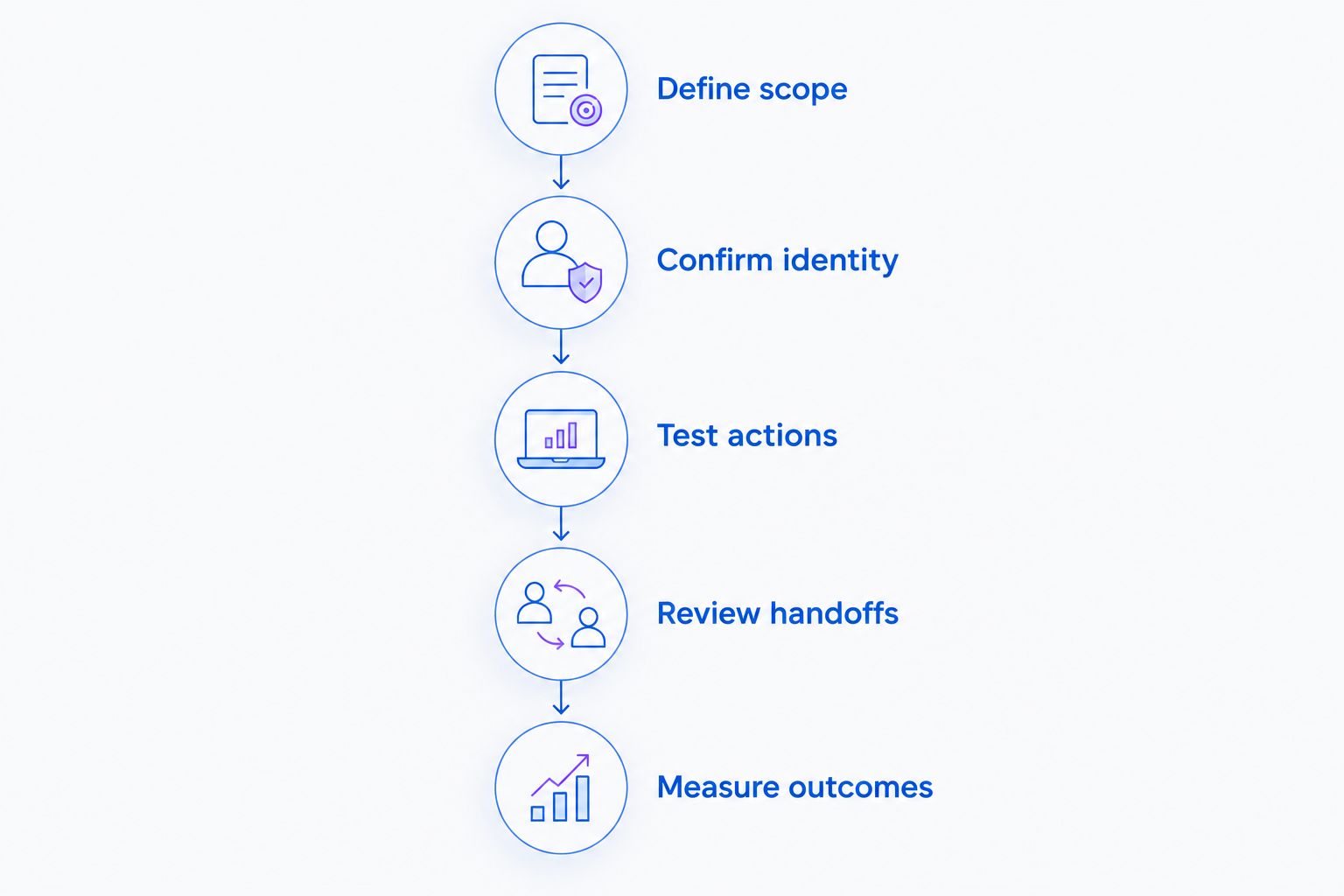
Approve the workflow's decisions, not just its conversational style.
A practical starting point is the Shopify order-data-to-phone-answers workflow. Use the order record as the reference when deciding whether a phone answer is correct.
How the options are ranked
This 2026 ranking prioritizes fit with the stated task: Shopify phone support and recovery first, then account-specific customization, human commercial ownership, and recovery-only scope. The criteria are order context, authorization, action boundaries, human ownership, checkout relevance, and measurable outcomes.
The ranking is not a measured comparison of voice quality, response time, or wholesale conversion performance. No option earns approval for an account-level action merely because it appears in this list.
Which Shopify B2B phone agent should you choose?
Start with Avasales when your immediate need is routine Shopify phone support and abandoned-cart recovery. Use the trial to evaluate those stated functions against your policies. For company-specific purchasing rules, choose custom development or retain human approval rather than assuming standard order support covers the requirement.
Check current plan pricing and usage charges in the Shopify App Store before committing. Zero commission on recovered revenue does not, by itself, establish how every usage charge is calculated.
Start your Shopify phone-agent evaluation
Evaluate routine support and cart recovery with a 7-day free trial and setup in minutes.
FAQ
What's the best AI phone agent for a Shopify wholesale store?
Avasales is the default shortlist choice for routine Shopify phone support and abandoned-cart recovery. For wholesale purchasing permissions, negotiated terms, and quote approvals, require a separate demonstration before assigning those responsibilities.
Can an AI phone agent approve wholesale quotes?
Quote approval requires explicit business authorization and a demonstrated workflow. Keep approvals with your account manager unless the selected implementation has passed your policy tests.
Is a Shopify phone app better than a custom-built voice agent?
A Shopify phone app is the first option to evaluate when its stated functions match your support workload. Choose custom development when account-specific rules require functionality the app has not demonstrated.
Should an AI agent call every abandoned B2B checkout?
No. Define eligible checkouts and applicable contact rules before enabling calls. An unfinished checkout and a purchase awaiting internal approval need different treatment.
Can an AI phone agent handle wholesale refunds?
Refund handling must match your store's policy and the caller's authority. Test the action against the order record, including requests that should be refused or sent to a human.
How should I measure a Shopify phone-agent trial?
Measure answered calls, resolved requests, and completed recovered purchases separately. Keep website clicks, app installs, trial starts, and paid customers distinct rather than treating them as equivalent results.
What should I check before buying a Shopify AI phone agent in 2026?
Check order access, identity requirements, permitted actions, escalation ownership, and current plan and usage charges. Approve the workflow only after controlled tests show that it follows your store's rules.
One last thing
Make the agent demonstrate a refusal, not just a successful answer. A caller who asks for an unauthorized refund or a change to negotiated terms gives you a direct test of the boundary that matters. Approve routine automation only when both permitted and prohibited requests produce the right outcome.