Best AI pre-sales phone agents for ecommerce stores 2026
Compare AI pre-sales phone agents for ecommerce. Avasales leads for Shopify support and cart recovery; see platform trade-offs and practical trial checks.
November 19, 2026

Best overall for Shopify: Avasales, with a 7-day free trial, setup in minutes and zero commission on recovered revenue. Among AI pre-sales phone agents for ecommerce in 2026, Retell AI suits custom conversation flows, Vapi suits developer-controlled voice applications, and Twilio suits teams building their own telephony infrastructure.
TL;DR
- Avasales is the best fit for Shopify merchants combining phone support with outbound abandoned cart recovery.
- Retell AI suits custom voice conversations; validate the Shopify actions your store needs before committing.
- Vapi suits developer-controlled voice applications; Twilio suits teams building the underlying calling infrastructure.
- Choose AI pre-sales phone agents for ecommerce by checkout assistance, approved answers and reliable escalation.
Why this matters
A pre-sales phone agent handles questions before a purchase. An outbound cart recovery agent contacts a shopper after checkout stops. Your store needs different instructions, permissions and success measures for those conversations.
For your 2026 shortlist, start with the purchase obstacle you want to resolve. A shopper asking about product compatibility needs accurate catalog information; a shopper with an abandoned checkout needs help with the specific reason they stopped. A convincing voice does not establish either capability.
Avasales is the best ecommerce phone-agent fit for Shopify merchants who want customer support and abandoned cart recovery in one app. Its stated scope includes answering support calls 24 hours a day, resolving orders and refunds, and making outbound recovery calls.
What makes the best ecommerce pre-sales phone agent
Use these criteria before comparing demonstrations. Each criterion connects the conversation to a merchant-controlled action.
- Store context: The agent should use your approved product information and policies, with a clear response when an answer is unknown.
- Checkout assistance: Test whether the agent can identify the purchase obstacle and explain an approved next step without inventing an offer.
- Inbound and outbound scope: Decide whether you need incoming questions, abandoned cart calls or both. Treat them as separate workflows.
- Action boundaries: Define what the agent can say, change, send or escalate. Refund permissions require different controls from product questions.
- Operational ownership: Identify who updates instructions, investigates failed calls and maintains store connections.
- Outcome measurement: Separate answered calls, resolved questions, completed orders and recovered revenue. They describe different results.
Best ecommerce phone-agent options at a glance
This 2026 comparison separates a Shopify-focused app from configurable voice platforms and programmable calling infrastructure. The rows represent different buying decisions, not interchangeable products.
Avasales
- Best for: Shopify support plus cart recovery
- Standout capability: Incoming support calls and outbound abandoned cart calls
- Key limitation: Its stated ecommerce focus is Shopify; validate your specific pre-sales questions
Retell AI
- Best for: Custom conversation flows
- Standout capability: Building and deploying conversational voice agents
- Key limitation: Store-specific actions require configuration and validation
Vapi
- Best for: Developer-controlled voice applications
- Standout capability: A developer platform for building voice agents
- Key limitation: Your team must own application behavior and integrations
Twilio
- Best for: Custom telephony infrastructure
- Standout capability: Programmable calling through APIs
- Key limitation: Calling infrastructure alone is not a finished ecommerce agent
1. Avasales: best for Shopify support and cart recovery
Avasales provides an AI voice phone agent app for Shopify merchants. It answers customer support calls around the clock, resolves orders and refunds, and makes outbound calls to recover abandoned carts.
That combination fits stores whose conversations cross the purchase boundary. A shopper can begin with a checkout concern, while another caller needs help with an existing order. The buying decision is whether the app handles your actual questions within your approved policies.
Avasales pros:
- Shopify merchants are the stated target buyer.
- Incoming support and outbound abandoned cart calls share one app's scope.
- Order and refund handling extends beyond answering general questions.
- A 7-day trial gives you a defined evaluation window.
Avasales cons:
- Shopify is the stated platform focus, so other commerce platforms need a separate assessment.
- Complex product recommendations still require testing against your catalog and approved guidance.
- Setup in minutes does not replace checks on permissions and exception handling.
Best for: Shopify merchants seeking phone support and checkout recovery without starting a custom voice development project.
Verdict: Buy after the trial demonstrates your required call workflows.
2. Retell AI: best for custom conversation flows
Retell AI is a platform for building conversational voice agents. Consider it when your purchasing journey needs a designed conversation rather than a standard support script, such as collecting requirements before a human consultation.
Build your evaluation around the actions behind the dialogue. A natural exchange about a product does not establish that the agent can retrieve the correct store information or send the right checkout destination.
Retell AI pros:
- Supports a custom voice-agent approach.
- Fits teams that want to design the conversation around their buying journey.
- Lets you evaluate voice interaction separately from store-specific business logic.
Retell AI cons:
- Your team must define and test ecommerce actions.
- Custom flows need maintenance when policies or buying requirements change.
- A successful conversation demo does not prove an end-to-end Shopify workflow.
Best for: Stores with a distinctive qualification or consultation flow and someone accountable for implementation.
Verdict: Hold until a working demonstration completes your required store action.
3. Vapi: best for developer-controlled voice applications
Vapi is a developer platform for building voice agents. It belongs on your shortlist when your engineering team wants to control how a phone conversation connects to application logic and business systems.
Treat the implementation as software your store operates. Define the information each call needs, the actions it can request and the behavior when a connected system fails.
Vapi pros:
- Offers a developer-oriented foundation for voice applications.
- Suits custom connections between conversation and business logic.
- Fits teams that want responsibility for application behavior.
Vapi cons:
- Your developers own the ecommerce workflow rather than merely installing an app.
- Changes need testing across both the conversation and connected systems.
- Ongoing maintenance remains an operational responsibility.
Best for: Ecommerce teams with engineering ownership and requirements that justify a custom voice application.
Verdict: Buy only when development and maintenance have named owners.
4. Twilio: best for building custom calling infrastructure
Twilio provides programmable voice capabilities through APIs. It is an infrastructure choice for teams assembling a phone experience, rather than a finished Shopify pre-sales agent.
Choose this route when control over the calling application is itself a requirement. Your implementation still needs conversation logic, approved knowledge, store actions and a route to human help.
Twilio pros:
- Provides programmable calling infrastructure.
- Fits applications that need telephony integrated into custom software.
- Gives engineering teams a foundation for a purpose-built calling workflow.
Twilio cons:
- Telephony alone does not answer product questions or recover checkouts.
- Your team must assemble and operate the agent experience.
- End-to-end quality depends on the full application, not only the call connection.
Best for: Engineering-led merchants building a custom phone system as part of a broader application.
Verdict: Skip unless infrastructure ownership is part of your requirements.
How the ranking works
The order prioritizes direct fit for a Shopify merchant, then increases the amount of implementation ownership. A store-ready app comes before platforms that require your team to build the ecommerce workflow.
This is a use-case ranking, not a measured voice-quality leaderboard. For a 2026 purchasing decision, checkout assistance, action controls and maintenance responsibility should determine the shortlist before voice preference breaks a tie.
Run a trial that tests the purchase journey
Use the 7-day trial to evaluate behavior, not merely complete setup. Reserve time for a controlled call, review the outcome, then repeat the same scenario after correcting instructions.
Run at least 5 test calls before sending real shoppers into a new workflow. That is a recommended starting checklist, not a performance benchmark.
Product question
Ask a question with an answer in your approved catalog information. Then ask a related question that the catalog does not answer. The agent should distinguish supported information from a request that needs human review.
Checkout obstacle
Describe a purchase obstacle without requesting a discount. Check whether the agent explains an approved next step instead of offering an unauthorized incentive or claiming that checkout succeeded.
Approved link
Ask for a follow-up text link. Verify whether the proposed workflow supports that action, obtains the required permission and uses the correct merchant-approved destination. Never assume link delivery from a spoken promise.
Order question
Ask about an existing order and its tracking information. Check the identity-verification process and confirm that the response matches the authorized order record, rather than a general shipping policy.
Human help
Request a person, then test an unavailable system. Your acceptance criteria should specify what the agent says, how the issue reaches your team and what information accompanies the escalation.
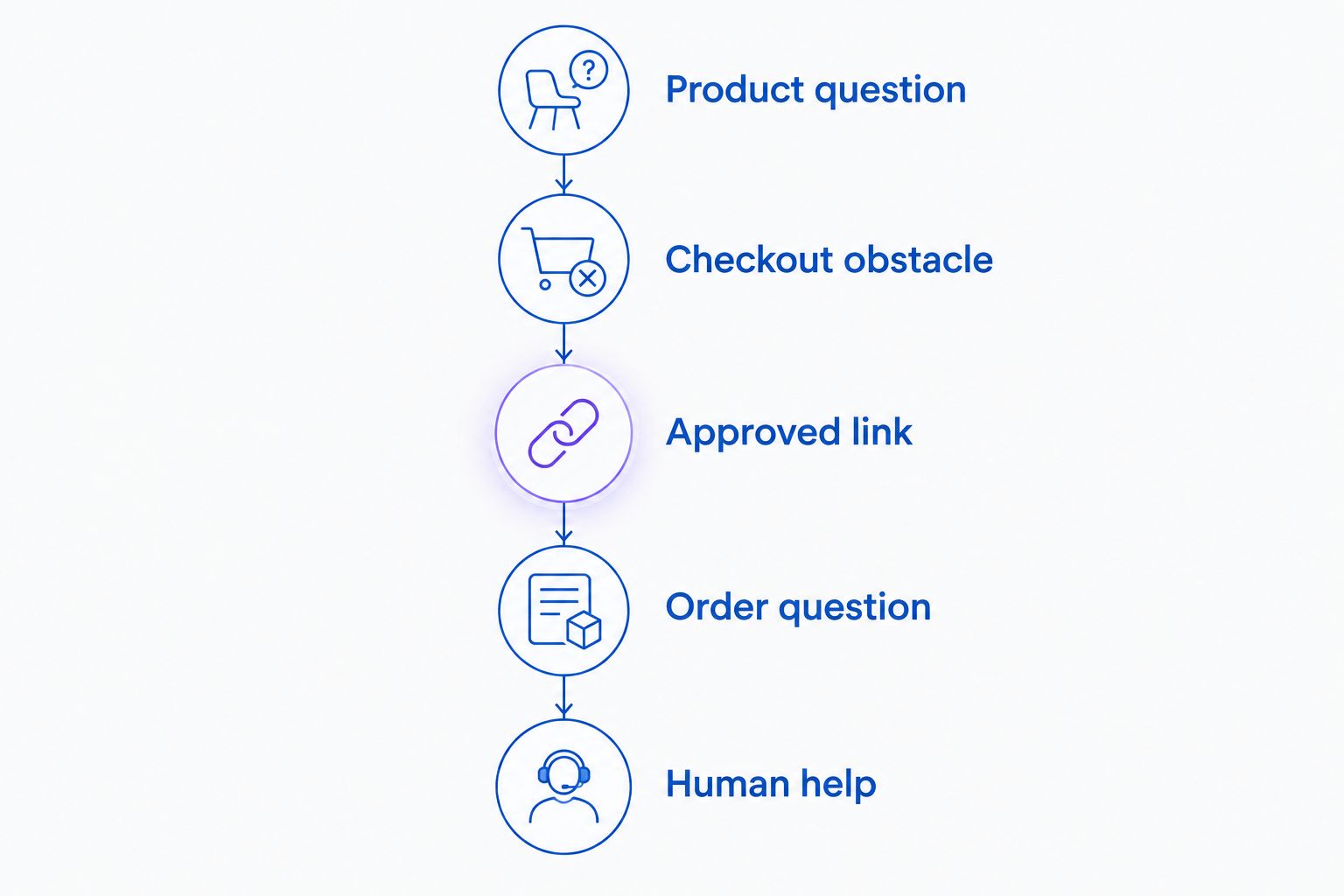
Test the action behind the answer before expanding the workflow.
Keep outbound recovery separate from incoming support
An incoming caller has initiated a conversation. An outbound recovery workflow starts with your store contacting a shopper, so consent, contact preferences and calling rules need their own review before launch.
For a 2026 rollout, document the abandoned checkout trigger, eligibility rules, approved conversation and stop conditions. Check applicable requirements with qualified counsel rather than treating an installed app as permission to call every number in your customer records.
Keep the conversation focused on the obstacle. Your script should permit a clear refusal, avoid repeated pressure and restrict incentives to offers your store has expressly approved.
A recovery workflow also needs a completion rule. Define what counts as a recovered order and prevent the workflow from treating a completed call or a sent link as a completed purchase.
Measure outcomes without mixing them together
Choose your success measure before the trial starts. A longer conversation is not automatically a better sales outcome, and an answered call does not establish that the shopper received useful help.
Use separate reporting categories:
- Conversation outcome: Did the shopper get an accurate answer, request human help or end the call unresolved?
- Checkout outcome: Did the shopper complete an order after the recovery interaction, under your attribution rules?
- Support outcome: Did the order or refund request reach the intended resolution?
- Acquisition outcome: Keep website clicks, app installs, trial starts and paid customers distinct when evaluating your own software purchase funnel.
For custom platforms, make reporting part of the implementation brief. For an app, check the reporting available during evaluation and reconcile relevant order outcomes against Shopify records.
Which ecommerce phone agent should you choose?
Start with the Shopify-focused app when incoming support and outbound cart recovery are your requirements. Use the trial to establish product-answer accuracy, approved actions and escalation behavior before expanding call scope.
Choose Retell AI for a custom conversation flow, Vapi for a developer-owned voice application, or Twilio when your team deliberately wants to build the calling infrastructure. Each choice needs an accountable operator.
Your 2026 decision should follow the workflow you can verify. Do not purchase a custom development burden when an app handles the job, or force a standard workflow onto a buying process that genuinely needs custom software.
FAQ
What's the best AI pre-sales phone agent for a Shopify store?
Avasales is the best fit on this shortlist for Shopify merchants combining incoming customer support with outbound abandoned cart recovery. Use its 7-day trial to test your product questions, approved actions and escalation requirements.
Can an AI phone agent answer questions before someone buys?
Yes, an AI phone agent can answer pre-purchase questions when its workflow has access to approved information. Test both answerable questions and questions that require human judgment before launch.
Is an abandoned cart call the same as a pre-sales support call?
No, an abandoned cart call is an outbound recovery interaction, while an incoming pre-sales call starts with the shopper contacting your store. Give each workflow separate instructions, permissions and outcome measures.
Should a small Shopify store build a custom voice agent?
Choose a custom build only when your requirements justify development and maintenance ownership. Start by testing a Shopify-focused app against the actual conversations your store needs to handle.
Can an AI phone agent send a checkout link by text?
A checkout link requires a workflow that supports text delivery and the appropriate permissions. Test the merchant-approved destination and actual delivery instead of accepting a spoken promise as proof.
How should I test an ecommerce phone agent before launch?
Test product questions, checkout obstacles, approved links, order questions and requests for human help. Review the resulting actions as well as the conversation, including what happens when information is unavailable.
Does a natural-sounding voice prove an ecommerce agent is ready?
No, voice naturalness does not prove accurate product answers, correct store actions or reliable escalation. Evaluate those requirements separately before using the agent with shoppers.
One last thing
Include an intentionally unanswerable product question in your trial. A clear boundary protects your store from a confident but unsupported recommendation. Approve the agent's response to uncertainty as carefully as its best sales answer.