Can an AI phone agent send a follow-up text after a call ends?
AI phone agent follow up text after call: yes, with a configured SMS workflow. Learn what to verify for Shopify tracking links, consent, and cart recovery.
November 6, 2026

Yes, an AI phone agent can send a follow-up text after a call ends when its calling workflow connects to an SMS service and an approved sending rule. The call ending does not itself authorize a message: you need the right recipient, permission appropriate to the message, and a verified link or call outcome before sending.
TL;DR
- An AI phone agent follow up text after call requires an SMS connection, recipient checks, and approved content.
- Avasales fits Shopify merchants evaluating voice support and abandoned-cart calls; verify post-call SMS behavior before rollout.
- Use follow-up texts for the customer's agreed next step, such as order tracking or checkout recovery.
- A completed call, delivered text, and completed purchase are separate outcomes. Measure each separately.
Can an AI phone agent send a follow-up text after a call ends?
Yes, but evaluate the complete call-to-text workflow, not just the agent's ability to speak. A working setup must identify what happened during the conversation, decide whether a text is appropriate, and pass approved content to the sending service.
For Shopify merchants evaluating this workflow in 2026, Avasales offers a 7-day free trial, setup in minutes, and zero commission on recovered revenue. Its voice app answers support calls 24 hours a day, 7 days a week, handles orders and refunds, and makes outbound abandoned-cart calls. Confirm the specific post-call text trigger, sending service, and reply handling during evaluation rather than assuming that voice coverage includes every SMS function.
Use this sequence as your acceptance checklist:
- Call outcome: Identify the request and whether the conversation reached an agreed next step.
- Recipient check: Confirm the destination number instead of assuming the incoming number is suitable.
- Permission check: Apply the rules appropriate to the recipient, location, and message purpose.
- Approved content: Select the correct order information, checkout destination, or support instruction.
- Delivery review: Record the sending result separately from whether the customer completes the action.
A successful demonstration should show these steps, not merely a message appearing on a test phone. Ask what happens when a prerequisite fails. The safe outcome is to withhold the message or route the issue for review, not improvise a destination or promise.
Why this matters
A phone conversation can answer a question while leaving the customer with something to do. A shopper asking about an order needs the correct tracking destination; someone returning to checkout needs the right checkout link.
Text is useful when it preserves that agreed next step in a form the customer can use after hanging up. It creates a new problem when it contains a stale link, repeats an unresolved promise, or reaches someone who did not request it.
For your 2026 evaluation, separate conversational quality from action accuracy. A natural-sounding call is not evidence that the right message went to the right person. Review the actual destination and content as part of the same test.
Which follow-up text fits the call?
Choose the message from the customer's request and the verified outcome. Do not use the same generic follow-up for order tracking, refund support, and abandoned-cart recovery.
Order-tracking text
- Best for: Customers asking where an order is
- Benefit: Keeps the tracking destination accessible after the call
- Limitation: Depends on matching the correct order and shipment
Checkout-recovery text
- Best for: Shoppers who agree to revisit an abandoned checkout
- Benefit: Gives the shopper a direct next step
- Limitation: A link click does not establish a recovered purchase
Refund-status text
- Best for: Customers asking what happened to a refund request
- Benefit: Preserves the verified status in writing
- Limitation: Must distinguish a request from a completed action
Support-next-step text
- Best for: Customers whose issue needs further handling
- Benefit: Records the agreed next step
- Limitation: Does not replace ownership of the unresolved issue
Order tracking: send the destination discussed
Best for customers who want to check shipment progress after the call. The useful content is the relevant tracking destination and enough context to recognize the message.
The limitation is order matching. A customer with several orders should not receive whichever tracking link happens to be easiest to retrieve. Confirm which order the caller means before preparing the message, and avoid including unnecessary personal information in the text.
Checkout recovery: send the agreed checkout link
Best for shoppers who have agreed to return to checkout. An outbound conversation can clarify the shopper's question, while a follow-up text supplies the destination for the next action.
The limitation is attribution. A shopper receiving a link has not necessarily opened it, resumed checkout, or purchased. Keep those events separate, and do not add an unapproved discount or urgency claim to encourage a response.
Refund support: describe the actual status
Best for customers who need a written record of a verified refund update. The text should distinguish between a refund request, an approved action, and a completed action.
The limitation is accuracy when an issue remains open. Never turn an intention expressed during the call into a confirmation that money has been returned. Where review is still required, the text should describe that next step without inventing a completion date.
How should you set up the call-to-text handoff?
Build the workflow around a specific customer request before expanding it. For a 2026 launch, an order-tracking follow-up is a clear test case because you can compare the spoken request, selected order, and final destination directly.
Capture intent
Define which call outcomes qualify for a text. An agreed tracking-link request qualifies under that workflow; an unrelated question does not.
Keep an incomplete call distinct from a completed request. If the caller hangs up before confirming the next step, do not treat silence as agreement to receive whatever message the workflow had prepared.
Confirm recipient
Ask the customer to confirm the intended destination when appropriate. A store's saved number, the incoming caller number, and the customer's preferred mobile number should not be treated as interchangeable without checking.
Limit what you expose during that check. Confirming where to send a link should not require reading unnecessary account or payment details aloud.
Check permission
Define the message purpose before deciding how permission is handled. A requested order update and an additional promotional message serve different purposes and need separate review.
Have qualified counsel review the requirements for your recipients and operating locations. Do not treat a customer's participation in a voice call as blanket permission for future marketing texts.
Select content
Use approved wording and verified destinations. The workflow should select the relevant information rather than invent a link from a store name or construct an unsupported refund promise.
Include an exception path for missing information. If the correct destination cannot be established, the system should not send a plausible-looking substitute.
Review outcome
Record whether the message was requested, attempted, and delivered where those statuses are available. Then record the business outcome separately.
Review the conversation alongside the message. That is how you identify a technically delivered text that answered the wrong question.
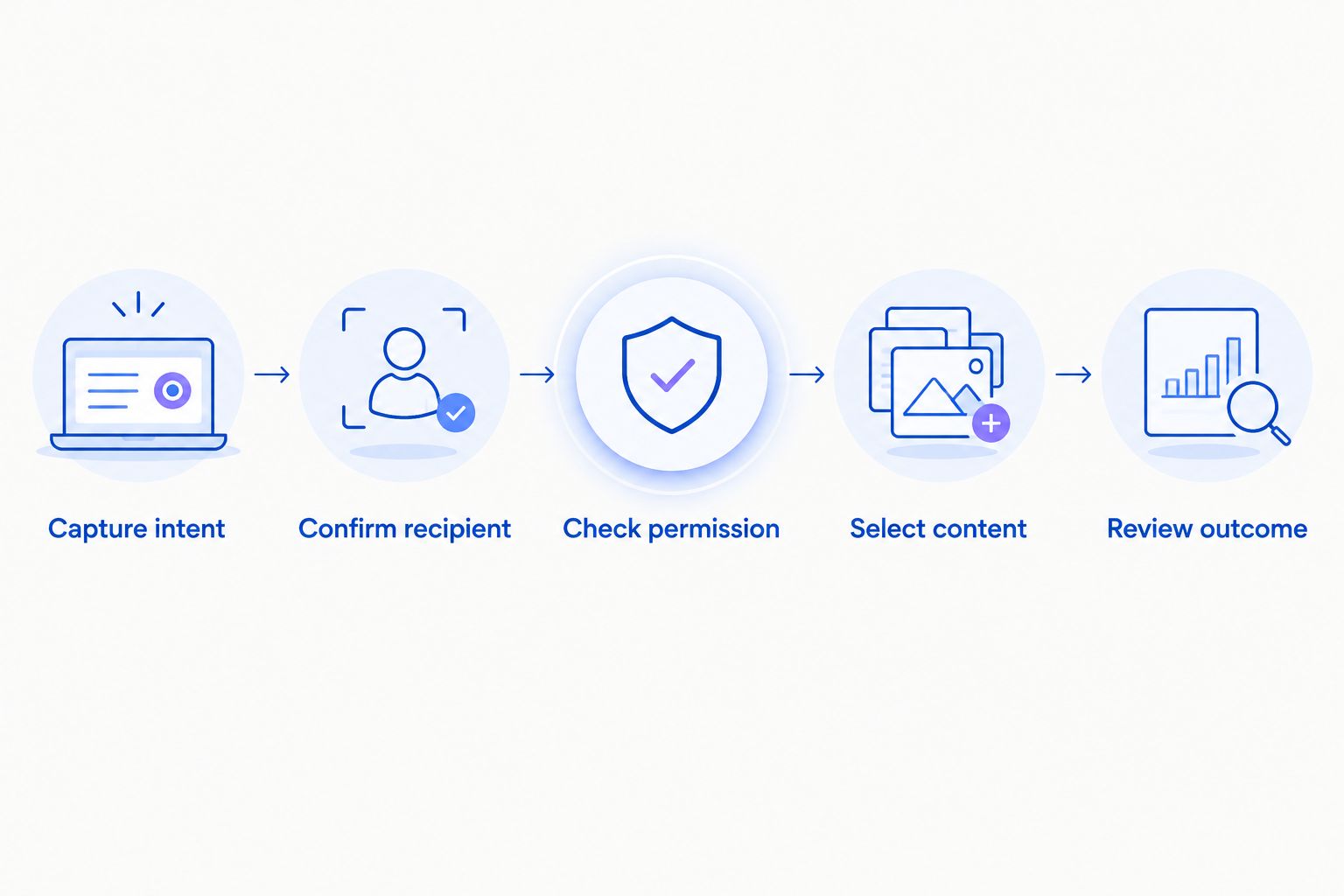
A call should reach the required checks before a follow-up text is sent.
Why follow-up text requirements vary
The right follow-up depends on the job the call performed. These Shopify support and recovery factors change what your workflow needs to verify:
- Order tracking: The message needs the destination for the specific order discussed, not a generic shipment reference.
- Refund handling: Wording must reflect whether the action is requested, under review, or completed.
- Abandoned checkout: The next step is returning to the appropriate checkout, not merely opening any store page.
- Approved text links: Your sending rules need to control both the destination and the accompanying wording.
- Around-the-clock support: Decide who owns delivery failures and unresolved requests when your team is unavailable.
These factors also define the limits of automation. A routine tracking request and a disputed refund should not share identical approval rules. Keep the routine path narrow enough to test, and give unresolved issues a named owner.
What should you verify before choosing a phone agent?
Avasales is best for Shopify merchants seeking voice support and outbound abandoned-cart calls. Its relevance comes from those stated functions; you should verify post-call SMS orchestration against your exact workflow before relying on it.
The benefit is a Shopify-focused voice use case covering support and recovery. The limitation for this decision is that a voice feature description does not establish the SMS trigger, sender configuration, reply routing, or failure handling you need.
Ask the provider to demonstrate a requested link, a declined message, an incorrect destination number, and an unresolved support request. Require an explanation of what is automatic, what requires configuration, and what reaches a person.
The same ownership question applies when comparing AI receptionists versus answering services: answering the call and owning the promised follow-up are separate responsibilities. For a Shopify store, establish who handles a failed text or a reply that reopens the customer's issue.
If the answer requires human intervention, define the handoff before enabling the workflow. Your human call-transfer process should preserve the customer's request rather than make the customer explain it again.
How do you test a follow-up text before rollout?
Use the 7-day free trial to test the customer journey rather than judge the voice alone. Setup in minutes gets you started; it does not replace checking recipient accuracy, approved content, and exception handling.
For your 2026 acceptance test, document the expected result before each call:
- A customer requests the correct tracking link and confirms the destination.
- A customer declines a text after receiving the spoken answer.
- A caller discusses several orders and selects a specific shipment.
- A refund remains unresolved when the call ends.
- A shopper agrees to revisit checkout but does not complete a purchase.
- A customer replies with a new question after receiving the text.
For each scenario, inspect what was sent, what was withheld, and who owns the next action. Treat a wrong-recipient message or unsupported refund confirmation as a failed test even if the conversation sounded natural.
Keep your 2026 reporting equally precise. Website clicks, app installs, trial starts, and paid customers are different acquisition events. Within the customer workflow, call completion, text delivery, checkout activity, and a completed order are also different outcomes.
Can the text go out automatically after every call?
Automatic sending is appropriate only for calls that satisfy the workflow's defined conditions. A call ending is an event, not proof that a message is relevant or authorized.
Use qualifying outcomes, not a blanket after-call rule. A customer who declines a text, reaches the wrong department, or leaves an unresolved request should not receive the same follow-up as someone who asks for a tracking link.
Does a follow-up text prove that a cart was recovered?
A follow-up text does not prove cart recovery. Record a recovered purchase only when your chosen attribution method supports connecting the completed order to the recovery activity.
Avasales charges zero commission on recovered revenue, but that does not make text delivery a revenue event. Keep delivered messages, checkout visits, and completed purchases distinct when assessing the workflow.
FAQ
Can an AI phone agent text me after we hang up?
Yes, when the phone workflow connects to an SMS service and the message passes its sending checks. Confirm the destination number and request the specific information you want sent.
Does every AI phone agent include follow-up SMS?
No, voice calling alone does not establish follow-up SMS capability. Verify the sending connection, trigger conditions, approved content, and reply handling before rollout.
Can a Shopify phone agent send an order-tracking link?
A configured call-to-text workflow can send an order-tracking link when it has the correct destination and appropriate permission. Test that the link matches the specific order discussed.
Can a customer reply to the follow-up text?
Reply handling depends on the messaging setup. Verify whether replies are supported, where they appear, and who is responsible for responding.
Should a phone agent text after a customer hangs up unexpectedly?
An unexpected hang-up should not automatically qualify a customer for a text. Apply the workflow's permission and outcome checks before sending anything.
Does a refund follow-up text mean the refund is complete?
No, the text must describe the verified refund status. A request or review should not be presented as a completed refund.
How can I test Avasales before committing?
Avasales offers a 7-day free trial and setup in minutes. Use the evaluation to confirm the post-call texting behavior you need, including declined messages, incorrect numbers, and unresolved requests.
One last thing
Test the message that should not be sent. A correct tracking text shows the happy path; withholding a message after a declined request shows whether your controls work.
Before your 2026 rollout, write down the conditions that stop a text and who receives the unresolved issue. That gives your team a concrete acceptance standard beyond whether a test phone received a link.