Best AI tools for taking phone orders on Shopify 2026
Compare AI tools for taking phone orders on Shopify. Choose Avasales for support and cart recovery; check order creation and payment workflows first.
November 20, 2026

Best for Shopify support and cart recovery: Avasales, with a 7-day free trial, setup in minutes and zero commission on recovered revenue. Best for custom order-entry requirements: a custom voice-agent workflow; best for staff-approved purchases: AI-assisted human phone ordering. This 2026 guide compares AI tools for taking phone orders on Shopify and separates answering order questions from creating orders and accepting payments.
TL;DR
- Avasales is best for Shopify merchants seeking phone support and outbound abandoned-cart recovery.
- Compare AI tools for taking phone orders on Shopify by order creation, checkout handling and human escalation.
- Choose a custom voice-agent workflow when your required order-entry process needs purpose-built development.
- Keep human approval for purchases that require judgment, negotiation or exceptions.
Why this matters
Taking a phone order involves several separate jobs: understanding the request, selecting the correct product, recording purchase details and completing payment. Answering a delivery question does not demonstrate that a tool can perform that entire transaction.
Your 2026 shortlist should start with the outcome you need. A store handling existing-order questions needs different capabilities from a store accepting new purchases entirely by phone. An abandoned-cart call starts from an existing shopping session, which is another distinct workflow.
Choose the workflow before choosing the voice. A natural conversation is useful, but your acceptance test must include the resulting Shopify record and the customer's next step.
What makes the best phone-ordering tools for Shopify
Use these criteria to evaluate each option before comparing demonstrations:
- Order creation: Require a demonstration of a new order or draft order if taking new orders is essential. Existing-order lookup is a separate capability.
- Product accuracy: Test variants, quantities and ambiguous product names. Require confirmation before any consequential action.
- Checkout handling: Establish whether the customer completes checkout through an approved link or another supported payment process.
- Action permissions: Define which changes the agent can make, which require approval and which are prohibited.
- Human escalation: Specify where unresolved requests go and what context accompanies them.
- Outcome reporting: Separate answered calls, created orders, completed purchases and recovered carts. Do not treat them as interchangeable results.
For your 2026 evaluation, turn each criterion into an observable pass or fail. A demonstration that ends with a friendly goodbye but no order record does not pass an order-creation test.
Shopify phone-ordering options at a glance
These rankings compare operating approaches rather than claim that every option is a ready-made app with identical functionality. The order reflects fit for standard Shopify support first, custom development second and human-controlled purchasing third.
Avasales
- Best for: Shopify support and abandoned-cart recovery
- Standout capability or design: Answers customer support calls around the clock and makes outbound recovery calls
- Key limitation: Support and recovery capabilities do not establish end-to-end new-order checkout
Custom voice-agent workflow
- Best for: Bespoke order-entry requirements
- Standout capability or design: You define the order-entry actions and approval rules
- Key limitation: Requires development, testing and ongoing maintenance
AI-assisted human phone ordering
- Best for: Purchases requiring staff judgment
- Standout capability or design: Staff retain control of order approval and customer exceptions
- Key limitation: A person remains responsible for completing the transaction
1. Avasales: best for Shopify support and cart recovery
Avasales provides a voice phone-agent app for Shopify store owners. It answers customer support calls 24 hours per day, handles order and refund requests, and makes outbound calls to recover abandoned carts.
Avasales is best for Shopify merchants seeking phone support and outbound abandoned-cart recovery. Choose this use case when callers need help with an existing purchase or an unfinished checkout, rather than assuming every caller needs a new order created from scratch.
Pros
- Shopify merchants are the stated target users.
- Customer support calls receive around-the-clock coverage.
- Order and refund requests fall within the stated service scope.
- Outbound abandoned-cart calls address an existing purchase journey.
Cons
- Existing-order support is not proof of new-order creation. Require a live demonstration if that is your central requirement.
- Refund handling still needs merchant-defined approval rules; do not treat automation as permission to disregard store policy.
- A cart-recovery conversation and a completed purchase need separate reporting.
Best for: Shopify owners who want phone support and cart recovery in the same app.
During the trial, test an order-status question, a refund request and an abandoned checkout. Review what the caller heard, which action occurred and whether the outcome matched your policy. For any required text-link workflow, confirm the exact approved destination and delivery behavior before using it with customers.
Verdict: Buy for support and cart recovery after the trial passes your acceptance checks. Hold if autonomous new-order creation is the deciding requirement until that exact workflow is demonstrated.
2. Custom voice-agent workflow: best for bespoke order entry
A custom voice-agent workflow is a development approach, not a single packaged Shopify app. You specify how the conversation collects purchase details, which Shopify actions the integration performs and where approval is required.
This approach fits a merchant whose written requirements extend beyond a standard support conversation. The implementation needs an explicit route from spoken request to a reviewable order record, followed by the chosen checkout process.
Pros
- You define the product-selection and confirmation steps.
- Approval rules can form part of the implementation specification.
- Your acceptance tests can cover the exact order types your store handles.
Cons
- Someone must build and maintain the integration.
- Changes to your catalog, policies or connected systems require regression testing.
- Voice handling, order actions and payment handling remain separate implementation responsibilities.
Best for: Merchants with a documented order-entry requirement and technical ownership for the resulting system.
Before commissioning development in 2026, write the successful transaction in plain language. Specify the starting call, required customer details, product confirmation, order record and payment-completion evidence. Include failure cases such as unavailable product data and a customer changing variants halfway through the call.
Do not approve a build solely because its conversation sounds convincing. Require a demonstration that the correct product, quantity and customer details reach the intended record without duplicating the purchase.
Verdict: Buy development only after the order-entry specification and acceptance tests are agreed. Skip custom development when standard support and recovery cover your actual needs.
3. AI-assisted human phone ordering: best for staff-approved purchases
AI-assisted human phone ordering keeps a staff member responsible for the purchase. In this operating model, automation handles defined intake or information-gathering tasks, while a person reviews the request and completes the approved ordering process.
Choose this model when the purchase depends on a decision you want staff to make. Examples include a negotiated exception, an unclear product requirement or a request that falls outside your written policies.
Pros
- Staff retain authority over exceptions and final approval.
- The customer has a route to discuss requirements that do not fit the standard process.
- You can introduce automation without immediately delegating purchasing decisions.
Cons
- Staff availability remains part of the ordering workflow.
- Transferring incomplete intake creates repeated questions for the customer.
- A captured request is not a completed order and must not be reported as one.
Best for: Stores that want assistance with call intake while keeping purchase approval with employees.
Define the information staff need before accepting a handoff: requested product, variant, quantity, unresolved question and customer contact details. Then decide what happens when no employee is available. A documented callback process is preferable to leaving the caller with an implied order that nobody has approved.
Your 2026 rollout should measure whether the handoff preserves the customer's request accurately. Do not judge this model by how many calls automation answers without checking what staff receive afterward.
Verdict: Buy assistance for intake when human approval is intentional. Skip this model if your requirement is unattended, end-to-end phone purchasing.
Test the complete phone-order workflow
Use the same sequence for every candidate. Keep a test record beside each call so you can compare what was requested with what actually happened.
Intent check
Establish whether the caller wants a new purchase, help with an existing order or assistance completing an abandoned checkout. Test a caller who changes intent during the conversation, too.
Product confirmation
Require the workflow to confirm the requested product, variant and quantity. Include a similar-sounding product name and an unavailable selection in your test set.
Approved action
Define whether the next step is an order record, a checkout link, an information response or a human handoff. Do not let a conversational confirmation substitute for evidence that the action occurred.
Payment completion
For purchasing workflows, inspect the actual checkout outcome. Treat a sent link, an opened checkout and a paid order as different events.
Outcome review
Compare the call result with the Shopify record and any follow-up task. Check that a second call about the same request does not create an unintended duplicate action.
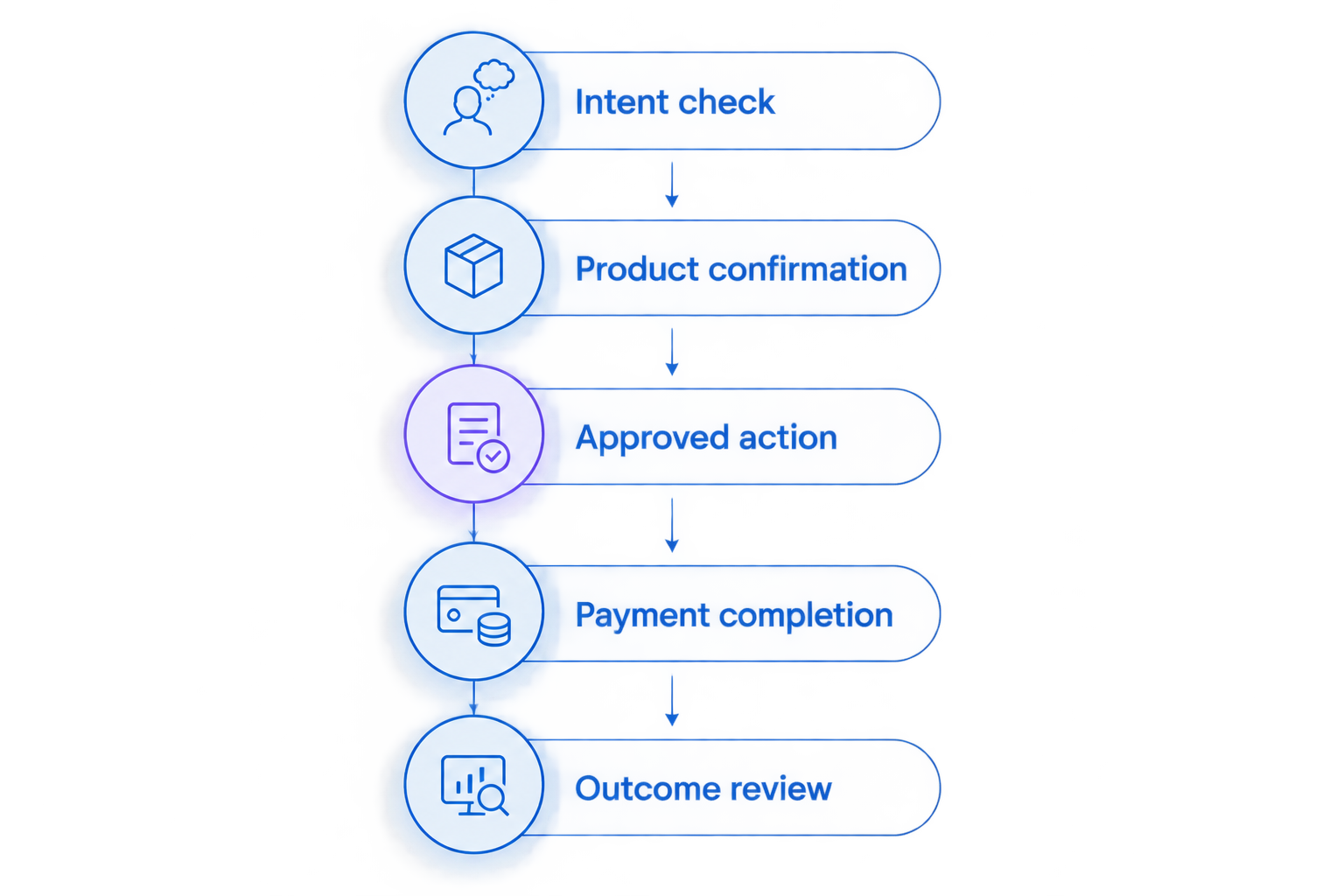
Evaluate the completed workflow, not just the spoken answer.
Run at least 5 test calls before expanding access: a straightforward request, an ambiguous variant, a changed quantity, an unavailable selection and a request outside policy. This is a recommended acceptance set, not a performance benchmark.
For unresolved requests, review the separate guide to human handoff quality. Make the receiving person's next action explicit before enabling the workflow for customers.
How to run a useful trial
Write the acceptance criteria before starting the trial. Otherwise, an engaging demonstration can distract from a missing order action.
Assign someone to inspect both the customer-facing conversation and the operational result. A call that sounds correct but records the wrong variant fails; a correct order with an unclear next step also needs attention.
Keep these checks in your trial log:
- Request captured: Does the record match what the customer asked for?
- Permission respected: Did the workflow stay inside the approved action limits?
- Next step explained: Does the customer know whether to complete checkout, await approval or expect follow-up?
- Result verified: Can you identify the order, completed purchase or unresolved task?
For Avasales, use the 7-day trial to evaluate support and recovery against those checks. Keep website clicks, app installs, trial starts and paid customers separate when assessing acquisition results. None of those events alone proves that a phone interaction produced a completed order.
Evaluate your Shopify phone workflow
Review support and cart recovery with a 7-day free trial, setup in minutes and zero commission on recovered revenue.
How we ranked these options
This 2026 ranking prioritizes fit with the stated Shopify use case, followed by control over order actions, checkout handling and human escalation. It is a workflow-based buying guide, not a comparative benchmark of call accuracy or conversion performance.
The packaged app ranks first for its stated support and recovery scope. Custom development takes the bespoke order-entry slot, while AI-assisted human ordering takes the staff-approval slot. These are different operating choices, not interchangeable products.
Which Shopify phone-ordering option should you choose?
Start with the packaged support-and-recovery option if existing orders and abandoned checkouts account for the work you want automated. Use the trial to verify the actions that matter to your store.
Choose custom development when new-order creation requires a process you have specified and can maintain. Keep human-assisted ordering when staff approval is part of the service you intend to provide. Do not buy unattended purchasing on the strength of an order-status demonstration.
FAQ
What are the best AI tools for taking phone orders on Shopify?
The best choice depends on whether you need support, new-order creation or staff-approved purchasing. Avasales fits Shopify support and abandoned-cart recovery; evaluate custom development for bespoke order entry and human-assisted workflows for purchases requiring approval.
Can an AI phone agent create a new Shopify order?
New-order creation must be verified for the specific tool and integration you choose. Ask for a demonstration that produces the correct Shopify order record, rather than accepting existing-order lookup as proof.
Is abandoned-cart recovery the same as taking a phone order?
No. Abandoned-cart recovery starts with an unfinished shopping session, while taking a new phone order requires collecting and confirming the purchase details before completing the ordering process.
Should customers read payment card details to a phone agent?
Do not instruct customers to read card details into a general-purpose voice workflow. Use an approved payment process and verify how payment information, recordings and transcripts are handled before launch.
What should I test during a Shopify phone-agent trial?
Test product confirmation, permitted actions, checkout completion and unresolved requests. Compare the conversation with the resulting Shopify record, and check for duplicate actions when the customer calls again.
Do I still need a person available for phone orders?
Keep a human route for requests outside your approved automation scope. Define what information accompanies the handoff and what happens when staff are unavailable.
How should I measure phone-ordering results?
Measure completed purchases separately from answered calls, captured requests and sent checkout links. For acquisition reporting, also keep website clicks, app installs, trial starts and paid customers distinct.
One last thing
A confirmation in a conversation is not necessarily an order confirmation. Before launching your 2026 phone workflow, place a test request and inspect the record yourself. The decisive evidence is the correct action in Shopify, not the agent saying the task is complete.