Can AI Phone Agents Reduce Chargeback Disputes? Test 2026
Can AI phone agents reduce chargeback disputes? Target order and refund problems, set clear escalation rules, and measure dispute outcomes for Shopify stores.
October 2, 2026

AI phone agents can address order questions, refund confusion, and unanswered calls before those problems become chargeback disputes, but that does not establish a measurable reduction in disputes. Their useful role is early service resolution, not deciding whether a cardholder’s claim is valid. For a Shopify store in 2026, the right approach is to resolve eligible problems promptly, preserve accurate records, and measure chargebacks separately from calls handled.
TL;DR
- Can AI phone agents reduce chargeback disputes? Shopify merchants should test service resolution, not assume a reduction.
- Order tracking and refund support address customer concerns before escalation; they do not replace the formal dispute process.
- Avasales fits Shopify merchants seeking phone support for orders and refunds, not a guaranteed chargeback outcome.
- Measure filed chargebacks separately from answered calls, refunds, and abandoned-cart recovery.
Avasales is best for Shopify merchants who need phone support for orders and refunds. Its stated support coverage is 24 hours a day, 7 days a week. Coverage addresses access to help; dispute prevention still depends on the information and resolution you provide.
Can AI phone agents reduce chargeback disputes?
AI phone agents belong in the service-resolution stage of chargeback prevention. They give customers a way to ask about an order, explain a problem, or request a refund without waiting for your team to answer the phone.
A helpful conversation is not proof that a dispute was prevented. You need to distinguish between resolving the underlying concern and simply completing a call.
Use this sequence to design a chargeback-focused support workflow:
- Identify the order. Verify the caller appropriately before discussing customer-specific information.
- Identify the concern. Separate delivery questions, cancellation requests, refund questions, and claims of an unauthorized purchase.
- Check the record. Use the current order, fulfillment, and payment information rather than a guessed explanation.
- Apply the policy. Complete only actions that your store has authorized and that the system can actually perform.
- Confirm the outcome. Explain what changed, what remains pending, and what happens next.
- Escalate exceptions. Route uncertain, disputed, or unauthorized actions to your team without marking them resolved.
This process gives you a practical test for 2026: did the call leave the customer with an accurate answer and an appropriate next step? A call marked complete without either outcome is not evidence of effective support.
Why this matters
A customer asking where an order is needs an answer grounded in the order record. A customer asking about a refund needs to know whether it has been requested, approved, or processed. Those are different questions, and a generic reassurance does not resolve either one.
Phone support gives you another place to address these concerns. It does not fix missing shipment information, unclear policies, or an unprocessed refund by itself.
Treat chargeback prevention as an operational objective rather than a call-volume objective. Answering more calls is useful only when those conversations lead to accurate information, permitted actions, or a clear handoff.
Where phone support belongs in the dispute timeline
The stage of the customer’s problem determines the appropriate response. A routine delivery question and an already-filed chargeback should not follow the same workflow.
Delivery uncertainty
- Best for: Order-status clarification
- Useful phone-support action: Explain the recorded fulfillment or tracking status
- Limitation: Tracking information does not establish that the customer received the parcel
Cancellation request
- Best for: Checking whether cancellation is still permitted
- Useful phone-support action: Review the order state and apply the store’s rules
- Limitation: A request does not guarantee that fulfillment can be stopped
Refund question
- Best for: Explaining an authorized refund action
- Useful phone-support action: Clarify the recorded refund status and next step
- Limitation: A refund promise is not a completed refund
Unrecognized purchase
- Best for: Identifying a potentially unauthorized transaction
- Useful phone-support action: Capture the concern and escalate through the approved process
- Limitation: Phone support cannot determine authorization from a conversation alone
Filed chargeback
- Best for: Merchant review and formal response
- Useful phone-support action: Document the customer’s concern for the responsible team
- Limitation: A support call does not replace the payment provider’s dispute process
Before a dispute: resolve the service issue
Before a customer files a chargeback, the support task is to understand and resolve the concern within your policy. That means checking facts before offering a remedy.
For example, a delivery question needs a recorded shipment status, not an invented arrival date. If the record does not answer the question, the next step is investigation or escalation. Repeating an unsupported delivery promise adds another claim your team must later explain.
After a dispute: follow the formal process
Once a chargeback has been filed, treat the case as a payment dispute as well as a customer-service issue. Follow the instructions and deadlines shown by your payment provider.
Do not let an automated conversation imply that the dispute has been closed. Before issuing another payment adjustment, your team should review the existing dispute and the provider’s instructions. Customer communication and formal dispute handling need separate owners and records.
Build the workflow around verified actions
A useful phone workflow has a defined endpoint. The customer receives a verified answer, an authorized action, or a handoff with enough context for your team to continue.
Order lookup
Require the support system to retrieve the relevant order before it gives an order-specific answer. Set an identity-checking process appropriate to the information being disclosed.
If a caller cannot identify the order, the workflow should explain the next verification step. It should not fill the gap with details from a similar order or disclose another customer’s information.
Policy check
Write down which requests the agent is permitted to handle. Include cancellation conditions, refund approval rules, and situations that require staff review.
The permission to explain a policy is different from the permission to execute a refund. Test both separately. A system that describes your refund policy accurately still needs authorization and a working connection before it can perform the action.
Approved action
Require a confirmed result before describing an action as complete. A cancellation request, a cancellation attempt, and a confirmed cancellation are separate states.
The same distinction applies to refunds. An approval recorded in a support conversation should not be presented as a processed payment unless the payment record confirms that status.
Customer confirmation
End the call with the verified outcome and the next step. Keep the language specific enough that the customer knows whether anything changed.
If your workflow sends a follow-up message or an approved text link, check that its wording matches the action taken. Avoid a confirmation message that says a refund is complete when the record only shows a request awaiting review.
Human review
Give exceptions a defined destination. Claims of an unauthorized purchase, conflicting order records, and requests outside your policy need review rather than a guessed resolution.
For your 2026 workflow, assign responsibility for these handoffs before enabling automation. A handoff that has no owner leaves the original concern unresolved.
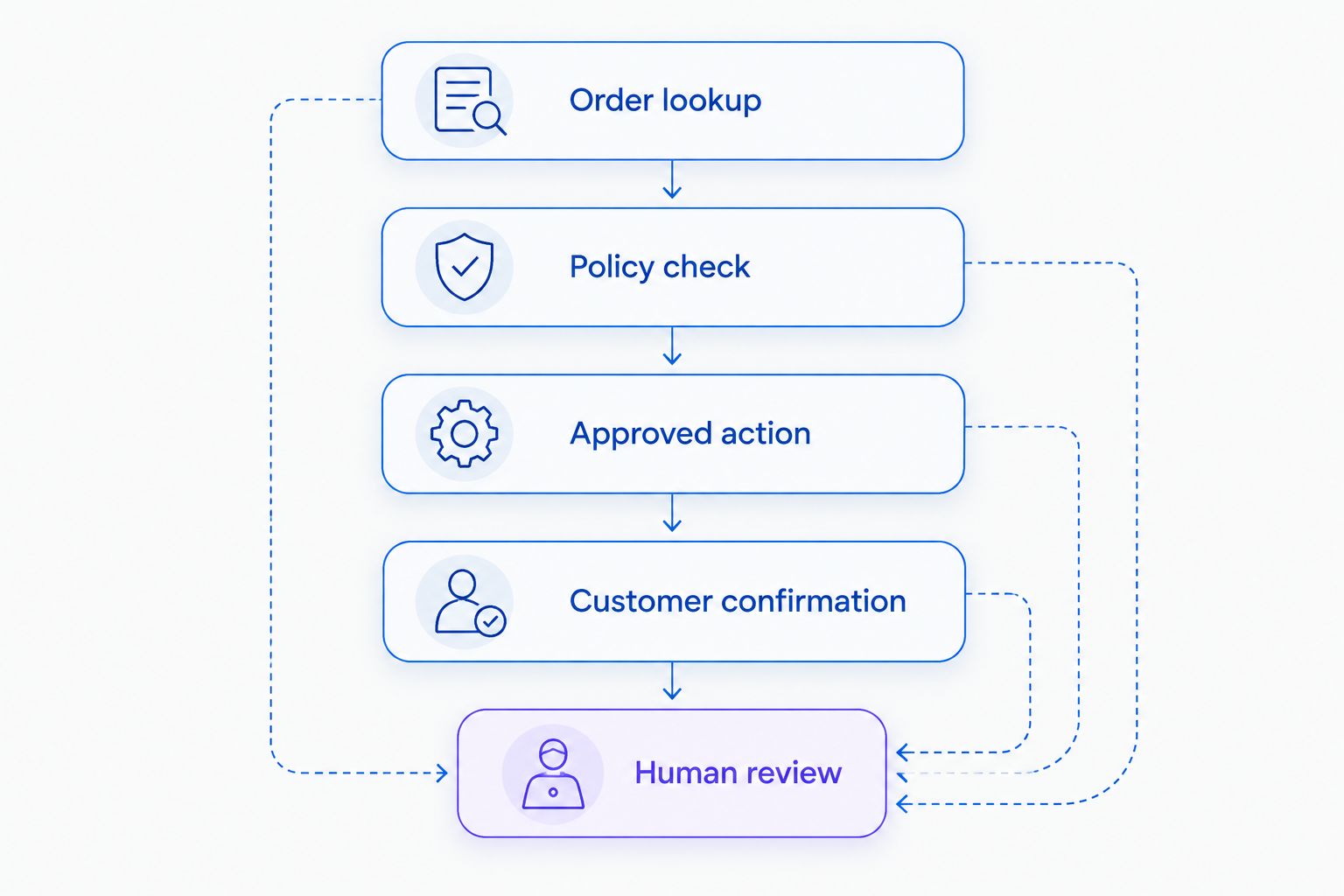
Only confirmed actions belong in the customer’s resolution summary.
Keep the underlying order information central to this process. The guide to Shopify order data and real-time phone answers covers the connection between order records and phone responses.
Why chargeback-prevention results vary
The phone agent is one part of the customer’s experience. Assess the surrounding workflow before attributing an outcome to automation.
- Reason for the complaint. An order-status question requires a different response from an allegation of an unauthorized transaction.
- Accuracy of order information. The agent needs a reliable record to explain fulfillment, cancellation, or refund status.
- Authority to act. Your approved permissions determine whether the agent can resolve a request or must refer it to staff.
- Timing of the contact. A conversation before a dispute and a conversation after filing have different operational purposes.
- Quality of escalation. An unresolved exception needs a responsible team member and enough context to act.
- Consistency of confirmation. Spoken answers, follow-up messages, and transaction records should describe the same outcome.
These factors are also your diagnostic checklist. If callers receive accurate answers but cases remain unresolved, review the available actions and escalation process. If actions complete but customers remain confused, review the confirmation language.
Can an AI phone agent issue a refund to stop a chargeback?
A refund should resolve an eligible customer request, not serve as an automatic response to any mention of a chargeback. The agent needs permission to act, a verified order, and a policy that applies to the request.
For an already-disputed transaction, review the payment provider’s instructions before taking another payment action. Do not tell the customer that a refund automatically ends the chargeback process.
Avasales offers Shopify order and refund support through its Ava AI phone agent app. Its stated offer includes a 7-day free trial, setup in minutes, and no commission on recovered revenue. Those features describe the service and its offer; they do not establish a chargeback-reduction result.
Test routine refund handling and exception handling independently. Ask whether the system can distinguish a request from an approval, recognize an existing dispute, and refer an unauthorized action to your team.
Does an answered call prove that a chargeback was prevented?
An answered call proves that a call was answered. It does not establish that the customer’s issue was resolved or that the customer would otherwise have filed a chargeback.
Keep these outcomes separate in your 2026 reporting:
- A call was answered.
- The caller received a verified order-status answer.
- A permitted action was completed.
- An exception was assigned for review.
- A chargeback was filed against the relevant transaction.
Also keep abandoned-cart recovery separate. Recovering a checkout and resolving a complaint about an existing order are different activities, even when the same phone system supports both.
How should a Shopify store measure the effect on disputes?
Measure filed chargebacks alongside the underlying transactions and support outcomes. Raw call volume cannot answer whether the dispute rate changed.
Choose a consistent reporting window and define the transaction population before comparing results. Record the chargeback rate as filed chargebacks divided by transactions in that defined population. Keep the calculation consistent across periods.
Review dispute reasons as well as the total. An improvement in delivery-related support does not establish an improvement in unauthorized-payment disputes. Account for the time between a purchase, a support contact, and a filed dispute before interpreting a recent change.
Where customer and order records permit an appropriate comparison, examine cases that received phone support separately from cases that did not. Differences still require careful interpretation because customers who contact support are not necessarily comparable to those who do not.
For a 2026 evaluation of Avasales phone support, pair the dispute review with a review of call outcomes. Check whether answers were accurate, actions were authorized, and unresolved cases reached the responsible person. Judge the service on verified resolutions before making a chargeback-reduction claim.
FAQ
Can AI phone agents reduce chargeback disputes for Shopify stores?
AI phone agents can address order and refund concerns before escalation, but a chargeback reduction must be measured separately. Use verified service outcomes and filed-dispute records rather than answered-call counts.
Can a phone agent stop a chargeback that has already been filed?
A phone agent does not replace the formal chargeback process. Your team must follow the payment provider’s instructions while documenting any relevant customer communication.
Is order tracking useful for preventing chargeback disputes?
Order tracking gives customers verified shipment information and helps clarify delivery questions. It does not prove receipt by itself or justify an arrival promise that the record does not support.
Should an AI phone agent refund every customer who mentions a chargeback?
No, refunds should follow your store’s policy and approved permissions. An existing dispute also requires review of the payment provider’s instructions before another payment action.
Is a call transcript enough evidence to win a chargeback?
A call transcript alone does not establish that a chargeback will be won. Submit the relevant evidence requested through your payment provider’s dispute process.
What is Avasales best for in a chargeback-focused support workflow?
Avasales is best for Shopify merchants seeking phone support for orders and refunds. Its stated coverage is 24 hours a day, 7 days a week; dispute outcomes require separate measurement.
What should I test before enabling automated refund calls?
Test identity checks, policy permissions, action confirmation, and exception handling. Include cases where the order record is incomplete or a dispute has already been filed.
One last thing
Review the last answer the customer receives, not just the first response. A fast greeting does little for an unresolved refund or an uncertain delivery.
Your final confirmation should match the recorded action and name the next step. That is the practical standard for phone support: an accurate outcome the customer can understand and your team can verify.