Can an AI voice agent recover carts without a discount code?
Recover abandoned carts without discount by answering checkout questions. Learn when voice calls help, where they fall short, and how to test results.
November 5, 2026

Yes, an AI voice agent can recover abandoned carts without a discount code by answering the question that stopped a shopper from completing checkout. It cannot remove a genuine affordability barrier without changing the offer, and a completed call is not a recovered order. Avasales offers a 7-day free trial, setup in minutes, and zero commission on recovered revenue for Shopify merchants testing this approach in 2026.
TL;DR
- To recover abandoned carts without discount codes, resolve the shopper’s checkout question before asking for the sale.
- Avasales supports Shopify abandoned-cart recovery calls; judge success by completed orders, not answered calls.
- Voice recovery suits questions that need conversation; it cannot guarantee a purchase or solve every price objection.
- Keep approved checkout links, customer permission, and purchase attribution central to your recovery workflow.
Why this matters
A discount changes the offer even when the shopper only needs an explanation. If the obstacle is an unanswered delivery question, offering a code leaves that question unresolved and reduces the amount collected if the shopper buys.
Avasales is best for Shopify merchants seeking voice-based customer support and outbound abandoned-cart recovery. The Avasales app answers customer support calls 24/7 and handles order and refund support alongside outbound recovery calls. That category fit does not establish a discount-free recovery rate for your store.
For a 2026 test, separate the sales question from the software question. First establish whether a conversation resolves your shoppers’ objections; then assess whether the application handles those conversations accurately and within your rules.
Can an AI voice agent recover carts without a discount code?
Yes. A voice conversation gives the shopper a way to explain the obstacle, hear an approved answer, and decide whether to return to checkout at the existing offer. The recovery mechanism is resolving uncertainty, not automatically changing the transaction.
Choose the response based on the stated obstacle. The following comparison describes recovery approaches, not measured performance claims.
Voice conversation
- Best for: Shoppers with questions that need follow-up
- Advantage: Allows clarification during the conversation
- Limitation: Requires an appropriate opportunity and permission to call
Checkout reminder
- Best for: Shoppers who already understand the offer
- Advantage: Gives a direct route back to checkout
- Limitation: Does not resolve an unanswered objection by itself
Discount-led recovery
- Best for: Shoppers whose stated obstacle is the existing offer
- Advantage: Changes the commercial proposition
- Limitation: Gives up the no-discount condition and does not fix unrelated concerns
Human follow-up
- Best for: Exceptions requiring judgment or approval
- Advantage: Allows an authorized person to review the case
- Limitation: Requires staff availability and a defined handoff
A shopper asking whether an item meets a particular requirement needs accurate product information. A shopper rejecting the total needs a different response. Treating both as requests for a coupon makes the recovery workflow less precise.
Question-led recovery
Best for: shoppers who need an answer before deciding. Ask what prevented checkout, then answer from approved product and policy information. Keep the response tied to the actual question rather than adding a general sales pitch.
The limitation is the available evidence. If the required detail is absent from the approved information, the agent should acknowledge that gap and route the question for review rather than inventing an answer.
Reminder-led recovery
Best for: shoppers who say they still want to complete the purchase. Once the shopper confirms that intention, an approved checkout link gives them a practical next step. Ask permission before sending a text and use your approved destination.
The limitation is diagnostic: a reminder does not prove that an objection has disappeared. If the shopper asks a new question, resolve it before treating the conversation as ready for checkout.
Human-reviewed recovery
Best for: exceptions outside the agent’s authority. Send requests for policy exceptions, disputed information, or unresolved questions to an authorized person. Preserve the shopper’s stated concern so they do not have to explain it again.
Human review is not an automatic recovery. The staff member still needs an accurate record, permission to follow up, and authority to make the decision requested.
Why discount-free cart recovery varies
Discount-free recovery depends on the shopper’s obstacle and the quality of the response. Use these factors to decide which conversations belong in a voice workflow:
- The stated objection. An information gap calls for an answer; a rejected offer calls for a commercial decision.
- The available information. Product, delivery, and return answers need an approved source. Do not substitute a confident response for a verified fact.
- The shopper’s willingness to talk. A phone number in a checkout record is not a reason to disregard calling requirements or an objection to contact.
- The checkout path. A resolved question still needs a clear next step. Use an approved checkout destination rather than asking the shopper to search again.
- The agent’s authority. Define which questions the agent can answer and which actions require review. A recovery goal does not authorize an exception.
- The outcome definition. An answered call, a text-link click, and a paid order represent different stages. Report them separately.
These factors explain why a useful call can end without a purchase. The shopper might receive a complete answer and decide against the item. Record that result honestly instead of labeling every resolved conversation as recovered revenue.
How to run a no-discount recovery workflow
Build the 2026 workflow around a short decision sequence. Make the rules explicit before enabling outbound calls, and verify which controls your chosen application actually supports.
1. Confirm eligibility
Review the rules governing automated outbound calls, customer consent, contact restrictions, and opt-outs with qualified counsel. Exclude shoppers who should not receive the call, and establish how requests to stop contact reach every relevant system.
Check whether the shopper has already completed the order before proceeding. A recovery call after purchase creates confusion and makes attribution harder to interpret.
2. Identify the blocker
Give the shopper room to explain why checkout stopped. Avoid an opening that assumes they need a discount or asks them to defend their decision.
Classify the answer using categories your team can apply consistently, such as product questions, delivery questions, checkout trouble, or an explicit objection to the offer. Keep the shopper’s actual explanation alongside the category.
3. Answer accurately
Use approved information to address the blocker. Explain existing policies as written, and distinguish confirmed information from details that require staff review.
Do not promise a delivery date, product outcome, refund exception, or checkout fix that you cannot support. If the answer changes the shopper’s decision, it needs to be correct.
4. Offer checkout
Ask whether the shopper wants to return to checkout after the question is resolved. With appropriate permission, provide the approved text link so the shopper can complete the purchase through the store’s checkout.
Do not request payment credentials during the recovery conversation. Keep the next action specific without describing the order as completed before payment succeeds.
5. Record the outcome
Record whether the shopper answered, received an answer, requested a link, completed an order, declined, or needed further help. Keep unresolved cases visible to the team responsible for follow-up.
Review failed conversations as well as successful ones. A repeated unanswered question identifies information your recovery workflow needs before you expand it.
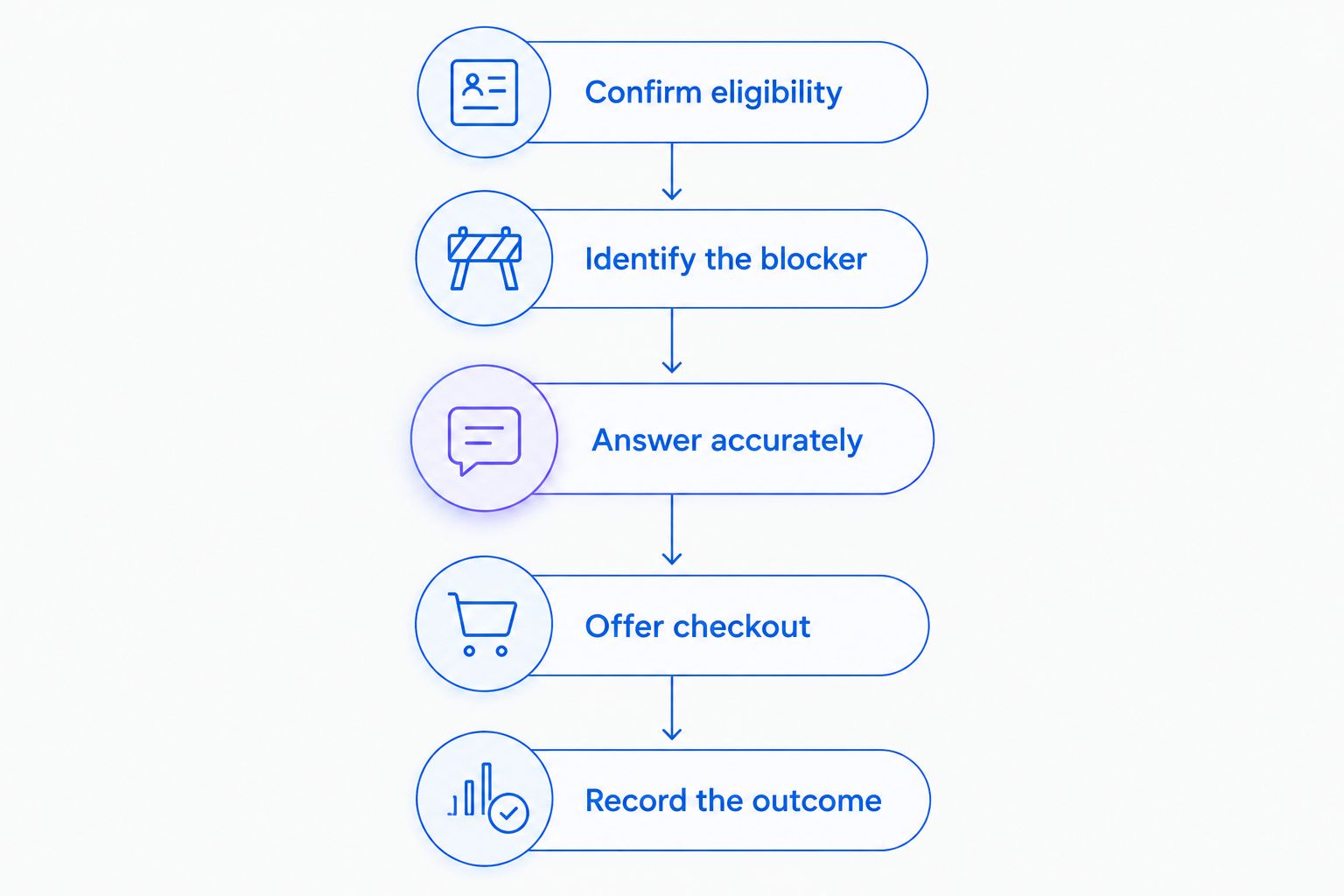
Offer checkout only after identifying and addressing the shopper’s blocker.
Distinguish purchase intent from a polite conversation
A shopper agreeing to listen has not necessarily agreed to buy. A shopper requesting a link has expressed a next-step preference, but the order still needs to be completed. Your call outcome categories should preserve those differences.
That distinction is central to measuring intent in conversational commerce: a question about completing checkout and a general acknowledgment require different follow-up decisions. Neither should be substituted for a paid order in reporting.
Use the shopper’s words to determine the next step. An explicit request to continue supports offering checkout; a request for information supports answering the question; a refusal supports ending the recovery attempt. Do not turn an ambiguous response into permission for repeated contact.
Also distinguish buying intent from permission to send a message. A person can express interest in the product without agreeing to receive a text link. Record both decisions rather than using one as a substitute for the other.
Measure recovered orders without overstating the result
For your 2026 evaluation, define success before reviewing the results. A no-discount order must meet your stated no-discount condition, and an order following a call is not automatically an order caused by that call.
Keep separate records for these events:
- Eligible cart: a checkout that meets your recovery and contact rules.
- Call connection: the shopper answers the outbound call.
- Resolved question: the shopper’s stated blocker receives an approved answer.
- Checkout action: the shopper requests or uses the approved checkout link.
- Completed order: payment succeeds for the relevant order.
- Retained revenue: the order remains after applicable cancellations and refunds are accounted for.
Use a comparison group where your testing setup permits one. Apply the same eligibility criteria and define the observation period in advance. This gives you a basis for assessing purchases beyond those that would have happened without the call.
Audit discount use separately from the agent’s behavior. An agent not issuing a code does not prove the order contained no discount: another campaign or an existing checkout promotion could affect the transaction. State whether your test excludes all discounts or only new recovery incentives.
Set boundaries before testing the app
Avasales provides outbound abandoned-cart calls alongside Shopify phone support, but that description does not establish every workflow control your test requires. Verify checkout-link handling, approved-answer boundaries, escalation behavior, and outcome reporting before relying on them.
The 7-day free trial provides an evaluation window, not a guaranteed recovery result. Setup in minutes describes getting started; it does not replace checking your policies, contact permissions, or test records. Zero commission on recovered revenue also does not mean there are no other application or usage charges.
Check current plan details and usage charges in the Shopify App Store before activating a paid plan. Keep website visits, app installs, trial starts, and paid subscriptions separate when assessing acquisition, just as you separate connected calls from recovered orders.
Can a voice agent resolve a shipping objection without a coupon?
Yes, when accurate delivery information addresses the shopper’s concern. Explain the existing delivery terms using approved information, and make clear when a requested date cannot be confirmed. Do not create a delivery promise to keep the conversation moving.
If the stated delivery terms do not meet the shopper’s needs, repeating those terms is not a resolution. Offer an authorized review if one exists, or accept that the order is not a fit.
What if the shopper asks directly for a discount?
A no-discount workflow should not issue a new incentive. State the boundary plainly, answer any remaining questions about the existing offer, and let the shopper decide whether to proceed.
Do not disguise an incentive as a service adjustment or invent an expiring offer. If your team chooses to approve an exception, classify the order outside the discount-free test rather than changing the definition afterward.
Is voice recovery better than a checkout reminder?
Voice recovery is a better fit when the shopper needs a conversation; a reminder fits a shopper who only needs the checkout path. That is a workflow distinction, not a claim that voice produces more orders for every store.
Use your 2026 test results to decide where each approach belongs. Judge completed purchases and retained revenue alongside accuracy, complaints, opt-outs, and unresolved questions.
FAQ
Can an AI voice agent recover abandoned carts without a discount code?
Yes, an AI voice agent can recover a cart without a discount code by addressing the question that prevented checkout. It cannot guarantee a purchase or remove an affordability barrier without changing the offer.
What should an abandoned-cart call say if I do not offer discounts?
An abandoned-cart call should ask what prevented checkout, answer from approved information, and offer a return to checkout when the shopper wants to proceed. It should not assume the shopper needs a coupon.
Does sending a checkout link count as a recovered cart?
No, sending a checkout link does not count as a recovered cart. Record a completed purchase separately from a requested link, a link click, or an answered call.
Can I text the shopper a checkout link after the call?
Send a checkout link only through an approved workflow with the necessary permission. Verify your application’s capabilities and applicable messaging requirements before enabling that step.
What if the customer only wants a discount?
A no-discount workflow should decline to create a new incentive and explain the existing offer accurately. If an authorized person approves an exception, keep that order outside the discount-free result.
How can Shopify merchants test Avasales?
Avasales offers a 7-day free trial, setup in minutes, and zero commission on recovered revenue. Check current plan details and usage charges in the Shopify App Store, and evaluate completed orders separately from connected calls.
How do I know whether the recovery call caused the purchase?
Use a comparison group where your testing setup permits one, with consistent eligibility rules and a predefined observation period. An order placed after a call establishes sequence, not proof that the call caused the purchase.
One last thing
Review the answers behind recovered orders, not just the order totals. A purchase following an unsupported promise is not evidence that the workflow is ready to expand. Check whether the conversation stayed within your approved information and authority.
For your next 2026 test, write the no-discount rule before the opening script. Specify which promotions disqualify an order, what counts as a completed recovery, and when the agent must stop. Those definitions make the result useful even when a shopper decides not to buy.