What happens if a customer hangs up during an AI voice call?
Customer hangs up AI voice call? End the session, verify refunds and orders, and choose a consent-aware follow-up without assuming the issue is resolved.
November 5, 2026

If a customer hangs up during an AI voice call, the live conversation ends; any callback, message, or escalation depends on the service and your configured workflow. Hanging up does not prove that the issue was resolved, cancel an action already submitted, or authorize another call.
TL;DR
- Customer hangs up AI voice call: end the conversation, verify business actions, and apply approved follow-up rules.
- Avasales offers Shopify merchants a 7-day free trial, setup in minutes, and zero commission on recovered revenue.
- Treat call status, refund status, and checkout completion as separate outcomes.
- Never interpret a disconnected call as permission to redial or send a text.
Why this matters
A disconnected call creates uncertainty about the customer's request and any work already underway. For a Shopify merchant, the important question is whether an order, refund, or checkout action completed before the connection ended.
Avasales provides Shopify phone support 24 hours a day and makes outbound abandoned-cart recovery calls. When evaluating that workflow in 2026, test what happens after a disconnect as carefully as you test the conversation itself.
A call ending is a telephone event, not proof of a business outcome. Keep those records separate so your team does not close an unresolved request or repeat an action that already succeeded.
What happens if a customer hangs up during an AI voice call?
The conversation stops when the connection closes. What happens next needs an explicit store policy: inspect the outcome, preserve available context, and decide whether further contact is appropriate. Do not assume every voice platform follows the same sequence automatically.
Use this post-disconnection procedure as an acceptance checklist for your 2026 setup:
- End conversation. Confirm the disconnected session stops accepting new conversational instructions. Do not continue the conversation as though the customer were still listening.
- Check actions. Inspect the relevant Shopify record or connected service for any submitted refund, cancellation, or other change. A spoken promise is not a completion receipt.
- Record outcome. Separate what the customer requested, what was authorized, what actually completed, and what remains unresolved.
- Choose follow-up. Apply the customer's stated preferences, your contact permissions, and the purpose of the original call before deciding on further contact.
- Escalate uncertainty. Send ambiguous or sensitive cases to a person with the context needed to finish the request safely.
This sequence is a recommended operating policy, not a claim that every app supplies these controls. Ask the provider to demonstrate the behavior and identify which settings, records, and integrations support it.
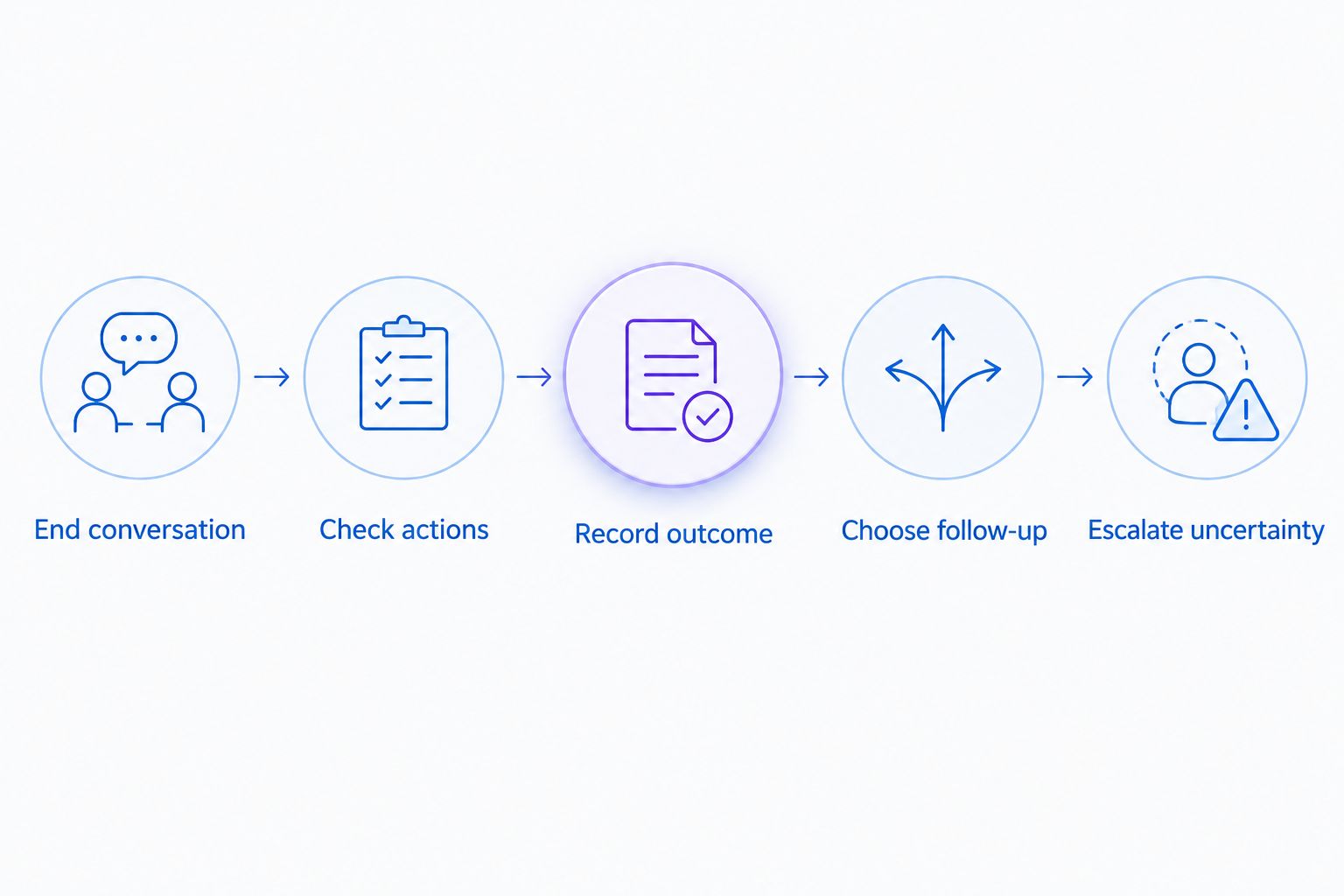
Check the business action before deciding whether to contact the customer again.
The most important checkpoint comes before a retry. If the system submitted a refund just before the hang-up, repeating the request without checking its status creates an avoidable operational risk.
Compare the possible outcomes
The following table describes situations to plan for, not guaranteed platform behavior. Each response has a benefit and a limitation.
Customer hangs up before explaining the request
- Recommended response: Record the request as unknown; do not mark it resolved
- Best for: Early disconnects
- Benefit: Avoids inventing intent
- Limitation: Leaves the reason for contact unknown
Customer disconnects during order tracking
- Recommended response: Preserve available context and check whether the answer was delivered
- Best for: Unfinished support calls
- Benefit: Gives the next handler a starting point
- Limitation: Does not prove the customer heard the update
Customer disconnects during a refund
- Recommended response: Verify authorization and the actual refund status before retrying
- Best for: Financial actions
- Benefit: Reduces the risk of repeating an action
- Limitation: Requires access to a reliable transaction record
Customer ends a cart recovery call
- Recommended response: End the attempt and check contact preferences before further outreach
- Best for: Outbound recovery
- Benefit: Respects the customer's response
- Limitation: Does not establish why the customer ended the call
Customer requests no more calls, then hangs up
- Recommended response: Apply the no-call preference through your approved process
- Best for: Explicit contact objections
- Benefit: Preserves a clear customer instruction
- Limitation: Requires coordination across calling workflows
Inbound support: preserve the unfinished request
An inbound caller has chosen to contact your store, but a disconnect still leaves the outcome uncertain. The customer might have heard the answer, lost the connection, or stopped the conversation before receiving help. The hang-up alone does not identify which happened.
For order tracking, record the last confirmed question and whether the response was delivered before the disconnect. Avoid marking an entire case resolved merely because the agent retrieved tracking information. Retrieving information and communicating it are separate steps.
For an unresolved support request, choose follow-up based on the request and contact permissions, not just the disconnected status. A callback, an approved message, or manual review each serves a different purpose. None should be an unconditional default for every caller.
If your store uses human escalation, verify how the unfinished request reaches the next handler. The guide to transferring calls to a human covers the adjacent handoff question; a transfer policy also needs a fallback when the caller has already disconnected.
Outbound cart recovery: do not treat a hang-up as interest
During an abandoned-cart call, a hang-up tells you that the conversation ended. It does not tell you whether the shopper dislikes the product, wants a discount, intends to purchase later, or welcomes another call.
Your 2026 recovery workflow should distinguish an unanswered attempt, a connected conversation, an explicit refusal, and a completed checkout. Combining those outcomes makes it harder to understand what happened and choose an appropriate next action.
Do not redial simply because the checkout remains incomplete. Check your outreach rules and the customer's preferences first. If the customer explicitly requested no further calls, retain that instruction through the process your store uses to manage contact preferences.
A checkout link also needs its own approval path. Do not treat a hang-up as permission to send a text, and do not describe a link as sent unless the messaging system confirms the action. A delivered link is not a recovered order; verify checkout completion separately.
Refunds and cancellations: verify before repeating
A customer can disconnect after requesting a refund but before hearing the result. The safe next move is to inspect the underlying order and transaction records. Do not infer success or failure from where the conversation stopped.
Separate the request, authorization, submission, and confirmed result in your review. Those stages answer different questions: what the customer wanted, what the store permitted, what the system attempted, and what actually happened.
When the result remains uncertain, hold the repeat action for review. Give the reviewer the order reference, available request context, and the last confirmed action status through your approved internal process.
This distinction also matters for cancellations. A disconnected call is not itself a cancellation request, and a cancellation request is not proof that the order was canceled. Your customer communication should describe only the status you can verify.
Why post-hang-up behavior varies
A useful 2026 evaluation compares workflow rules rather than assuming a universal response. These factors determine what your store should permit after a disconnect:
- Call purpose. An inbound delivery question and an outbound checkout reminder create different follow-up needs.
- Customer instructions. A clear request to stop calling needs different handling from a conversation that ends without explanation.
- Action status. A confirmed refund requires a different response from a refund request that never reached submission.
- Available records. Your team needs a reliable source for the order or transaction status before repeating a change.
- Contact permissions. Permission for a particular channel or purpose should be checked before further outreach.
- Provider controls. Verify which callback, messaging, logging, and escalation behaviors the service actually supports.
Ask for a demonstration using your intended workflow. A general statement that a service handles disconnected calls does not establish its behavior during a partially completed refund or an interrupted recovery attempt.
Will the agent automatically call the customer back?
Automatic callbacks depend on the provider and configuration; a hang-up alone does not establish that a callback will occur. Ask whether disconnected inbound calls and ended outbound calls follow different rules.
For your store, require a clear reason for any retry and a process for honoring customer contact preferences. Evaluate callbacks as a separate capability rather than assuming they are included in basic phone answering.
Does hanging up stop a refund or order change?
Hanging up does not automatically reverse an action already submitted to another system. Check the actual order or transaction status before deciding whether to retry, cancel, or communicate a result.
The same rule applies when the agent was interrupted mid-sentence. What the customer heard and what the connected system processed are not necessarily the same event.
Can the agent text the customer after the call ends?
A post-call text requires supported messaging functionality and appropriate permission for that message. The disconnected call itself supplies neither.
If your workflow includes approved checkout or order-tracking links, test the approval and delivery steps separately. Record a message as sent only when the relevant system confirms it, and keep link delivery separate from purchase completion.
How to test disconnect handling before launch
Use controlled test calls during your 2026 rollout. Test the moments that create uncertainty, then inspect both the call record and the relevant business record.
- Opening disconnect: End the call before stating a request. Confirm the case is not presented as resolved.
- Interrupted tracking answer: Disconnect while the order update is being delivered. Check how unfinished communication is represented.
- Pending refund: Disconnect after requesting a refund but before confirmation. Verify the underlying status before any repeat attempt.
- Contact objection: State that you do not want further calls, then disconnect. Check the process used to retain and apply that instruction.
- Requested text: Approve a specific link, then end the call. Inspect whether the approved message was sent without assuming delivery or checkout completion.
- Interrupted handoff: Disconnect during escalation. Confirm that your team can identify the unfinished request through the supported workflow.
Keep expected behavior beside observed behavior. Where the provider does not support a required control, assign a manual owner or change the workflow before launch. Do not fill a capability gap with an assumption.
Where Avasales fits for Shopify merchants
Avasales is best for Shopify merchants seeking voice customer support and outbound abandoned-cart recovery in one app. Its stated scope includes answering support calls, resolving orders and refunds, and calling shoppers about abandoned carts.
The benefit is coverage across support and recovery use cases. The limitation is that those capabilities alone do not establish specific hang-up behavior, such as automatic redial, transcript retention, post-call messaging, or refund retry controls. Confirm those details for the workflow you intend to run.
Use the Avasales 7-day free trial to test interrupted conversations alongside ordinary calls. Setup takes minutes, and the service charges zero commission on recovered revenue. Review current plan terms and usage charges in the Shopify App Store before choosing a plan.
Test your disconnected-call workflow
Check support and cart-recovery scenarios during the 7-day free trial.
FAQ
What happens when a customer hangs up on an AI phone agent?
The live conversation ends. Any callback, message, or escalation depends on the service and configuration, while any submitted business action needs a separate status check.
Does hanging up mean the customer support issue is resolved?
No. A disconnected call does not prove the customer received an answer or that the requested action completed; verify the support outcome separately.
Will an AI agent keep calling after a customer hangs up?
Further calls depend on the provider, configuration, and applicable contact rules. Do not assume a hang-up authorizes another attempt, and preserve explicit requests for no further calls.
Can a refund complete after the customer disconnects?
A submitted refund can finish independently of the live conversation. Check the transaction record before repeating the request or telling the customer it failed.
Should a Shopify store send a checkout text after a hang-up?
Send a checkout text only through a supported, appropriately permitted workflow. Hanging up is not approval for a text, and sending a link is not proof of a recovered order.
How should I test an interrupted cart recovery call?
End a controlled recovery call at different stages and inspect the recorded outcome, contact preferences, and any follow-up action. Verify checkout completion separately from call or message status.
Does Avasales guarantee an automatic callback after a hang-up?
Do not assume an automatic callback. Confirm disconnected-call handling with the provider and test the specific support or recovery workflow before enabling it for customers.
One last thing
Test a disconnect after an action succeeds but before the customer hears confirmation. That boundary exposes whether your process relies on conversation text or checks the actual business result. A reliable workflow preserves the completed action and routes the unfinished communication appropriately.