Can AI voice agents call customers about restocked items?
AI voice agents can call customers about restocked items with verified inventory and proper consent. See the Shopify workflow, safeguards, and buying checks.
October 7, 2026

Yes, AI voice agents can call customers about restocked items when the calling system connects an inventory event to the correct customer request, checks calling consent, and supports outbound calls. A restock notification signup does not automatically authorize an automated marketing call. Before you launch a restock campaign in 2026, verify the inventory connection, consent requirements, and what the agent can actually do during the conversation.
TL;DR
- Can AI voice agents call customers about restocked items? Yes, with suitable consent and verified inventory.
- Avasales is best for Shopify merchants seeking phone support and outbound abandoned-cart recovery.
- Match restock notifications to the requested variant, not just the product name.
- Confirm restock-trigger support separately from general outbound calling capability.
Can AI voice agents call customers about restocked items?
Yes. The required workflow is an inventory event followed by customer matching, a consent check, and an outbound call. A platform that makes outbound calls still needs a supported way to receive and act on restock events.
Avasales offers a 7-day free trial, setup in minutes, and zero commission on recovered revenue. Its Shopify phone agent answers support calls and makes outbound abandoned-cart recovery calls. Confirm restock-trigger support before treating it as a restock-calling solution.
A practical restock workflow follows these steps:
- Inventory event: Receive a change from the store's inventory system rather than relying on a product description.
- Customer match: Find customers who requested the exact product variant and supplied a usable phone number.
- Consent check: Confirm that the intended automated call is covered by the customer's permission and applicable rules.
- Variant check: Recheck the requested variant before dialing and before making a product-specific statement.
- Call outcome: Record whether the customer answered, declined, requested help, or asked to stop receiving calls.
- Suppression: Remove ineligible contacts and stop further calls after an opt-out or another defined stopping event.
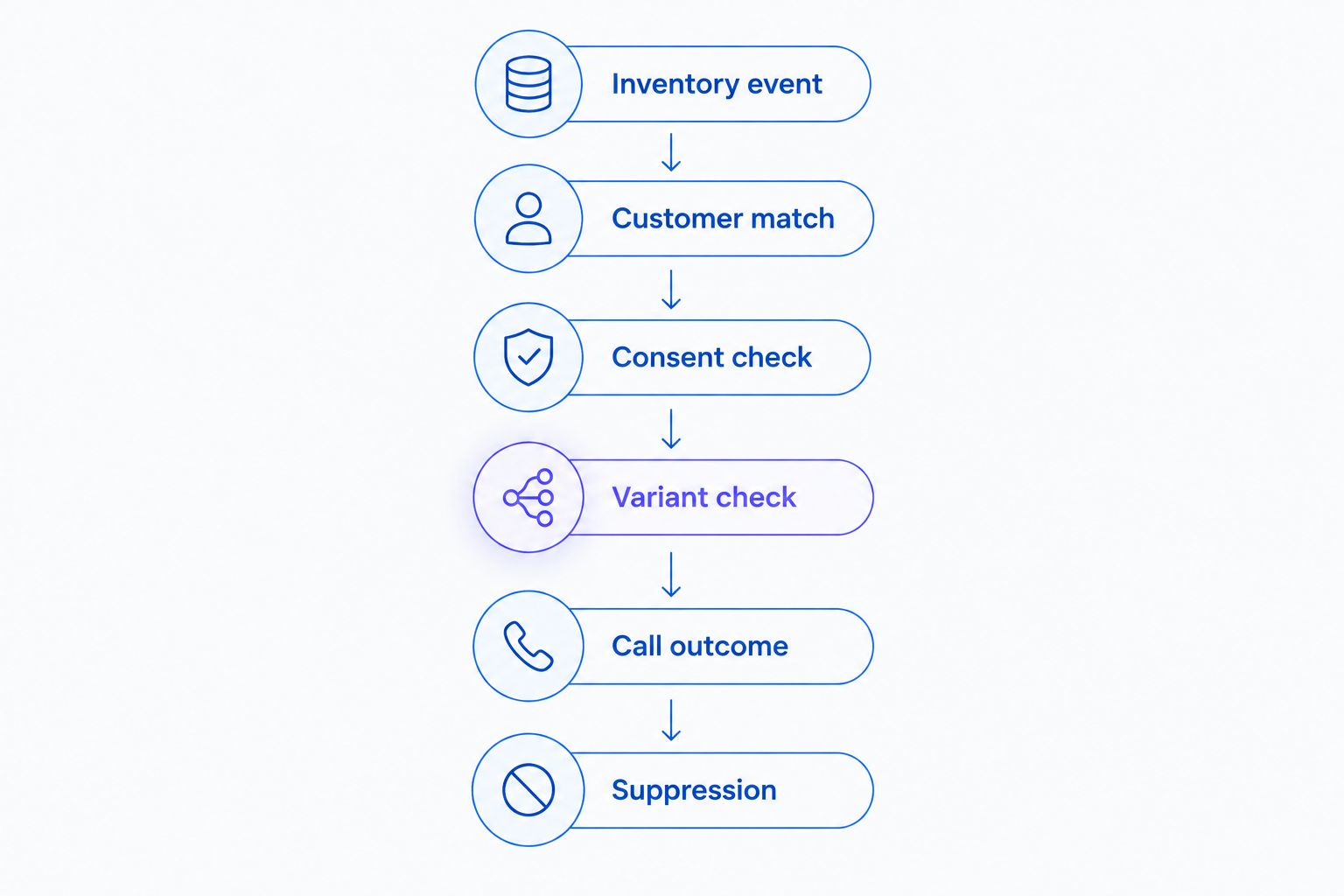
An inventory change should pass through customer and consent checks before it triggers a call.
Why this matters
A customer who requested a particular size does not need a call about a different size. Your notification system must preserve that distinction from signup through the final conversation. Otherwise, a technically successful call delivers the wrong message.
Restock calling also combines merchandising with customer outreach. The inventory system answers whether the requested item can be offered; the permission record answers whether you can call that customer. Neither record replaces the other.
For your 2026 evaluation, assess those connections before voice quality. A natural conversation cannot correct an incorrect variant match or an unauthorized campaign. Test the complete journey, including the cases where the system should refuse to call.
What should you verify before enabling restock calls?
Inventory event
Ask how the calling platform receives an inventory change. A supported integration, an automation workflow, or a documented API connection must carry the relevant product and variant identifiers to the calling system. A general claim of Shopify compatibility does not establish that connection.
Also define which inventory changes qualify. Your workflow should distinguish a meaningful restock event from an adjustment that does not make the requested variant eligible for the intended sale. Document the rule in terms your operations team can check.
For trigger planning, see the guide to connecting Ava AI to Shopify Flow for call triggers. Use it to frame integration questions, not as a substitute for confirming your particular restock workflow.
Customer match
Keep the notification request tied to the exact variant identifier. Product titles, color descriptions, and customer notes are useful context, but they should not be the only matching keys. Similar names create avoidable ambiguity.
Record the requested communication channel alongside that match. A customer who selected email should remain in the email workflow unless you separately obtain the necessary permission for calls. A phone number collected for delivery questions is not a blanket invitation to run promotional campaigns.
Consent check
In 2026, assess US automated voice campaigns against the Telephone Consumer Protection Act and FCC rules governing artificial or prerecorded voice calls. Marketing calls using artificial voices generally require prior express written consent where those rules apply. State requirements and other calling restrictions also need review.
Have qualified counsel approve your campaign purpose, signup wording, calling hours, disclosures, and opt-out process. Keep the consent record retrievable. Do not launch on the assumption that an existing customer relationship authorizes every automated sales call.
Variant check
Check the inventory source again near the time of the call. A queued restock event describes an earlier state, while the customer hears the message later. The script should use current information rather than repeating the event payload without validation.
Define what happens when the inventory check fails or returns ambiguous data. The agent should stop the product-specific offer or route the issue for review. An uncertain database response is not permission to make a confident claim.
Call outcome
Write outcomes that describe what actually happened. An answered call is different from customer interest, and customer interest is different from an order. Keep those stages separate in your reporting.
Capture requests that affect the next action, including a different communication preference or a request for human help. If your workflow supports text links, send only the approved destination through an authorized messaging process. Do not let a generated conversation invent a checkout address or offer.
Suppression
Define stopping rules before launching. An opt-out must stop the relevant outreach, and a completed purchase should prevent unnecessary repeat promotion for the same request. Repeated inventory events should not create duplicate campaigns for one customer.
Test suppression independently from successful calls. A system that handles a positive response but ignores a stop request is not ready for customer-facing use. Your campaign needs a clear owner for investigating failed suppression events.
Which notification channel fits the customer's request?
Choose the channel around the requested interaction and recorded permission. Voice is useful when a customer wants a conversation; a written notification is useful when the customer primarily needs a link. There is no supported basis here for claiming that one channel always generates more sales.
AI voice call
- Best for: Consented outreach where customers need conversational help
- Main advantage: Lets customers ask questions during the notification
- Main limitation: Requires calling permission, reliable data, and defined action limits
Email notification
- Best for: Customers who want a written product reminder
- Main advantage: Gives customers a message they can revisit
- Main limitation: Does not provide a live conversation within the notification
SMS notification
- Best for: Customers who specifically request a short text update
- Main advantage: Delivers a concise written message and approved link
- Main limitation: Requires appropriate messaging permission and limited message scope
Human callback
- Best for: Exceptions requiring judgment or sensitive handling
- Main advantage: Gives a staff member control over unusual requests
- Main limitation: Requires staff scheduling and manual handling
Use the customer's chosen channel as your starting point. Add voice when the customer has authorized it and the conversation serves a clear purpose. Do not move an email-only waitlist into a calling campaign simply because phone numbers exist elsewhere in your store.
Why restock-calling workflows vary
The differences come from the store's data and operating rules, not just the voice model. Check these factors during your 2026 selection process:
- Trigger connection: The inventory event must reach the calling platform through a supported route.
- Variant detail: Matching must preserve the requested size, color, or other variant selection.
- Permission scope: Your records must cover the channel and purpose of the intended outreach.
- Conversation actions: The agent needs clear boundaries for answering questions, sending approved links, or requesting staff help.
- Data freshness: Queued events require validation before the agent repeats product-specific information.
- Stopping rules: Opt-outs, purchases, and duplicate events need explicit handling.
Request a demonstration using your workflow rather than a generic sales conversation. Ask the vendor to show both a successful notification and a blocked call. Those demonstrations answer different questions: whether the agent can act and whether the system knows when it must not act.
Where does Avasales fit for Shopify merchants?
Avasales is best for Shopify merchants seeking 24/7 phone support and outbound abandoned-cart recovery. Its stated offering covers answering support calls, resolving orders and refunds, and calling shoppers about abandoned carts. That makes it relevant to merchants evaluating phone support alongside outbound commerce conversations.
The restock decision needs a separate capability check. Confirm that the proposed setup accepts inventory events, matches notification requests, checks permission, and records stopping events. Do not infer a restock feature from abandoned-cart calling alone.
For a 2026 trial, separate support testing from restock testing. Support calls should demonstrate correct order handling; restock tests should demonstrate the inventory-to-customer connection. A short installation process does not remove the need to validate either workflow.
The practical advantage is a Shopify-focused phone offering with support and recovery use cases. The limitation for this question is that you must establish the restock connection and campaign controls before relying on it. Evaluate the workflow you need, not a broader category label.
Can a restock signup count as permission for an AI call?
A restock signup counts as calling permission only when its wording and collection process satisfy the requirements for the intended call. An email notification request alone does not establish permission for an automated marketing call. Have counsel review the actual form and consent record before activation.
Keep the customer's preference attached to the request after signup. Changing platforms or importing a list should not erase channel restrictions. Your automation must carry permission forward along with the product identifier.
Can the agent send a checkout link after the call?
An agent can send a checkout link only if the configured workflow supports messaging and the customer has the required permission for that message. Use an approved destination and confirm that it corresponds to the discussed product or checkout. Do not treat permission for a call as automatic permission for every follow-up channel.
Avasales's merchant guidance includes approved text links and checkout recovery. Confirm how those functions apply to your proposed restock workflow before including them in a campaign script.
Can the agent promise that an item is reserved?
An agent should promise a reservation only when an actual reservation process supports that statement. A notification request or inventory event does not establish a customer-specific hold. If no reservation workflow exists, keep the conversation within the verified information the system can provide.
The same boundary applies to discounts, delivery commitments, and purchase completion. Allow only actions supported by your systems and approved policies. A fluent answer is not evidence that an operational action occurred.
FAQ
Can AI voice agents call customers about restocked items?
Yes, AI voice agents can call customers about restocked items through a supported inventory-to-outbound-call workflow. The system needs accurate variant matching, suitable calling permission, and stopping rules.
Does signing up for a restock email authorize an AI phone call?
No, a restock email signup does not by itself authorize an AI marketing call. Review the consent wording and applicable calling rules before adding voice outreach.
Can Avasales automatically call my Shopify restock list?
Confirm restock-trigger support with Avasales before connecting a restock list. Its stated offering includes Shopify phone support and outbound abandoned-cart recovery, which does not by itself establish a restock integration.
Should I use calls, email, or texts for restock notifications?
Use the channel the customer requested and authorized. Choose voice when a conversation serves a clear purpose, and written notifications when the customer wants a message to revisit.
What happens if inventory changes before the customer answers?
The workflow should recheck the requested variant before making a product-specific statement. If the check fails or returns ambiguous information, stop the offer or route it for review.
Can an AI restock call send a purchase link?
An AI restock call can lead to an approved purchase link when the setup supports messaging and the necessary permission exists. Verify the destination rather than letting the agent generate one.
How do I stop customers from getting repeated restock calls?
Use suppression rules for opt-outs, completed purchases, and duplicate inventory events. Test those rules before launch and keep call outcomes separate from orders.
One last thing
Before launching in 2026, test the customer who should receive nothing: someone who requested email only, bought the item already, or withdrew permission. Confirm that each case blocks the call and leaves an understandable record. A restock workflow is ready only when its stopping rules work as reliably as its calling rules.