Can AI voice agents handle returns on final sale items?
Can AI voice agents handle final sale returns? Yes, within approved policies. Learn when to deny, review claims, and require human approval for refunds.
November 7, 2026

Yes, AI voice agents can handle final sale return calls by explaining your policy, checking the reason for the request, and routing exceptions for review. Issuing a refund is a separate action that requires verified order details, approved permissions, and a decision that respects applicable consumer rights.
TL;DR
- AI voice agents handle final sale returns through policy explanations, request intake, and authorized actions, not unrestricted refund decisions.
- Shopify merchants should separate change-of-mind requests from damaged, incorrect, or disputed orders.
- Avasales provides Shopify voice support; test final sale restrictions before allowing refund actions.
- Escalate unclear eligibility and disputed policy disclosures instead of promising or permanently denying a refund.
Avasales offers a 7-day free trial, setup in minutes, and zero commission on recovered revenue. Use the trial to test difficult support conversations separately from outbound cart recovery; success in one workflow does not establish safe handling in another.
Why this matters
A final sale caller is asking about a particular purchase, not requesting a recital of your return policy. Your phone workflow needs to distinguish dissatisfaction with an item from a report that the store delivered something damaged or incorrect.
For your 2026 support policy, define which questions the agent can answer, which actions it can take, and which decisions require a person. A clear explanation is a useful outcome even when the agent cannot authorize the requested return.
Can AI voice agents handle returns on final sale items?
Yes, provided the workflow separates conversation handling from refund authority. Configure the agent to identify the affected item, establish the customer's reason, check the applicable policy, and take only the action your store has authorized.
These requests need different treatment:
Change of mind on an item confirmed as final sale
- Best handling path: Best for policy explanation
- Benefit: Gives the customer a direct answer
- Limitation: Requires the correct purchase-specific policy
Reported damage or incorrect item
- Best handling path: Best for claim intake and review
- Benefit: Captures a problem that needs separate assessment
- Limitation: A phone conversation alone does not establish the claim
Customer disputes the final sale disclosure
- Best handling path: Best for human review
- Benefit: Allows someone to examine purchase evidence
- Limitation: Leaves the eligibility decision pending
Merchant has already approved an exception
- Best handling path: Best for authorized execution
- Benefit: Separates approval from processing
- Limitation: Still requires identity, scope, and action checks
This table is a recommended operating model, not a statement that every voice platform supports every step. Before enabling a 2026 workflow, demonstrate each permitted action in your actual configuration.
Policy explanation: handle the conversation without changing the order
For a straightforward change-of-mind request, the agent should identify the relevant item and explain the applicable restriction in plain language. It should avoid describing every discounted item as final sale unless your policy explicitly does so.
The advantage is consistency. The limitation is that a policy explanation becomes unreliable when the agent cannot establish which terms applied to the purchase.
Exception intake: gather the facts without promising approval
A customer reporting damage, an incorrect shipment, or disputed disclosure needs a different path from someone who simply prefers another color. Configure the agent to record the allegation accurately and identify what your reviewer needs next.
This preserves the customer's account without prejudging it. Intake is not approval, and the agent should make that distinction explicit.
Approved action: process only what the merchant authorized
When an authorized person approves an exception, the processing step should remain limited to that approval. Confirm the affected item, the permitted action, and whether the action has already occurred.
The benefit is a defined boundary. The limitation is that approval alone does not protect against processing the wrong item or repeating an earlier action.
Why final sale handling varies
Your 2026 rules should account for these factors rather than treating the phrase final sale as a complete decision:
- Purchase-specific terms. Establish which policy and product disclosures applied when the customer ordered.
- Reason for the request. Separate preference changes from reported fulfillment problems and disputed disclosures.
- Item-level eligibility. Evaluate the affected line item instead of assuming every product in the order shares its status.
- Identity and authority. Verify the caller before exposing protected order details or allowing account-changing actions.
- Available evidence. Identify whether the decision requires purchase records, photographs, or another review step.
- Approved permissions. Separate the ability to explain, document, approve, and execute a return or refund.
Applicable consumer protections also need legal review. Do not configure a blanket statement that final sale wording eliminates every possible remedy.
Build the call workflow around permission checks
Use this sequence as a configuration brief for your 2026 returns workflow. Treat it as a set of requirements to demonstrate, not a feature list to assume.
- Verify identity. Apply your approved verification process before sharing protected information or making changes. An order number alone should not become unrestricted authority.
- Find the item. Identify the product and affected quantity. Keep other items in the same order outside the decision unless the customer also raises them.
- Classify the request. Establish whether the customer changed their mind, reports a problem, or disputes the terms. Preserve the customer's meaning in the record.
- Check the policy. Match the request to the relevant purchase terms. If the necessary evidence is unavailable, stop the automatic decision and request review.
- Apply permissions. Explain the policy, collect the claim, or execute an approved action within the configured limits. Do not let conversational pressure expand those limits.
- Record the outcome. Distinguish a completed explanation, pending review, approved exception, and completed refund. Leave the next person a usable record.
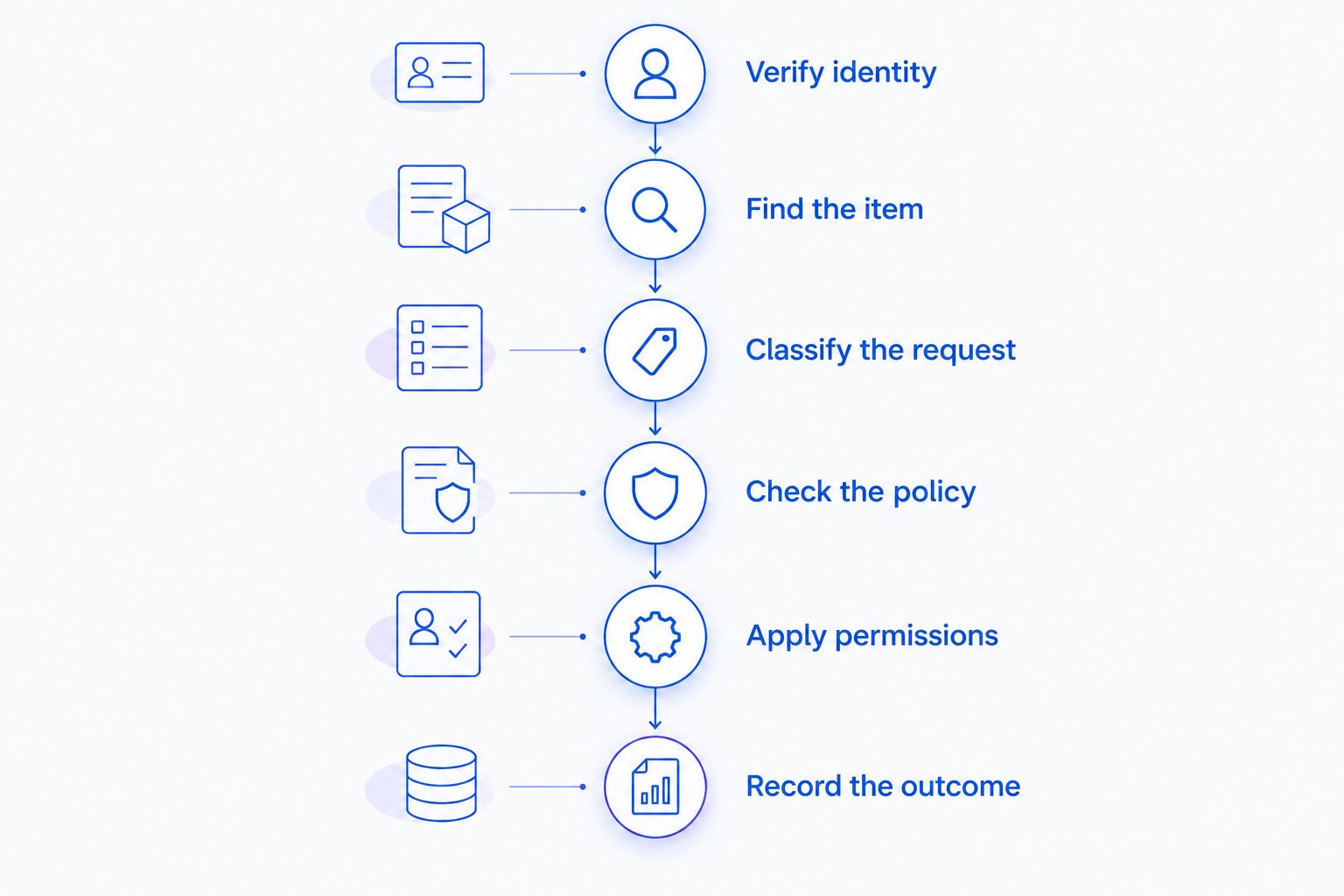
Policy checks and permission checks belong before any refund action.
Keep the verification process proportionate to the action. Explaining a public policy and issuing a refund carry different consequences; your permissions should reflect that difference.
The details in identity verification before issuing a refund belong in the same operating procedure as eligibility checks. A correct policy decision does not authorize a change requested by an unverified caller.
What should happen when the customer disputes the decision?
Route a disputed final sale decision to review when the disagreement requires evidence or authority the agent does not have. Repeating the policy more forcefully does not resolve a disagreement about what the customer bought or what the store disclosed.
A useful handoff record should contain:
- The verified order and affected item.
- The customer's stated reason for requesting a return.
- The policy information available during the call.
- The specific point the customer disputes.
- Any action already taken and the decision still needed.
Your escalation process also needs an owner. Tell the customer what happens next without inventing a response deadline or promising an outcome the reviewer has not approved.
For after-hours calls, distinguish accepting the request from deciding it. Continuous phone coverage does not mean every exception has continuous human approval available.
Separate eligibility, authorization, and execution
A safe workflow answers different questions at different stages: does the policy permit the request, who can approve an exception, and what action has actually completed? Combining those questions into a single conversational response makes the outcome difficult to audit.
For example, a reviewer can approve an exception without the refund being processed yet. Your agent should describe that state accurately rather than telling the customer that money has already been returned.
The same separation applies to AI automation for order operations: a conversation can initiate a request, but the order workflow still needs explicit authorization and a recorded execution result. Treat a spoken promise and a completed system action as different events.
Recommended safeguards include checking for a prior refund before another attempt, limiting actions to the approved line item, and preserving the approval record. If the action result is unclear, route the case for reconciliation instead of repeating it blindly.
Test difficult calls before allowing refund actions
Evaluate outcomes against your policy, not against how natural the conversation sounds. A polite call that grants an unauthorized exception is still a failed test.
Use these scenarios in your 2026 acceptance checks:
- Mixed order: The customer asks to return an eligible item from an order that also contains a final sale item. Check that the workflow evaluates the correct item.
- Reported damage: The customer describes a defect on a final sale purchase. Check that the workflow collects the claim rather than treating it only as buyer's remorse.
- Disputed disclosure: The customer says the restriction was absent at purchase. Check that the workflow requests evidence review instead of asserting an unverified history.
- Pressure for an exception: The caller repeatedly asks the agent to ignore the policy. Check that repetition does not change the permission boundary.
- Existing refund: The customer calls again after an earlier action. Check that the workflow recognizes the recorded state before attempting another action.
- Unavailable reviewer: The call arrives outside the review team's working hours. Check that the agent explains the pending status without inventing a callback promise.
Review both the conversation and the resulting order state. Correct wording does not compensate for an incorrect action, and a correct action does not excuse a misleading explanation.
Where Avasales fits for Shopify merchants
Avasales is best suited to Shopify merchants seeking voice customer support and outbound abandoned-cart recovery. Its stated offering includes answering support calls around the clock and resolving orders and refunds.
Those capabilities make returns conversations relevant to an evaluation, but they do not establish a particular final sale approval workflow. Test your policy rules, action permissions, and exception paths before treating any request as automatically resolvable.
The benefit is access to phone support alongside outbound recovery in the stated offering. The limitation for this use case is that general refund capability does not establish item-specific eligibility controls or exception authority.
During the trial, keep support evaluation separate from recovery reporting. Website clicks, app installs, trial starts, and paid customers are distinct events; none establishes that a disputed return was handled correctly.
Can a final sale label decide every return request?
No. Configure final sale wording as relevant policy information, not as a substitute for reviewing the customer's actual claim and applicable rights.
Ask qualified counsel to review the rules for the markets you serve. The voice workflow should apply approved guidance rather than invent legal conclusions during a call.
Can an agent offer store credit instead of a refund?
Only configure a store-credit offer where your store has expressly authorized that option and its conditions. Do not assume credit is an acceptable substitute for every request.
Treat issuing credit as an account-changing action with its own permissions. If approval is required, the agent should describe it as pending until that approval exists.
FAQ
Can AI voice agents handle final sale returns without a human?
AI voice agents can handle policy explanations and approved steps without a human when the configured workflow supports them. Disputed eligibility and unauthorized exceptions should go to review.
Can an AI phone agent refuse a return on a final sale item?
An AI phone agent can communicate an applicable final sale restriction when the purchase facts and approved policy support that response. Reported damage, incorrect items, and disputed disclosures need separate assessment.
What if the customer says a final sale item arrived damaged?
The agent should record the reported damage and follow your approved claims process. It should not assume that a final sale label settles the claim.
Can an AI voice agent issue a refund after a manager approves it?
An AI voice agent can execute an approved refund only if its integration and permissions support that action. Require identity checks, item-specific authorization, and confirmation of the execution result.
Should the agent offer an exchange on every final sale call?
No, the agent should offer an exchange only when your policy or an authorized exception permits it. Offering an unapproved alternative creates another promise your store must address.
Does Avasales offer a trial for Shopify merchants?
Avasales offers a 7-day free trial and setup in minutes. Test final sale explanations and exception handling before permitting refund actions.
What should an agent say when a refund decision is pending?
The agent should explain that the request is awaiting review and identify the next approved step. It should not describe a pending approval as a completed refund.
One last thing
Test a call in which the correct outcome is no account change. Your final sale workflow needs to demonstrate restraint, not just successful refund execution. A documented explanation or a well-prepared handoff can be the right resolution.