Can an AI phone agent verify a shipping address before dispatch?
Can an AI phone agent verify shipping address details? Yes, with order access and safeguards. Learn what to confirm, when to hold, and when to escalate.
November 13, 2026

Yes, an AI phone agent can confirm a shipping address with a customer before dispatch when it has access to the relevant order and an approved verification workflow. Customer confirmation alone does not establish that an address is deliverable or authorize an order change. Keep address confirmation, address validation, and permission to update the order as separate checks.
TL;DR
- For Shopify, an AI phone agent verify shipping address workflow needs order access, customer confirmation, and controlled updates.
- A spoken confirmation does not prove carrier deliverability or authorize a destination change.
- Hold unresolved address requests for review instead of treating an answered call as approval to dispatch.
Avasales offers Shopify merchants a 7-day free trial, setup in minutes, and zero commission on recovered revenue. Its phone support and abandoned-cart calling offering is distinct from the address-editing permissions and fulfillment controls you must assess for this workflow.
Can an AI phone agent verify a shipping address before dispatch?
Yes, provided you define what verification means. For your 2026 workflow, require a clear result for each check below rather than a single ambiguous status such as verified.
Customer confirmation
- What it establishes: The customer agrees with the stated destination
- What it does not establish: The carrier can deliver there
Address validation
- What it establishes: An address-checking service accepts the address under its rules
- What it does not establish: The caller is authorized to change the order
Change authorization
- What it establishes: The request meets your store's identity and policy requirements
- What it does not establish: The warehouse has received the correction
Fulfillment confirmation
- What it establishes: The system preparing the parcel has the approved destination
- What it does not establish: Delivery is guaranteed
The practical sequence is to identify the order, authenticate the requester, confirm the address, handle discrepancies, and verify the final saved destination. If any required check fails, route the order for review under your store's policy.
A successful conversation is not proof of a successful order update. Your dispatch decision needs evidence from the system that actually prepares the shipment.
Why this matters
A phone conversation can resolve an unclear apartment number or street spelling through direct questioning. Its limitation is that spoken information still needs to reach the correct order and fulfillment record.
Treat the call as an information-gathering step with controlled outcomes. Otherwise, your support record can say corrected while the warehouse continues using the original address.
For 2026, define ownership before enabling automation: who approves destination changes, which system stores the approved address, and who releases an order after review. Those decisions determine whether the workflow is safe to operate.
How should the verification workflow work?
Use the following sequence as a configuration and acceptance-testing checklist. These are requirements to assess, not assumed features of every phone agent.
Identify the order
Find the intended order through your approved lookup process. A customer with several purchases needs to confirm which shipment the conversation concerns before the agent discusses or changes delivery details.
Require a matching order record. If the lookup produces conflicting results, stop the update path and send the case for review rather than guessing from a name or partial address.
Authenticate the requester
Apply your store's identity-checking policy before revealing the full destination or accepting a correction. An order number identifies an order; your policy must separately establish whether the requester can act on it.
Do not treat caller ID alone as authorization. Keep the information requested proportionate to the task, and avoid collecting payment credentials for an address-confirmation call.
Confirm the destination
Ask the customer to provide the shipping address, then read back the relevant fields. Include the street, building or unit information, city, region where applicable, postal code, and country.
Resolve unclear words explicitly. If speech recognition produces conflicting street names, ask for spelling instead of choosing the more familiar result.
Resolve discrepancies
Separate a missing unit number from a request to redirect the parcel to a different destination. Your store can assign different approval requirements to those cases.
Do not invent a postal code, infer a house number, or silently substitute another street. An uncertain answer remains unresolved until the customer or an authorized reviewer supplies the missing information.
Verify the saved result
Where updates are permitted, save the approved correction and read back the resulting order data. Then confirm that the fulfillment system has received the destination it will use.
Where updates are not permitted, create a review task with the proposed correction. Tell the customer the request needs approval; do not describe the address as changed.
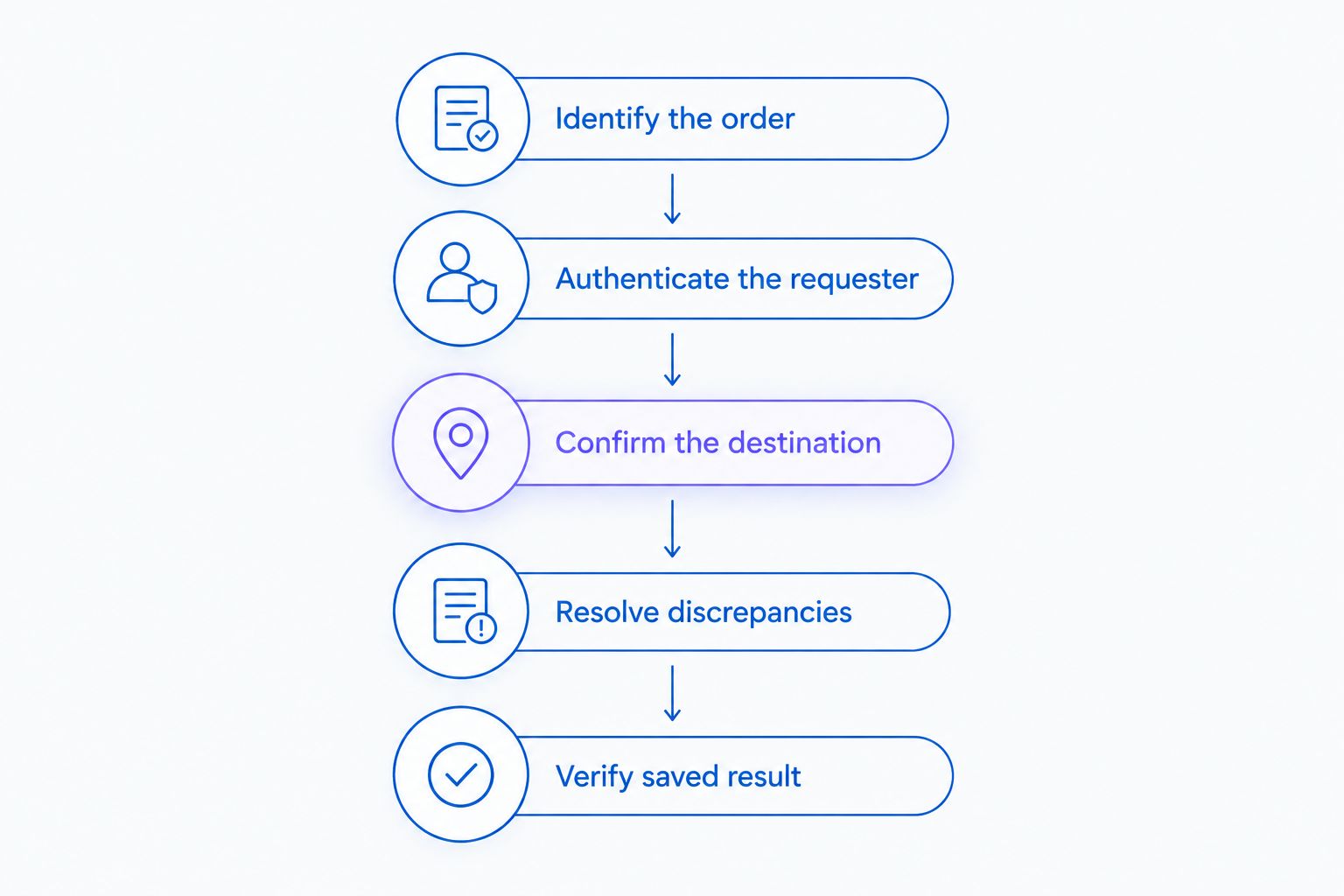
The final check concerns the saved fulfillment destination, not just the customer's spoken answer.
Which verification approach should you use?
Choose the approach based on the decision you need to make. Customer confirmation and address validation answer different questions. Neither replaces authorization to change an order.
Voice confirmation
- Best for: Clarifying the customer's intended destination
- Benefit: Lets the customer explain missing or unclear details
- Limitation: Depends on accurate capture and clear answers
Address-validation service
- Best for: Checking address structure and supported delivery information
- Benefit: Adds a separate machine-readable check
- Limitation: Does not establish the requester's authority
Human review
- Best for: Conflicting details or policy exceptions
- Benefit: Allows judgment before approving a change
- Limitation: Requires staff availability and ownership
Combine the checks according to your order policy rather than choosing a single method for every case. A clearly confirmed address still needs review when the requester fails authentication.
For a 2026 rollout, write the release criteria before selecting the call script. That keeps a fluent conversation from becoming the only standard for success.
Why shipping-address verification varies
The right workflow depends on the systems and permissions around the call. Assess these factors during configuration:
- Order access: The agent needs the current order, not an outdated copy of the checkout information.
- Update permissions: Reading an address and writing a replacement are separate capabilities to verify.
- Fulfillment stage: A proposed correction requires different handling once shipment preparation is underway.
- Address complexity: Unit details, unfamiliar street names, and international formats require explicit clarification.
- Identity policy: Your rules determine which changes require additional authentication or staff approval.
- System synchronization: The approved destination must reach the system producing the shipping label.
Document what each factor changes. For example, a failed identity check should lead to a defined review path, not repeated questioning until the caller supplies an acceptable answer.
What should happen when the address cannot be confirmed?
An unresolved address needs a recorded exception, not an optimistic success status. Decide whether your store holds the order, requests written confirmation, or assigns a staff review before enabling the workflow.
If the customer does not answer, record that confirmation was not obtained. Voicemail, a disconnected call, and an incomplete conversation do not establish approval to dispatch.
If the customer disputes the destination, retain the proposed correction and the reason for review. Keep the original record available under your data-handling policy so staff can understand what changed and why.
For conversations requiring judgment, define when the phone agent should transfer calls to a human. The transfer should carry the order reference, unresolved issue, and proposed next action so the customer does not have to reconstruct the request.
How do you keep the warehouse from using the old address?
Treat the fulfillment destination as a separate checkpoint. An edit in a storefront order record does not, by itself, prove that every connected fulfillment system is using the same value.
Design your 2026 workflow to check the handoff explicitly. Identify which system controls label creation, when it receives updates, and what happens if the update fails.
This is where reliable 3PL fulfillment integrations belong in the address-verification design: the approved correction must reach the fulfillment record before your workflow treats the change as complete. Require a visible success or failure result rather than relying on a call summary.
If a label already exists, route the case through your fulfillment exception process. Do not let the phone agent promise a corrected shipment until the responsible system or staff member confirms the action.
Your customer-facing message should match that state. Requested, approved, saved, and released for dispatch describe different outcomes and should remain distinct in your records.
What should you test before enabling address-confirmation calls?
Test both ordinary requests and failures. A demonstration using a clear address does not establish that the workflow handles an interrupted call, ambiguous speech, or a rejected update.
Use test orders and approved test data. Check the final order and fulfillment records after each scenario instead of judging only the conversation.
Customer confirms the existing destination
- Expected behavior: Record confirmation without making an unnecessary edit
Customer supplies a missing unit detail
- Expected behavior: Apply the configured authorization and update process
Customer requests a different destination
- Expected behavior: Follow the store's destination-change policy
Speech remains unclear
- Expected behavior: Request clarification or route for review
Customer disconnects before confirming
- Expected behavior: Leave the outcome incomplete
Order update fails
- Expected behavior: Record the failure and avoid claiming success
Fulfillment has already progressed
- Expected behavior: Route through the fulfillment exception process
Include access controls in the test. A phone agent should not receive broader permissions simply because an address workflow is difficult to configure.
For your 2026 acceptance review, require evidence of the saved outcome and exception handling. A transcript shows what was said; the order and fulfillment records show what will happen next.
Where does Avasales fit for Shopify merchants?
Avasales is best for Shopify merchants seeking phone-based customer support and outbound abandoned-cart recovery. Its stated offering includes answering support calls 24/7, resolving orders and refunds, and calling customers about abandoned carts.
Those capabilities make the support conversation relevant to this use case. They do not remove the need to assess address-specific permissions, identity checks, validation services, or warehouse synchronization before allowing destination changes.
Evaluate Avasales phone support against your actual dispatch process during the trial. Keep inbound address questions separate from outbound cart-recovery results so you can judge each workflow on its own outcome.
The trade-off is operational control: broader automation requires clearer permissions and exception rules. Start with confirmation and review if your store is not ready to authorize unattended address edits.
Can the agent change the address instead of just confirming it?
An agent can change an address only when the connected system permits updates and your store authorizes the action. Confirmation does not grant editing permission.
Require an explicit saved result before the agent tells the customer the correction is complete. If staff approval is required, describe the correction as a request awaiting review.
Does customer confirmation guarantee delivery?
Customer confirmation does not guarantee delivery. It establishes the customer's stated destination, while deliverability and shipment handling remain separate checks.
Avoid promising that a parcel will arrive simply because the customer agreed with the address. Explain the completed action precisely.
FAQ
Can an AI phone agent verify my shipping address before dispatch?
Yes, an AI phone agent can confirm your intended shipping address when it has the relevant order access and an approved verification workflow. Address validation, authorization, and fulfillment confirmation remain separate checks.
Can an AI phone agent fix a missing apartment number?
An AI phone agent can collect a missing apartment number, but saving it requires approved update permissions. If those permissions are unavailable, the correction should go to staff for review.
Is reading an address back enough to verify it?
Reading an address back confirms what the customer agrees with; it does not prove deliverability or authorization. Use separate checks for those decisions.
What happens if I miss the address-confirmation call?
A missed call leaves the address unconfirmed. The store should follow its stated process for another contact attempt, written confirmation, or review.
Can an AI agent change an address after a shipping label is created?
A created shipping label requires the store's fulfillment exception process. The agent should not promise a corrected shipment without confirmation from the responsible system or staff member.
Does Avasales provide Shopify phone support around the clock?
Avasales provides Shopify phone support 24/7. Assess address-editing permissions and fulfillment controls separately before enabling an address-change workflow.
One last thing
Test the saved address, not just the spoken answer. Your most revealing acceptance check is whether the system preparing the parcel holds the approved destination after the conversation ends.
If that check fails, keep the order in your review process. A clear call cannot correct a fulfillment record that never received the change.